Best Sustainable Hat Materials for U.S. Brands (2026 Guide)
Organic Cotton, rPET & Hemp—Plus Certifications, BOM Options, and a Buyer Checklist
Picture this: you’re presenting a new cap line at a U.S. trade show. A buyer checks the hand-feel, flips the label, and asks the question that now determines purchase decisions:
“Is this sustainable—and can you prove it?”
In the U.S. market, sustainability claims are increasingly evaluated through documentation—certifications, test reports, and traceability. This guide helps you choose the right sustainable hat materials and prepare the proof retailers and buyers expect.
Key takeaways (fast selection):
-
Premium lifestyle collections: GOTS-certified organic cotton (or organic blends)
-
Performance & athleisure: verified recycled polyester (rPET) under GRS/RCS where applicable
-
Outdoor & eco-first positioning: hemp or hemp blends for texture, durability, and brand story
At GUANGZHOU EASTLUCKY Hat & Garment Co., Ltd., we provide high-end custom hat OEM/ODM with integrated design support, sampling, scalable production, and quality control, helping global brands deliver retail-ready headwear with compliant documentation.
1) Quick Recommendations: Choose by Brand Positioning
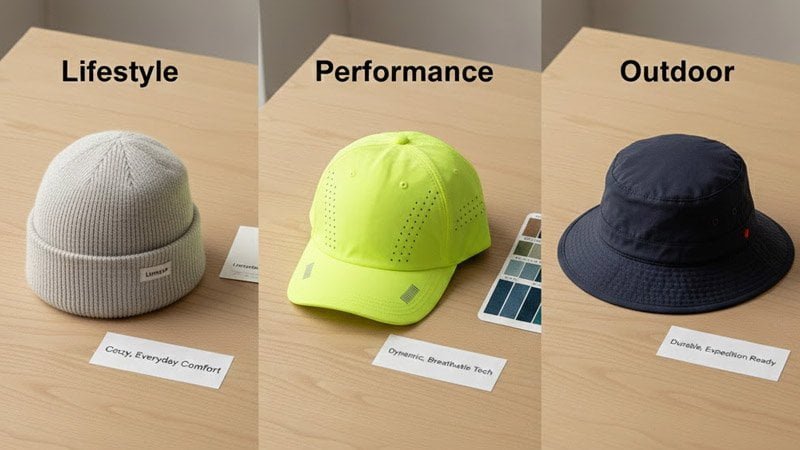
Lifestyle brands (soft hand-feel + premium storytelling)
GOTS-certified organic cotton (or organic cotton blends)
Best for: dad hats, baseball caps, 5-panels, washed caps, premium basics.
Performance & athleisure (durability + moisture management)
Verified recycled polyester (rPET), often blended
Best for: truckers, sport caps, mesh-back caps, lightweight structured caps.
Outdoor & “eco-first” brands (distinct texture + strong eco narrative)
Hemp or hemp blends
Best for: bucket hats, utility caps, outdoor structured styles, UV-focused lines.
2) Material Comparison Matrix (What Matters in Hat Development)
Actual performance depends on fabric construction, finishing, blend ratio, and dyeing. Use this matrix to shortlist materials for your hat style and price point.
| Category | Organic Cotton (GOTS) | Recycled Polyester (rPET / GRS-RCS) | Hemp (Often Blended) |
|---|---|---|---|
| Hand-feel | Soft, natural | Smooth, technical | Textured; can feel firm |
| Breathability | High | Medium (mesh improves) | High |
| Durability | Medium–High | High | High |
| Embroidery | Excellent | Good–Excellent | Good (needs correct backing) |
| Best decoration | Embroidery, patches, screen print | Sublimation/heat transfer, embroidery | Embroidery, patches (printing varies) |
| Care | May shrink if not pre-shrunk | Easy-care, holds shape | Stable, strong; softens with finishing |
| Sustainability value | Avoids synthetic pesticides (certified) | Uses recycled feedstock (certified/verified) | Low-input crop story; strong eco positioning |
| Watch-outs | Shrinkage + lot color consistency | Microfiber shedding risk; manage via fabric choice & care guidance | Hand-feel + dye lot control |
3) Deep Dive: Top Sustainable Materials (Practical Build Notes)
A) GOTS Organic Cotton for Premium Lifestyle Hats
Why buyers choose it: The most recognizable “clean fiber” story for mainstream consumers—especially when supported by valid certification and clear labeling.
Best styles: dad hats, baseball caps, washed cotton caps, soft structured 5-panels.
Build notes:
-
Use pre-shrinking/sanforization to reduce post-wash size changes
-
Choose stable weaves (twill/canvas) for crisp embroidery
-
For washed effects: confirm lab dips + wash standard early
Documentation buyers may request:
-
GOTS scope certificate (valid dates) + supplier info
-
Fiber content spec + care label guidance
-
Colorfastness & shrinkage testing (brand-specific)
B) Verified rPET for Performance, Trucker, and Athleisure
Why buyers choose it: Strong durability and shape retention with a circular story—best when supported by GRS/RCS documentation where applicable.
Best styles: truckers, mesh-back caps, structured sport caps, sublimation panels.
Build notes:
-
Choose constructions that minimize pilling for high-wear use
-
To address microfiber concerns: use tighter weaves/stable yarns + care guidance
-
For sublimation: lock color targets + heat settings early
Documentation buyers may request:
-
GRS/RCS scope certificates (if applicable)
-
Batch-level documentation supporting recycled claims (when required)
-
Chemical compliance statement aligned with brand RSL/MRSL
C) Hemp & Hemp Blends for Outdoor-First and Eco-First Collections
Why buyers choose it: Distinct “authentic eco” texture and durable wear—commonly preferred in blends for comfort.
Best styles: bucket hats, utility caps, outdoor structured caps, UV-oriented styles.
Build notes:
-
Many brands prefer hemp + organic cotton blends for softness
-
Use softening finishes while keeping structure
-
Confirm dye lots carefully—hemp can dye differently than cotton
Documentation buyers may request:
-
Fiber content/blend proof
-
Dyeing chemical compliance (OEKO-TEX or equivalent)
-
Performance tests (rubbing/perspiration/colorfastness)
4) Sustainable Hat BOM: It’s Not Just the Fabric
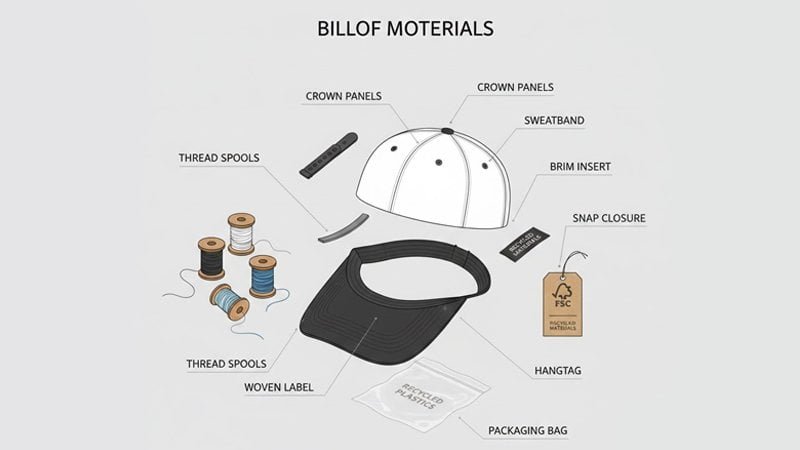
U.S. buyers increasingly evaluate the full BOM, not only the main fabric.
BOM components to review:
-
Sweatband: organic cotton / recycled polyester / low-impact dyed
-
Buckles & closures: recycled plastic, recycled metal, durable metal hardware
-
Brim insert: recycled options where feasible
-
Threads: recycled sewing thread; embroidery thread options
-
Interlinings: certified and compliant
-
Labels & packaging: FSC paper hangtags, recycled polybags, water-based inks
Three practical BOM packages (by price tier):
-
Entry: organic cotton body + standard trims + FSC hangtag
-
Mid: rPET body + recycled buckle + recycled packaging + compliance testing
-
Premium: hemp/organic blend + recycled metal trim + custom lining + premium packaging
5) What U.S. Retailers & Buyers Typically Ask (Compliance & Proof)
Typical onboarding questions include:
-
Can you provide valid scope certificates (with dates)?
-
Can you support recycled claims with batch-level documentation when required?
-
Are dyes/processes compliant with OEKO-TEX or brand RSL/MRSL?
-
Can you pass standard tests (rubbing, perspiration, shrinkage, durability)?
-
Do you have social compliance audits (BSCI/SEDEX/other)?
Buyer document checklist (copy/paste):
-
Material certification (scope certificate + validity dates)
-
Fiber content & blend confirmation (spec sheet)
-
Recycled claim support (batch documentation where applicable)
-
Chemical compliance statement (aligned with RSL/MRSL requirements)
-
Performance tests: rubbing/perspiration colorfastness, shrinkage, durability
-
Social compliance / audit status (BSCI/SEDEX/other)
-
Traceability overview (what’s traceable by batch/lot)
6) Quality & Testing: Minimum Standards for Retail-Ready Hats
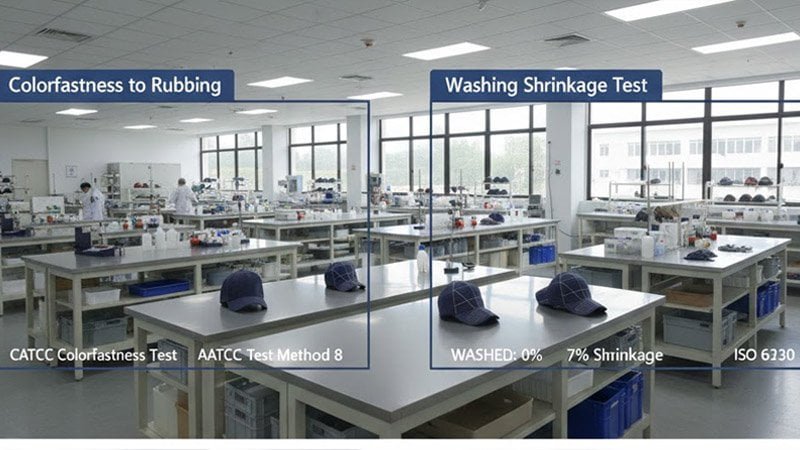
To reduce returns and protect brand reputation, align early on:
-
Colorfastness to rubbing (dry/wet)
-
Colorfastness to perspiration
-
Shrinkage / dimensional stability (especially cotton)
-
Embroidery durability (wash/abrasion exposure)
-
Structure stability (panel shape retention, brim deformation)
High-end development is not only about passing tests—it’s about repeatability at scale.
7) Sample-to-Bulk Process (What a Smooth Project Looks Like)
A professional workflow typically includes:
-
Tech pack / mood board + target cost + target positioning
-
Material selection + BOM confirmation
-
Lab dips / color approvals + decoration method selection
-
Prototype sample → fit/hand-feel review → revisions
-
Pre-production approval
-
Bulk production + QC + packaging + shipping
8) FAQ (Common Buyer Questions)
Q: Can sustainable hats still look premium and hold structure?
Yes. Structure is driven by construction, interlinings, brim inserts, and sewing specs—not only fiber type.
Q: Is rPET always “better” than virgin polyester?
Recycled content supports circularity goals, but brands should also address microfiber shedding via fabric choice, finishing, and care guidance.
Q: What’s the best “eco-first” material for outdoor collections?
Hemp blends are a common sweet spot: durable, distinctive texture, strong story, improved comfort.
9) Next Step: What to Send for Fast Quotes & Accurate Samples
To accelerate quoting and sampling, send this RFQ template:
-
Style & structure: (dad hat / 5-panel / trucker / bucket; soft or structured)
-
Fabric: (organic cotton / rPET / hemp blend) + weight + composition
-
Colors: Pantone + number of colorways
-
Logo: method (embroidery/patch/print) + placement + artwork file
-
Trims: buckle/closure, sweatband, lining, labels
-
Packaging: hangtag, polybag, retail-ready requirements
-
Quantity: per colorway + total
-
Target: target FOB (optional) + target delivery window
-
Compliance: required certifications/tests (GOTS/GRS/RCS/OEKO-TEX, etc.)
Final Thoughts: Proof + Execution Win Orders
U.S. consumers want sustainability, but retailers and buyers expect verifiable claims, consistent quality, and scalable delivery. Organic cotton, recycled polyester, and hemp—especially in well-engineered blends—remain leading pathways when paired with the right construction, documentation, and testing.
GUANGZHOU EASTLUCKY Hat & Garment Co., Ltd. supports global brands with high-end OEM/ODM hat manufacturing, professional R&D, and end-to-end execution—from sampling to bulk production—helping you launch sustainable headwear with confidence.