Custom Snapback vs Trucker Hat: Fit, Logo Options and Bulk Order Guide
When ordering custom hats in bulk, choosing between a snapback hat and a trucker hat is not only about style. The right choice can affect your logo effect, wearing comfort, target audience, production cost, and final brand presentation.
Both snapback hats and trucker hats are popular choices for brands, sports teams, events, fashion labels, outdoor companies, and promotional product buyers. However, they serve different purposes.
A snapback hat is usually more structured, bold, and fashion-focused. It is a strong choice for streetwear brands, sports merchandise, retail collections, and premium embroidered logos.
A trucker hat is usually more breathable, lightweight, and practical. It is ideal for outdoor brands, summer promotions, corporate giveaways, fishing brands, camping brands, and large-volume promotional campaigns.
In this guide, we will compare custom snapback hats and trucker hats from a buyer’s perspective, including structure, fit, materials, logo decoration options, cost factors, bulk order tips, and customization process.
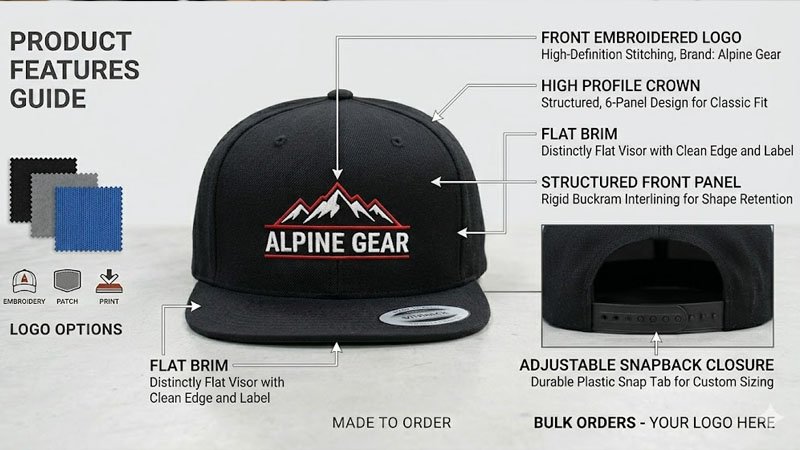
A snapback hat is a structured cap with an adjustable plastic snap closure at the back. It usually has a flat brim, a firm front panel, and a high-profile crown.
Snapback hats became popular through baseball, hip-hop culture, streetwear, and sports fashion. Today, they are widely used by fashion brands, sports clubs, music merch brands, skate brands, and companies that want a bold and modern cap style.
The most common features of a snapback hat include:
- Flat brim
- Structured front panel
- High-profile crown
- Adjustable snapback closure
- Strong shape retention
- Bold streetwear appearance
- Large front area for logo decoration
Because of its firm front panel, a snapback hat is especially suitable for embroidery and patch branding. If your brand wants a clean, structured, and premium look, a custom snapback hat is a strong option.
A trucker hat is a casual cap style that usually combines a foam or fabric front panel with breathable mesh back panels. Like snapbacks, many trucker hats also use an adjustable plastic snap closure.
Trucker hats were originally used as promotional giveaway caps for truck drivers, farmers, outdoor workers, and industrial brands. Their breathable mesh back made them practical for long hours outdoors.
Today, trucker hats are widely used by outdoor brands, fishing brands, beer and beverage companies, lifestyle brands, event organizers, corporate buyers, and promotional product distributors.
The most common features of a trucker hat include:
- Mesh back panels
- Foam, cotton, canvas, or polyester front panel
- Lightweight construction
- Better airflow
- Casual and relaxed look
- Adjustable snapback closure
- Practical design for outdoor use
If your project needs a breathable, comfortable, and cost-effective hat for outdoor use or promotional campaigns, a custom trucker hat is a smart choice.
| Feature |
Custom Snapback Hat |
Custom Trucker Hat |
| Main Style |
Streetwear, sports, fashion |
Outdoor, casual, promotional |
| Front Panel |
Structured fabric front |
Foam or fabric front |
| Back Panel |
Usually full fabric |
Breathable mesh back |
| Brim Style |
Usually flat brim |
Usually curved or slightly curved brim |
| Crown Profile |
High profile and structured |
Medium to high profile, more relaxed |
| Breathability |
Medium |
High |
| Logo Effect |
Premium embroidery and patch effect |
Strong print, patch, and label effect |
| Best Logo Methods |
Flat embroidery, 3D embroidery, appliqué, PVC patch |
Leather patch, woven patch, screen print, embroidered patch |
| Best Buyers |
Fashion brands, sports teams, retailers |
Outdoor brands, event buyers, promotional distributors |
| Best Use |
Brand merchandise, retail collections, team caps |
Giveaways, outdoor events, summer promotions |
| Cost Impression |
Medium to premium |
Cost-effective to mid-range |
| Bulk Order Suitability |
Great for premium merchandise |
Great for large promotional orders |
Key Difference 1: Structure and Fit
The biggest difference between a snapback hat and a trucker hat is the structure.
A snapback hat has a firm and structured crown. It keeps its shape well and gives the cap a clean, bold, and premium appearance. This makes snapback hats popular for fashion brands, sports merchandise, streetwear collections, and retail cap lines.
A trucker hat has a lighter and more breathable structure. The mesh back allows better airflow, making it more comfortable in hot weather or outdoor environments. This makes trucker hats suitable for summer events, outdoor promotions, fishing, camping, travel, and workwear-related projects.
Choose a snapback hat if you want:
- A strong structured shape
- A bold streetwear look
- A premium brand image
- Better front-panel embroidery effect
- A hat for fashion, sports, or merchandise collections
Choose a trucker hat if you want:
- Better breathability
- A lightweight wearing experience
- A casual promotional look
- A hat for outdoor or summer use
- A practical product for large-volume giveaways
Key Difference 2: Materials
Material choice affects the look, comfort, cost, and logo result of your custom hat.
Common Materials for Snapback Hats
Snapback hats are usually made from solid fabrics that help keep the cap shape stable.
Common material options include:
- Cotton twill
- Polyester
- Acrylic
- Wool blend
- Nylon
- Performance fabric
- Recycled polyester
Cotton twill is a popular choice for custom embroidered snapback hats because it has a smooth texture and works well with detailed embroidery. Polyester is durable and cost-effective, making it suitable for bulk custom cap orders.
Common Materials for Trucker Hats
Trucker hats usually combine a front panel with mesh back panels.
Common material options include:
- Foam front
- Cotton front
- Polyester front
- Canvas front
- Polyester mesh
- Nylon mesh
- Recycled mesh fabric
Foam-front trucker hats are often used for screen printing, heat transfer printing, or bold logo graphics. Cotton or canvas front trucker hats work well with patches, embroidery, and woven labels.
For eco-conscious brands, recycled polyester or recycled mesh can also be considered.
Key Difference 3: Brim Style
Snapback hats usually have a flat brim. This gives them a sharp, modern, and fashion-forward look. The flat brim is strongly connected with streetwear, hip-hop culture, sports teams, and youth fashion.
Trucker hats usually have a curved or slightly curved brim. This gives them a more casual, practical, and outdoor-friendly appearance. The curved brim also provides better sun protection, which is useful for outdoor activities.
From a branding perspective:
A flat brim creates a bold and premium style.
A curved brim creates a relaxed and practical style.
If your target market is fashion or streetwear, a snapback may be more suitable. If your target market is outdoor, travel, workwear, or promotional use, a trucker hat may be a better fit.
Key Difference 4: Breathability and Comfort
Breathability is one of the strongest advantages of trucker hats.
The mesh back allows air to flow through the cap, helping the wearer stay cooler in warm weather. This is why trucker hats are popular for:
- Outdoor events
- Summer promotions
- Fishing trips
- Camping brands
- Construction teams
- Farm and ranch brands
- Travel campaigns
- Sports activities
- Corporate giveaways
Snapback hats are also comfortable, but they usually use full fabric panels, which means they are less breathable than mesh-back trucker hats. However, they offer a stronger structure and a more premium appearance.
For airflow and outdoor comfort, choose a trucker hat.
For shape and brand image, choose a snapback hat.
Which Hat Is Better for Custom Logo Branding?
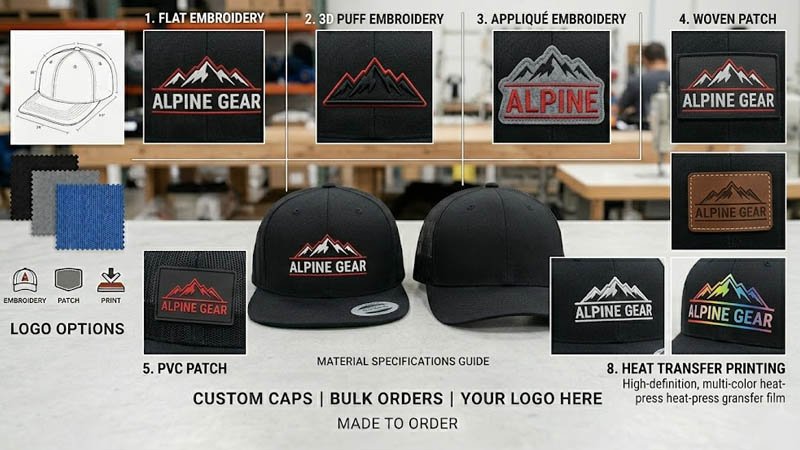
Both snapback hats and trucker hats can be customized with logos. The best choice depends on the logo design, material, front panel structure, and final brand style.
Best Logo Options for Snapback Hats
Snapback hats are excellent for logo customization because the structured front panel provides a stable surface for embroidery and patches.
Flat Embroidery
Flat embroidery is clean, professional, and suitable for most brand logos. It works well for corporate logos, sports team logos, fashion brands, school clubs, and retail merchandise.
3D Puff Embroidery
3D puff embroidery creates a raised logo effect. It is popular for streetwear brands, sports caps, hip-hop style hats, and bold logo designs.
Appliqué Embroidery
Appliqué embroidery combines fabric pieces with embroidery. It creates a layered and premium look, making it suitable for high-end custom snapback hats.
Woven Patch
A woven patch is suitable for detailed logos, small text, and clean brand labels. It is a good choice when embroidery cannot show small details clearly.
PVC Patch
PVC patches create a modern, durable, and sporty look. They are often used by outdoor brands, sports brands, and fashion labels.
Leather Patch
Leather patches give snapback hats a vintage and premium feeling. They are suitable for lifestyle brands, outdoor brands, western-style brands, and retail collections.
Trucker hats are also flexible for custom branding, especially because the front panel can be foam, cotton, polyester, canvas, or twill.
Screen Printing
Screen printing works well on foam-front trucker hats. It is suitable for bold graphics, simple logos, event slogans, and large promotional orders.
Heat Transfer Printing
Heat transfer printing is suitable for colorful logos and small-batch custom projects. It can show more color details than traditional embroidery.
Embroidered Patch
For trucker hats, an embroidered patch often gives a cleaner result than direct embroidery, especially on foam front panels. It is durable and professional.
Leather Patch
Leather patches are very popular for trucker hats. They work especially well for fishing brands, camping brands, beer brands, ranch brands, outdoor companies, and lifestyle brands.
Woven Label
Woven labels create a retro and casual look. They are suitable for simple brand logos and promotional hats.
Sublimation Printing
Sublimation printing can be used on polyester materials for colorful designs, patterns, or full-panel graphics.
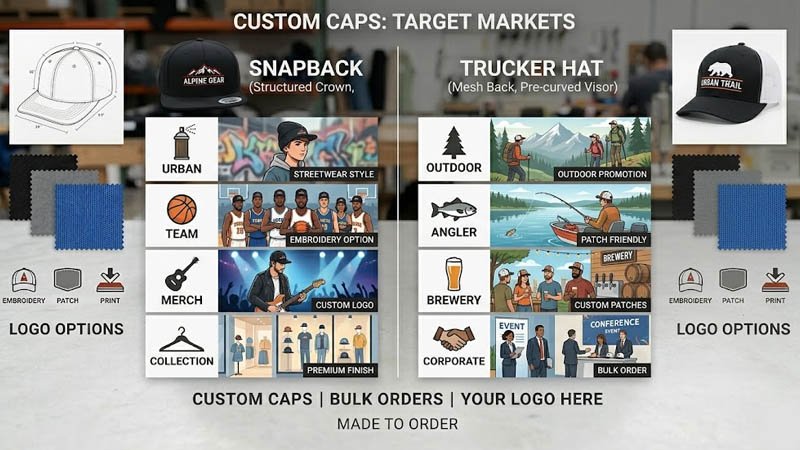
Different buyers have different goals. Choosing the right hat style depends on your market, product positioning, and end users.
Choose Snapback Hats If You Are:
- A streetwear brand
- A sports team
- A fashion retailer
- A music merch brand
- A skate brand
- A youth culture brand
- A company looking for premium embroidered caps
- A brand building a retail merchandise collection
Snapback hats are better when your project needs strong structure, bold logo visibility, and a more fashion-focused appearance.
Choose Trucker Hats If You Are:
- An outdoor brand
- A fishing or camping brand
- A beer or beverage company
- A corporate event organizer
- A promotional product distributor
- A travel company
- A construction or workwear company
- A company looking for breathable giveaway caps
Trucker hats are better when your project needs comfort, airflow, practical use, and strong promotional value.
Custom snapback hats are ideal for projects that focus on brand identity, style, and retail value.
They are commonly used for:
- Streetwear collections
- Sports team merchandise
- Music festival merchandise
- Skateboarding brands
- Hip-hop fashion brands
- Brand launch campaigns
- Retail cap collections
- Club and association merchandise
- Premium corporate gifts
A well-made snapback hat with embroidery or a high-quality patch can make a brand look more professional and valuable.
Best Use Cases for Custom Trucker Hats
Custom trucker hats are ideal for projects that need breathability, practicality, and large-volume brand exposure.
They are commonly used for:
- Outdoor events
- Summer promotions
- Fishing and camping brands
- Beer and beverage promotions
- Corporate giveaways
- Trade shows
- Travel campaigns
- Farm and ranch brands
- Construction teams
- Promotional product programs
Because trucker hats are comfortable and easy to wear outdoors, they often have a high usage rate after being given away. This makes them effective promotional products.
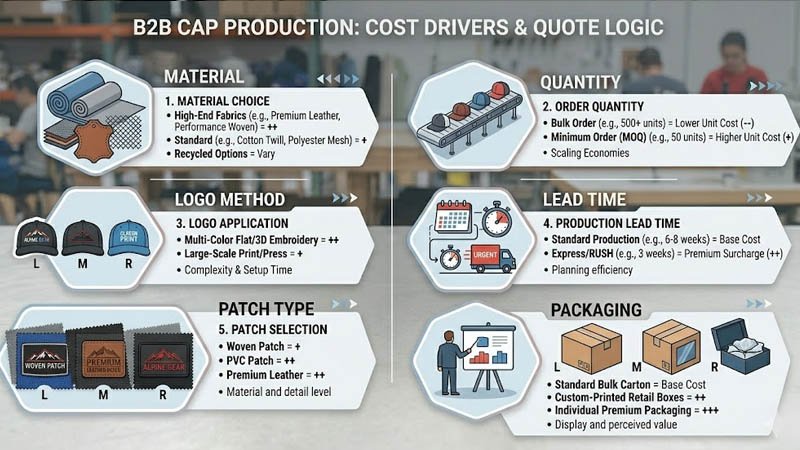
The final price of custom hats depends on several factors. Understanding these factors can help buyers make better decisions before requesting a quotation.
1. Hat Material
Cotton, polyester, nylon, canvas, foam, mesh, and recycled fabrics all have different costs. Premium fabrics usually increase the unit price.
2. Hat Structure
A structured snapback hat may cost more than a simple promotional trucker hat because it requires a firmer crown construction and more shape control.
3. Logo Method
Embroidery, 3D puff embroidery, appliqué embroidery, woven patches, PVC patches, leather patches, screen printing, and heat transfer printing all have different production costs.
4. Embroidery Size and Stitch Count
For embroidered logos, larger designs and higher stitch counts usually increase the cost.
5. Number of Logo Colors
More logo colors may increase production complexity, especially for embroidery, printing, and patch production.
6. Patch Material
Leather patches, PVC patches, embroidered patches, and woven patches have different price levels.
7. Order Quantity
Larger quantities usually reduce the unit cost. For bulk custom hat orders, quantity is one of the most important pricing factors.
8. Packaging Requirements
Custom packaging, barcode labels, hangtags, inner labels, and individual polybags may increase the total cost.
9. Sample Requirements
Custom samples are important before mass production, especially for new designs, new logo methods, or private label projects.
10. Lead Time
Urgent orders may require special production arrangements, which can affect cost and delivery planning.
In general, a snapback hat with 3D embroidery or appliqué embroidery may cost more than a simple printed trucker hat. However, a trucker hat with a premium leather patch or custom woven label can also create a high-end look.
How to Start a Custom Hat Order
A clear customization process helps reduce mistakes and improve production efficiency.
Here is a common process for custom snapback and trucker hat orders:
Step 1: Send Your Logo or Design Idea
Prepare your logo file, brand color, reference image, or design concept. Vector files such as AI, EPS, or PDF are usually preferred for production.
Step 2: Choose the Hat Style
Decide whether you want a snapback hat, trucker hat, baseball cap, 5-panel cap, dad hat, or another cap style.
Step 3: Confirm Material and Color
Choose the fabric, mesh, brim color, panel color, closure color, and stitching color based on your brand identity.
Step 4: Select the Logo Method
Choose embroidery, 3D embroidery, appliqué, woven patch, PVC patch, leather patch, screen printing, heat transfer printing, or another method.
Step 5: Confirm Logo Size and Position
Common logo positions include:
- Front panel
- Side panel
- Back panel
- Brim
- Closure area
- Inner label
The front panel is the most popular position for custom hat logos.
Step 6: Make a Pre-Production Sample
A sample helps confirm the hat shape, fabric quality, logo effect, stitching, color matching, and overall appearance.
Step 7: Confirm the Sample
After reviewing the sample, buyers can request adjustments before bulk production.
Step 8: Start Bulk Production
Once the sample is approved, mass production can begin.
Step 9: Quality Inspection and Packaging
Before shipment, the hats should be checked for logo accuracy, stitching quality, shape, color, packaging, and quantity.
Step 10: Shipping
After inspection and packing, the order can be shipped by express, air, sea, or other logistics methods based on the buyer’s timeline and budget.
Common Mistakes to Avoid When Ordering Custom Hats
Custom hats may look simple, but small details can affect the final quality. Here are some common mistakes buyers should avoid.
Mistake 1: Choosing a Hat Style Only by Appearance
A snapback may look stylish, but it may not be the best choice for hot outdoor events. A trucker hat may be breathable, but it may not create the premium streetwear look some fashion brands need.
Always choose the style based on the target user and use scenario.
Mistake 2: Using the Wrong Logo Method
Not every logo works well with every decoration method. Small text may not work well with 3D embroidery. Complex gradients may not be suitable for traditional embroidery. Detailed logos may look better as woven patches.
Mistake 3: Ignoring the Front Panel Structure
The front panel affects how the logo appears. A structured front panel is better for embroidery, while a foam front panel may be better for printing or patch application.
Mistake 4: Not Checking Color Contrast
The hat color and logo color should have enough contrast. If the colors are too close, the logo may not stand out clearly.
Mistake 5: Skipping the Sample Process
For custom hat orders, sampling is important. A sample helps confirm size, shape, fabric, logo effect, stitching quality, and overall appearance before mass production.
Mistake 6: Forgetting Packaging Details
For retail brands and distributors, packaging matters. Hangtags, labels, barcode stickers, and individual bags should be confirmed before production.
For buyers who are not sure whether a snapback or trucker hat is better for their project, working with an experienced manufacturer can reduce trial-and-error costs.
GUANGZHOU EASTLUCKY Hat & Garment Co., Ltd., based in Guangzhou, China, is a high-end custom hat and OEM/ODM manufacturer with 15 years of experience in professional R&D, production, and distribution of various hats and embroidered accessories. From design sampling and material selection to embroidery, patch development and bulk production, EASTLUCKY helps global brands build reliable custom hat solutions with consistent quality and efficient delivery.
A professional factory can help buyers choose the right cap structure, material, logo method, packaging, and production solution based on their target market and order quantity.
So, which one should you choose?
Choose a custom snapback hat if your project focuses on structure, style, premium branding, embroidery, sports merchandise, streetwear, or retail fashion.
Choose a custom trucker hat if your project focuses on breathability, outdoor comfort, summer events, promotional giveaways, practical use, or large-volume brand exposure.
In simple terms:
Snapback hats are better for structure, style, and premium logo presentation.
Trucker hats are better for breathability, comfort, and promotional use.
Both styles can be excellent custom products when the material, logo method, and design are chosen correctly.
Before placing a bulk order, consider your target customers, wearing scenario, logo design, budget, packaging needs, and expected delivery time. The right hat choice will help your brand create a product that looks good, feels comfortable, and delivers lasting promotional value.
What is the main difference between a snapback and a trucker hat?
The main difference is the structure. A snapback hat usually has a full fabric structure, flat brim, and high-profile crown. A trucker hat usually has a mesh back, foam or fabric front panel, and better breathability.
Is a snapback hat good for custom embroidery?
Yes. Snapback hats are excellent for custom embroidery because they usually have a structured front panel. Flat embroidery, 3D puff embroidery, appliqué embroidery, and embroidered patches all work well on snapback hats.
Is a trucker hat good for outdoor promotions?
Yes. Trucker hats are very suitable for outdoor promotions because they are lightweight, breathable, and comfortable in warm weather. They are popular for fishing, camping, travel, outdoor events, and summer marketing campaigns.
Which hat is better for streetwear brands?
Snapback hats are usually better for streetwear brands because they have a bold structure, flat brim, and strong fashion identity. They also work well with 3D embroidery and large front logos.
Which hat is better for corporate giveaways?
Trucker hats are often a good choice for corporate giveaways because they are practical, breathable, and suitable for large promotional orders. Snapback hats can also work well for premium corporate merchandise.
Are snapback hats more expensive than trucker hats?
Not always. The price depends on the material, logo method, structure, quantity, and packaging. A snapback with 3D embroidery may cost more than a simple printed trucker hat, but a trucker hat with a leather patch or custom woven label can also be premium.
Which hat is better for embroidered logos?
Snapback hats are often better for direct embroidery because of their structured front panel. Trucker hats can also use embroidery, but patches may create a cleaner result on foam-front styles.
Which hat is better for summer events?
Trucker hats are usually better for summer events because the mesh back improves airflow and wearing comfort.
Can I order custom snapback and trucker hats with the same logo?
Yes. Many brands use the same logo across different hat styles to create a complete merchandise collection. This is a good option for brands that want to serve different customer groups.
What is the best hat style for promotional giveaways?
Trucker hats are often popular for giveaways because they are practical, breathable, and suitable for large-volume branding. Snapbacks are better for premium brand merchandise.
What should I prepare before ordering custom hats?
You should prepare your logo file, preferred hat style, material, color, logo method, order quantity, packaging requirements, and target delivery time. If you are not sure which style to choose, a manufacturer can recommend the best option based on your project.
Call to Action
Looking for custom snapback hats or trucker hats for your brand?
Send us your logo, order quantity, preferred style, target market, and packaging requirements. Our team can help recommend the right material, logo method, and production solution for your bulk custom hat order
How Much Does a Baseball Cap Weigh? Custom Hat Weight Guide for Bulk Buyers
A standard baseball cap usually weighs between 50 and 120 grams. Lightweight promotional caps may weigh around 50–70 grams, while structured cotton caps, snapbacks, or premium embroidered caps can weigh 80–120 grams.
For everyday wearers, cap weight may seem like a small detail. But for brands, distributors, event organizers, and bulk buyers, it can affect comfort, product quality, packing quantity, carton weight, and international shipping cost.
When planning a custom baseball cap order, understanding cap weight helps you choose the right fabric, crown structure, brim, closure, logo method, and packing solution. This guide explains what affects baseball cap weight and how to choose the right option for different custom projects.
Most baseball caps weigh between 50 and 120 grams per piece. The final weight depends on the fabric, structure, brim material, logo decoration, closure type, and packaging.
Here is a general reference:
| Cap Type |
Typical Weight |
Common Use |
| Lightweight Promotional Cap |
50–70g |
Events, giveaways, summer promotions |
| Cotton Baseball Cap |
60–90g |
Daily wear, brand merchandise |
| Structured Baseball Cap |
80–110g |
Corporate uniforms, retail caps |
| Heavy Cotton Baseball Cap |
90–120g |
Premium brand collections |
| Polyester Sports Cap |
55–85g |
Outdoor use, sports teams |
| Trucker Cap |
70–100g |
Outdoor events, casual promotions |
| Snapback Hat |
85–120g |
Streetwear, fashion branding |
| 5 Panel Cap |
50–85g |
Lightweight fashion and outdoor use |
These numbers are only general references. A finished custom cap may be lighter or heavier depending on the materials and customization details.
What Parts Affect the Weight of a Baseball Cap?
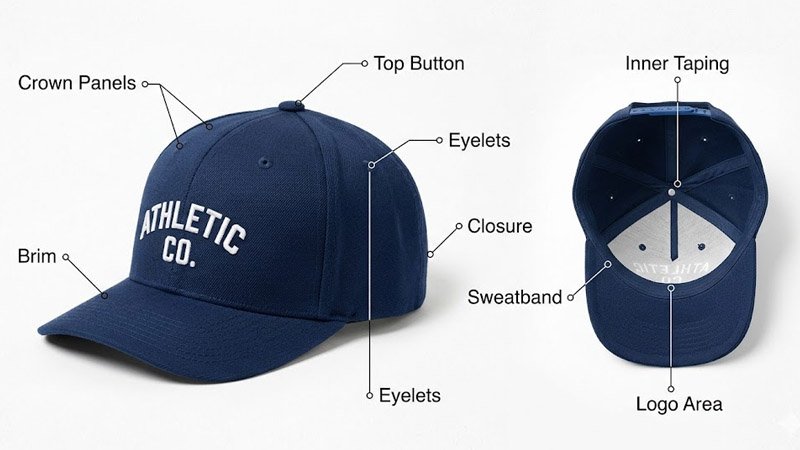
A baseball cap is made from several parts. Each part adds weight and also affects comfort, shape, and durability.
The main components include:
- Fabric panels
- Crown structure
- Front buckram or inner support
- Brim insert
- Sweatband
- Inner taping
- Eyelets
- Top button
- Closure
- Logo decoration
- Labels and packaging
For custom cap production, the weight is not decided by fabric alone. A cap with the same outer material may still have a different weight if it uses a structured front panel, thicker brim, metal buckle, or heavy embroidery.
How Fabric Choice Changes Cap Weight
Material is one of the most important factors that affect baseball cap weight. Different fabrics have different thickness, texture, breathability, and durability.
Cotton Baseball Caps
Cotton baseball caps usually weigh around 60–90 grams.
Cotton is soft, breathable, and comfortable for daily use. It is one of the most popular materials for custom baseball caps because it works well for embroidery, patches, labels, and brand merchandise.
Lightweight cotton caps are suitable for summer promotions and casual wear. Heavier cotton twill caps are better for retail brands, corporate uniforms, and premium custom projects.
Polyester Baseball Caps
Polyester caps usually weigh around 55–85 grams.
Polyester is lightweight, durable, and quick-drying. It is commonly used for sports caps, outdoor caps, team caps, and promotional caps. If buyers need a cap for active use or warm weather, polyester is a practical option.
Cotton-Polyester Blended Caps
Blended fabric caps usually weigh around 70–100 grams.
A cotton-polyester blend can balance comfort, durability, and cost. It is suitable for bulk custom orders because it provides stable quality and can support different logo methods.
Canvas or Heavy Cotton Caps
Canvas or heavy cotton caps usually weigh around 90–120 grams.
These caps feel stronger and more premium. They are often used for fashion brands, outdoor brands, workwear uniforms, and retail collections. The heavier fabric helps the cap keep its shape and creates a higher-value hand feel.
Mesh Trucker Caps
Trucker caps usually weigh around 70–100 grams.
Because the back panels are made of mesh, trucker caps are breathable and may be lighter than fully structured cotton caps. They are popular for outdoor events, lifestyle brands, summer promotions, and casual merchandise.
Structured vs. Unstructured Caps
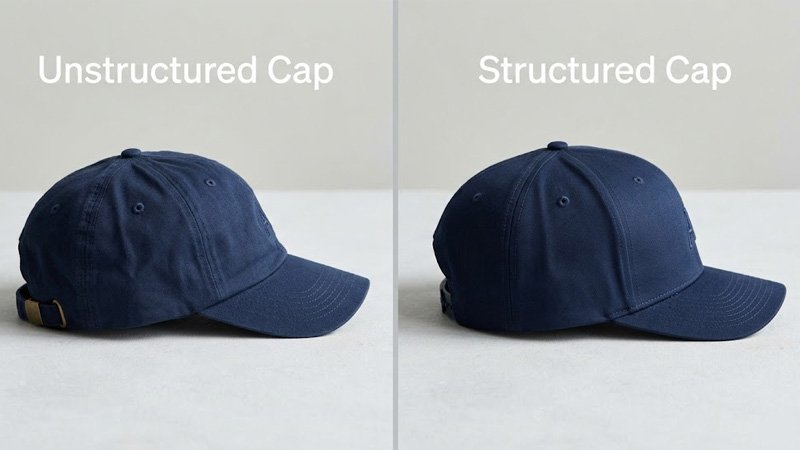
Cap structure can make a big difference in weight.
A structured baseball cap has a reinforced front panel, usually with buckram or inner support. It holds its shape better and gives the cap a cleaner, more professional appearance. However, the extra support also adds weight.
An unstructured baseball cap has a softer crown with less reinforcement. It is usually lighter, more relaxed, and comfortable for casual wear.
| Structure Type |
Typical Weight |
Features |
| Unstructured Cap |
50–80g |
Soft, relaxed, lightweight |
| Semi-Structured Cap |
70–95g |
Balanced shape and comfort |
| Structured Cap |
80–120g |
Stronger shape, premium look |
For promotional giveaways or outdoor activities, an unstructured cap can be a good choice. For corporate uniforms, retail brands, and premium merchandise, a structured cap may be more suitable.
Brim, Crown and Closure Weight
The brim, crown height, and closure also affect the final weight of a baseball cap.
A thicker or stiffer brim can add around 10–30 grams, depending on the material and construction. Flat brims, curved brims, sandwich brims, and reinforced brims may all have different weight levels.
The crown height also matters. A high-profile cap uses more material than a low-profile cap, so it is usually slightly heavier.
| Crown Style |
Weight Impact |
Common Use |
| Low Profile |
Lighter |
Casual wear, sports caps |
| Mid Profile |
Medium |
Most custom baseball caps |
| High Profile |
Heavier |
Snapbacks, fashion caps |
Closures also add small weight differences:
| Closure Type |
Weight Impact |
Features |
| Velcro Closure |
Light |
Cost-effective, easy adjustment |
| Plastic Snapback |
Medium |
Popular for streetwear and casual caps |
| Metal Buckle |
Medium to heavier |
More premium appearance |
| Elastic Fitted Band |
Medium |
Comfortable fit, no rear opening |
For large custom orders, even small weight differences can affect total net weight and shipping planning.
Does Custom Logo Decoration Add Weight?
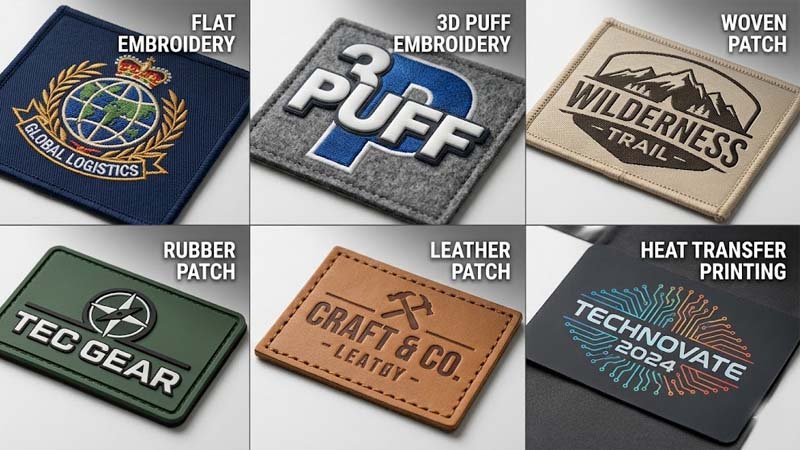
Yes. Custom logo decoration can increase the weight of a baseball cap, especially when the logo is large, thick, or made with additional materials.
| Logo Method |
Weight Impact |
Best For |
| Flat Embroidery |
Low to medium |
Brand logos, text, corporate caps |
| 3D Puff Embroidery |
Medium |
Bold logos, fashion caps |
| Woven Patch |
Medium |
Detailed artwork, brand labels |
| Rubber Patch |
Medium to high |
Outdoor, sports, streetwear caps |
| Leather Patch |
Medium |
Premium branding |
| Heat Transfer Printing |
Low |
Lightweight caps, colorful designs |
| Appliqué Embroidery |
Medium to high |
Fashion and retail caps |
A small flat embroidered logo may only add a few grams. A large 3D puff embroidery, rubber patch, or leather patch can add more weight.
For one cap, the difference may not feel significant. But for 1,000 pieces, a 10g increase per cap becomes 10kg of extra net weight before adding packaging and cartons.
Net Weight, Gross Weight and Volumetric Weight
For bulk buyers, it is important to understand the difference between net weight, gross weight, and volumetric weight.
Net Weight
Net weight refers to the weight of the product itself, without cartons or outer packaging.
For example, if one cap weighs 80g, then:
80g × 1,000pcs = 80,000g = 80kg net weight
Gross Weight
Gross weight includes the product, individual packaging, inner packing, carton, labels, and other packing materials.
For example, 1,000 caps with a net weight of 80kg may have a gross weight of around 95–110kg, depending on the packing method.
Volumetric Weight
Volumetric weight is calculated based on carton size. For caps, this is especially important because structured caps often need more space to protect their shape.
A lightweight cap may not be heavy, but if the carton size is large, the shipping company may calculate freight by volume instead of actual weight.
For structured caps, snapbacks, or premium retail caps, volumetric weight may sometimes affect shipping cost more than actual product weight.
Example: How Cap Weight Affects a 1,000-Piece Order
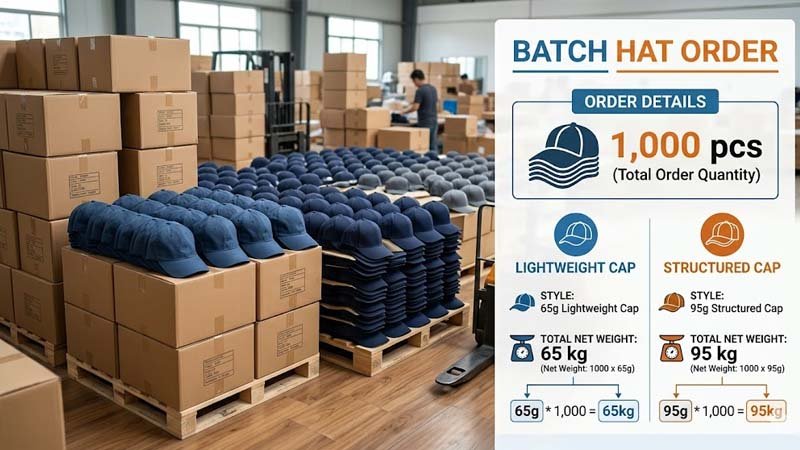
Here is a simple example.
If one lightweight promotional cap weighs 65g, then:
65g × 1,000pcs = 65kg net weight
If one structured embroidered cap weighs 95g, then:
95g × 1,000pcs = 95kg net weight
The difference is:
95kg – 65kg = 30kg
That means a heavier cap design may add around 30kg of extra net weight for a 1,000-piece order. After adding cartons and packing materials, the final gross weight may increase even more.
This is why cap weight should be considered before confirming fabric, structure, logo method, and packing requirements.
Estimated Shipping Weight for Bulk Baseball Cap Orders
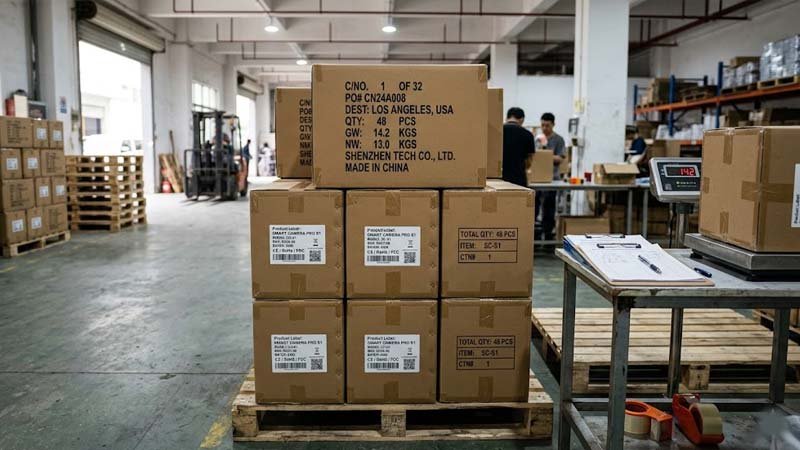
The final shipping weight depends on cap style, packing method, carton size, and logo process. However, the table below can be used as a general reference.
| Quantity |
Estimated Net Weight |
Estimated Gross Weight |
| 100 pcs |
6–10 kg |
8–13 kg |
| 500 pcs |
30–50 kg |
38–60 kg |
| 1,000 pcs |
60–100 kg |
75–120 kg |
| 5,000 pcs |
300–500 kg |
380–600 kg |
These are estimated ranges only. Before shipment, buyers should always confirm the exact carton quantity, carton size, gross weight, and volume with the manufacturer.
How to Choose the Right Cap Weight for Your Project
The best baseball cap weight depends on the purpose of the order. A heavier cap is not always better, and a lighter cap is not always lower quality.
Here is a practical guide for different projects:
| Project Type |
Suggested Cap Weight |
Recommended Customization |
| Event Giveaway |
50–75g |
Printing or simple embroidery |
| Summer Promotion |
50–80g |
Lightweight cotton or polyester |
| Sports Team |
55–85g |
Polyester with breathable panels |
| Corporate Uniform |
70–100g |
Structured cap with flat embroidery |
| Retail Brand |
85–120g |
3D embroidery, woven patch, or leather patch |
| Outdoor Brand |
80–120g |
Heavy cotton, mesh, or rubber patch |
| Premium Gift |
80–120g |
Structured design with custom packaging |
For large promotional orders, a lightweight cap can reduce cost and improve comfort. For retail and premium projects, a medium or heavier cap can improve structure, brand value, and perceived quality.
Both lightweight and heavy baseball caps have advantages. The right choice depends on your market and usage.
Lightweight Caps
Lightweight caps are usually better for:
- Outdoor events
- Summer promotions
- Sports teams
- School activities
- Large giveaways
- Budget-friendly campaigns
They are comfortable, breathable, easy to pack, and suitable for long-time wear.
Heavy Caps
Heavier caps are usually better for:
- Fashion brands
- Retail collections
- Corporate uniforms
- Premium gifts
- Outdoor workwear
- Streetwear designs
They usually have a stronger shape, thicker fabric, and better hand feel. They are also suitable for more premium logo methods such as 3D embroidery, woven patches, rubber patches, or leather labels.
The best option is not the lightest or the heaviest cap. The best option is the cap that matches your brand positioning, target users, and budget.
Factory Tips Before Requesting a Quote
Before requesting a custom baseball cap quotation, buyers should prepare the basic specifications. This helps the manufacturer calculate a more accurate price, weight, production time, and shipping cost.
Useful details include:
- Cap style
- Fabric material
- Fabric color
- Structured or unstructured crown
- Brim type
- Logo artwork
- Logo method
- Closure type
- Quantity
- Packaging requirements
- Delivery destination
As a Guangzhou-based OEM/ODM hat manufacturer with 15 years of experience, GUANGZHOU EASTLUCKY Hat & Garment Co., Ltd. provides one-stop custom hat solutions from design sampling to mass production. Our team helps global brands choose suitable fabrics, embroidery methods, structures, closures, and packing solutions based on product positioning, budget, and delivery requirements.
For bulk orders, it is also useful to ask the supplier:
- What is the approximate weight per cap?
- What is the estimated net weight and gross weight?
- How many pieces are packed per carton?
- What is the carton size?
- Will the logo method affect the final weight?
- Is the cap suitable for air shipping or sea shipping?
- Can a pre-production sample be provided before mass production?
These questions can help avoid misunderstandings and make the order process smoother.
How much does a baseball cap weigh in grams?
A standard baseball cap usually weighs between 50 and 120 grams, depending on the material, structure, brim, closure, logo method, and packing style.
How much does a cotton baseball cap weigh?
A cotton baseball cap usually weighs around 60–90 grams. Lightweight cotton caps are closer to 60g, while structured or heavy cotton caps may weigh 90g or more.
How much does a structured baseball cap weigh?
A structured baseball cap usually weighs around 80–120 grams. The reinforced front panel, stronger brim, and heavier fabric can increase the final weight.
Does embroidery make a baseball cap heavier?
Yes. Embroidery can add extra weight to a cap. Small flat embroidery may only add a few grams, while large 3D puff embroidery or dense stitching can add more.
Does a patch make a cap heavier?
Yes. Woven patches, rubber patches, leather patches, and appliqué embroidery can increase cap weight. The final weight depends on the patch material, size, and thickness.
How much does 1,000 baseball caps weigh?
If each cap weighs 60–100g, then 1,000 caps may have a net weight of around 60–100kg. After adding packaging and cartons, the gross weight may be around 75–120kg.
Are heavier baseball caps better quality?
Not always. Heavier caps may feel more structured and premium, but lightweight caps can also be high quality. The best choice depends on the purpose, target users, and budget.
Does cap weight affect shipping cost?
Yes. Cap weight can affect shipping cost, especially for bulk orders. However, carton size and volumetric weight are also important, especially for structured caps and snapbacks.
Final Thoughts
A baseball cap usually weighs between 50 and 120 grams, but the final weight depends on the fabric, structure, brim, closure, logo decoration, and packing method.
For bulk buyers, cap weight is more than a small product detail. It can affect comfort, product quality, carton quantity, gross weight, volumetric weight, and international shipping cost.
If you need lightweight promotional caps, materials such as polyester, lightweight cotton, or unstructured designs may be more suitable. If you need premium retail caps, corporate uniforms, or fashion brand merchandise, medium to heavy cotton caps with embroidery or patch decoration may create a better brand impression.
Before placing a custom baseball cap order, confirm the cap weight, packing method, carton size, and shipping details with your manufacturer. Choosing the right cap weight from the beginning can help you balance comfort, quality, branding effect, and total order cost.
How to Style Custom Trucker Hats for Brands and Events
Custom trucker hats are more than casual accessories. For brands, events, sports teams, outdoor campaigns, and promotional programs, they are practical, stylish, and highly visible branding tools.
With a structured front panel, breathable mesh back, and adjustable closure, trucker hats are easy to wear and easy to customize. They work well with casual outfits, uniforms, streetwear, outdoor clothing, and event merchandise. More importantly, the front panel provides a clear space for embroidery, patches, printed logos, or branded artwork.
Whether you are planning a corporate event, launching a retail merchandise collection, preparing a trade show giveaway, or designing custom hats for your team, the right trucker hat style can help your brand look more professional and memorable.
In this guide, we will explain how to style custom trucker hats for brands and events, how to choose the right materials and colors, and what buyers should consider before placing a bulk order.
What Makes Trucker Hats Popular for Brands and Events?
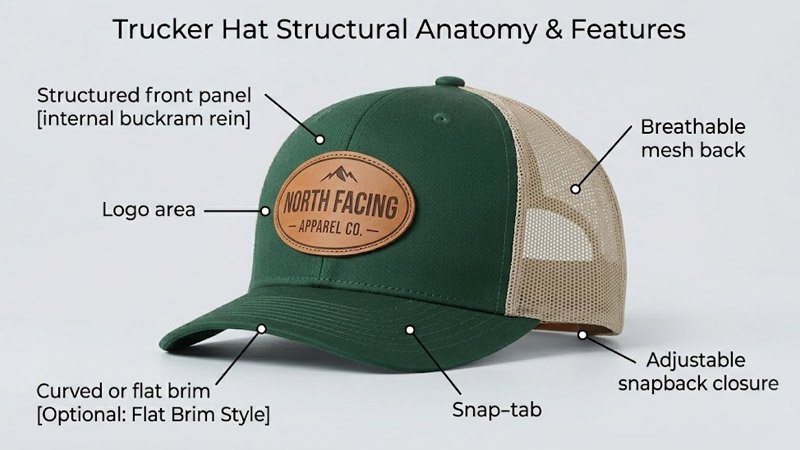
Trucker hats are popular because they combine comfort, visibility, and strong customization potential.
The classic trucker hat usually includes:
- A structured front panel
- A breathable mesh back
- An adjustable snapback closure
- A flat or curved brim
- A large front area for custom branding
For events and brand promotions, this design is very practical. The mesh back keeps the hat breathable, while the front panel gives the logo enough space to stand out.
Compared with many other promotional products, custom trucker hats are also more wearable. People can use them after the event, which means your logo continues to get exposure in daily life.
Before styling a custom trucker hat, it is important to choose the right base design. The material, brim shape, color, and logo method all affect the final look.
1. Choose the Right Front Panel
The front panel is the most important area for branding.
Common front panel options include:
- Foam front panel for a classic vintage trucker look
- Cotton front panel for a soft and natural appearance
- Polyester front panel for durability and stable colors
- Canvas front panel for a heavier outdoor or workwear style
For embroidered logos or patches, a structured front panel is usually recommended because it helps the logo stay clean and visible.
2. Choose the Right Mesh Back
The mesh back is one of the key features of a trucker hat. It provides ventilation and keeps the hat lightweight.
A breathable mesh back is especially suitable for:
- Outdoor events
- Summer campaigns
- Sports teams
- Camping brands
- Fishing brands
- Workwear teams
- Music festivals
- Promotional giveaways
For brand projects, the mesh color can match or contrast with the front panel to create a more customized look.
3. Choose a Flat Brim or Curved Brim
The brim shape affects the overall style of the hat.
A flat brim trucker hat gives a modern, bold, and streetwear-inspired look. It is suitable for fashion brands, youth brands, sports promotions, and retail merchandise.
A curved brim trucker hat gives a more classic, relaxed, and everyday look. It is suitable for corporate events, outdoor brands, team uniforms, and casual promotional use.
For most brand events, curved brim trucker hats are easier to wear for a wide audience. For streetwear or fashion-focused projects, flat brim styles may look more eye-catching.
4. Choose the Right Closure
Most trucker hats use an adjustable snapback closure. This is a practical option for bulk orders because it fits different head sizes.
Other closure options may include:
- Velcro closure
- Metal buckle closure
- Plastic snapback closure
- Elastic fit
For event giveaways and promotional campaigns, snapback closures are usually the most convenient choice.
The logo method is one of the most important decisions when designing custom trucker hats. Different logo techniques create different styles and price levels.
Flat Embroidery
Flat embroidery is clean, professional, and widely used for custom trucker hats. It works well for company logos, event names, simple icons, and short text.
Best for:
- Corporate events
- Trade shows
- Team hats
- Promotional gifts
- Uniform hats
Flat embroidery is a good choice when you want a professional and durable logo effect.
3D Puff Embroidery
3D puff embroidery creates a raised logo effect. It looks bold and premium, especially on structured front panels.
Best for:
- Streetwear brands
- Sports teams
- Fashion merchandise
- Bold letter logos
This method works best for simple logos with thick lines. Very small details may not be suitable for 3D embroidery.
Woven Patch
A woven patch is a good option for detailed logos. It can show small text, fine lines, and more complex artwork better than direct embroidery.
Best for:
- Outdoor brands
- Retail merchandise
- Lifestyle brands
- Detailed logo designs
Woven patches also give the hat a finished, retail-ready appearance.
Leather Patch
Leather patches create a vintage, premium, and outdoor-inspired look. They are often used for workwear, camping, fishing, and lifestyle brands.
Best for:
- Outdoor brands
- Workwear brands
- Premium merchandise
- Minimal logo designs
Brown, black, and tan leather patches are common choices for custom trucker hats.
Heat Transfer Printing
Heat transfer printing is suitable for colorful artwork, gradients, and full-color designs.
Best for:
- Event graphics
- Colorful brand artwork
- Promotional campaigns
- Photo-style designs
For long-term use, buyers should confirm the durability requirements before choosing heat transfer printing.
How to Style Custom Trucker Hats for Different Brand Scenarios
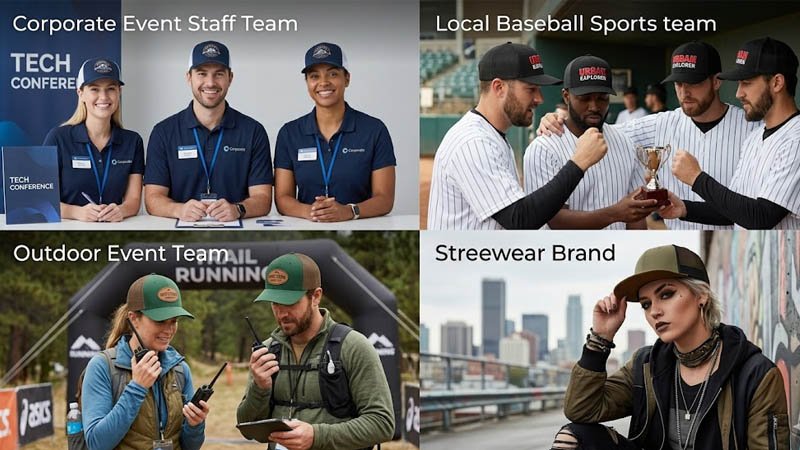
Custom trucker hats can be styled differently depending on your brand identity and event type.
Corporate Events
For corporate events, the style should be clean, simple, and professional.
Recommended design:
- Neutral colors such as black, navy, grey, or white
- Curved brim
- Flat embroidery logo
- Simple front panel design
- Adjustable snapback closure
Recommended outfit match:
- Polo shirts
- Company T-shirts
- Chinos
- Casual jackets
- Staff uniforms
A clean embroidered trucker hat can help event staff look unified while keeping the brand visible.
Trade Shows and Exhibitions
At trade shows, custom trucker hats can work as both staff uniforms and promotional giveaways.
Recommended design:
- High-contrast logo
- Lightweight mesh back
- Comfortable fit
- Clear brand name or slogan
- Simple color combination
Recommended outfit match:
- Branded T-shirts
- Lanyards
- Casual business wear
- Exhibition uniforms
For trade shows, the logo should be easy to read from a distance. Avoid overly complex designs that may lose clarity.
Outdoor Events
For outdoor events, comfort and breathability are very important.
Recommended design:
- Breathable mesh back
- Durable front panel
- Curved brim for sun protection
- Earth-tone or high-visibility colors
- Embroidery or patch logo
Recommended outfit match:
- Outdoor shirts
- Cargo pants
- Shorts
- Sunglasses
- Work jackets
This style is suitable for camping events, fishing competitions, hiking clubs, outdoor brand promotions, and summer festivals.
Sports Teams
For sports teams, trucker hats should feel energetic, comfortable, and easy to wear.
Recommended design:
- Team colors
- Embroidered team logo
- Adjustable closure
- Breathable mesh back
- Curved or flat brim depending on team style
Recommended outfit match:
- Team jerseys
- Sports T-shirts
- Joggers
- Shorts
- Sneakers
For sports teams, bold embroidery and clear color contrast can make the design more recognizable.
Streetwear Brands
For streetwear brands, trucker hats can be bold, creative, and expressive.
Recommended design:
- Flat brim
- 3D puff embroidery
- Woven patch
- Contrast mesh back
- Strong logo placement
Recommended outfit match:
- Oversized T-shirts
- Hoodies
- Denim jackets
- Cargo pants
- Sneakers
Streetwear trucker hats should feel more visual and attitude-driven. A bold front logo or raised embroidery can help create a stronger brand identity.
Music Festivals and Promotional Events
For music festivals, concerts, and promotional campaigns, trucker hats can be fun, colorful, and memorable.
Recommended design:
- Bright colors
- Printed graphics
- Event slogan
- Mesh back for comfort
- Lightweight structure
Recommended outfit match:
- Event T-shirts
- Casual shorts
- Denim
- Sneakers
- Sunglasses
For these events, the design can be more creative, but the logo should still remain clear and readable.
Color plays an important role in both styling and branding. A good color combination can make the hat easier to wear and help the logo stand out.
| Hat Color |
Best For |
Recommended Logo Style |
| Black |
Corporate events, streetwear, daily wear |
White or bright embroidery |
| Navy |
Business casual, team uniforms, events |
White, silver, or light blue embroidery |
| White |
Summer events, clean brand looks |
Dark embroidery or colorful patch |
| Grey |
Minimal branding, everyday use |
Black or navy embroidery |
| Beige / Khaki |
Outdoor brands, camping, travel |
Brown leather patch or dark embroidery |
| Olive Green |
Workwear, outdoor campaigns |
Tan patch or cream embroidery |
| Red / Bright Colors |
Sports teams, festivals, promotions |
High-contrast logo |
| Camo |
Outdoor brands, streetwear |
Leather patch or simple embroidery |
For brand projects, always check logo visibility before bulk production. A low-contrast logo may look stylish on screen but unclear on the final product.
Which Custom Trucker Hat Style Is Right for Your Brand?
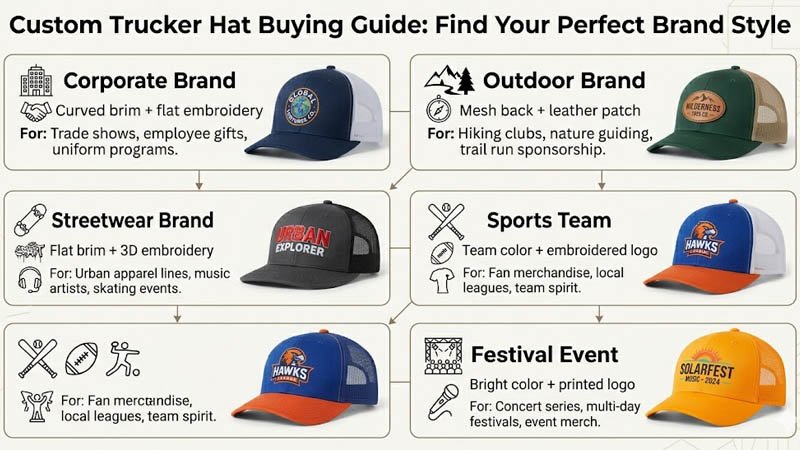
Different brands need different hat styles. The best choice depends on your market, design style, and usage scenario.
| Brand Type |
Recommended Hat Style |
Best Logo Method |
| Corporate Brand |
Curved brim trucker hat |
Flat embroidery |
| Outdoor Brand |
Mesh back trucker hat |
Leather patch or woven patch |
| Streetwear Brand |
Flat brim structured trucker hat |
3D puff embroidery or woven patch |
| Sports Team |
Breathable team trucker hat |
Embroidery or heat transfer |
| Trade Show |
Lightweight promotional trucker hat |
Flat embroidery or printed logo |
| Retail Brand |
Premium cotton trucker hat |
Woven patch or embroidery |
| Workwear Brand |
Canvas or cotton trucker hat |
Leather patch or embroidery |
| Festival Event |
Colorful trucker hat |
Heat transfer print or patch |
This type of planning helps buyers choose a hat that fits both the brand image and the actual usage environment.
Common Styling Mistakes to Avoid
Even a good trucker hat can look wrong if it is styled poorly. Here are some common mistakes to avoid.
1. Using Too Many Colors
If the hat already has a bright color or bold logo, keep the outfit simple. Too many colors can make the whole look messy.
2. Choosing the Wrong Fit
The hat should sit naturally on the head. It should not be too tight, too loose, too low, or too high.
3. Mixing the Wrong Style
A trucker hat is casual by nature. It works best with casual, sporty, outdoor, streetwear, and relaxed smart casual outfits. It is usually not suitable for formal business suits or very formal occasions.
4. Ignoring Logo Balance
For custom hats, the logo should not be too large or too small. It should fit the front panel naturally and leave enough space around the design.
5. Overloading the Front Panel
Too many words, icons, slogans, and graphics can make the hat look crowded. A clean design is often more professional and easier to remember.
Common Customization Mistakes to Avoid
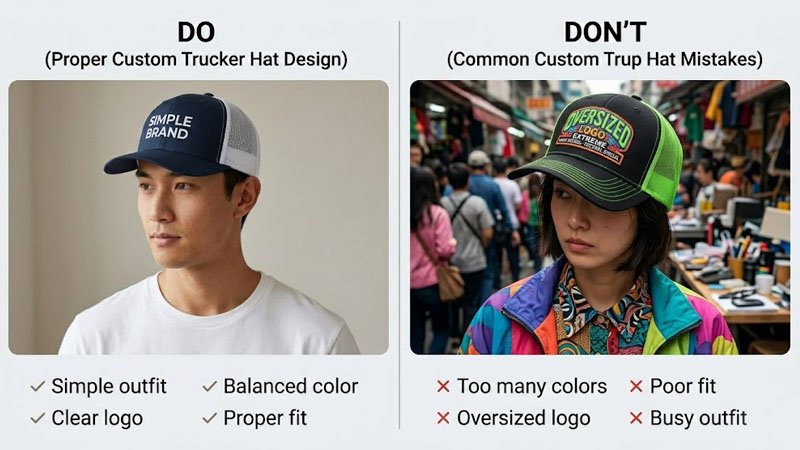
For bulk buyers, design mistakes can affect the final result and increase production risk.
1. Choosing a Logo That Is Too Detailed
Small text and fine lines may not work well with embroidery. If the logo has many details, a woven patch or printed patch may be a better choice.
2. Ignoring Material Compatibility
Different materials create different logo effects. Foam, cotton, polyester, and canvas panels may all react differently to embroidery, patches, or printing.
3. Not Checking Color Contrast
A logo needs enough contrast against the hat color. Before production, buyers should confirm whether the logo is visible and clear.
4. Skipping Sample Approval
Sampling is important for custom trucker hats. It helps confirm the logo effect, stitching quality, material, color, size, and overall shape before mass production.
5. Choosing Style Only by Price
Low-cost hats may not always deliver the best brand impression. For brand events and retail merchandise, quality, comfort, and logo clarity are very important.
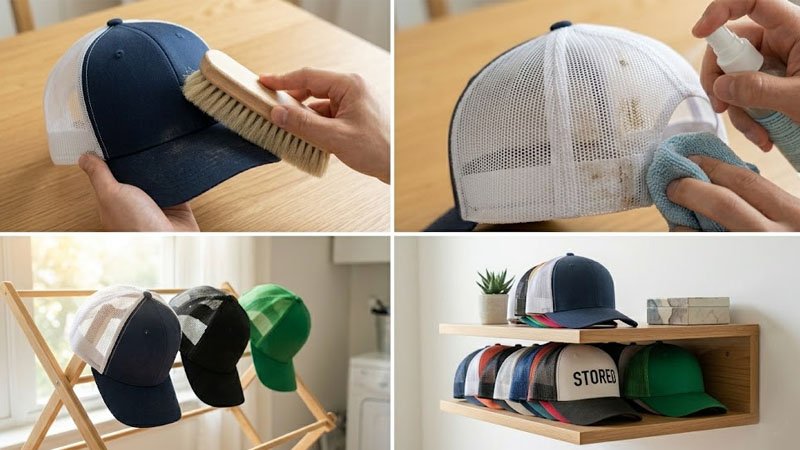
Proper care helps trucker hats keep their shape and appearance for longer.
Cleaning Tips
Spot cleaning is usually the safest method. Use a soft cloth or soft brush with mild detergent to gently clean dirt or stains.
Avoid machine washing if possible, because it may damage the structure, bend the brim, or deform the mesh back.
After cleaning, let the hat air dry naturally. Do not use high heat, as it may affect the material or logo.
Storage Tips
Store trucker hats in a cool and dry place. Avoid crushing them in bags or drawers.
For better shape protection, place the hats on a shelf, hat rack, or store them upside down. Keep the brim flat and avoid bending it too much.
For bulk orders, proper packaging is also important. Individual polybags, inner boxes, and export cartons can help protect hats during transportation.
What Buyers Should Prepare Before Ordering Custom Trucker Hats
To make the custom process smoother, buyers should prepare the following information before requesting a quote:
- Logo file
- Preferred hat style
- Quantity
- Pantone colors
- Logo size
- Logo method
- Brim style
- Material preference
- Packaging requirement
- Target delivery date
- Usage scenario
For custom buyers, working with an experienced manufacturer can help reduce sampling errors, improve logo accuracy, and ensure stable quality in bulk production.
GUANGZHOU EASTLUCKY Hat & Garment Co., Ltd. is a high-end custom hat and OEM/ODM manufacturer based in Guangzhou, China, with 15 years of expertise in professional R&D, production, and distribution of various hats and embroidered accessories. Guided by the philosophy “Quality as Root, Innovation as Soul,” the company provides global clients with one-stop solutions from design sampling to mass production, helping brands create efficient and high-quality custom hat programs.
Are trucker hats good for brand promotion?
Yes. Trucker hats are practical, wearable, and highly visible. The front panel provides a strong area for logos, while the mesh back makes the hat comfortable for daily and outdoor use.
What is the best logo method for custom trucker hats?
Flat embroidery is best for clean and professional logos. 3D embroidery is good for bold designs. Woven patches are suitable for detailed logos. Leather patches are ideal for outdoor and premium styles.
Are trucker hats suitable for outdoor events?
Yes. The breathable mesh back makes trucker hats very suitable for outdoor events, festivals, sports activities, camping, fishing, and summer promotions.
Should I choose a flat brim or curved brim?
Choose a flat brim for streetwear, fashion, and bold brand styles. Choose a curved brim for corporate events, outdoor use, sports teams, and wider audience appeal.
Can I order trucker hats with different colors?
Yes. Custom trucker hats can usually be made with different front panel colors, mesh colors, brim colors, and logo colors. Buyers can match the hat design with their brand color system.
What should I check before bulk production?
You should check the sample carefully, including material, logo position, embroidery quality, color matching, stitching, brim shape, closure, size, and packaging.
Are custom trucker hats suitable for retail merchandise?
Yes. With the right material, logo method, and packaging, custom trucker hats can be used as retail merchandise for fashion brands, outdoor brands, sports brands, and lifestyle brands.
Final Thoughts
Custom trucker hats are a smart choice for brands and events because they combine comfort, style, and strong logo visibility. They can be used for corporate events, trade shows, sports teams, outdoor campaigns, music festivals, staff uniforms, and retail merchandise.
To create a successful custom trucker hat, buyers should consider the hat structure, material, brim shape, color matching, logo method, and final usage scenario. A simple and well-balanced design often creates a stronger brand impression than an overloaded one.
Whether you need embroidered trucker hats, patch trucker hats, promotional trucker hats, or OEM custom hat solutions, the right design can turn a simple hat into a wearable part of your brand identity.
For your next custom trucker hat project, prepare your logo, quantity, preferred style, and event details. A professional manufacturer can help you choose the right material, logo technique, and production solution for your brand.
What Are the Main Parts of a Baseball Cap? A Complete Guide for Custom Hat Buyers
Choosing a baseball cap for custom production is not only about selecting a color and adding a logo. Every part of a baseball cap — from the crown and brim to the closure, sweatband, eyelets, and stitching — affects the final look, comfort, durability, and branding result.
For brands, distributors, sports teams, promotional product buyers, and OEM/ODM customers, understanding the main parts of a baseball cap can help you make better decisions before placing a bulk order. The right cap structure can improve logo presentation, wearing comfort, production stability, and overall brand value.
In this guide, we will explain the main components of a baseball cap and show how each part affects custom hat design and manufacturing.
Quick Answer: What Are the Main Parts of a Baseball Cap?
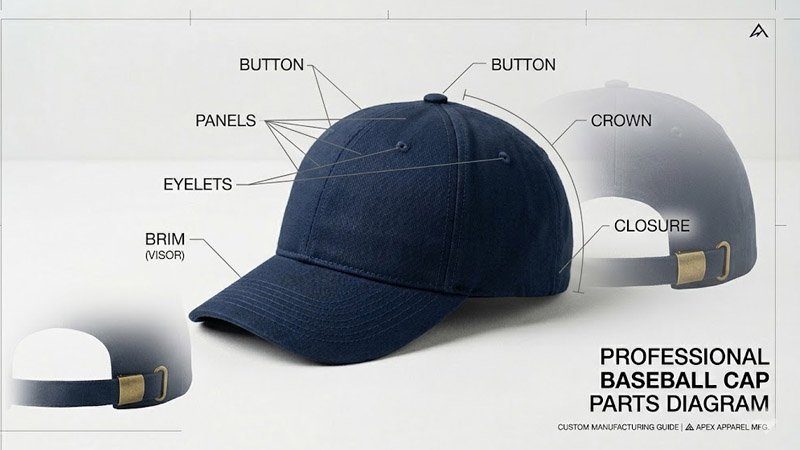
The main parts of a baseball cap include the crown, panels, brim or visor, closure, eyelets, sweatband, top button, seams, stitching, and logo decoration areas.
For custom baseball caps, these parts are not just design details. They directly affect the cap’s shape, fit, comfort, ventilation, durability, logo placement, and final production quality.
Why Baseball Cap Parts Matter for Custom Buyers
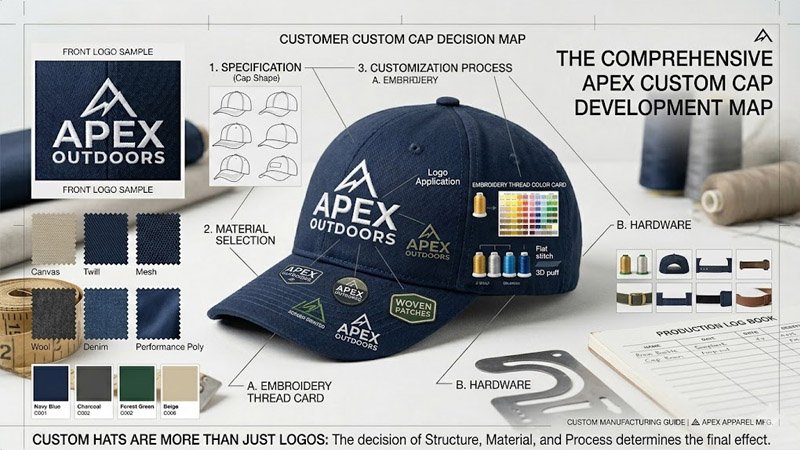
When buyers customize baseball caps, they often focus first on the logo and color. However, the structure of the cap is just as important.
A structured crown can make embroidery look cleaner. A curved brim can create a classic sports look. A snapback closure can fit more head sizes. A moisture-wicking sweatband can improve comfort for outdoor or sports use.
For bulk orders, choosing the wrong cap parts may lead to problems such as poor logo presentation, uncomfortable fit, weak structure, or a product that does not match the target market.
That is why understanding each part of a baseball cap is important before custom production begins.
1. Crown: The Main Body of the Baseball Cap
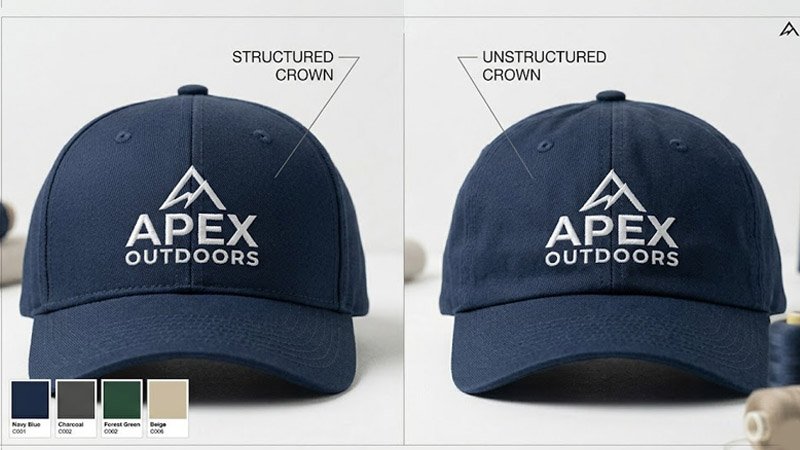
The crown is the main body of the baseball cap. It covers the top of the head and gives the cap its overall shape.
The crown affects:
- Cap structure
- Wearing comfort
- Logo placement
- Front embroidery quality
- Overall style
For custom caps, the crown is usually the most important area because it is where the main logo is placed.
A firm and well-shaped crown gives the cap a clean, professional appearance. A softer crown creates a relaxed and casual style.
2. Panels: 5-Panel and 6-Panel Construction
The crown is made from several fabric panels sewn together. Most baseball caps use either a 5-panel or 6-panel structure.
5-Panel Baseball Cap
A 5-panel cap usually has one large front panel without a center seam. This makes it suitable for large front logos, patches, and printed artwork.
A 5-panel cap is often used for:
- Camp caps
- Streetwear caps
- Outdoor caps
- Fashion headwear
- Large logo designs
Because the front panel is smooth and uninterrupted, it gives more space for clean branding.
6-Panel Baseball Cap
A 6-panel cap has six fabric sections, usually with a center seam on the front. This is the most classic baseball cap construction.
A 6-panel cap is commonly used for:
- Traditional baseball caps
- Dad hats
- Sports caps
- Corporate caps
- Uniform caps
If you want a classic baseball cap shape, a 6-panel structure is usually the safest choice.
3. Structured vs. Unstructured Crown
Another important choice is whether the cap should be structured or unstructured.
Structured Crown
A structured crown has inner support, especially in the front panels. It keeps the cap shape firm and upright.
Best for:
- Flat embroidery
- 3D embroidery
- Snapback caps
- Sports caps
- Corporate logo caps
- Premium promotional caps
Factory Tip: For large front embroidery or 3D embroidery, a structured front panel usually provides better support and helps the logo stay clean during stitching.
Unstructured Crown
An unstructured crown is softer and more relaxed. It does not have strong inner support, so it fits closer to the head.
Best for:
- Dad hats
- Casual cotton caps
- Lifestyle brands
- Small embroidered logos
- Minimalist designs
Unstructured caps are comfortable and fashionable, but they may not be the best choice for heavy or raised embroidery.
4. Crown Profile: High, Mid, and Low
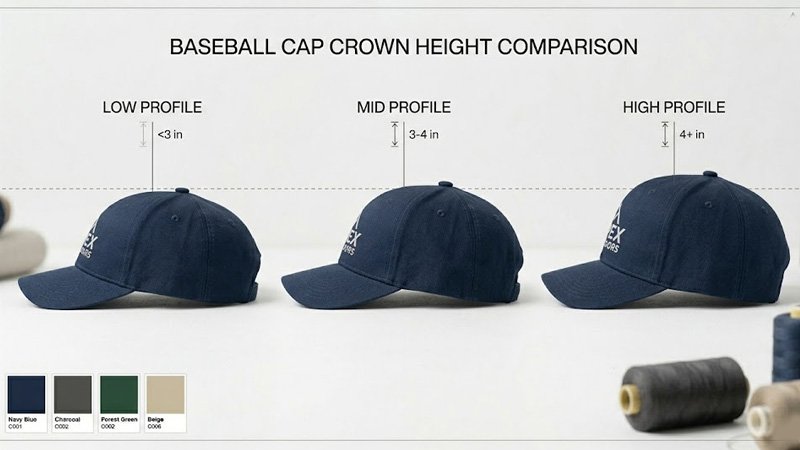
The crown profile refers to the height of the cap when worn. It affects both fit and style.
High-Profile Caps
High-profile caps have a taller crown and a bolder look.
Best for:
- Snapbacks
- Trucker caps
- 3D embroidery
- Streetwear brands
- Large front logos
Mid-Profile Caps
Mid-profile caps offer a balanced shape that suits most users.
Best for:
- Corporate caps
- Retail brands
- Sports teams
- Promotional caps
- General custom orders
Low-Profile Caps
Low-profile caps sit closer to the head and create a softer, more casual appearance.
Best for:
- Dad hats
- Casual fashion caps
- Small logo embroidery
- Lifestyle merchandise
- Minimalist brand designs
For custom buyers, the crown profile should match the target market and logo style.
5. Brim or Visor: Function and Style
The brim, also called the visor, extends from the front of the cap. It protects the face from sunlight and strongly affects the style of the cap.
The brim can be flat, curved, or pre-curved. It can also be customized with contrast colors, sandwich layers, stickers, labels, or printed designs.
6. Common Brim Types
Flat Brim
A flat brim creates a modern, bold, and streetwear-inspired look.
Best for:
- Snapbacks
- Hip-hop caps
- Fashion brands
- Sports merchandise
- 3D embroidered logos
Curved Brim
A curved brim gives a classic baseball cap appearance. It is practical, comfortable, and suitable for daily wear.
Best for:
- Sports caps
- Corporate caps
- Outdoor caps
- Promotional giveaways
- Uniform caps
Pre-Curved Brim
A pre-curved brim is already shaped during production. It gives a natural, ready-to-wear look.
Best for:
- Dad hats
- Casual caps
- Lifestyle brands
- Outdoor events
Sandwich Brim
A sandwich brim has a contrast color layer between the upper and lower brim fabrics. It is a simple way to add brand color without making the cap look too complicated.
Best for:
- Team caps
- Corporate color matching
- Promotional caps
- Brand accent designs
Factory Tip: For bulk orders, buyers should confirm the brim shape and stiffness during sampling, because different markets may prefer different brim curves.
7. Closure: The Back Adjustment System
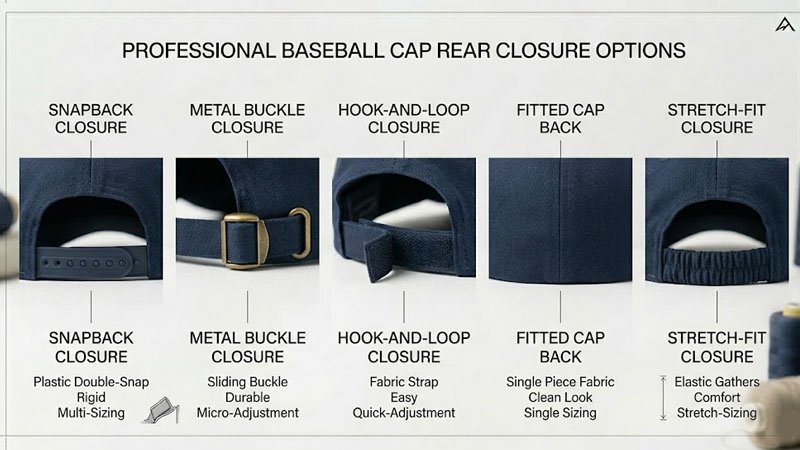
The closure is located at the back of the cap. It helps adjust the size and ensures a comfortable fit.
The closure type affects:
- Wearing comfort
- Size flexibility
- Cap style
- Target market
- Production cost
Snapback Closure
A snapback closure uses a plastic adjustable strap with holes. It is popular, durable, and easy to adjust.
Best for:
- Snapbacks
- Streetwear caps
- Sports caps
- Promotional caps
- Youth markets
Metal Buckle Closure
A metal buckle closure gives the cap a clean and premium look. It is commonly used for cotton dad hats and casual caps.
Best for:
- Dad hats
- Fashion caps
- Corporate gifts
- Premium promotional caps
Hook-and-Loop Closure
Hook-and-loop closure is easy to adjust and convenient for daily use.
Best for:
- Workwear caps
- Kids’ caps
- School caps
- Outdoor caps
- Event caps
Fitted Cap
A fitted cap has no adjustable strap. It is made according to specific head sizes.
Best for:
- Sports teams
- Retail cap collections
- Premium headwear
- Professional baseball caps
Stretch-Fit Closure
A stretch-fit cap uses elastic material to fit different head sizes comfortably.
Best for:
- Sports caps
- Performance caps
- Activewear brands
- Comfortable daily wear
Factory Tip: For promotional giveaways or event caps, adjustable closures such as snapback, hook-and-loop, or metal buckle are usually safer because they fit more head sizes.
9. Eyelets: Small Holes for Ventilation
Eyelets are the small holes on the crown of the cap. They allow air to flow through the cap and help keep the wearer cooler.
Common eyelet options include:
- Sewn eyelets
- Metal eyelets
- Matching color eyelets
- Contrast color eyelets
- Ventilation holes for performance caps
For cotton baseball caps, sewn eyelets are the most common. For outdoor caps or fashion caps, metal eyelets can add a stronger design detail.
Eyelets are especially important for summer caps, sports caps, outdoor caps, and promotional caps used in warm climates.
10. Sweatband: The Hidden Comfort Detail
The sweatband is located inside the cap, around the lower edge of the crown. It touches the forehead and helps absorb sweat.
Although it is not visible from the outside, the sweatband has a big impact on wearing comfort.
Common sweatband materials include:
- Cotton sweatband
- Polyester sweatband
- Terry cloth sweatband
- Moisture-wicking sweatband
- Elastic sweatband
For casual caps, cotton sweatbands are soft and comfortable. For sports and outdoor caps, moisture-wicking sweatbands are better because they help keep the wearer dry.
Factory Tip: Do not ignore the sweatband when developing custom caps for sports, outdoor events, or long-time wear. A poor sweatband can make the cap uncomfortable even if the outside design looks good.
11. Top Button: A Small Detail That Completes the Cap
The top button is located where the crown panels meet. It helps secure the panel structure and completes the appearance of the cap.
Common button options include:
- Matching fabric button
- Contrast color button
- Custom color button
- No-button design
A matching button gives a clean and classic look. A contrast button can add a small design highlight.
For some performance caps, a no-button design may be preferred because it feels more comfortable when worn under helmets or headgear.
12. Seams and Stitching: Details That Show Quality
Seams and stitching are important indicators of baseball cap quality. Clean stitching makes the cap look more professional and improves durability.
Custom buyers should check:
- Straight stitching
- Clean panel seams
- Even brim stitching
- Reinforced stress points
- No loose threads
- Consistent stitch density
- Neat embroidery edges
Poor stitching can make a cap look cheap, even if the fabric and logo are good. For brand buyers, these details directly affect the final product image.
13. Logo Placement Options on Baseball Caps
Logo placement is one of the most important decisions in custom baseball cap production. Different positions create different branding effects.
Front Logo
The front panel is the most common and visible logo position.
Suitable for:
- Flat embroidery
- 3D embroidery
- Woven patches
- Leather patches
- Rubber patches
- Heat transfer logos
For the best result, the logo size should match the crown height and front panel structure.
Side Logo
Side logos are usually smaller and more subtle.
Suitable for:
- Small icons
- Flag embroidery
- Event names
- Brand slogans
- Team details
Back Logo
The back area can be used for small embroidery, woven labels, or brand names near the closure.
This is a good option when the front design needs to stay simple.
Brim Logo
The brim can be customized with embroidery, stickers, labels, or under-brim printing.
This works well for streetwear caps, sports caps, and fashion headwear.
Different logo methods create different visual effects. The right method depends on the logo design, fabric, cap structure, order quantity, and target market.
Flat Embroidery
Flat embroidery is one of the most popular logo methods for baseball caps. It gives a clean, durable, and professional look.
Best for:
- Company logos
- Text logos
- Uniform caps
- Corporate caps
- Promotional caps
3D Embroidery
3D embroidery creates a raised logo effect. It gives the cap a stronger and more premium appearance.
Best for:
- Bold letters
- Sports logos
- Snapbacks
- Streetwear caps
- High-profile crowns
Appliqué Embroidery
Appliqué embroidery uses fabric pieces stitched onto the cap. It is suitable for larger designs and fashion-style branding.
Best for:
- Large logos
- Retro designs
- Streetwear caps
- Premium custom caps
Woven Patch
A woven patch is suitable for detailed logos and small text. It creates a neat and high-quality look.
Best for:
- Outdoor brands
- Fashion caps
- Retail headwear
- Detailed artwork
Leather Patch
Leather patches create a premium, outdoor, and vintage feeling.
Best for:
- Outdoor caps
- Workwear caps
- Lifestyle brands
- Premium merchandise
Heat Transfer Printing
Heat transfer printing is suitable for colorful designs, gradients, and detailed artwork.
Best for:
- Multi-color logos
- Small quantity orders
- Smooth artwork
- Fashion designs
15. Why Embroidery Is Popular for Baseball Caps
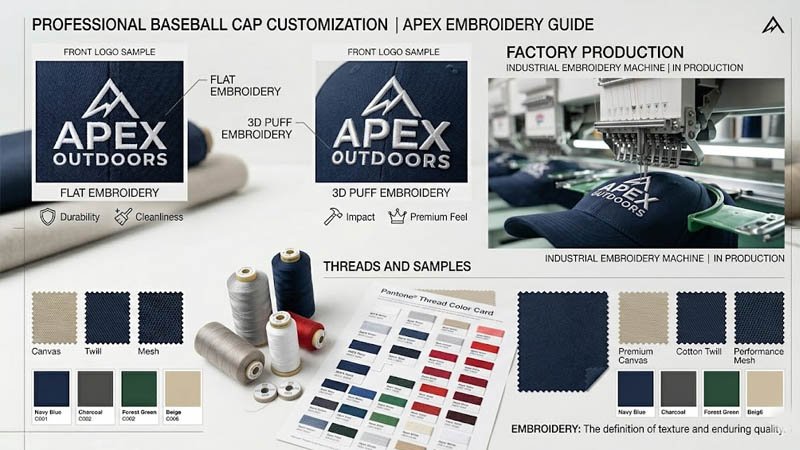
Embroidery remains one of the most popular choices for custom baseball caps because it is durable, professional, and suitable for many types of logos.
Compared with simple printing, embroidery adds texture and a more premium feeling. It is especially suitable for corporate logos, team logos, brand names, and promotional caps that need long-lasting quality.
For baseball caps, embroidery works best on stable fabric and structured front panels. If the logo has bold text or simple shapes, flat embroidery or 3D embroidery can create a strong branding effect.
For very detailed artwork, a woven patch or heat transfer logo may be more suitable than direct embroidery.
The fabric affects the cap’s texture, comfort, durability, and price. Different materials are suitable for different markets and usage scenarios.
| Material |
Best For |
Advantages |
| Cotton |
Dad hats, casual caps, corporate caps |
Soft, breathable, natural feel |
| Polyester |
Sports caps, promotional caps |
Durable, lightweight, colorfast |
| Nylon |
Outdoor caps, performance caps |
Lightweight, practical, outdoor style |
| Wool Blend |
Premium caps, winter caps |
Structured, warm, classic look |
| Mesh |
Trucker caps, summer caps |
Breathable and cost-effective |
For most custom baseball caps, cotton and polyester are the most common choices. Cotton gives a natural and comfortable feeling, while polyester offers better durability and color stability for large promotional orders.
17. Baseball Cap Parts Overview
| Cap Part |
Main Function |
Custom Options |
| Crown |
Defines cap shape and fit |
5-panel, 6-panel, structured, unstructured |
| Panels |
Build the cap structure |
Front panel, side panels, back panels |
| Brim / Visor |
Sun protection and style |
Flat, curved, pre-curved, sandwich brim |
| Closure |
Adjusts cap size |
Snapback, buckle, hook-and-loop, fitted, stretch-fit |
| Eyelets |
Improve ventilation |
Sewn eyelets, metal eyelets, contrast color |
| Sweatband |
Absorbs sweat and improves comfort |
Cotton, polyester, moisture-wicking |
| Top Button |
Secures panels and completes the look |
Matching color, contrast color, no-button |
| Stitching |
Supports durability and quality |
Brim stitching, panel stitching, reinforced seams |
| Logo Area |
Displays brand identity |
Front, side, back, brim, closure label |
18. How Different Buyers Should Choose Baseball Cap Parts
Different buyers have different needs. The right baseball cap structure should match the project purpose.
| Buyer Type |
Recommended Cap Style |
Best Logo Method |
Key Focus |
| Corporate Buyers |
Mid-profile cotton cap |
Flat embroidery |
Professional and clean |
| Sports Teams |
Structured performance cap |
3D embroidery or heat transfer |
Durable and comfortable |
| Fashion Brands |
5-panel cap or snapback |
Patch or 3D embroidery |
Strong visual identity |
| Event Companies |
Adjustable promotional cap |
Flat embroidery or printing |
Cost-effective and flexible |
| Outdoor Brands |
Trucker cap or nylon cap |
Woven patch or leather patch |
Breathability and durability |
| Retail Brands |
Premium structured cap |
Embroidery or appliqué |
Quality and brand value |
This table can help buyers choose suitable cap parts before confirming the sample.
19. Common Mistakes to Avoid in Custom Cap Production
Choosing the Wrong Crown for the Logo
A soft unstructured crown may not support heavy 3D embroidery well. If the logo is large or raised, a structured front panel is usually better.
Making the Logo Too Detailed
Small embroidery areas cannot show very fine details clearly. For detailed logos, woven patches or heat transfer printing may be better.
Ignoring the Sweatband
The sweatband affects comfort. For sports or outdoor caps, a better sweatband material can improve the wearing experience.
Choosing Fabric Only by Price
Low-cost fabric may reduce the final product quality. Buyers should consider the target market, usage, brand positioning, and budget together.
Not Confirming the Brim Shape
Different markets prefer different brim shapes. Some prefer flat brims, while others prefer curved or pre-curved brims. Always confirm the brim shape during sampling.
Skipping the Pre-Production Sample
For custom caps, a sample helps confirm the cap shape, material, color, logo size, embroidery effect, and overall quality before bulk production.
For custom baseball cap projects, a reliable manufacturer can help buyers avoid many production problems and improve final product quality.
GUANGZHOU EASTLUCKY Hat & Garment Co., Ltd. is a high-end custom hat and OEM/ODM manufacturer based in Guangzhou, China, with 15 years of expertise in professional R&D, production, and distribution of various hats and embroidered accessories. Guided by the philosophy “Quality as Root, Innovation as Soul,” we provide global clients with one-stop solutions from design sampling to mass production, enabling efficient and high-quality supply chain services for brands.
An experienced factory can support:
- Cap style recommendation
- Material selection
- Logo method suggestions
- Artwork checking
- Sample development
- Color matching
- Bulk production
- Quality inspection
- Export packaging
This is especially important for brands, distributors, event companies, sports teams, and promotional product buyers who need stable quality and reliable delivery.
Conclusion
The main parts of a baseball cap include the crown, panels, brim, closure, eyelets, sweatband, top button, seams, stitching, and logo decoration areas. Each part affects the cap’s structure, comfort, style, durability, and branding result.
For custom buyers, a baseball cap is more than a simple accessory. The right crown can improve logo embroidery. The right brim can create the correct style. The right closure can fit more users. The right sweatband can improve comfort. The right logo method can make your brand look more professional.
Before placing a bulk order, buyers should confirm the cap structure, material, crown profile, brim shape, closure type, logo method, sample quality, and packing requirements.
Whether you need embroidered baseball caps, snapbacks, dad hats, trucker caps, sports caps, or promotional caps, understanding the main parts of a baseball cap will help you create a better custom product for your brand.
FAQs
What are the main parts of a baseball cap?
The main parts of a baseball cap include the crown, panels, brim or visor, closure, eyelets, sweatband, top button, seams, stitching, and logo decoration areas.
What is the crown of a baseball cap?
The crown is the main body of the cap that covers the top of the head. It affects the cap shape, fit, structure, and front logo presentation.
What is the brim of a baseball cap?
The brim, also called the visor, extends from the front of the cap. It helps protect the face from sunlight and affects the cap’s style.
What is the best crown type for embroidery?
A structured crown is usually better for embroidery because it keeps the front panel stable and helps the logo look cleaner.
What is the difference between a 5-panel and 6-panel cap?
A 5-panel cap usually has one large front panel without a center seam, making it suitable for large logos or patches. A 6-panel cap has a classic baseball cap structure with a center seam and a traditional look.
Which closure is best for promotional baseball caps?
Adjustable closures such as snapback, hook-and-loop, or metal buckle are usually better for promotional caps because they fit more head sizes.
Is embroidery better than printing for baseball caps?
Embroidery is more durable and gives a professional textured look. Printing is better for colorful, detailed, or gradient artwork.
Can I customize both the front and side of a baseball cap?
Yes. Most custom baseball caps can support front embroidery, side logo embroidery, back logo placement, brim decoration, and custom labels.
What material is best for custom baseball caps?
Cotton is soft and breathable, making it suitable for casual caps. Polyester is durable and colorfast, making it good for sports caps and promotional caps. Mesh is often used for trucker caps and summer caps.
What should I confirm before bulk cap production?
You should confirm the cap style, material, color, crown profile, brim shape, closure type, logo size, logo method, sample quality, packing details, and delivery time.
Baseball Caps for Short Hair: How to Choose the Right Fit, Crown, and Brim
Baseball caps are one of the easiest accessories to wear, but when you have short hair, the right cap shape matters more than you may think. A cap that fits well can frame the face, highlight your haircut, and create a clean, confident look. A cap that is too deep, too tight, or poorly shaped can flatten the hair and make the overall style look unbalanced.
Short hair works especially well with baseball caps because it keeps the face open and allows the cap design to stand out. Whether you have a pixie cut, bob haircut, curly short hair, layered short hair, or a buzz cut, choosing the right fit, crown, and brim can make a big difference.
This guide explains how to choose and wear baseball caps for short hair, including cap structure, face shape advice, styling tips, and custom cap options for brands.
Why Short Hair Works Well with Baseball Caps
Short hair gives baseball caps a clean and modern look. Unlike long hair, which often needs to be tied, tucked, or adjusted under a cap, short hair is easier to manage and naturally keeps the neckline and face visible.
A baseball cap can also add structure to short hairstyles. For very short hair, such as a pixie cut or buzz cut, the cap adds shape around the head. For bob cuts or layered short hair, it creates a relaxed and casual balance.
Because short hair exposes more of the face, the cap becomes an important part of the overall style. This means details such as crown depth, brim shape, logo position, fabric, and closure type all matter.
The Right Fit: Comfortable, Secure, and Not Too Tight
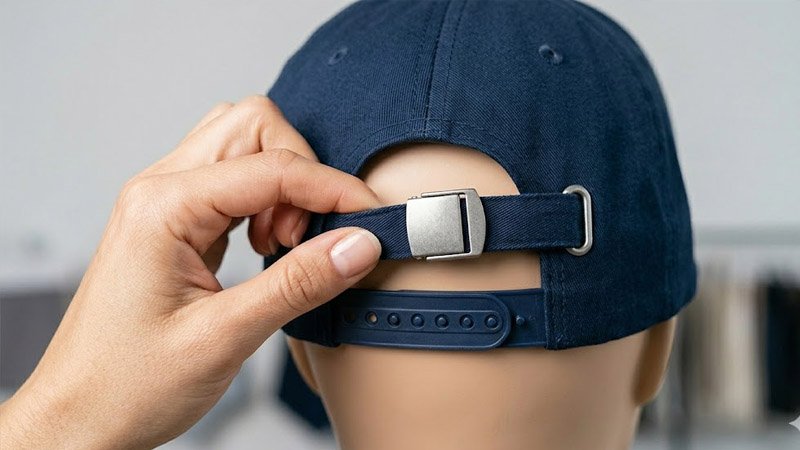
Fit is the first thing to consider when choosing a baseball cap for short hair. A cap should feel secure on the head without pressing too hard.
If the cap is too tight, it can flatten the hair, leave pressure marks, and make the style look stiff. If the cap is too loose, it may move around and look untidy. The best fit is snug but comfortable.
For short hair, adjustable closures are usually the best choice. Metal buckles, snapbacks, Velcro straps, and plastic closures allow the wearer to adjust the cap according to head size and hairstyle.
What to check for fit:
- The cap should sit comfortably above the ears.
- The front panel should not press too hard against the forehead.
- The cap should stay in place when moving.
- The hair should not be completely hidden.
- The closure should allow flexible adjustment.
For brands and retailers, adjustable baseball caps are a practical option because they fit a wider range of customers.
Crown Depth: Why It Matters for Short Hair
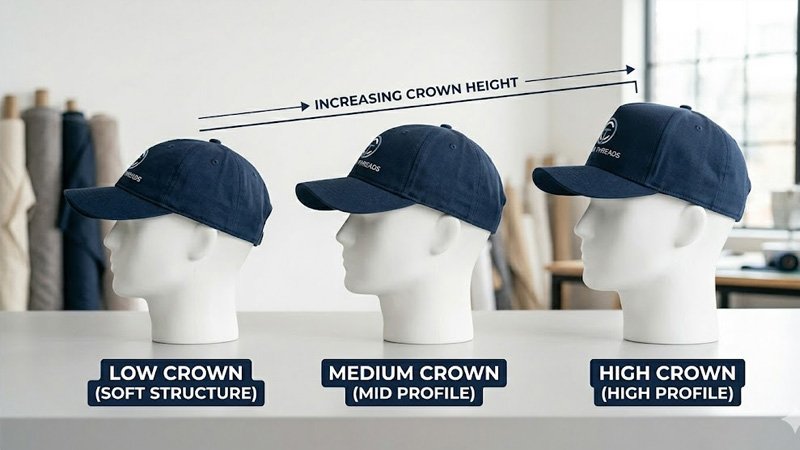
Crown depth refers to the height and depth of the cap body. This is one of the most important details for short hair.
A crown that is too deep may cover too much of the forehead and hide the hair completely. This can make short hair disappear under the cap. A crown that is too shallow may not feel secure and can sit awkwardly on the head.
For most short hairstyles, a medium-depth crown is the safest and most flattering choice. It provides enough coverage while still allowing some hair to show around the front, sides, or ears.
Low Crown Caps
Low crown caps sit closer to the head and create a clean, low-profile look. They are a good choice for pixie cuts, small faces, and casual everyday outfits.
Medium Crown Caps
Medium crown caps offer the best balance for most people. They work well with bob cuts, layered short hair, curly short hair, and general everyday wear.
High Crown Caps
High crown caps create a stronger and more structured look. They can work well for streetwear, snapbacks, and buzz cuts, but they may feel too bold for some short hairstyles.
Brim Shape: Curved Brim or Flat Brim?
The brim changes the whole look of a baseball cap. For short hair, the brim can help balance the face and create a softer or stronger style.
Curved Brim Baseball Caps
Curved brim caps are classic, easy to wear, and flattering for most face shapes. They create a softer look and work well with pixie cuts, bob cuts, layered short hair, and casual outfits.
A curved brim also helps frame the face naturally, which is useful when short hair exposes more facial features.
Flat Brim Caps
Flat brim caps have a bolder, more streetwear-inspired look. They work especially well with buzz cuts, pixie cuts, and fashion-forward outfits.
However, flat brims can look stronger and more angular, so they may not suit every face shape. For a softer everyday look, curved brims are usually easier to style.
Slightly Curved Brim Caps
A slightly curved brim offers a good middle ground. It feels modern but not too bold. This style works well for brands that want a versatile cap suitable for different customers.
Best Baseball Cap Styles for Different Short Hairstyles
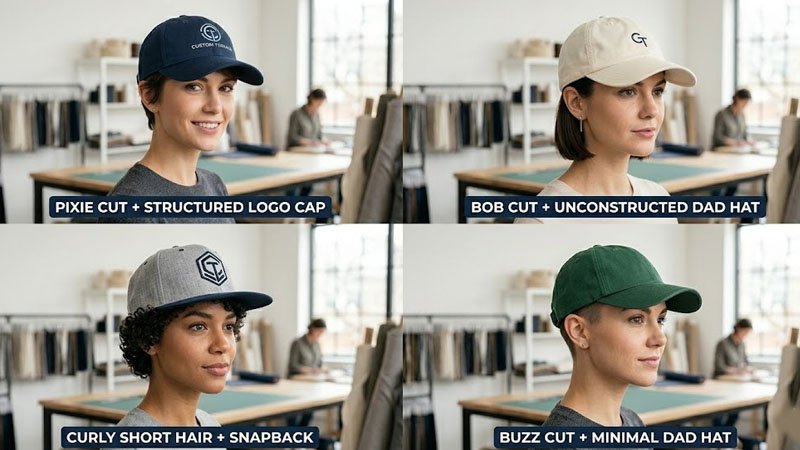
Different short hairstyles need different cap shapes. The goal is to choose a cap that supports the haircut instead of covering it completely.
| Short Hairstyle |
Best Cap Style |
Why It Works |
| Pixie Cut |
Low-profile cap or 5-panel cap |
Keeps the face open and highlights texture |
| Bob Cut |
Curved brim baseball cap |
Balances softness and structure |
| Curly Short Hair |
Adjustable mesh cap or trucker cap |
Gives curls more space and airflow |
| Layered Short Hair |
Unstructured dad cap |
Matches natural movement and texture |
| Buzz Cut |
Structured 6-panel cap or snapback |
Adds shape and a stronger style |
Pixie cuts look great with low-profile baseball caps, 5-panel caps, and soft cotton dad caps. These styles do not overpower the face and allow the haircut to remain visible.
For a natural look, leave a few small pieces of hair around the forehead or ears. This softens the overall style and prevents the cap from looking too heavy.
Recommended cap features:
- Low or medium crown
- Curved brim
- Soft cotton fabric
- Simple front embroidery
- Adjustable back closure
Bob haircuts work well with classic 6-panel baseball caps and curved brim caps. The round shape of a bob pairs nicely with the structure of a cap.
To avoid a flat look, keep a little volume at the crown and let some front pieces fall naturally outside the cap. This creates a relaxed and stylish effect.
Recommended cap features:
- Medium crown
- Curved brim
- Structured or semi-structured front panel
- Cotton or cotton-blend fabric
- Embroidered logo design
Curly short hair needs more space and breathability. A cap that is too tight can flatten curls and make them lose shape.
Adjustable caps, mesh back caps, and trucker caps are good choices because they provide better airflow and more room for natural volume.
Recommended cap features:
- Adjustable closure
- Medium crown
- Breathable mesh or cotton fabric
- Slightly relaxed fit
- Curved or slightly curved brim
Baseball Caps for Buzz Cuts and Very Short Hair
For buzz cuts or very short hair, the baseball cap becomes a major part of the overall look. A structured cap can add shape and definition.
Snapbacks and structured 6-panel caps work well for bold streetwear styles. Curved brim caps create a cleaner, more classic everyday look.
Recommended cap features:
- Structured crown
- Medium or high crown
- Flat brim or curved brim
- Strong front logo placement
- Durable fabric
How to Choose a Cap Based on Face Shape
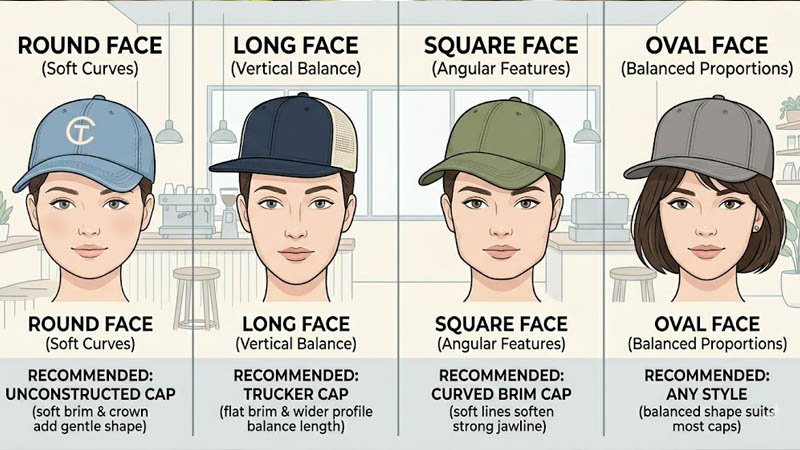
Short hair makes the face shape more visible, so the cap should help balance the face.
Round Face
Choose a baseball cap with a slightly structured crown to add height. A curved brim can help make the face look longer and more balanced.
Avoid caps that sit too low or look too flat.
Long Face
Choose a low-profile or medium crown cap. Avoid very high crowns because they may make the face look longer.
A curved brim can soften the overall appearance.
Square Face
Choose a curved brim cap or soft unstructured cap. These styles help soften strong jawlines and create a more relaxed look.
Avoid overly boxy caps if you want a softer style.
Oval Face
Oval faces can wear most baseball cap styles. Curved brim caps, snapbacks, 5-panel caps, dad caps, and trucker caps can all work well.
Small Face
Choose a low-profile cap with a neat brim. Avoid oversized crowns or very wide brims because they may overwhelm the face.
Fabric Choice: Comfort and Shape Matter
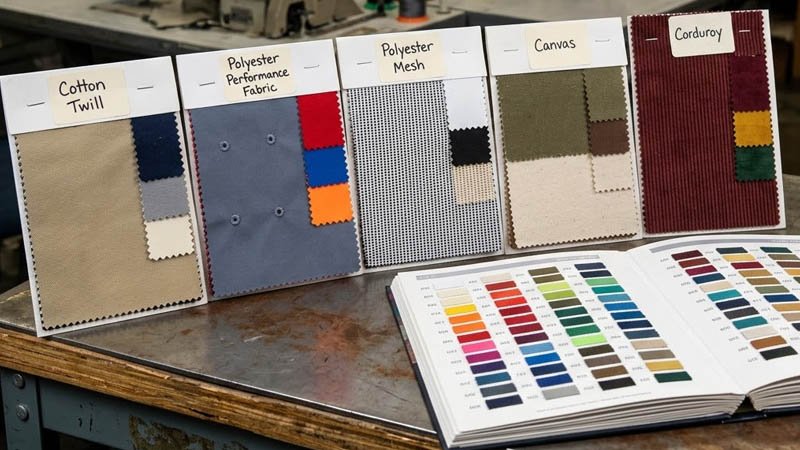
The fabric of a baseball cap affects comfort, structure, and appearance.
Cotton
Cotton is soft, breathable, and comfortable for everyday wear. It works well for dad caps, casual baseball caps, and embroidered caps.
Polyester
Polyester is lightweight, durable, and suitable for sports or outdoor caps. It can also hold color well for promotional caps.
Mesh
Mesh is breathable and ideal for summer, outdoor activities, and trucker caps. It is a good choice for curly short hair because it allows better airflow.
Canvas
Canvas is stronger and more structured. It works well for caps that need a firm shape or a more durable feel.
Corduroy
Corduroy adds texture and a vintage look. It is suitable for fashion brands and seasonal collections.
When the wearer has short hair, the cap design becomes more visible. This makes logo placement important.
Front embroidery is the most classic and professional choice. It gives the cap a clean branded look and works well for uniforms, retail caps, and promotional products.
Side embroidery can add subtle detail without making the front too crowded. Back embroidery near the closure is also a good option for brand names, slogans, or small icons.
For fashion brands, woven patches, leather patches, and printed designs can create a more distinctive style.
Common logo options include:
- Flat embroidery
- 3D embroidery
- Woven patch
- Leather patch
- Printed logo
- Side embroidery
- Back embroidery
Styling Tips: How to Wear a Baseball Cap with Short Hair
Choosing the right cap is important, but styling also matters.
Keep Some Hair Visible
Do not hide all your hair under the cap. Leaving a little hair visible around the forehead, ears, or sides helps frame the face and keeps the look natural.
Add Volume at the Front
Before wearing the cap, use your fingers to lift the roots slightly. A light volumizing spray or dry shampoo can help short hair stay fresh.
Try a Side Sweep
A side-swept style adds softness and shape. It works especially well for pixie cuts, bobs, and layered short hair.
Do Not Use Heavy Hair Products
Heavy wax, gel, or oil can make short hair look greasy under a cap. Use light styling products that add texture without stiffness.
Adjust the Cap Position
Wearing the cap slightly higher on the forehead can show more hair and make the face look more open. Wearing it lower creates a sportier look.
Common Mistakes to Avoid
Choosing a Cap That Is Too Tight
A tight cap can flatten short hair and make it difficult to maintain natural texture. Always choose a comfortable adjustable fit.
Choosing a Crown That Is Too Deep
A deep crown may cover too much of the head and hide the haircut. Medium crown caps are usually more flattering for short hair.
Hiding All the Hair
Short hair looks better when some texture or shape remains visible. Avoid pushing all the hair completely under the cap.
Ignoring Brim Shape
The brim affects face balance. Curved brims are softer and easier to wear, while flat brims create a stronger fashion look.
Choosing Heavy Fabric for Hot Weather
Heavy fabrics can feel uncomfortable and may flatten the hair. For summer or outdoor use, breathable cotton, mesh, or lightweight polyester is a better choice.
For Brands: How to Develop Baseball Caps for Different Hairstyles
For brands, a baseball cap should not only look good on product photos. It should also fit different customers, hairstyles, face shapes, and daily-use situations.
A short-hair-friendly cap is often easier to sell because it works for a wider group of users. It can be used for fashion retail, corporate uniforms, sports teams, promotional events, schools, travel brands, and lifestyle collections.
When developing custom baseball caps, brands should consider:
- Medium crown depth for wider acceptance
- Adjustable closure for flexible sizing
- Curved or slightly curved brim for everyday wear
- Breathable fabric for comfort
- Clean embroidery for a premium brand image
- Sample testing before bulk production
- Logo placement that remains visible when worn
GUANGZHOU EASTLUCKY Hat & Garment Co., Ltd. is a high-end custom hat and OEM/ODM manufacturer based in Guangzhou, China, with 15 years of expertise in professional R&D, production, and distribution of various hats and embroidered accessories. Guided by the philosophy “Quality as Root, Innovation as Soul,” the company provides global clients with one-stop solutions from design sampling to mass production, helping brands build efficient and high-quality custom cap supply chains.
For B2B buyers, the best custom cap is practical, comfortable, brand-focused, and suitable for different users. A well-designed baseball cap can become more than an accessory. It can become a wearable brand message.
Custom Baseball Cap Options for Brands
When creating custom baseball caps, brands can choose different materials, structures, and decoration methods based on their market.
Cap Structure
Structured caps keep their shape and are good for clear front logo display. Unstructured caps feel softer and more casual. Semi-structured caps offer a balance between shape and comfort.
Brim Style
Curved brims are classic and suitable for daily wear. Flat brims are more suitable for streetwear and youth fashion. Slightly curved brims are versatile and modern.
Closure Type
Common closure types include metal buckles, snapbacks, Velcro straps, plastic buckles, and fitted designs. Adjustable closures are usually the most flexible for promotional and retail caps.
Logo Method
Embroidery is one of the most popular choices because it looks clean, durable, and premium. Flat embroidery is ideal for simple logos, while 3D embroidery creates a raised effect. Patches and printing can also be used for different styles.
Color Selection
Neutral colors such as black, navy, beige, white, and grey are easy to match. Bright colors can work well for events, sports teams, and promotional campaigns. Brands can also use Pantone color matching for consistent brand identity.
Final Buying Checklist
Before choosing or customizing a baseball cap for short hair, check these details:
- Is the cap adjustable?
- Is the crown too deep or too shallow?
- Does the brim shape suit the target style?
- Is the fabric comfortable for the season?
- Does the cap allow some hair to remain visible?
- Is the logo placement clean and balanced?
- Does the cap work for different face shapes?
- Is the design suitable for both retail and promotional use?
FAQs
What type of baseball cap is best for short hair?
A medium-depth adjustable baseball cap is usually the best choice. It gives enough coverage without hiding the hair completely.
Are low-profile caps good for short hair?
Yes. Low-profile caps work especially well for pixie cuts, small faces, and casual everyday looks.
Is a curved brim or flat brim better for short hair?
A curved brim is easier to wear and suits most face shapes. A flat brim creates a bolder streetwear look and works well with buzz cuts or fashion-forward styles.
How do I avoid flat hair under a baseball cap?
Avoid wearing the cap too tight. Use light volumizing spray or dry shampoo, and leave some hair visible around the front or sides.
Can curly short hair wear baseball caps?
Yes. Curly short hair works best with adjustable caps, mesh caps, or slightly relaxed fits that allow curls to keep their shape.
What crown depth is best for short hair?
Medium crown depth is the safest choice for most short hairstyles. It provides balance, comfort, and enough room without hiding the hair completely.
Conclusion
Baseball caps can look excellent with short hair when the fit, crown, and brim are chosen carefully. The right cap should frame the face, support the hairstyle, and feel comfortable for daily wear.
For pixie cuts, low-profile caps and soft cotton caps work well. For bob cuts, curved brim baseball caps create balance. For curly short hair, breathable adjustable caps are a better choice. For buzz cuts, structured caps and snapbacks can add shape and style.
For brands, short-hair-friendly baseball caps are practical because they suit a wide range of customers. By choosing the right crown depth, brim shape, fabric, closure, and logo method, brands can create custom baseball caps that are stylish, comfortable, and easy to wear.
A good baseball cap is not only about design. It is about fit, function, comfort, and brand value.
Can Men Wear Women’s Baseball Caps? Fit & Unisex Cap Guide
Fashion is becoming more flexible than ever. Today, many people choose caps, clothing, and accessories based on fit, comfort, design, and personal style rather than whether a product is labeled “men’s” or “women’s.”
So, can men wear women’s baseball caps?
The answer is yes. Men can wear women’s baseball caps if the cap fits comfortably, suits their face shape, and matches their personal style. In many cases, the difference between men’s and women’s baseball caps is smaller than people think. The most important details are head size, crown depth, brim shape, back closure, fabric, and overall design.
For brands, retailers, and promotional product buyers, this question also leads to a bigger topic: unisex baseball caps. A well-designed unisex cap can work for both men and women, making it a practical choice for fashion collections, corporate gifts, event merchandise, and custom brand orders.
Can Men Really Wear Women’s Baseball Caps?
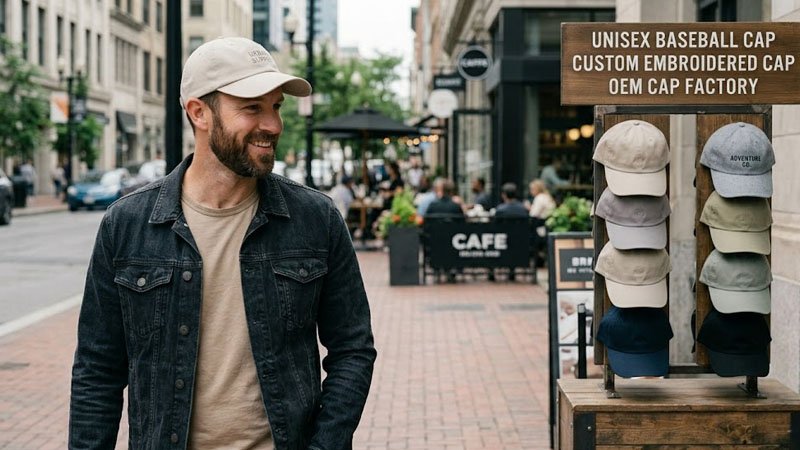
Yes, men can absolutely wear women’s baseball caps. The label on the cap is not as important as the way it fits and looks.
Many women’s baseball caps are built with the same basic structure as men’s caps. They usually include a crown, brim, sweatband, panels, eyelets, and an adjustable back closure. The difference often comes from sizing, color, decoration, and style positioning.
A women’s cap may be slightly smaller, softer, or lower in profile. A men’s cap may have a larger fit, higher crown, or more structured shape. However, many modern caps are designed with neutral colors, adjustable closures, and simple logo placement, which makes them suitable for both men and women.
If a man likes the style of a women’s baseball cap and the size is comfortable, there is no reason he cannot wear it.
Men’s vs. Women’s Baseball Caps: What Is the Difference?
Although the overall construction is similar, there are still a few differences between men’s and women’s baseball caps.
| Feature |
Women’s Baseball Cap |
Men’s Baseball Cap |
What It Means |
| Head Size |
Usually slightly smaller |
Usually slightly larger |
Men should check the size range before buying |
| Crown Height |
Often lower profile |
Usually medium or higher crown |
Crown depth affects comfort and face shape |
| Brim Shape |
May be narrower or more curved |
Usually standard or wider |
The difference is often subtle |
| Fit Type |
Commonly adjustable |
Adjustable or fitted |
Adjustable caps are easier for unisex wear |
| Design Style |
Softer colors, smaller logos, decorative details |
Neutral, sporty, bold, or structured designs |
Choose based on your style, not the gender label |
| Material |
Often soft cotton, washed fabric, or lightweight fabric |
Cotton, twill, canvas, polyester, or structured fabric |
Fabric affects comfort and shape |
In most daily situations, people will not notice whether a cap comes from the men’s or women’s section. They will notice whether it fits well, matches the outfit, and looks balanced.
How to Know If a Women’s Baseball Cap Will Fit a Man
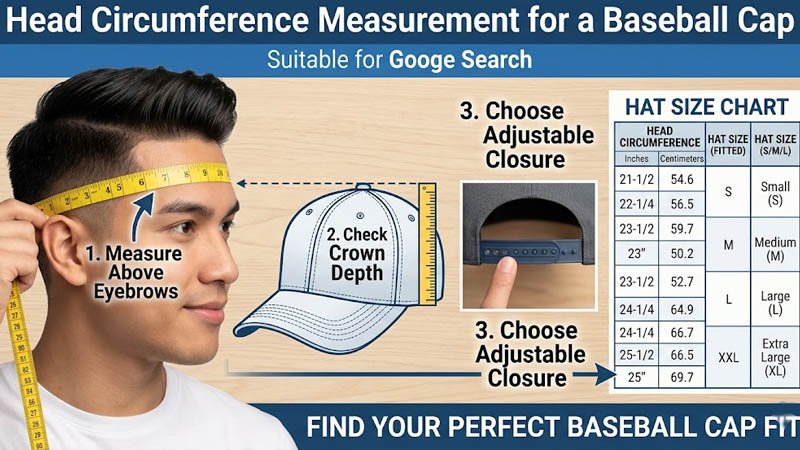
Fit is the most important factor when choosing any baseball cap. Even the best-looking cap will not work well if it feels too tight, too shallow, or uncomfortable.
1. Measure Your Head Size
Before buying a women’s baseball cap, measure your head circumference. Use a soft measuring tape and wrap it around the widest part of your head. The tape should sit above your eyebrows and around the back of your head.
Here is a simple size reference:
| Head Size |
Measurement in CM |
Measurement in Inches |
Fit Suggestion |
| Small |
54–56 cm |
21.25–22 in |
Low-profile or adjustable caps may fit well |
| Medium |
57–58 cm |
22.4–22.8 in |
Most adjustable caps should work |
| Large |
59–61 cm |
23.2–24 in |
Choose larger adjustable or structured caps |
| Extra Large |
62 cm+ |
24.4 in+ |
Avoid very shallow or small women’s caps |
If the cap is adjustable and fits within your head size range, it can be suitable for men.
2. Check the Back Closure
For men wearing women’s baseball caps, adjustable closures are usually the safest choice. They allow more flexibility and can fit a wider range of head sizes.
Common adjustable closures include:
- Metal buckle closure
- Fabric strap closure
- Snapback closure
- Velcro closure
- Plastic buckle closure
If you are buying caps for a group, event, or brand order, adjustable caps are usually better than fitted caps because they reduce sizing problems.
3. Look at the Crown Depth
The crown is the part of the cap that covers your head. Some women’s caps have a lower crown, which creates a softer and closer fit.
A low-profile cap can look stylish and casual, but it may not be suitable for men with larger heads or those who prefer a more structured shape.
A medium crown is often more versatile. It works well for both men and women and is commonly used in unisex baseball cap designs.
4. Consider the Brim Shape
Women’s caps may sometimes have a slightly narrower or more curved brim. However, in most cases, the difference is not very obvious.
A curved brim gives a classic casual look, while a flat brim creates a stronger streetwear style. If you want a more masculine or neutral look, choose a standard curved brim or a clean flat brim design.
Best Women’s Baseball Cap Styles That Men Can Wear
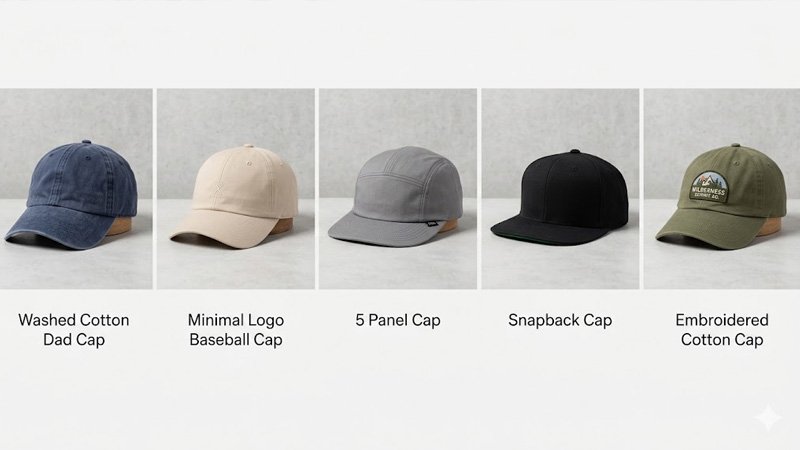
Not every women’s baseball cap will suit every man, but many styles are easy to wear. The following styles are especially suitable for men who want a comfortable, natural, or unisex look.
1. Washed Cotton Dad Cap
A washed cotton dad cap is one of the easiest styles for both men and women. It usually has a soft crown, curved brim, and adjustable back strap.
This style is casual, relaxed, and easy to match with daily outfits. It works well with T-shirts, hoodies, denim jackets, oversized shirts, joggers, and sneakers.
For brands, washed cotton dad caps are also popular for lifestyle merchandise, outdoor events, fashion collections, and promotional gifts.
2. Minimal Logo Baseball Cap
A women’s baseball cap with a small logo or simple embroidery can look clean and modern on men. Minimal designs are less gender-specific and easier to style.
Good color choices include:
- Black
- Navy
- Beige
- Grey
- Olive
- White
- Washed blue
- Khaki
Minimal logo caps are also suitable for brands that want a premium, understated look.
3. 5 Panel Cap / Camp Cap
A 5 panel cap or camp cap has a more modern and street-style appearance. Although some designs may be marketed to women, the structure itself is often unisex.
This cap style is suitable for outdoor brands, fashion labels, skate brands, music events, and lifestyle collections.
For customization, 5 panel caps work well with woven labels, small embroidery, printed logos, or rubber patches.
4. Snapback Cap
A snapback cap usually has a more structured crown and an adjustable plastic snap closure. If a women’s snapback has enough depth and size range, it can fit men very well.
Snapbacks are suitable for streetwear, sports teams, youth brands, and promotional campaigns. They are also a good choice for bold embroidery, 3D embroidery, or patch logo designs.
5. Embroidered Cotton Cap
A clean embroidered cotton cap can work for both men and women. Embroidery gives the cap a premium, durable, and professional look.
For men, simple front embroidery, side embroidery, or small back embroidery is often easier to wear than overly decorative designs. For brands, embroidered caps are a strong option because they help improve logo visibility and product value.
How Men Can Style a Women’s Baseball Cap
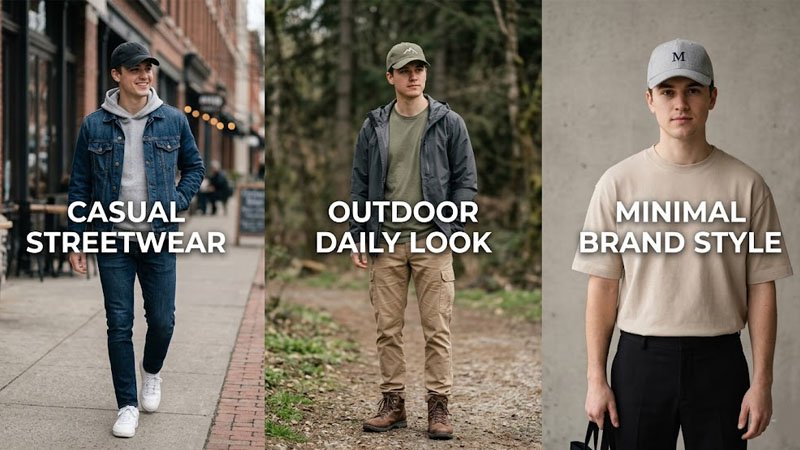
Wearing a women’s baseball cap is not difficult. The key is to choose the right color, shape, and outfit combination.
Choose Neutral or Low-Saturation Colors
If you want a natural and versatile look, start with neutral colors. Black, navy, beige, grey, olive, and khaki are easy to match and suitable for most wardrobes.
Soft colors such as cream, washed blue, or light brown can also work well if the overall design is simple.
Match It with Casual Outfits
Women’s baseball caps can look natural on men when paired with casual basics such as:
- Plain T-shirts
- Hoodies
- Denim jackets
- Bomber jackets
- Oversized shirts
- Cargo pants
- Joggers
- Sneakers
The simpler the outfit, the easier it is for the cap to blend in.
Avoid Overly Decorative Details If You Want a Neutral Look
Some women’s caps may include rhinestones, glitter, floral embroidery, bows, or very soft pastel designs. These styles can still be worn if they match your personality, but they may create a more feminine effect.
For a cleaner unisex style, choose plain fabric, simple embroidery, washed cotton, small logos, or neutral color combinations.
Choose the Right Crown for Your Face Shape
A low-profile cap can look good on smaller or longer faces. A medium crown usually works better for wider faces or larger head sizes. A structured cap creates a stronger shape, while a soft dad cap gives a relaxed and casual feeling.
The best cap should feel balanced with your face and outfit.
When a Women’s Baseball Cap May Not Be the Best Choice
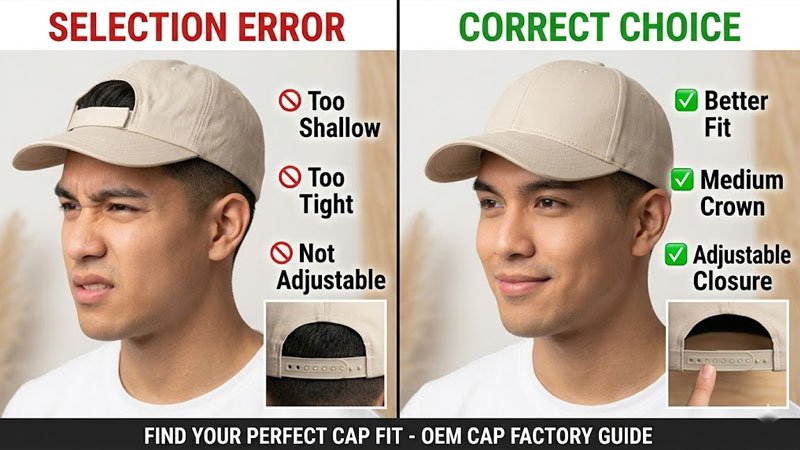
Although men can wear women’s baseball caps, not every style will be suitable. You may want to avoid a women’s cap if:
- The head circumference is too small
- The crown is too shallow
- The brim looks too narrow for your face
- The design is too decorative for your style
- The cap is not adjustable
- The fabric feels too thin or too soft
- The cap does not sit comfortably on your head
If comfort is your priority, always check the size chart, crown depth, and closure type before buying.
For Brands: Why Unisex Baseball Caps Are a Smart Choice
For brands, retailers, event organizers, and promotional product buyers, unisex baseball caps are often more practical than separating men’s and women’s styles.
A well-designed unisex cap can help brands:
- Reduce inventory pressure
- Simplify size selection
- Reach a wider audience
- Improve product flexibility
- Make bulk ordering easier
- Support both retail and promotional use
- Create a cleaner brand image
The best unisex baseball caps usually have a comfortable fit, adjustable closure, medium crown height, classic brim shape, durable stitching, and neutral color options.
GUANGZHOU EASTLUCKY Hat & Garment Co., Ltd. is a high-end custom hat and OEM/ODM manufacturer based in Guangzhou, China, with 15 years of expertise in professional R&D, production, and distribution of various hats and embroidered accessories. Guided by the philosophy “Quality as Root, Innovation as Soul,” the company provides global clients with one-stop solutions from design sampling to mass production, enabling efficient and high-quality supply chain services for brands.
For custom cap projects, details such as fabric, crown shape, brim style, embroidery size, thread color, back closure, label design, and packaging should all be confirmed before mass production.
Customization Tips for Unisex Baseball Caps
If your brand wants to develop baseball caps for both men and women, the following details are important.
1. Use an Adjustable Back Closure
An adjustable closure makes the cap suitable for more head sizes. Metal buckle, fabric strap, snapback, and Velcro closures are all common choices.
For brand merchandise or event giveaways, adjustable caps are usually better than fitted caps because they reduce the risk of size mismatch.
2. Choose a Medium Crown Height
A medium crown is usually the safest option for unisex baseball caps. It is not too shallow and not too tall, making it suitable for different head shapes.
If the cap is too shallow, it may not fit larger heads well. If it is too high, it may look too structured for customers who prefer a casual style.
3. Select Comfortable and Durable Fabric
Common fabric choices include:
- Cotton
- Cotton twill
- Washed cotton
- Polyester
- Canvas
- Blended fabric
Cotton is soft and breathable. Cotton twill gives better structure. Washed cotton creates a relaxed vintage look. Polyester is lightweight and suitable for sports or outdoor use.
The fabric should match the brand’s positioning and usage scenario.
4. Keep the Logo Clean and Clear
For unisex baseball caps, simple logo placement usually works best. Common logo options include:
- Front embroidery
- Side embroidery
- Back embroidery
- Woven patch
- Leather patch
- Rubber patch
- Printed logo
Embroidery is one of the most popular choices because it looks durable, textured, and professional. However, the logo should not be too small or too complicated, otherwise the embroidery details may not be clear.
5. Use Neutral and Market-Friendly Colors
For bulk orders, neutral colors are often safer and easier to sell. Popular choices include black, navy, white, beige, grey, olive, and khaki.
Brands can also develop seasonal colors, but the main collection should include easy-to-match colors that appeal to both men and women.
6. Confirm Samples Before Mass Production
Sample confirmation is very important for custom baseball caps. Before bulk production, brands should check:
- Cap shape
- Fabric quality
- Crown depth
- Brim curve
- Logo size
- Embroidery quality
- Thread color
- Back closure
- Label details
- Packaging method
This step helps avoid production mistakes and ensures the final caps match the brand’s expectations.
Common Mistakes When Choosing Unisex Baseball Caps
When developing or buying unisex baseball caps, some mistakes can affect comfort, appearance, and customer satisfaction.
Mistake 1: Only Choosing by Color
Color is important, but fit and structure matter more. A beautiful cap will not sell well if it feels uncomfortable.
Mistake 2: Using a Crown That Is Too Shallow
A very shallow crown may work for some women’s styles, but it may not fit many men. For unisex designs, a medium crown is usually more practical.
Mistake 3: Choosing Non-Adjustable Caps for Bulk Orders
For large orders, fitted caps can create sizing problems. Adjustable caps are more flexible and easier to distribute.
Mistake 4: Making the Logo Too Complicated
Small details may not show clearly in embroidery. A clean and simple logo usually creates a better result.
Mistake 5: Ignoring the Sample Stage
Skipping sample confirmation can lead to problems in fit, logo placement, embroidery quality, or fabric texture. A good sample helps reduce risk before mass production.
Conclusion: Fit Matters More Than Gender Labels
So, can men wear women’s baseball caps?
Yes. Men can wear women’s baseball caps as long as the cap fits well, feels comfortable, and matches their style. The label is not the most important factor. Head size, crown depth, brim shape, fabric, and back closure matter much more.
For individual wearers, the best choice is a cap that feels natural and looks balanced. For brands, unisex baseball caps are a smart option because they can serve a wider customer group and simplify bulk ordering.
In modern fashion, a good baseball cap is not defined by gender. It is defined by fit, comfort, quality, and confidence.
FAQs
Can men wear women’s baseball caps?
Yes. Men can wear women’s baseball caps if the cap fits comfortably and matches their style. Many women’s baseball caps are adjustable and can also fit men.
Are women’s baseball caps smaller than men’s?
Women’s baseball caps are often slightly smaller or lower in crown height, but this depends on the design. Adjustable caps can fit a wider range of head sizes.
What is the main difference between men’s and women’s baseball caps?
The main differences are usually head size, crown depth, color, decoration, and style positioning. The basic cap structure is often very similar.
Do women’s baseball caps look different on men?
Some may look slightly smaller or softer, especially if they have a low crown or decorative design. However, simple women’s caps with neutral colors can look very natural on men.
What type of women’s baseball cap is best for men?
Washed cotton dad caps, minimal logo caps, snapbacks, 5 panel caps, and adjustable embroidered caps are usually the easiest styles for men to wear.
Are unisex baseball caps better for brands?
Yes. Unisex baseball caps are often better for brands because they fit a wider audience, reduce inventory pressure, and make bulk orders easier.
Is embroidery suitable for unisex baseball caps?
Yes. Embroidery is a popular choice for unisex baseball caps because it looks professional, durable, and suitable for fashion, retail, and promotional use.
What should brands check before ordering custom unisex caps?
Brands should check the fabric, crown height, brim shape, logo size, embroidery quality, closure type, label details, and packaging before mass production.
Why Men Look Better in Hats: Style, Confidence, and How to Choose the Right Hat
A hat is often one of the first details people notice. Before someone pays attention to your shoes, watch, or even the logo on your shirt, a well-chosen hat can shape your first impression.
It can make a man look more relaxed, sporty, refined, creative, confident, or adventurous. That is why many men look better in hats — not because every hat works for everyone, but because the right hat adds structure, personality, and intention to an outfit.
A hat is more than a practical item for sun, rain, or cold weather. It is also a style tool. It frames the face, completes the outfit, and communicates something about the wearer’s lifestyle and confidence.
From baseball caps and beanies to bucket hats, fedoras, cowboy hats, and outdoor hats, every style has its own message. The key is knowing which hat fits your face, your outfit, your occasion, and your personality.
In this guide, we will explore why men often look better in hats, what different hat styles say, how hats influence confidence, and how to choose the right hat for your look.
Why the Right Hat Makes Men Look Better
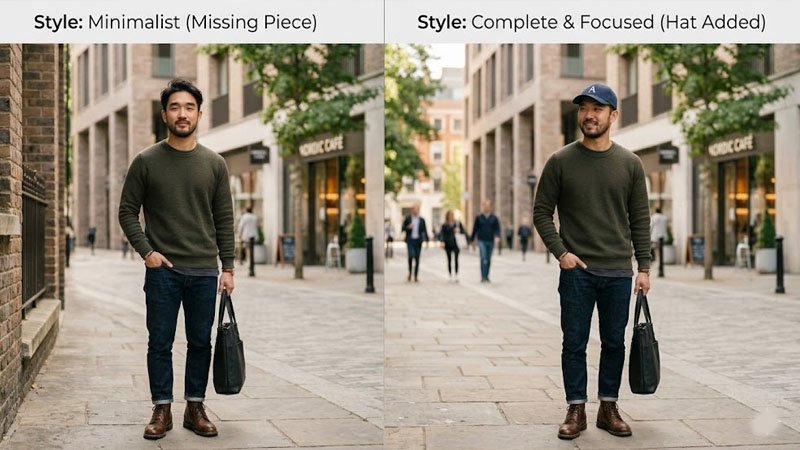
A good hat can improve a man’s overall appearance because it adds a clear focal point to the outfit.
When styled well, a hat can:
Frame the face
Balance head and body proportions
Add personality to simple clothing
Make casual outfits look more intentional
Create a stronger first impression
Show confidence and personal taste
Many men wear simple outfits: T-shirts, jeans, hoodies, jackets, or casual shirts. A hat can instantly make these looks feel more complete. For example, a clean baseball cap can make a basic T-shirt and jeans look sporty and relaxed. A beanie can make a winter outfit look warmer and more stylish. A fedora can turn a simple smart-casual outfit into something more polished.
The hat does not need to be loud. In fact, the best hat choices often look natural. They do not feel like the man is trying too hard. They simply make the outfit look finished.
That is the real reason hats work so well: they create intention.
A man who wears the right hat looks like he understands his style.
Hats and Confidence: Why They Change First Impressions
Confidence plays a big role in why men look better in hats.
When a man wears a hat comfortably, it can make him appear more self-assured. A hat shows that he is willing to add character to his look. It suggests he is not afraid to be noticed, but also not desperate for attention.
The right hat can make a man look:
More stylish
More relaxed
More approachable
More mature
More interesting
More memorable
But confidence does not come from the hat alone. It comes from the relationship between the hat and the wearer.
A hat that fits well gives a polished impression.
A hat that matches the outfit creates harmony.
A hat that suits the occasion looks natural.
A hat that reflects personality feels authentic.
This is why one man may look great in a snapback while another looks better in a fedora or a beanie. The best hat is not always the trendiest one. It is the one that feels right for the person wearing it.
A good hat should support your confidence, not cover up your insecurity.
What Different Hats Say About a Man’s Personality
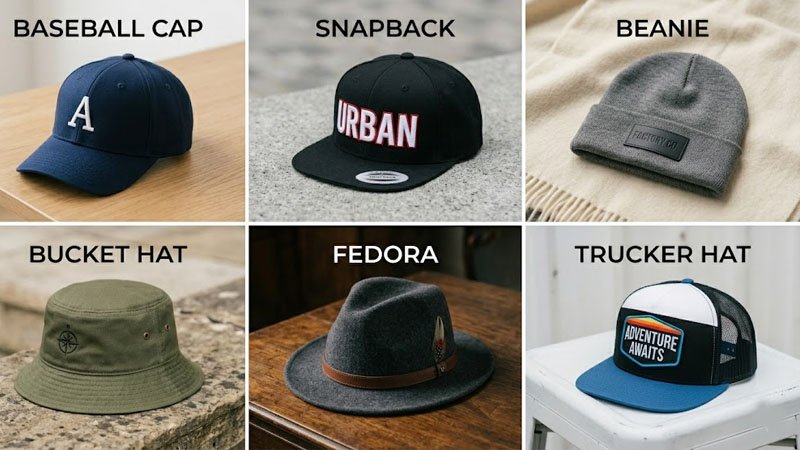
Every hat style communicates something different. This is one reason hats are such powerful accessories. They help men express personality without saying anything.
Baseball Caps
Baseball caps are casual, practical, and easy to wear. They are one of the most popular hat styles for men because they work with many everyday outfits.
A baseball cap often suggests that a man is relaxed, active, sporty, and approachable. It works well for weekends, travel, outdoor activities, casual work environments, sports, and streetwear-inspired outfits.
Baseball caps are also one of the most common choices for custom branding because they are wearable, familiar, and suitable for many groups and industries.
Snapbacks
Snapbacks usually feel more urban and bold. With their structured crown, flat brim, and adjustable back, they are strongly connected with streetwear, youth culture, sports, and music.
A snapback can make a man look confident, trendy, and energetic. It is a good choice for men who enjoy bold casual fashion and want their outfit to feel more expressive.
Beanies
Beanies are simple, warm, and stylish in colder weather. They are often associated with streetwear, creative lifestyles, and relaxed winter dressing.
A beanie can make a man look casual, artistic, and easygoing. It works especially well with hoodies, denim jackets, bomber jackets, wool coats, and layered outfits.
Bucket Hats
Bucket hats have become popular again because of streetwear, travel fashion, festivals, and outdoor lifestyles. They feel youthful, fun, and slightly playful.
A bucket hat can make a man look relaxed, fashionable, and trend-aware. It is also practical for sun protection, making it a good choice for summer activities, beachwear, travel, and outdoor events.
Fedoras and Trilby Hats
Fedoras and trilby hats create a more polished and classic impression. They are often connected with elegance, vintage style, and confidence.
These hats work best when the outfit is already smart or semi-formal. They pair well with coats, blazers, button-up shirts, boots, and tailored clothing.
However, these hats need to be worn carefully. If the outfit is too casual or the hat does not fit well, the look can feel forced. A fedora should feel natural, not like a costume.
Cowboy Hats
Cowboy hats are bold and full of character. They represent independence, outdoor life, western culture, strength, and tradition.
A man wearing a cowboy hat makes a clear statement. This hat style is best suited for people who genuinely connect with western fashion, country culture, outdoor lifestyles, or rugged personal style.
Outdoor and Performance Hats
Fishing hats, hiking hats, golf caps, running caps, and performance hats are designed for function. They protect from sun, sweat, wind, or light rain while supporting an active lifestyle.
These hats make a man look practical, outdoorsy, energetic, and prepared. They are especially suitable for sports, travel, hiking, camping, fishing, golf, and outdoor work.
Function Meets Style: Why Men Wear Hats in Daily Life
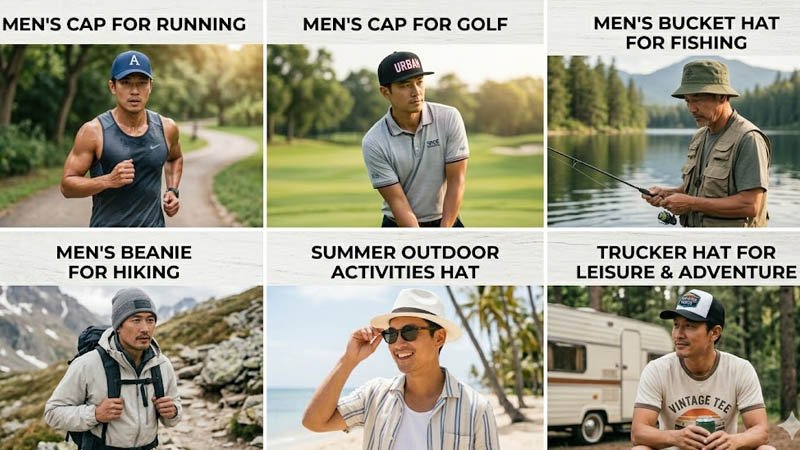
Men do not wear hats only because they look good. Hats are also practical.
A good hat can protect, comfort, and support the wearer in different environments.
Sun Protection
On sunny days, hats help protect the face, eyes, and head from direct sunlight. Baseball caps, bucket hats, fishing hats, hiking hats, and wide-brimmed hats are especially useful outdoors.
They are ideal for:
Golf
Fishing
Hiking
Running
Beach trips
Travel
Outdoor work
Sports events
Summer promotions
A hat can make outdoor activities more comfortable while still adding style.
Cold Weather Warmth
In winter, beanies, knitted hats, and wool caps help keep the head and ears warm. They are easy to wear and can add texture to cold-weather outfits.
A simple beanie can turn a basic jacket-and-jeans outfit into something more complete and stylish.
Sports and Movement
For active men, hats are often essential. A cap can keep sunlight and sweat out of the eyes during running, training, golf, tennis, baseball, or outdoor exercise.
This is why caps are so closely connected with energy, movement, and athletic confidence.
Work and Team Identity
Hats are also useful in workplaces, teams, and events. Staff caps, chef hats, outdoor work hats, promotional caps, and branded hats can help create a unified look.
For companies and organizations, hats are not just accessories. They can support brand visibility, team identity, and professional presentation.
How to Choose the Right Hat for Your Face Shape
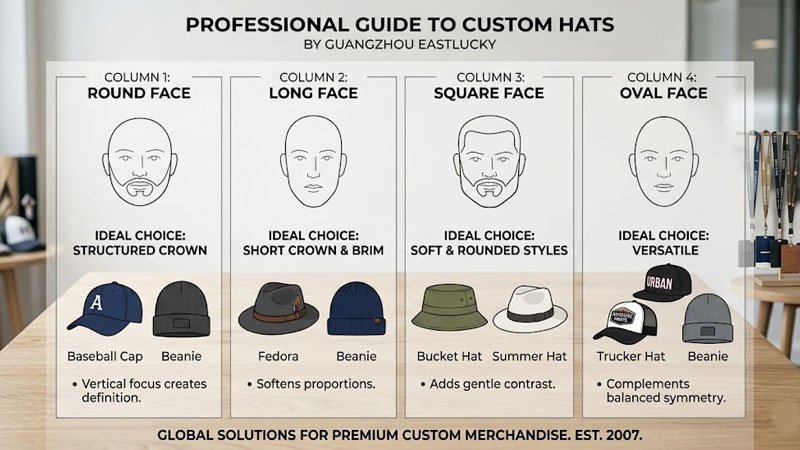
One reason some men look better in hats than others is simple: they choose styles that fit their face shape.
The right hat can balance your features. The wrong hat can make your face look wider, longer, or less proportionate.
Round Face
Men with round faces usually look better in hats with more structure and height.
Good choices include:
Structured baseball caps
Snapbacks
Fedoras
Trucker hats
Hats with a slightly higher crown
These styles can help add length and definition to the face.
Avoid hats that sit too low or look too soft, as they may make the face appear rounder.
Long Face
Men with long faces should avoid hats with very tall crowns, because they can make the face look even longer.
Good choices include:
Low-profile caps
Bucket hats
Beanies
Dad hats
Medium-brim hats
These styles help create balance and avoid adding too much height.
Square Face
Men with square faces often have strong jawlines and angular features. Softer hat shapes can help balance the look.
Good choices include:
Beanies
Bucket hats
Curved-brim caps
Soft dad hats
Rounder crown shapes
Avoid overly sharp or boxy hat shapes if you want a softer overall appearance.
Oval Face
Men with oval faces usually have the most flexibility. Many hat styles can work well, including baseball caps, beanies, fedoras, bucket hats, and snapbacks.
The main focus should be outfit, occasion, and personal style rather than face shape alone.
How to Match Hats with Outfits
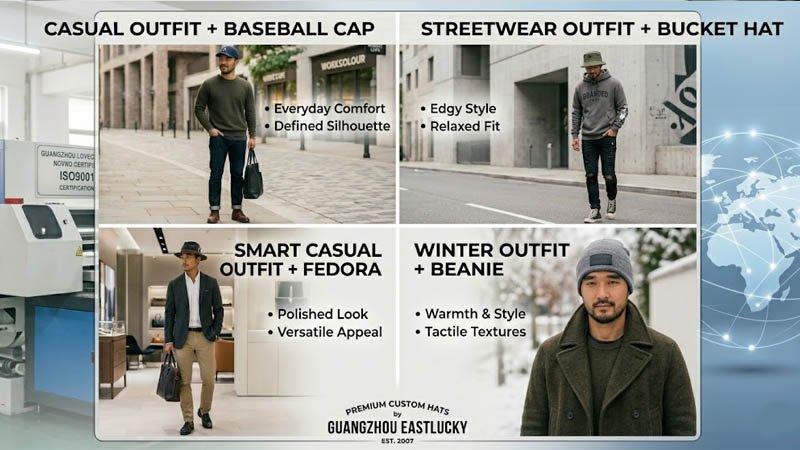
A hat should not feel separate from the outfit. It should feel like part of the full look.
Casual Outfits
For T-shirts, jeans, hoodies, shorts, and casual jackets, the easiest choices are:
Baseball caps
Dad hats
Snapbacks
Beanies
Bucket hats
These styles feel natural and relaxed.
Streetwear Outfits
For oversized T-shirts, hoodies, sneakers, cargo pants, bomber jackets, and graphic clothing, stronger hat choices include:
Snapbacks
Bucket hats
Beanies
Trucker hats
Flat-brim caps
These hats add attitude and personality.
Smart-Casual Outfits
For button-up shirts, chinos, boots, coats, and blazers, more refined options may work better:
Fedoras
Trilby hats
Clean structured caps
Wool caps
Minimalist baseball caps
The key is to keep the hat clean, simple, and well-fitted.
Outdoor Outfits
For hiking, fishing, camping, travel, golf, and outdoor work, function should come first.
Good choices include:
Fishing hats
Hiking hats
Performance caps
Bucket hats
Wide-brimmed hats
Golf caps
These hats should be breathable, comfortable, durable, and suitable for the environment.
Winter Outfits
For coats, jackets, scarves, sweaters, and layered looks, beanies and knitted hats are the easiest choices.
Neutral colors such as black, gray, navy, beige, and dark green are easy to match and suitable for most winter wardrobes.
Common Mistakes Men Make When Wearing Hats
Hats can improve a man’s style, but only when worn well. Here are some common mistakes to avoid.
Choosing the Wrong Size
A hat that is too tight looks uncomfortable. A hat that is too loose looks careless.
The hat should sit securely and comfortably on the head without squeezing, slipping, or leaving deep marks.
Wearing a Hat That Does Not Match the Occasion
A baseball cap may be perfect for a casual weekend but not for a formal dinner. A fedora may work well with a smart outfit but feel strange at the gym.
Always consider where you are going before choosing a hat.
Ignoring Color Coordination
Neutral colors are the easiest to wear. Black, navy, gray, beige, white, and olive can match many outfits.
Bright colors, bold patterns, and large logos can work, but they need to fit the rest of the look. If the hat clashes with the clothing, the outfit may look messy.
Wearing a Dirty or Damaged Hat
Because hats sit close to the face, people notice them quickly. A dirty, faded, or misshapen hat can make the entire outfit look less polished.
Keep hats clean, store them properly, and replace them when they lose shape.
Trying Too Hard
A hat should feel natural. If it looks like a costume or feels uncomfortable, it may not be the right choice.
The best hat styles look effortless, even when they are carefully chosen.
Why Custom Hats Are Powerful for Brands, Teams, and Events
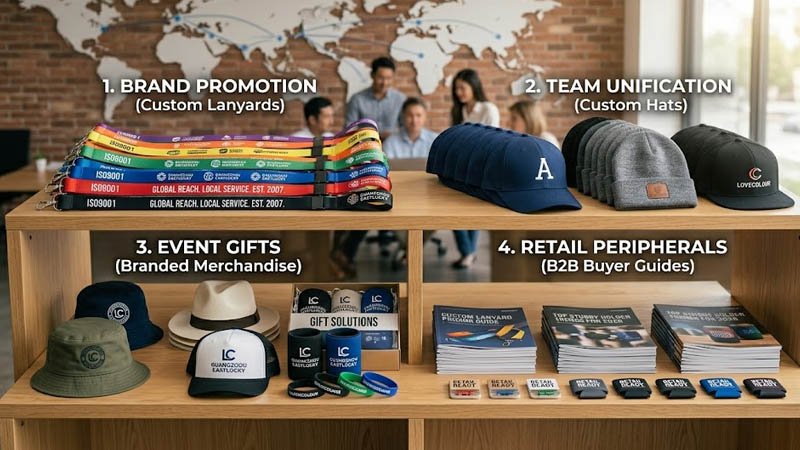
Hats are not only useful for personal style. They are also one of the most effective products for branding.
A custom hat is practical, visible, wearable, and memorable. Unlike some promotional products that are used once and forgotten, a well-made hat can be worn again and again.
Custom hats are suitable for:
Fashion brands
Sports teams
Outdoor brands
Corporate events
School clubs
Music festivals
Retail collections
Travel souvenirs
Employee uniforms
Promotional campaigns
Trade shows and exhibitions
A hat with a good logo, embroidery, patch, slogan, or color design can help people remember a brand. It can also create a sense of belonging among team members, staff, customers, or event participants.
For brands, event organizers, sports teams, and fashion labels, this is where custom hat manufacturing becomes valuable. GUANGZHOU EASTLUCKY Hat & Garment Co., Ltd. is a high-end custom hat and OEM/ODM manufacturer based in Guangzhou, China, with 15 years of expertise in professional R&D, production, and distribution of various hats and embroidered accessories. Guided by the philosophy “Quality as Root, Innovation as Soul,” EASTLUCKY provides global clients with one-stop solutions from design sampling to mass production, helping brands build efficient and high-quality custom hat supply chains.
A good custom hat does more than complete an outfit. It helps a brand stay visible in everyday life.
Best Hat Styles for Custom Branding
Different hat styles work for different branding needs. Choosing the right style depends on your target audience, season, market, and purpose.
Custom Baseball Caps
Custom baseball caps are one of the most versatile options. They are suitable for corporate events, sports teams, schools, retail brands, outdoor campaigns, and everyday promotions.
They are easy to wear, easy to customize, and widely accepted by different age groups.
Custom Snapbacks
Custom snapbacks are ideal for streetwear brands, youth fashion, music events, sports culture, and lifestyle merchandise.
They offer a bold shape and strong visual impact, making them suitable for brands that want a modern and energetic look.
Custom Bucket Hats
Custom bucket hats are great for summer campaigns, festivals, travel brands, beachwear, streetwear collections, and outdoor promotions.
They are lightweight, fashionable, and popular among younger consumers.
Custom Beanies
Custom beanies work well for winter collections, outdoor brands, employee gifts, ski events, and cold-weather promotions.
Embroidery, woven labels, and patches are common decoration methods for beanies.
Custom Trucker Hats
Custom trucker hats are popular for outdoor brands, lifestyle products, casual retail collections, farms, breweries, sports groups, and travel campaigns.
Their mesh-back design provides breathability and a relaxed look.
Custom Performance Caps
Performance caps are suitable for running clubs, golf events, fitness brands, hiking groups, and outdoor sports.
They usually focus on lightweight fabrics, breathability, moisture control, and comfort.
How to Choose the Right Custom Hat for Your Brand
If you are choosing hats for a brand, team, or event, personal style is not the only factor. You also need to consider your audience and purpose.
Ask these questions before starting a custom hat project:
Who will wear the hat?
Will it be used indoors or outdoors?
Is it for summer, winter, or all seasons?
Should the style be casual, sporty, premium, or trendy?
Do you need embroidery, printing, patches, or woven labels?
Will the hat be sold as merchandise or given as a promotional gift?
Does the hat need special materials, packaging, or brand labels?
For example, a fitness brand may prefer lightweight performance caps. A streetwear label may choose snapbacks or bucket hats. A corporate event may need clean embroidered baseball caps. A winter outdoor brand may choose custom beanies.
The better the hat matches the audience, the more likely people are to wear it.
The Psychology of Hats: Why They Make Men Feel Different
Hats do not only change how men look. They can also change how men feel.
When a man wears a hat that suits him, he may feel more confident, prepared, stylish, or expressive. This can affect posture, facial expression, and the way he interacts with others.
A baseball cap can make someone feel relaxed and active.
A fedora can make someone feel polished and mature.
A beanie can make someone feel casual and creative.
A cowboy hat can make someone feel strong and independent.
A bucket hat can make someone feel playful and trend-aware.
This is one reason fashion matters. What people wear can influence how they carry themselves.
A good hat can give a man a stronger sense of identity. It helps him step into a certain style, mood, or role.
That confidence often becomes visible.
Final Thoughts
Men often look better in hats because the right hat adds structure, confidence, and personality to their overall style.
A hat can frame the face, complete an outfit, express lifestyle, and create a stronger first impression. It can make a simple outfit look more intentional and help the wearer feel more confident.
But the key word is right.
The right hat should fit your face shape, match your outfit, suit the occasion, and feel natural to wear. A baseball cap may be perfect for one man, while a beanie, fedora, bucket hat, or outdoor cap may work better for another.
For brands, teams, and events, hats also offer powerful value. A well-designed custom hat is not only stylish and practical — it is a wearable brand message.
Whether you are choosing a hat for personal style or planning a custom hat project for your brand, the goal is the same: choose a hat that people will want to wear.
A good hat helps men stand out.
A well-made custom hat helps brands stay remembered.
New Era 9TWENTY vs. 9FORTY: Fit, Structure, Style, and Customization Guide
When comparing the New Era 9TWENTY and 9FORTY, the biggest difference is simple: the 9TWENTY is softer and more relaxed, while the 9FORTY is more structured and sporty.
The New Era 9TWENTY is known for its unstructured crown, low-profile fit, and casual “dad hat” style. It is comfortable, easy to wear, and perfect for everyday outfits.
The New Era 9FORTY, on the other hand, has a structured crown, a pre-curved visor, and a cleaner athletic look. It holds its shape better and offers stronger front logo visibility, making it a popular choice for sports teams, events, uniforms, and promotional caps.
Both styles are adjustable, versatile, and widely loved. However, they serve different purposes. If you are choosing a cap for personal wear, brand merchandise, or a custom hat project, understanding these differences can help you make the right decision.
Quick Answer: 9TWENTY vs. 9FORTY
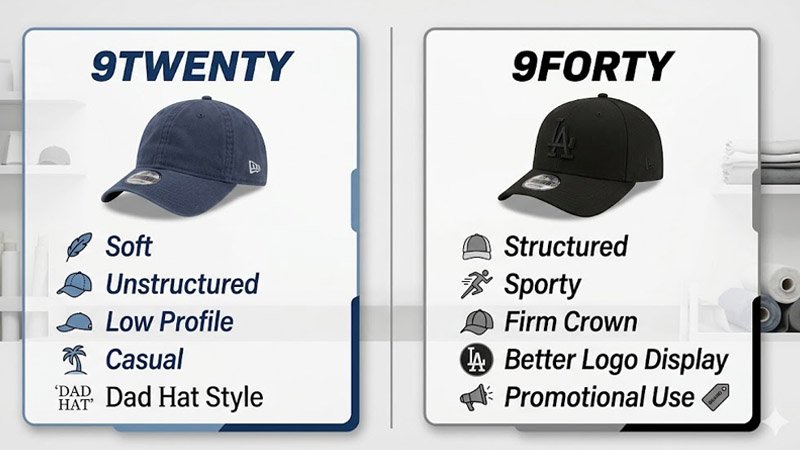
Choose the 9TWENTY if you want a soft, unstructured, low-profile cap with a relaxed vintage look.
Choose the 9FORTY if you want a structured, sporty cap with a firmer crown and better logo presentation.
In short:
9TWENTY = relaxed, soft, casual, dad-hat style
9FORTY = structured, sporty, polished, brand-ready style
9TWENTY vs. 9FORTY Comparison Table
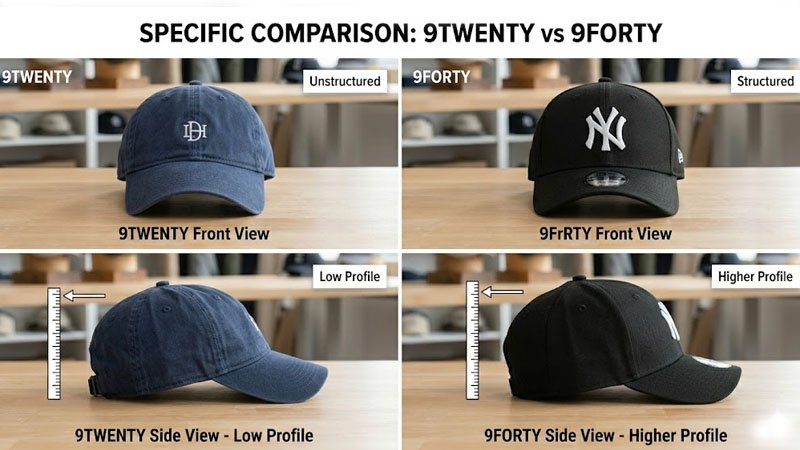
| Feature |
New Era 9TWENTY |
New Era 9FORTY |
| Crown Structure |
Unstructured |
Structured |
| Profile |
Low profile |
Mid to slightly higher profile |
| Fit Feel |
Soft and relaxed |
Firmer and more secure |
| Overall Style |
Casual, vintage, dad hat |
Sporty, clean, polished |
| Visor |
Curved visor |
Pre-curved visor |
| Logo Display |
Softer and more subtle |
More upright and visible |
| Best For |
Casual wear and lifestyle fashion |
Sports teams and brand promotion |
| Comfort |
Very soft and flexible |
Comfortable with more support |
| Custom Use |
Lifestyle caps, fashion merch, souvenirs |
Team caps, corporate caps, event caps |
| Recommended Buyer |
Brands wanting a relaxed look |
Brands needing strong logo visibility |
What Is the New Era 9TWENTY Cap?
The New Era 9TWENTY is one of the most relaxed cap styles in the New Era lineup. It is widely recognized for its soft, unstructured crown and easygoing fit.
Unlike structured caps that keep a firm front shape, the 9TWENTY has soft front panels. This allows the cap to naturally follow the shape of the wearer’s head. The result is a comfortable, slightly worn-in look that feels casual and effortless.
This is why the 9TWENTY is often associated with the popular dad hat style.
Key Features of the 9TWENTY
The 9TWENTY usually features:
- An unstructured crown
- A low-profile shape
- A curved visor
- An adjustable back closure
- A soft and flexible fit
- A relaxed vintage appearance
Because of its soft structure, the 9TWENTY does not look stiff or bulky. It is a great option for people who want a cap that feels natural, comfortable, and easy to style.
Fit and Comfort
The 9TWENTY is designed for comfort. Its soft crown and flexible material make it suitable for long-time wear.
Many 9TWENTY-style caps are made from cotton, washed cotton, or similar soft fabrics. These materials help create a breathable and lightweight feel.
The adjustable closure makes it suitable for most head sizes. However, because it has a low-profile and relaxed shape, people who prefer a stronger and more secure fit may prefer the 9FORTY.
Best Uses for the 9TWENTY
The 9TWENTY is ideal for:
- Everyday casual wear
- Lifestyle fashion brands
- Vintage-style merchandise
- Travel souvenirs
- Retail fashion collections
- Cafés, clubs, and creative brands
- Low-key logo embroidery
- Soft and relaxed promotional caps
If your brand wants a friendly, relaxed, and lifestyle-focused image, the 9TWENTY-style cap is a strong choice.
What Is the New Era 9FORTY Cap?
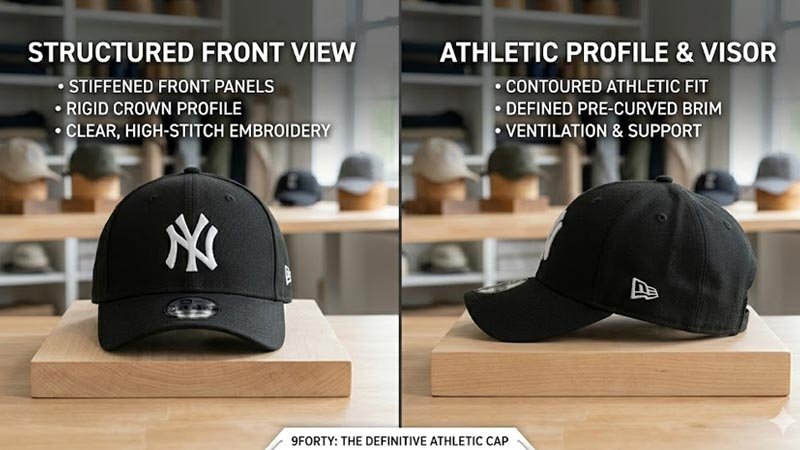
The New Era 9FORTY is an adjustable cap with a more structured and sporty design. Compared with the 9TWENTY, it has a firmer crown and a cleaner shape.
The structured front panels help the cap maintain its form. This gives the 9FORTY a sharper look and makes the front logo area more stable.
Because of this, the 9FORTY is commonly used for sports teams, corporate branding, staff uniforms, outdoor events, and promotional merchandise.
Key Features of the 9FORTY
The 9FORTY usually features:
- A structured crown
- A pre-curved visor
- A mid-profile or slightly higher-profile fit
- An adjustable back closure
- A sporty appearance
- A stronger front logo area
The structured crown makes the 9FORTY look more polished than the 9TWENTY. It is a good choice for buyers who want a cap that looks neat, stable, and brand-focused.
Fit and Comfort
The 9FORTY still offers good comfort, but it feels different from the 9TWENTY.
Instead of being soft and floppy, the 9FORTY feels more supportive. It sits more firmly on the head and holds its shape throughout the day.
For medium to larger head sizes, the 9FORTY may feel more secure. For buyers who want a professional cap shape, it is often the better option.
Best Uses for the 9FORTY
The 9FORTY is ideal for:
- Sports team caps
- Corporate event caps
- School and club caps
- Staff uniforms
- Outdoor promotional caps
- Brand merchandise
- Strong logo embroidery
- Patch designs
- Clean and professional cap collections
If your brand wants a structured, sporty, and highly visible logo presentation, the 9FORTY-style cap is usually the better choice.
Main Differences Between 9TWENTY and 9FORTY
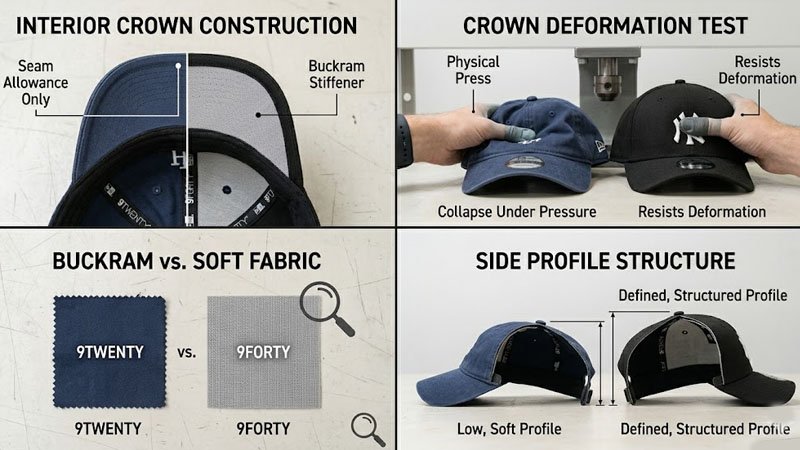
1. Crown Structure
The most important difference is the crown structure.
The 9TWENTY has an unstructured crown, which means the front panels are soft and flexible. It creates a relaxed, casual look.
The 9FORTY has a structured crown, which means the front panels are firmer and help the cap keep its shape.
If you want a soft and natural cap shape, choose the 9TWENTY.
If you want a firm and defined cap shape, choose the 9FORTY.
2. Profile and Shape
The 9TWENTY usually has a lower profile. It sits closer to the head and looks more understated.
The 9FORTY has a slightly higher and more structured profile. It creates a stronger visual shape and looks more athletic.
For a subtle daily cap, the 9TWENTY is better.
For a sharper branded cap, the 9FORTY is better.
3. Style and Appearance
The 9TWENTY is more casual and vintage. It is often worn with T-shirts, hoodies, denim, sneakers, and relaxed streetwear.
The 9FORTY is more sporty and polished. It works well with jerseys, polo shirts, uniforms, jackets, and activewear.
The difference can be summarized like this:
9TWENTY: relaxed lifestyle style
9FORTY: structured sports style
4. Logo Display
Logo display is very important for custom hat projects.
Because the 9TWENTY has a soft crown, logos appear more relaxed and subtle. It is suitable for small embroidery, minimalist branding, and lifestyle-style designs.
Because the 9FORTY has a structured front panel, logos appear more upright and visible. It is better for bold embroidery, woven patches, rubber patches, and team logos.
If you want understated branding, choose the 9TWENTY.
If you want stronger logo visibility, choose the 9FORTY.
5. Comfort and Wearing Experience
Both caps are comfortable, but they offer different wearing experiences.
The 9TWENTY feels softer, lighter, and more flexible. It is ideal for people who want a cap that feels easy and casual.
The 9FORTY feels more secure and supportive. It is ideal for people who want a cap that keeps its shape and feels more stable.
There is no single better choice. The right option depends on your style preference, head shape, and intended use.
Which Cap Should You Choose?
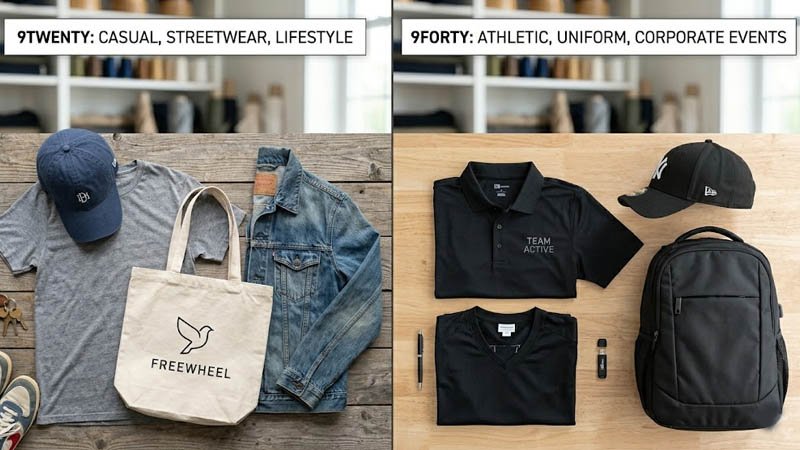
Choose the 9TWENTY If You Want:
- A soft unstructured cap
- A low-profile fit
- A relaxed dad-hat look
- A casual everyday style
- A vintage-inspired appearance
- A more subtle logo effect
- A comfortable cap for long wear
- A lifestyle-focused custom cap
The 9TWENTY is best for brands and wearers who want comfort, softness, and an easygoing fashion style.
Choose the 9FORTY If You Want:
- A structured cap
- A cleaner and sharper shape
- A sporty appearance
- A more secure fit
- Better logo visibility
- A professional branded look
- A cap for teams, events, or uniforms
- A custom cap suitable for bold decoration
The 9FORTY is best for brands and wearers who want structure, logo impact, and a more polished look.
Customization Guide: Which Style Is Better for Custom Hats?
For custom cap buyers, the choice between a 9TWENTY-style and 9FORTY-style cap is not only about fashion. It also affects production structure, logo placement, embroidery result, fabric selection, and final brand image.
A 9TWENTY-style cap is usually better for relaxed lifestyle branding. A 9FORTY-style cap is usually better for professional, sporty, or promotional branding.
Custom Hat Project Recommendations
| Custom Project Type |
Recommended Style |
Reason |
| Lifestyle fashion brand |
9TWENTY-style |
Soft, casual, and easy to style |
| Sports team caps |
9FORTY-style |
Structured crown supports bold logos |
| Corporate event caps |
9FORTY-style |
Clean and professional appearance |
| Travel souvenir caps |
9TWENTY-style |
Relaxed and approachable look |
| School or club caps |
9FORTY-style |
Durable structure and strong logo display |
| Café or creative brand merch |
9TWENTY-style |
Friendly and lifestyle-oriented |
| Promotional giveaway caps |
9FORTY-style |
Better visibility for brand logos |
| Streetwear merchandise |
Both styles |
Depends on brand image and design direction |
Manufacturing Perspective: What Should Brands Consider?
When developing custom caps inspired by 9TWENTY or 9FORTY styles, brands should consider more than just the outside appearance.
Important details include:
- Crown structure
- Front panel support
- Fabric type
- Visor shape
- Closure style
- Sweatband quality
- Embroidery method
- Patch material
- Logo size
- Color matching
- Packaging requirements
- Bulk production consistency
For example, if your logo is large, detailed, or needs strong visibility, a structured 9FORTY-style cap may provide a better decoration surface.
If your brand wants a soft, vintage, and casual feeling, an unstructured 9TWENTY-style cap may be a better match.
From a custom manufacturing perspective, choosing the right cap structure helps improve both the appearance and the final wearing experience.
GUANGZHOU EASTLUCKY Hat & Garment Co., Ltd. is a high-end custom hat and OEM/ODM manufacturer based in Guangzhou, China, with 15 years of expertise in professional R&D, production, and distribution of various hats and embroidered accessories. Guided by the philosophy “Quality as Root, Innovation as Soul,” EASTLUCKY provides global clients with one-stop solutions from design sampling to mass production, supporting efficient and high-quality supply chain services for brands worldwide.
Styling the 9TWENTY and 9FORTY
Casual Outfits
The 9TWENTY is perfect for casual daily wear. You can pair it with a T-shirt, jeans, hoodie, denim jacket, or sneakers.
Its soft crown gives the outfit a relaxed and natural feeling. It is especially suitable for people who like minimal, vintage, or lifestyle fashion.
The 9FORTY can also be styled casually, but it creates a cleaner and more structured look. It pairs well with polo shirts, bomber jackets, casual shirts, and sporty sneakers.
Sporty Looks
For sporty outfits, the 9FORTY is usually the stronger choice.
Its structured crown and pre-curved visor make it suitable for team jerseys, training wear, baseball jackets, athletic shorts, and sports-inspired streetwear.
This is also why 9FORTY-style caps are often selected for team uniforms, sports clubs, outdoor events, and athletic brand merchandise.
Streetwear Looks
Both 9TWENTY and 9FORTY caps are popular in streetwear, but they create different styles.
The 9TWENTY gives a relaxed and vintage streetwear look. It works well with oversized hoodies, loose pants, washed denim, and retro sneakers.
The 9FORTY gives a cleaner and bolder streetwear look. It works well with statement jackets, cargo pants, sports jerseys, and large logo designs.
If your brand wants a soft lifestyle identity, the 9TWENTY-style cap may be better.
If your brand wants a stronger sporty or urban identity, the 9FORTY-style cap may be better.
Final Recommendation
The New Era 9TWENTY and 9FORTY are both excellent adjustable cap styles, but they are designed for different needs.
The 9TWENTY is best for people who want a soft, unstructured, low-profile cap with a relaxed dad-hat look. It is comfortable, casual, and ideal for lifestyle fashion or subtle branding.
The 9FORTY is best for people who want a structured, sporty, and polished cap. It offers a firmer crown, stronger shape, and better logo visibility, making it ideal for sports teams, corporate events, uniforms, and promotional merchandise.
For personal wear, the best choice depends on your style preference and comfort needs.
For custom hat projects, the best choice depends on your brand image, logo design, target audience, and usage scenario.
If your brand wants a relaxed and casual product, choose a 9TWENTY-style cap.
If your brand wants a structured and professional product, choose a 9FORTY-style cap.
FAQs
What is the main difference between the New Era 9TWENTY and 9FORTY?
The main difference is the crown structure. The 9TWENTY has a soft, unstructured crown, while the 9FORTY has a structured crown that holds its shape better.
Is the 9TWENTY the same as a dad hat?
The 9TWENTY is often considered a dad-hat style because it has a low-profile, unstructured crown and a relaxed casual fit.
Is the 9FORTY structured?
Yes. The 9FORTY usually has a structured front crown, which helps the cap maintain its shape and display logos more clearly.
Which cap is more comfortable?
The 9TWENTY usually feels softer and more relaxed, while the 9FORTY feels firmer and more supportive. The more comfortable choice depends on personal preference.
Which cap is better for embroidery?
The 9FORTY is usually better for bold embroidery because its structured front panel provides a more stable surface. The 9TWENTY is better for softer, more subtle embroidery effects.
Which cap is better for small heads?
The 9TWENTY may be better for smaller heads because of its lower profile and softer fit. However, the final fit depends on the specific cap pattern and closure type.
Which cap is better for sports teams?
The 9FORTY is usually better for sports teams because it has a structured crown, sporty appearance, and stronger front logo display.
Which cap is better for lifestyle brands?
The 9TWENTY is often better for lifestyle brands because it feels casual, vintage, and easy to style.
Can both 9TWENTY and 9FORTY styles be customized?
Yes. Both styles can be customized with embroidery, woven patches, rubber patches, printed logos, different fabrics, custom closures, and branded packaging.
Which style should I choose for promotional caps?
For corporate promotions, sports events, and uniforms, the 9FORTY-style cap is usually better. For casual giveaways, lifestyle merchandise, and travel souvenirs, the 9TWENTY-style cap is a strong option.
How to Break in a New Hat Without Damaging It
A new hat can look great when you first buy it, but it does not always feel perfect right away. The crown may feel stiff, the sweatband may feel tight, or the brim may not have the shape you want. This is completely normal. Most new hats need a little time to soften, adjust, and fit more naturally.
However, breaking in a new hat should be done carefully. Using too much heat, soaking the wrong material, bending the brim too hard, or putting the hat in a dryer can cause shrinkage, fading, warping, or permanent damage.
The good news is that you can make a new hat fit better without ruining its shape. Whether you are breaking in a baseball cap, fitted cap, snapback, dad hat, trucker hat, bucket hat, wool hat, or another style, the key is to choose the right method for the material and structure.
In this guide, you will learn how to break in a new hat safely, how to soften a stiff crown, how to shape a brim, how to stretch a tight hat, and what mistakes to avoid.
Quick Answer: What Is the Safest Way to Break in a New Hat?
The safest way to break in a new hat is to wear it regularly. Your body heat, natural movement, and light moisture will gradually soften the sweatband, crown, and fabric, helping the hat adjust to your head shape.
If you want faster results, use gentle steam, hand shaping, or a hat stretcher. Avoid boiling water, dryers, harsh washing, aggressive bending, and soaking delicate materials such as wool, leather, straw, or structured hats.
For most hats, the best approach is simple: start gently, test slowly, and avoid high heat.
Before You Start: Check the Hat Material
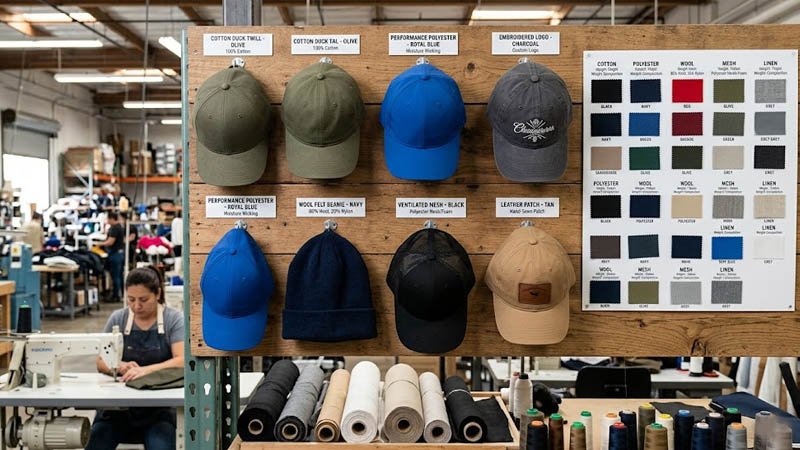
Not all hats should be broken in the same way. Before using water, steam, heat, or stretching tools, check the hat’s material and care label.
Different materials react differently to moisture and heat. A cotton cap may soften easily with regular wear or light steam, while a wool hat can shrink if soaked in hot water. A leather hat should not be washed like a fabric cap, and a straw hat can crack or lose shape if bent too aggressively.
Here is a simple guide:
| Hat Material |
Recommended Method |
Avoid |
| Cotton |
Regular wear, light steam, gentle hand shaping |
High heat, dryer |
| Wool |
Steam, slow shaping, professional care |
Hot water soaking, machine washing |
| Polyester |
Regular wear, gentle steam, careful shaping |
Excessive heat |
| Nylon |
Regular wear, hand shaping |
High heat or harsh washing |
| Leather |
Leather conditioner, professional care |
Soaking, machine washing |
| Straw |
Gentle hand shaping |
Water soaking, aggressive bending |
| Structured caps |
Steam, careful shaping, hat form drying |
Dryer, heavy washing, forceful bending |
If you are not sure what your hat is made of, choose the safest method first: wear it regularly and shape it gently by hand.
Best Methods to Break in a New Hat Safely
Different hats need different treatments. Below are the most common break-in methods, along with when to use them and what risks to watch for.
| Method |
Best For |
Time Needed |
Risk Level |
| Regular wear |
Most hats |
Several days to weeks |
Low |
| Hand shaping |
Brims and crowns |
A few minutes |
Low |
| Steam |
Stiff crowns, tight sweatbands, brim shaping |
10–20 minutes |
Low to medium |
| Warm water |
Cotton caps |
A few hours |
Medium |
| Hat stretcher |
Tight fitted hats |
Several hours to overnight |
Low to medium |
| Machine wash |
Washable cotton caps only |
One wash cycle |
Medium to high |
| Sun fading |
Vintage look |
Several days |
Medium |
The best method depends on the hat’s material, structure, and the problem you want to solve.
Wear Your Hat Regularly
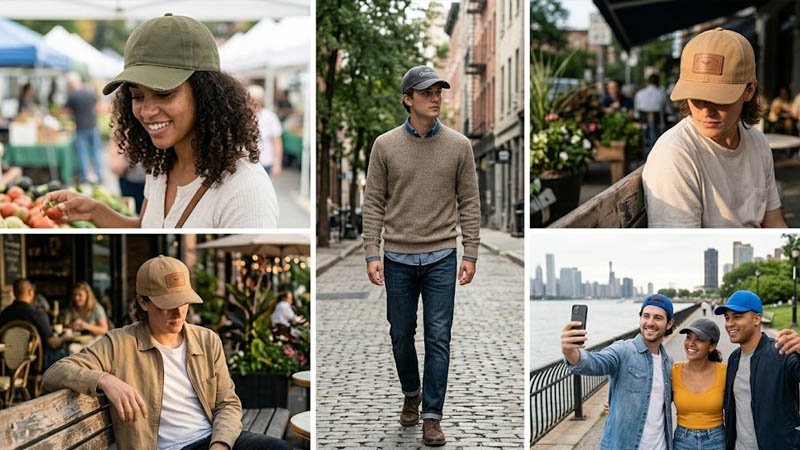
The Most Natural Break-In Method
The easiest and safest way to break in a new hat is to wear it often. Just like a new pair of shoes, a new hat may feel stiff at first, but it gradually becomes more comfortable with use.
When you wear a hat, your body heat and natural movement help soften the fabric and sweatband. Over time, the hat begins to follow the shape of your head. This creates a more personalized and comfortable fit.
This method works well for:
- Baseball caps
- Dad hats
- Trucker hats
- Snapbacks
- Cotton caps
- Casual bucket hats
- Everyday fabric hats
If your hat feels only slightly stiff or snug, regular wear may be enough.
How to Speed It Up Naturally
You can speed up the process by wearing your hat during light daily activities, such as walking, running errands, doing outdoor chores, or wearing it around the house.
A little body heat and light moisture can help relax the sweatband and fabric. However, avoid soaking the hat with heavy sweat too often, especially if it has delicate embroidery, leather patches, printed logos, or dark colors.
How Long Does This Take?
A soft cotton hat may start to feel better after a few wears. A structured cap may take one to two weeks. A fitted hat or wool hat may take longer.
This method requires patience, but it is the safest option and has the lowest chance of damaging your hat.
How to Shape a Hat Brim or Bill
The brim is one of the most visible parts of a hat. If it is too flat, too stiff, or uneven, the whole hat may look uncomfortable or unnatural.
Shaping the brim is one of the easiest ways to make a new hat look and feel better.
Shape the Brim by Hand
Start by holding the brim with both hands. Gently bend it into the curve you want. Work slowly from the sides toward the center.
Do not force the shape all at once. Light pressure is better than aggressive bending.
For a relaxed everyday look, create a soft curve. For a more traditional baseball cap style, create a deeper curve.
If the brim feels very stiff, use steam first to soften it slightly before shaping.
Use a Mug or Can for an Even Curve
For a more consistent curve, wrap the brim around a coffee mug, soda can, or another smooth round object.
Follow these steps:
- Gently curve the brim around the object.
- Hold it in place with a rubber band if needed.
- Leave it for several hours or overnight.
- Remove the hat and check the shape.
- Repeat if you want a deeper curve.
This method works best for baseball caps, dad hats, and casual caps with flexible brims.
Avoid Over-Bending the Brim
Do not fold the brim sharply in the middle. Do not twist it or bend it backward. If the brim has a stiff insert, aggressive bending can cause cracks, creases, or permanent unevenness.
A good brim shape should look natural, not forced.
How to Use Steam to Soften a New Hat
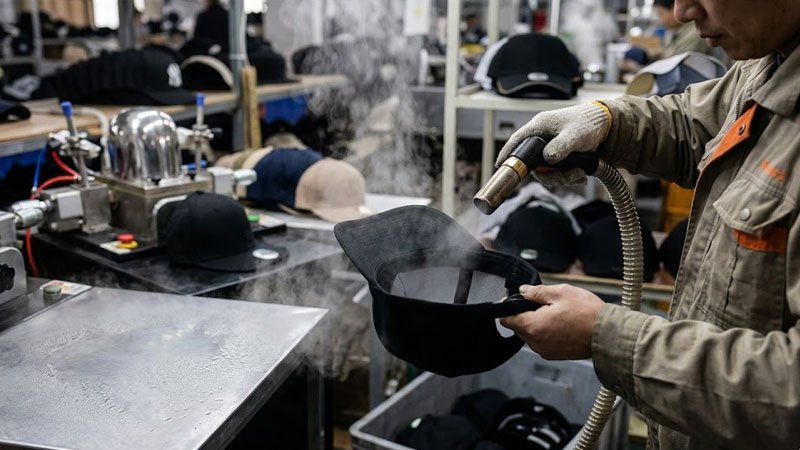
Steam is one of the most useful ways to break in a hat faster. It can soften the crown, relax the sweatband, and make the brim easier to shape.
Compared with soaking, steam gives you more control. It adds warmth and moisture without fully wetting the hat.
When to Use Steam
Steam is helpful when:
- The crown feels stiff
- The sweatband feels tight
- The brim is hard to shape
- The hat needs light reshaping
- You want faster results than regular wear
Steam works especially well for cotton caps, wool hats, and some structured hats. However, it should still be used carefully.
Step-by-Step Steam Method
- Use a garment steamer, kettle, or hot shower steam.
- Hold the hat near the steam, not directly against boiling water.
- Steam the stiff area for 20–30 seconds at a time.
- Gently shape the hat with your hands.
- Wear the hat while it cools, or place it on a hat form.
- Let it air dry naturally.
Do not over-steam the hat. Too much moisture and heat may weaken glue, affect embroidery, loosen patches, or change the structure.
Can Steam Damage a Hat?
Steam is usually safe when used lightly, but it can damage certain hats if overused. Be careful with leather hats, straw hats, glued patches, delicate trims, and highly structured crowns.
If the hat is expensive, rare, or delicate, consider professional cleaning or reshaping instead.
Can You Use Warm Water to Break in a Hat?
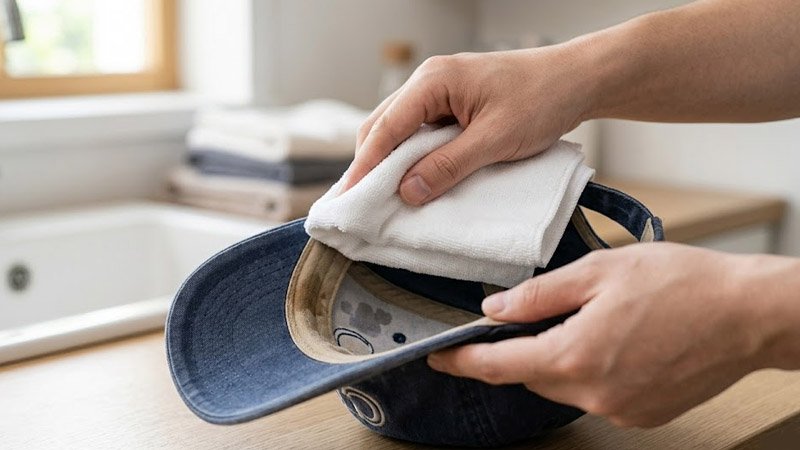
Warm water can soften some hats, especially cotton caps. However, it is riskier than regular wear or steam.
Water can cause shrinkage, fading, color bleeding, and shape loss if used incorrectly. This method should only be used for hats that can safely handle water.
Warm Water Method for Cotton Caps
If your hat is suitable for water treatment, follow these steps:
- Fill a basin with warm water. Do not use boiling water.
- Lightly soak or dampen the hat.
- Remove the hat and gently press out excess water. Do not twist it.
- Wear the hat while it is damp so it can mold to your head shape.
- Let it air dry naturally.
This can help a cotton cap become softer and more comfortable.
What to Avoid
Do not soak wool, leather, straw, or structured hats unless the care label says it is safe.
Do not use hot water on hats with dark colors, delicate embroidery, printed logos, leather patches, or cardboard-like brim inserts.
Before wetting the whole hat, test a small hidden area to see if the color runs.
The Shower Method
The shower method is a gentler version of the warm water method. Instead of soaking the hat, you expose it to steam and light moisture.
You can wear the hat during a warm shower, or place it in the bathroom while steam fills the room. Once the hat becomes slightly warm and damp, wear it until it begins to adjust to your head shape.
This method can work for casual cotton caps and some wool hats, but it is not suitable for leather, straw, or hats that should stay dry.
The shower method is useful when you want to soften the hat slowly without fully soaking it.
Should You Machine Wash a Hat to Break It In?
Machine washing can soften some hats, but it is one of the riskier methods. It should only be used when the hat’s care label allows machine washing.
Machine washing may cause shrinkage, fading, loose stitching, warped brims, or crown deformation. It is not recommended for high-end hats, wool hats, leather hats, straw hats, structured caps, or hats with cardboard brims.
How to Machine Wash a Hat Safely
If your hat is washable, follow these steps:
- Place the hat in a hat cage or delicate laundry bag.
- Use cold or lukewarm water.
- Choose a gentle cycle.
- Use mild detergent.
- Avoid bleach or harsh cleaners.
- Remove the hat immediately after washing.
- Air dry it on a towel, hat form, or rounded object.
Never put your hat in the dryer. Dryer heat can shrink the fabric, warp the brim, and damage the overall shape.
Better Alternative: Spot Cleaning
If your goal is only to clean and soften the hat slightly, spot cleaning is safer than machine washing.
Use a soft cloth, cool water, and mild soap. Gently clean dirty areas without soaking the entire hat.
How to Stretch a Tight Hat for a Better Fit
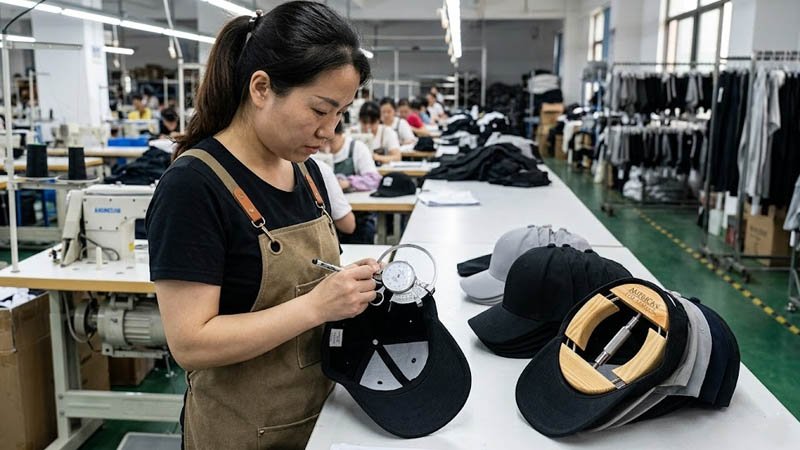
Sometimes a new hat feels too tight even after several wears. In that case, gentle stretching can help.
The key word is gentle. Stretching too quickly can damage the sweatband, seams, panels, or crown shape.
Stretch the Sweatband
If the tightness is mainly around the sweatband, lightly steam or dampen the inside band. Then gently stretch it by hand.
Wear the hat while it cools or dries. This helps the sweatband adjust to your head size.
Do not cut the sweatband unless there is no other option. Cutting can affect the hat’s structure and durability.
Use a Hat Stretcher
A hat stretcher is one of the safest tools for improving fit. It applies even pressure and helps avoid uneven stretching.
To use a hat stretcher:
- Lightly steam or dampen the sweatband.
- Insert the hat stretcher.
- Expand it slowly.
- Leave it in place for several hours or overnight.
- Try on the hat and repeat if necessary.
This method works especially well for fitted hats that are slightly too tight.
Use a Round Object
If you do not have a hat stretcher, you can place the hat over a clean round object, such as a bowl, jar, or ball.
Make sure the object is only slightly larger than the hat. If it is too large, it may overstretch the hat and distort the shape.
How to Make a New Hat Look Vintage
Some people want their new hat to feel and look worn-in. A vintage look can be created carefully, but it is easy to overdo.
Wear It Often
The most natural vintage look comes from regular wear. Over time, the fabric softens, the color becomes more relaxed, and the hat develops its own character.
This is the safest way to create an authentic worn-in appearance.
Use Sunlight Carefully
Leaving a cotton hat in the sun can create a faded look. However, strong sunlight can cause uneven fading, especially on dark colors.
If you want a subtle vintage effect, expose the hat to sunlight gradually instead of leaving it outside for too long.
Use Fine Sandpaper Lightly
Fine sandpaper can be used to gently distress the brim edge or certain fabric areas.
Use very light pressure. Avoid sanding embroidery, printed logos, patches, seams, or decorative details.
If you want a vintage look without the risk, consider choosing a pre-washed or pre-distressed hat.
What Not to Do When Breaking in a New Hat
Many hats are damaged not because people try to break them in, but because they use methods that are too harsh.
Avoid these common mistakes:
- Do not use boiling water.
- Do not put the hat in a dryer.
- Do not machine wash hats that are not washable.
- Do not soak leather, straw, or delicate wool hats.
- Do not bend the brim sharply in the middle.
- Do not twist or wring the hat when wet.
- Do not use bleach or harsh detergents.
- Do not stretch the hat too quickly.
- Do not leave dark hats in direct sunlight for too long.
- Do not ignore the care label.
When in doubt, choose the gentlest method first. A slow break-in process is better than permanent damage.
Troubleshooting Common Hat Fit Problems
The Hat Feels Too Tight
Wear it regularly for a few days first. If it still feels tight, use light steam on the sweatband and stretch it gently. A hat stretcher can help if the hat needs a little more room.
The Crown Feels Too Stiff
Use steam to soften the crown, then shape it gently with your hands. Wearing the hat often will also help the crown relax naturally.
The Brim Is Too Flat
Shape the brim by hand or wrap it around a mug or can for several hours. If the brim is stiff, use light steam before shaping.
The Hat Shrunk After Washing
Lightly steam the hat or dampen it with warm water, then stretch it carefully while it is still damp. Let it air dry on your head or on a hat form.
The Hat Lost Its Shape
Use steam to soften the fabric, then reshape it by hand. Place the hat on a rounded object, towel, or hat form while it dries.
If the hat is expensive, delicate, or badly misshapen, professional reshaping may be the safest option.
How Long Does It Take to Break in a New Hat?
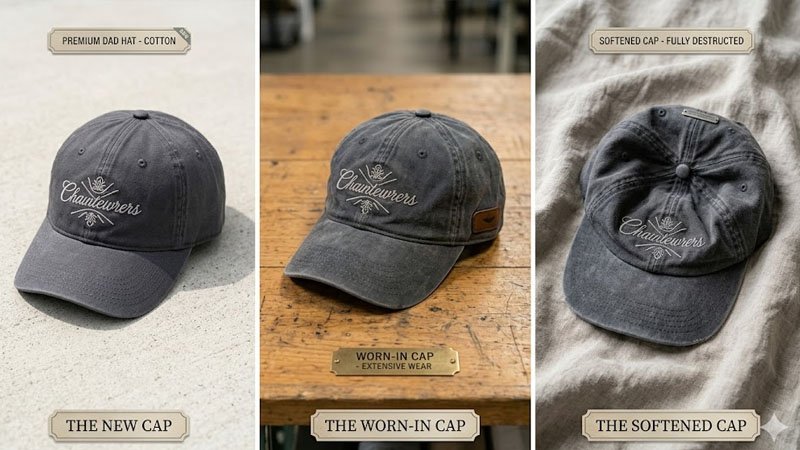
The time depends on the material, construction, and how often you wear it.
A soft cotton dad hat may feel better after a few wears.
A structured baseball cap may take one to two weeks.
A fitted cap may need several wears plus gentle stretching.
A wool hat may take longer and should be shaped carefully with steam.
A stiff or high-crown cap may take more time because the structure is designed to hold its shape.
In general, regular wear is the safest method, while steam and gentle stretching can speed up the process.
For Brands: Better Comfort Starts with Better Hat Design
For brands, retailers, and businesses ordering custom hats in bulk, the break-in experience begins long before the customer wears the hat. Fabric weight, sweatband softness, crown height, panel structure, brim flexibility, embroidery density, stitching quality, and finishing process all affect how comfortable a hat feels from the first wear.
As a Guangzhou-based high-end custom hat and OEM/ODM manufacturer with 15 years of experience, GUANGZHOU EASTLUCKY Hat & Garment Co., Ltd. understands that comfort starts at the production stage. Guided by the philosophy “Quality as Root, Innovation as Soul,” EASTLUCKY provides global clients with one-stop solutions from design sampling to mass production, helping brands build efficient and high-quality hat supply chains.
For custom hat projects, brands can improve the customer experience by choosing the right fabric, sweatband, brim insert, crown structure, and fit testing process. A well-designed hat should look good, hold its shape, and become comfortable with minimal break-in time.
Hat Care After Breaking It In
Once your hat fits well, proper care helps it stay comfortable and keep its shape longer.
Clean It Gently
Spot cleaning is usually the safest method. Use a soft cloth, mild soap, and cool water. Avoid harsh chemicals, bleach, and abrasive brushes.
If deeper cleaning is needed, always check the care label first.
Store It Properly
Do not crush your hat in a drawer or bag. Store it on a shelf, hat rack, or clean surface where the crown and brim can keep their shape.
For structured hats, use a hat form or support the crown with soft paper.
Avoid Excessive Heat and Moisture
Too much sun, rain, sweat, or heat can shorten the life of a hat. Let sweaty hats dry naturally before storing them.
If you wear hats often, rotate between different styles to reduce wear and maintain shape.
FAQs
What is the safest way to break in a new hat?
The safest way is to wear it regularly. Body heat and natural movement will gradually soften the hat and help it fit your head without much risk of damage.
How do you break in a baseball cap?
Wear it often, shape the brim gently by hand, and use light steam if the crown or brim feels stiff. Avoid dryers, boiling water, and aggressive bending.
Can you break in a fitted hat?
Yes. A fitted hat can be broken in by regular wear, light steam, and gentle stretching. If it is slightly too tight, a hat stretcher can help.
Will breaking in a hat make it bigger?
Breaking in a hat may make it feel slightly roomier because the sweatband and crown relax over time. However, it will not increase the size dramatically. If the hat is much too small, it is better to choose a larger size.
Can I use water to break in a new hat?
Warm water can be used on some cotton hats, but it should be done carefully. Avoid soaking wool, leather, straw, structured hats, or hats with delicate decorations.
Can steam damage a hat?
Light steam is usually safe for many hats, but too much steam can damage glue, patches, embroidery, or structured panels. Use short bursts of steam and shape the hat gently.
Should I put my hat in the dryer?
No. A dryer can shrink the fabric, warp the brim, and damage the hat’s shape. Always air dry your hat naturally.
How do I make a stiff hat softer?
Wear it regularly, use light steam, or gently dampen the sweatband if the material allows it. Avoid harsh washing or high heat.
How do I curve a hat brim?
Use your hands to bend the brim gently, or wrap it around a mug or can for several hours. Do not fold or crease the brim sharply.
How long does it take to break in a new hat?
It can take a few days to a few weeks, depending on the material and structure. Soft cotton hats usually break in faster, while structured or fitted hats may take longer.
Conclusion
Breaking in a new hat does not have to be difficult, but it should be done carefully. The safest method is regular wear, while steam, hand shaping, warm moisture, and gentle stretching can help speed up the process.
The most important rule is to match the method to the material. Cotton caps can usually handle more moisture, while wool, leather, straw, and structured hats need extra care. Avoid boiling water, dryers, harsh washing, and aggressive bending if you want to protect the hat’s shape, color, and durability.
With the right approach, your new hat can become softer, more comfortable, and better fitted without being damaged. A good hat should not only look great on the first day, but also become even better with time.
Can You Wear a Hat in Court? Rules, Exceptions, and Courtroom Etiquette
If you are going to court, one of the most important things to remember is that your appearance matters. Courtrooms are formal environments, and even small details—such as wearing a hat—can affect how you are perceived.
So, can you wear a hat in court?
In most courtrooms, wearing a hat is not recommended, and you may be asked to remove it. However, religious, cultural, and some medical head coverings are often treated differently. The exact answer depends on the court, the judge, and the reason you are wearing it.
Here is what you should know before stepping into a courtroom.
Why What You Wear to Court Matters
Court is not like going to a store, a restaurant, or even a normal office. It is a place where rules, procedures, and respect for the legal process matter. Because of that, the way you dress plays an important role in first impressions.
You do not need expensive clothing to look appropriate in court. In most situations, clean, modest, and professional-looking attire is enough. The goal is to show that you understand the seriousness of the occasion.
A hat may seem like a small detail, but in court, small details often matter. If your clothing looks too casual or distracting, it may give the impression that you are not taking the situation seriously.
The Short Answer: Hats Are Usually Discouraged
In general, casual hats are usually discouraged in court. This includes items such as:
- baseball caps
- beanies
- fashion hats
- streetwear caps
- any headwear worn mainly for style rather than necessity
Even when there is no clearly posted rule saying “no hats,” court staff or security officers may still ask you to remove one. This is common because courtroom expectations are based not only on written rules, but also on formality and decorum.
If the hat is optional, the safest choice is to leave it off.
Why Hats Are Often Not Allowed in Court
There are several reasons hats are commonly discouraged in courtrooms.
1. Courtrooms Are Formal Spaces
The most common reason is simple: courts are formal institutions. Judges, lawyers, jurors, and court staff are expected to maintain a professional environment. Wearing a casual hat can appear too relaxed for that setting.
In many cultures, removing a hat indoors—especially in official or serious spaces—is considered a basic sign of respect. Courtrooms often follow that same expectation.
2. Security Procedures Matter
Courthouses usually have security screening at the entrance. During that process, officers may ask visitors to remove hats so they can confirm identity and ensure nothing is concealed.
This is important because courthouse security rules and courtroom etiquette often overlap. You may be allowed to wear a hat while arriving at the building, but once you go through screening or enter the courtroom itself, you may be told to take it off.
3. Clear Identification Is Important
In a courtroom, everyone needs to be clearly seen and identified. Hats with low brims, oversized shapes, or anything that partially covers the face can make that harder. Court staff want to avoid confusion, unnecessary distraction, or anything that could interfere with orderly proceedings.
The issue is often not the hat itself, but whether it fits the seriousness and visibility requirements of the setting.
Does the Rule Change from Court to Court?
Yes, it can.
Not every courtroom handles attire in exactly the same way. Some judges are more strict than others. Some local courts may have posted dress standards, while others rely more on courtroom staff to manage appearance and behavior.
That is why people sometimes hear different answers to the same question. One person may say they wore a hat without issue, while another may say they were immediately told to remove it.
Still, the safest general rule remains the same: do not assume a casual hat will be acceptable in court.
Different Roles, Different Expectations
Whether you can wear a hat may also depend on why you are in court.
If You Are a Defendant
If you are appearing in court as a defendant, your appearance matters even more. You want to look respectful, responsible, and prepared. Wearing a casual hat usually does not help create that impression.
Even if no one says anything, it may still affect how others view you. In court, that is not a risk worth taking.
If You Are a Witness
Witnesses are also expected to appear neat and respectful. Since witnesses may be speaking directly before the judge or jury, their appearance should not distract from their testimony.
A casual hat may draw unnecessary attention and may be viewed as inappropriate unless there is a valid reason for wearing it.
If You Are a Juror
Jurors are usually expected to follow conservative dress standards. Courts often want jurors to appear neutral, consistent, and professional. Because of that, hats are typically discouraged unless there is a religious or medical reason.
If You Are Just Observing
Even spectators and family members attending a hearing are expected to respect courtroom rules. Being “just a visitor” does not mean dress expectations no longer apply. If you wear a hat into court, you may still be asked to remove it.
Are Religious or Cultural Head Coverings Allowed?
In many cases, yes.
Religious and cultural head coverings are usually treated differently from fashion hats or casual caps. Courts generally recognize that items such as turbans, hijabs, yarmulkes, and other faith-based or culturally significant coverings are not simply accessories.
That said, you may still be asked to cooperate with identification or security procedures. This usually does not mean the court is rejecting the head covering—it simply means courthouse rules still apply to everyone entering the building.
If you know in advance that you will be wearing religious or cultural headwear and you are concerned about how it may be handled, contacting the court ahead of time is a smart step.
What About Medical Reasons?

Medical needs can also make a difference.
Some people wear head coverings because of surgery, treatment, hair loss, scalp sensitivity, or other health-related reasons. In many situations, courts will be understanding if the headwear is clearly functional and not worn as casual fashion.
If the court appearance is important, it is wise to notify your lawyer or the court in advance. That can help avoid confusion and reduce stress on the day of the hearing.
What Happens If You Refuse to Remove a Hat?
If a judge, bailiff, or court officer asks you to remove your hat, the best response is to comply politely.
Refusing a direct instruction in court can create unnecessary problems. At a minimum, you may be asked to leave the courtroom. In more serious situations, refusing to follow courtroom instructions may be seen as disrespectful or disruptive conduct.
Even if you personally feel the rule is minor, arguing about it in court is rarely a good idea. It is always better to cooperate and keep the focus on the legal matter itself.
A Practical Example
Imagine you are attending traffic court and wearing a baseball cap. Your clothing is otherwise neat and appropriate. Even so, there is a good chance that security staff or courtroom personnel will ask you to remove the cap before the hearing begins.
Now imagine a different situation. You are wearing a head covering for religious reasons. In that case, the response from the court is likely to be different. Staff may still need to confirm identity or follow screening procedures, but the head covering itself is more likely to be accommodated.
These examples show why the answer is not always a simple yes or no. The context matters.
Best Practice: What Should You Do?
If you are unsure whether wearing a hat to court is acceptable, the safest approach is very simple:
- do not wear a casual hat into the courtroom
- remove your hat during security screening if asked
- dress neatly and conservatively
- contact the court in advance if your head covering is religious, cultural, or medical
As a rule, if the hat is optional, it is usually better to leave it off.
A Note on Professional Presentation
Understanding when headwear is appropriate is not only a matter of fashion, but also of context. In formal settings, presentation can influence perception in powerful ways. As a company specializing in premium headwear development, GUANGZHOU EASTLUCKY Hat & Garment Co., Ltd. understands that hats serve different purposes across branding, uniforms, fashion, and professional use. Knowing when a hat enhances appearance—and when it may be inappropriate—is part of understanding the product itself.
Final Thoughts
So, can you wear a hat in court?
For most people, in most situations, the safest answer is no. Casual hats are usually not considered appropriate courtroom attire, and you may be asked to remove one even if there is no posted written rule.
Religious, cultural, and some medical head coverings are often treated differently, but if you are ever unsure, it is best to check with the court ahead of time.
Court appearances are serious, and the goal is to avoid distractions, show respect, and present yourself appropriately. In that setting, removing a hat is often the simplest and smartest choice.
FAQs
Can you wear a baseball cap in court?
Usually not. A baseball cap is generally considered too casual for a courtroom, and you may be asked to remove it.
Can you wear a beanie in court?
In most cases, a beanie is also discouraged unless there is a medical or other valid reason.
Are religious head coverings allowed in court?
Often yes. Courts usually respect religious head coverings, although standard security or identification procedures may still apply.
Can jurors wear hats in court?
Jurors are typically expected to follow conservative dress standards, so hats are usually discouraged unless there is an approved reason.
What if I need to wear a hat for medical reasons?
Medical needs may be accommodated. If possible, inform your lawyer or the court before your appearance.
What should I wear to court instead of a hat?
Choose clean, modest, and professional clothing. A simple and respectful appearance is usually the best option.