Embroidery vs. Screen Printing for Custom Caps: A Complete Guide for Bulk Buyers
When ordering custom caps in bulk, choosing the right logo decoration method is just as important as choosing the cap style, fabric or color. The logo is the first thing people notice, and it directly affects how professional, durable and valuable your custom cap looks.
Two of the most common logo decoration methods are embroidery and screen printing. Both can be used for branding, but they are not suitable for the same designs, materials or business purposes.
For most custom caps, embroidery is the more popular and recommended choice because it creates a raised, textured and long-lasting logo effect on structured hat panels. Screen printing is better for large, colorful and flat designs, especially on T-shirts, tote bags and some promotional fabric products.
In this complete guide, we will explain the differences between embroidery and screen printing, compare their advantages, and help bulk buyers choose the best logo method for custom caps.
Quick Answer: Which Method Is Better for Custom Caps?
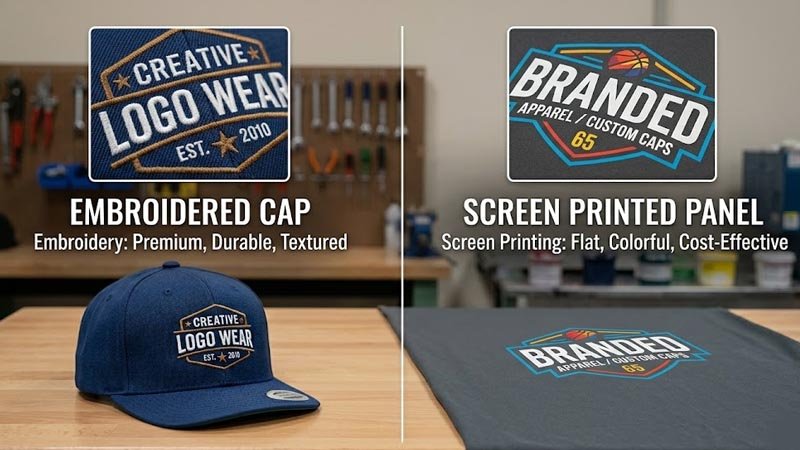
For most custom caps, embroidery is usually better than screen printing.
Embroidery works well on baseball caps, snapback hats, golf caps, trucker hats and uniform caps because it creates a premium and durable logo. It is especially suitable for company logos, team emblems, brand names and small to medium-sized artwork.
Screen printing is more suitable for flat fabric surfaces, large graphics and colorful promotional designs. It can be used on some cap panels, but it is usually less suitable for curved, textured or highly structured cap surfaces.
For custom caps, buyers often choose:
Flat embroidery for clean corporate logos;
3D puff embroidery for bold streetwear logos;
Woven patches for detailed logos and small text;
Embroidered patches for a textured and premium look;
Screen printing for simple flat designs or promotional projects.
What Is Embroidery?
Embroidery is a decoration method that uses colored threads to stitch a logo or design directly onto fabric. The result is a raised, textured and durable logo effect.
Before production, the logo artwork is converted into a digital embroidery file. This process is called digitizing. The embroidery machine then follows this file and stitches the design onto the cap panel.
Embroidery is one of the most popular logo methods for custom caps because it looks professional, feels premium and lasts for a long time.
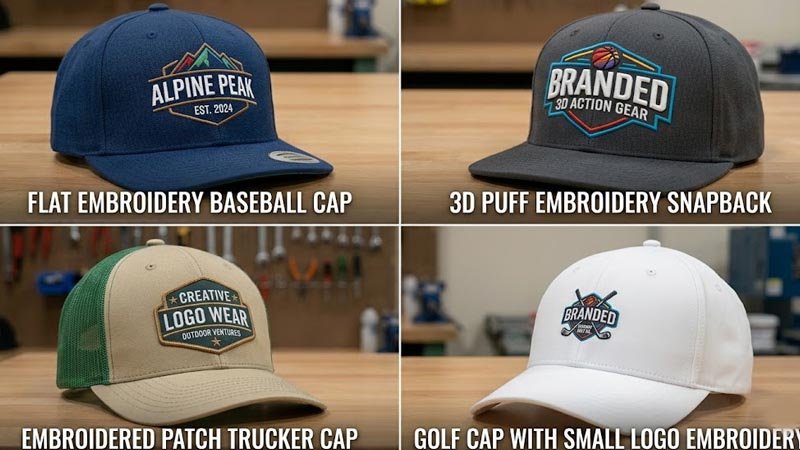
Custom caps are different from T-shirts or tote bags. A cap usually has a curved crown, structured front panels, seams, stitching lines and different fabric thicknesses. These details make logo decoration more challenging.
Embroidery works well on caps because the thread becomes part of the fabric surface. It can hold its shape on structured panels and create a strong visual effect.
Embroidery is commonly used for:
Baseball caps;
Snapback caps;
Golf caps;
Trucker caps;
Dad hats;
5-panel caps;
Bucket hats;
Workwear caps;
Team caps;
Corporate uniform caps.
Advantages of Embroidery
1. Premium and Professional Appearance
Embroidery gives custom caps a high-end look. The raised thread texture makes the logo stand out and creates a more valuable brand impression.
This is why many companies, golf clubs, sports teams, fashion brands and corporate buyers choose embroidered caps for their branding projects.
2. Excellent Durability
Embroidered logos are stitched directly into the fabric, so they do not peel or crack. Compared with many printed designs, embroidery can better withstand regular use, handling and washing.
For caps that will be worn frequently, embroidery is a reliable long-term choice.
3. Strong Brand Recognition
Embroidery is ideal for logos, letters, emblems and simple icons. A clean embroidered logo can make a cap look more professional and easier to recognize.
For brands that care about image and quality, embroidery is often the first choice.
4. Suitable for Many Cap Styles
Embroidery can be applied to many cap types, including structured caps, unstructured caps, cotton caps, twill caps, denim caps and polyester caps.
Different embroidery techniques can also create different styles, from clean corporate branding to bold streetwear designs.
Limitations of Embroidery
Although embroidery is very suitable for custom caps, it is not perfect for every design.
Embroidery may not be ideal for:
Very small text;
Thin lines;
Complex gradients;
Photo-like artwork;
Large filled areas;
Extremely detailed patterns.
The cost of embroidery is usually affected by stitch count. A larger or more complex logo requires more stitches, which increases production time and cost.
For detailed artwork, a woven patch or printed label may sometimes be a better option.
Common Embroidery Options for Custom Caps
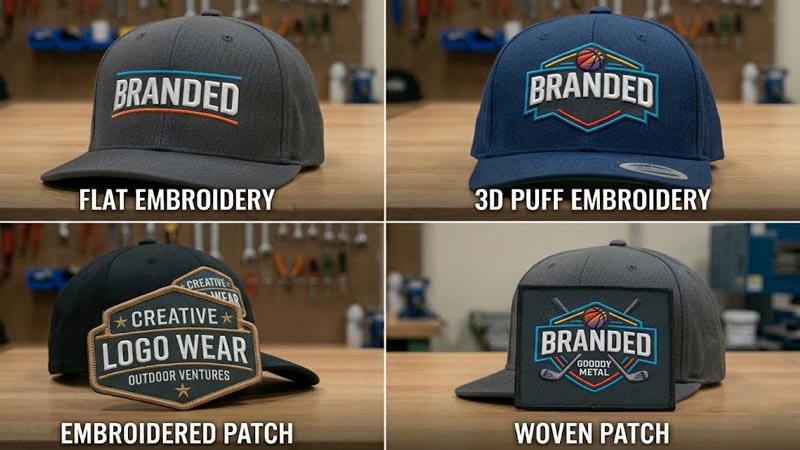
Flat Embroidery
Flat embroidery is the most common embroidery method. The logo is stitched flat onto the cap surface. It is suitable for company logos, text, simple icons and professional branding.
Best for:
Corporate caps;
School caps;
Event caps;
Golf caps;
Uniform caps.
3D Puff Embroidery
3D puff embroidery uses foam under the stitches to create a raised three-dimensional effect. It is popular for snapback caps, streetwear caps and bold logo designs.
Best for:
Large letters;
Bold logos;
Sports caps;
Fashion caps;
Streetwear brands.
However, 3D puff embroidery is not suitable for very thin lines or small detailed text.
Embroidered Patch
An embroidered patch is made separately and then sewn or heat-applied onto the cap. It creates a strong textured look and is suitable for vintage, outdoor or fashion-style caps.
Best for:
Outdoor brands;
Lifestyle brands;
Retail caps;
Promotional collections.
Woven Patch
A woven patch is made with finer threads than embroidery, so it can show smaller details and clearer text. It is a good choice when the logo is too detailed for direct embroidery.
Best for:
Small text;
Detailed logos;
Label-style branding;
Retail-ready caps.
What Is Screen Printing?
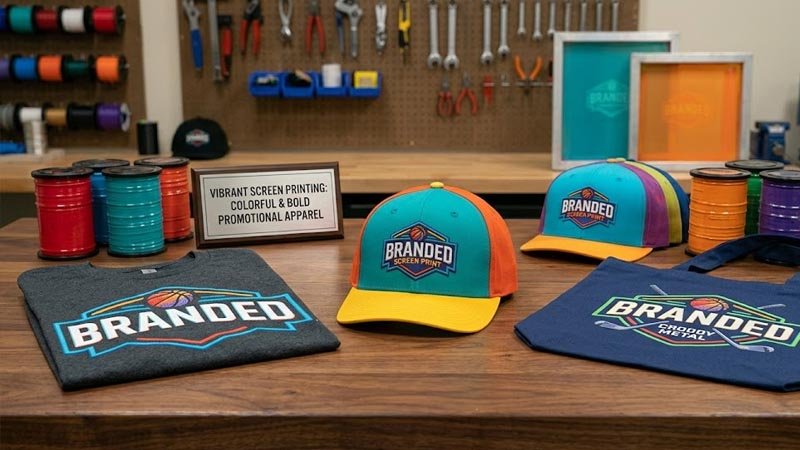
Screen printing is a decoration method that uses ink and a mesh screen to transfer the design onto fabric. Each color usually needs a separate screen.
The final effect is smooth, flat and colorful. Screen printing is very popular for T-shirts, hoodies, tote bags and promotional apparel.
For caps, screen printing can be used in some cases, but it depends on the cap material, panel structure and logo design.
Advantages of Screen Printing
1. Good for Large Graphic Designs
Screen printing works well for large graphics, bold text and simple flat artwork. If the design covers a wide area and does not need a raised texture, screen printing can be a practical choice.
2. Bright and Vibrant Colors
Screen printing can create strong and eye-catching colors. It is suitable for promotional designs that need high visual impact.
3. Cost-Effective for Large Quantities
For large orders with the same design, screen printing can be cost-effective because the setup cost is spread across the whole order.
This makes it popular for event merchandise, promotional apparel and large-volume campaigns.
4. Smooth Surface Feel
Unlike embroidery, screen printing does not add thread texture. The design stays flat on the fabric, which is suitable for some casual or lightweight products.
Limitations of Screen Printing on Caps
Screen printing is not always the best choice for caps because caps are not completely flat. Structured cap panels, curved surfaces, seams and textured fabrics can make printing more difficult.
Screen printing may not be ideal for:
Mesh trucker caps;
Highly curved front panels;
Thick or textured fabrics;
Small detailed logos on curved surfaces;
Premium brand caps that need a raised logo effect.
Printed logos may also fade or crack over time if the ink quality, curing process or washing care is not good.
Embroidery vs. Screen Printing: Key Differences
| Factor |
Embroidery |
Screen Printing |
| Logo Effect |
Raised, textured, premium |
Flat, smooth, colorful |
| Best For |
Custom caps, uniforms, polos, jackets |
T-shirts, tote bags, flat fabric products |
| Durability |
Very high |
Medium to high |
| Design Style |
Simple logos, text, emblems |
Large graphics, colorful designs |
| Color Performance |
Good for solid colors |
Good for vibrant and multicolor designs |
| Detail Level |
Limited for tiny details |
Better for fine graphics on flat surfaces |
| Cost Factor |
Stitch count, logo size, complexity |
Number of colors, screens, print area |
| Best Order Type |
Premium branding and long-term use |
Bulk promotional printing |
| Cap Compatibility |
Very strong |
Limited by surface and material |
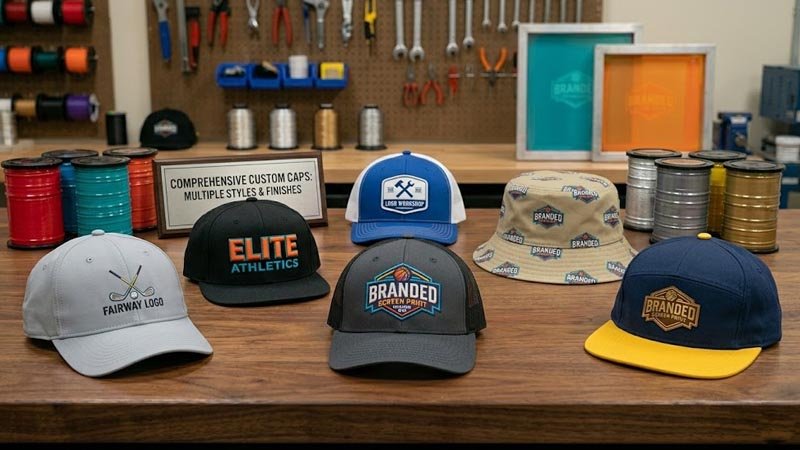
Baseball Caps
Baseball caps are one of the best products for embroidery. Flat embroidery is ideal for clean logos, while 3D puff embroidery works well for bold front designs.
Recommended methods:
Flat embroidery;
3D puff embroidery;
Embroidered patch;
Woven patch.
Snapback Caps
Snapback caps are often used for streetwear, sports and fashion brands. Their structured front panels are perfect for bold embroidery.
Recommended methods:
3D puff embroidery;
Flat embroidery;
Woven patch;
Rubber patch.
Trucker Caps
Trucker caps usually have a foam, cotton or twill front panel with mesh back panels. Embroidery or patches are usually applied to the front panel.
Recommended methods:
Flat embroidery;
Embroidered patch;
Woven patch;
Leather patch.
Screen printing is usually not recommended on the mesh back.
Golf Caps
Golf caps often require a clean, premium and professional logo. Flat embroidery is usually the best option.
Recommended methods:
Flat embroidery;
Small side embroidery;
Woven label;
Subtle back logo embroidery.
Bucket Hats
Bucket hats can use embroidery for small front logos or side logos. For casual fashion designs, printing may also be used depending on the fabric.
Recommended methods:
Flat embroidery;
Woven patch;
All-over printing;
Small screen printing.
5-Panel Caps
5-panel caps often have a flatter front panel, which allows more decoration flexibility.
Recommended methods:
Flat embroidery;
Woven patch;
Screen printing;
Heat transfer logo.
Logo placement also affects the final look and production method.
Front Panel
The front panel is the most common position for main branding. It is best for embroidery, 3D puff embroidery and patches.
Side Panel
Side embroidery is suitable for small logos, flags, slogans or secondary branding.
Back Panel
The back panel can be used for a website, short slogan, brand name or small embroidered logo.
Brim
The brim can be decorated with small embroidery, woven labels or printed details, depending on the design.
Inner Tape and Sweatband
For private label and retail brands, inner tape and sweatband customization can help create a complete branded product.
How to Choose Based on Your Logo Design
Choose embroidery if your logo has:
Simple lines;
Solid colors;
Clear text;
Small to medium size;
Professional brand style;
Long-term use requirements.
Choose screen printing if your logo has:
Large flat graphics;
Many colors;
Gradients;
Fine artwork;
Promotional style;
A large printing area.
Choose woven patch if your logo has:
Small text;
Detailed patterns;
Thin lines;
Label-style design;
Retail branding needs.
Choose 3D puff embroidery if your logo has:
Bold letters;
Thick lines;
Simple shapes;
Streetwear style;
Strong visual impact.
Cost Comparison for Bulk Buyers
For bulk buyers, cost is always an important factor. However, the cheapest method is not always the best choice. The right method should match the product value, brand image and usage purpose.
What Affects Embroidery Cost?
Embroidery cost is mainly affected by:
Stitch count;
Logo size;
Embroidery area;
Thread colors;
Flat or 3D puff embroidery;
Cap structure;
Order quantity.
A larger filled logo usually costs more because it needs more stitches and more machine time. Even if the logo uses only one color, a large design may still cost more than a small multi-color design.
What Affects Screen Printing Cost?
Screen printing cost is mainly affected by:
Number of colors;
Number of screens;
Printing size;
Ink type;
Fabric type;
Setup cost;
Order quantity.
For screen printing, each color normally requires a separate screen. This means a multi-color design may have a higher setup cost.
Which Is More Cost-Effective?
For premium custom caps, embroidery is usually worth the investment because it improves the product’s perceived value.
For large-volume promotional apparel or simple flat designs, screen printing may be more cost-effective.
For detailed logos on caps, woven patches may offer a good balance between cost, detail and appearance.
Recommended Logo Method by Buyer Type
| Buyer Type |
Recommended Method |
| Corporate Uniform Buyers |
Flat embroidery |
| Sports Teams |
Flat embroidery or 3D puff embroidery |
| Streetwear Brands |
3D puff embroidery or woven patch |
| Golf Clubs |
Flat embroidery |
| Outdoor Brands |
Embroidered patch or leather patch |
| Event Companies |
Simple embroidery or screen printing |
| Retail Fashion Brands |
Woven patch, embroidered patch or 3D embroidery |
| Schools and Clubs |
Flat embroidery |
| Promotional Gift Buyers |
Embroidery for caps, screen printing for apparel |
Common Mistakes to Avoid Before Production
1. Using Embroidery for Very Small Text
Small text may not be clear when embroidered. If the letters are too tiny, a woven patch may be better.
2. Choosing 3D Puff Embroidery for Thin Lines
3D puff embroidery needs bold shapes. Thin lines and small details may not work well.
3. Ignoring the Cap Surface
Caps have curved panels and seams. A design that looks good on a flat screen may not work perfectly on a cap.
4. Making the Logo Too Large
A very large embroidered logo can make the front panel stiff or cause slight puckering. Proper logo sizing is important.
5. Not Checking a Sample
For bulk orders, it is always better to check a sample before mass production. This helps confirm logo size, color, placement and final effect.
Factory Recommendation
From a factory perspective, the best logo method should be selected after checking the logo artwork, cap structure, fabric type, order quantity and target market.
As a Guangzhou-based high-end custom hat and OEM/ODM manufacturer with 15 years of experience, GUANGZHOU EASTLUCKY Hat & Garment Co., Ltd. supports global brands from design sampling to mass production. With professional R&D, production and distribution capabilities, EASTLUCKY helps buyers choose suitable decoration methods such as flat embroidery, 3D puff embroidery, woven patches, embroidered patches, screen printing and other custom solutions.
For bulk buyers, working with an experienced custom cap factory can reduce production risks, improve logo quality and ensure more consistent results from sample to mass production.
Final Recommendation: Embroidery or Screen Printing?
If you are ordering custom caps, embroidery is usually the better choice for most projects. It is durable, professional and suitable for structured cap panels.
Choose embroidery if you want:
A premium logo effect;
Long-lasting branding;
Custom caps for uniforms;
Corporate or team caps;
A professional product image.
Choose screen printing if you want:
Large flat graphics;
Colorful promotional designs;
Cost-effective bulk printing;
Designs on flatter fabric products;
Casual event merchandise.
For many custom cap projects, buyers may also consider woven patches, embroidered patches or 3D puff embroidery depending on the logo and brand style.
The best choice is not always one single method. It depends on your design, cap style, fabric, budget and target market.
Conclusion
Embroidery and screen printing are both useful decoration methods, but they serve different purposes.
For custom caps, embroidery is usually the preferred option because it offers a raised, durable and premium logo effect. It works especially well on baseball caps, snapback caps, golf caps, trucker caps and uniform caps.
Screen printing is better for large, colorful and flat designs, especially on T-shirts, tote bags and some promotional fabric products. It can be used on certain cap styles, but it is more limited by fabric surface and cap structure.
For bulk buyers, the best solution is to review the logo artwork, cap material, order quantity and branding purpose before production. A professional custom cap manufacturer can help recommend the most suitable method and make sure the final product matches your brand image.
Is embroidery better than screen printing for caps?
Yes, embroidery is usually better for custom caps because it is more durable and works well on structured hat panels. It also gives the cap a more premium and professional look.
Can screen printing be used on caps?
Yes, screen printing can be used on some caps, especially when the fabric surface is flat and smooth. However, it is not always suitable for curved, textured or mesh areas.
What is the best logo method for snapback caps?
For snapback caps, 3D puff embroidery and flat embroidery are very popular. Woven patches are also a good option for detailed logos.
What is the best logo method for trucker caps?
For trucker caps, embroidery or patches are usually applied to the front panel. The mesh back is generally not suitable for embroidery or screen printing.
Is 3D puff embroidery good for all logos?
No. 3D puff embroidery works best for bold letters and simple shapes. It is not suitable for thin lines, small text or highly detailed artwork.
Which method is more durable?
Embroidery is generally more durable because the logo is stitched into the fabric. Screen printing can also last well, but it may fade or crack over time depending on ink quality and care.
Which method is more cost-effective for bulk orders?
Screen printing can be more cost-effective for large-volume flat printing projects. However, for custom caps, embroidery often provides better value because it improves the product’s quality and brand image.
What file format is needed for embroidery?
Usually, buyers can provide AI, PDF, EPS, PNG or JPG artwork. The factory will convert the logo into an embroidery file before production.
Can small text be embroidered on caps?
Small text can be embroidered if the size is large enough. If the text is too small, a woven patch may provide better clarity.
Should I make a sample before bulk production?
Yes. For bulk custom cap orders, making a sample is strongly recommended. It helps confirm logo size, thread color, placement, cap fit and overall quality before mass production.
Custom White Golf Hats for Golf Events, Clubs and Brands
White golf hats are one of the most classic and practical accessories in the golf industry. They offer a clean appearance, comfortable wearing experience, reliable sun protection, and strong branding potential. For golf events, clubs, corporate activities, sports teams, and lifestyle brands, a custom white golf hat is more than a simple headwear item. It can become part of a uniform, a promotional gift, a retail product, or a memorable branded merchandise piece.
Because white is easy to match with different outfits and provides a clean background for logos, it has become a popular choice for golf tournaments, club uniforms, corporate golf events, and custom promotional campaigns. Whether you are planning a small club event or preparing bulk orders for a brand launch, choosing the right white golf hat can help improve both product value and brand image.
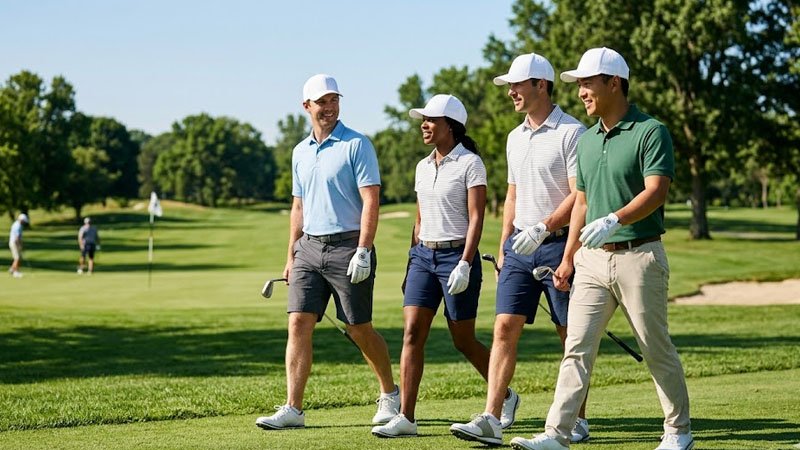
White has always been closely connected with golf fashion. It gives a fresh, clean, and professional look that fits the atmosphere of golf courses, country clubs, resorts, and outdoor sports events.
Unlike strong or seasonal colors, white is timeless. It can match almost any polo shirt, sports jacket, team uniform, or casual golf outfit. This makes white golf hats a safe and flexible choice for both individual golfers and bulk buyers.
For brands, white is also a strong background color. Logos, embroidered designs, woven patches, and printed graphics can stand out clearly on a white hat. This is especially useful when the hat is used for brand promotion, sponsorship events, or team identity.
Clean and Professional Appearance
A white golf hat gives a simple but premium impression. It looks neat, fresh, and suitable for both casual and formal golf occasions.
For golf clubs and corporate events, white hats help create a consistent and professional team image. When every player, staff member, or guest wears the same custom white hat, the event looks more organized and branded.
Easy to Match with Different Outfits
White is one of the easiest colors to coordinate. It works well with dark colors, bright colors, neutral tones, and branded uniforms.
This makes white golf hats ideal for events where participants may wear different clothing styles. Even if the apparel colors are not exactly the same, white hats can help create a unified visual effect.
Better Heat Reflection
Golf is often played under strong sunlight. Compared with darker colors, white reflects more sunlight and absorbs less heat. This can help the wearer feel cooler during long hours outdoors.
Of course, comfort also depends on the material, structure, sweatband, and ventilation design. But in warm weather, white is usually a practical color choice for outdoor sports hats.
Good Sun Protection
A golf hat helps protect the face, forehead, and eyes from direct sunlight. A suitable brim design can reduce glare and improve comfort during play.
For outdoor golf tournaments, corporate golf days, resort events, and summer promotional activities, sun protection is an important product benefit. Buyers can choose standard curved brims, wider brims, or performance golf cap designs depending on the final use.
Strong Logo Visibility
White golf hats are excellent for custom branding. A white background allows logos to look clean and easy to recognize.
Dark embroidery, colorful patches, rubber labels, and heat transfer designs can all create strong contrast on white hats. This makes custom white golf hats especially suitable for brand promotion, sponsor exposure, and event merchandise.

Custom white golf hats are suitable for many types of buyers and business needs.
Golf Clubs
Golf clubs can use custom white hats as member gifts, staff uniforms, pro shop merchandise, or tournament accessories. A clean embroidered club logo on a white hat can create a premium and professional look.
Golf Tournament Organizers
For golf tournaments, custom hats can be used as participant gifts, volunteer uniforms, sponsor merchandise, or event souvenirs. White hats are easy to match with different event colors and sponsor logos.
Corporate Event Buyers
Many companies organize golf events for clients, employees, partners, or VIP guests. Custom white golf hats with a company logo can work as practical and memorable corporate gifts.
Sports and Lifestyle Brands
For sports brands, resort brands, outdoor brands, and lifestyle labels, white golf hats can become part of a seasonal headwear collection. With the right material, logo technique, and packaging, they can be sold as retail products.
Promotional Product Distributors
White golf hats are also suitable for distributors who supply promotional gifts, branded apparel, and event products. They are easy to customize and have wide market demand.
Choosing the right material is one of the most important steps in custom hat production. Different materials create different looks, costs, and wearing experiences.
Cotton Golf Hats
Cotton is soft, breathable, and comfortable. It gives a natural hand feel and a classic appearance. Cotton white golf hats are suitable for golf clubs, resort merchandise, casual golf wear, and lifestyle brands.
Cotton is a good choice when the buyer wants a more traditional and premium look.
Polyester Golf Hats
Polyester is lightweight, durable, and suitable for outdoor sports. It can be used for performance golf hats, tournament hats, and promotional caps.
Polyester is often chosen for active use because it can support quick-dry and moisture-wicking features depending on the fabric type.
Performance Fabric Golf Hats
Performance fabrics are designed for sports and outdoor activities. They may include moisture-wicking, quick-dry, breathable, and lightweight properties.
For professional golf events, summer activities, and sports brands, performance fabrics can improve comfort and product value.
Mesh Back Golf Hats
Mesh back designs offer better ventilation. They are suitable for hot weather, outdoor events, and casual golf styles.
A white front panel with a mesh back can also create a sporty and relaxed look, making it suitable for golf teams, resort shops, and promotional campaigns.
How to Choose the Right Hat Style
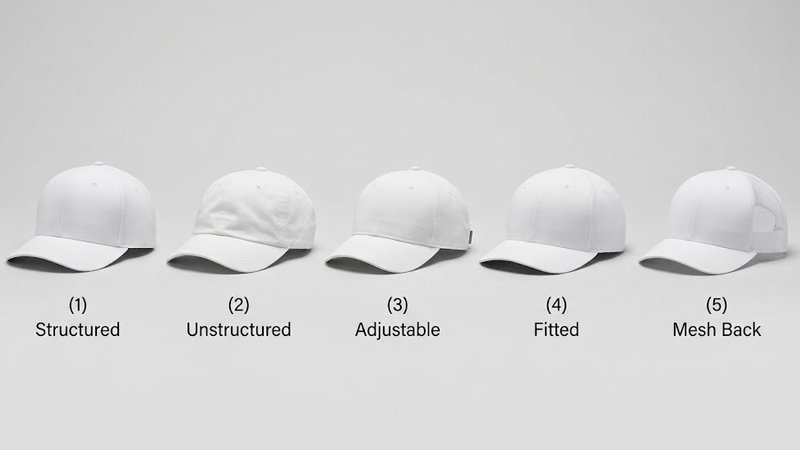
The style of the hat affects both appearance and wearing experience. Buyers should choose the right style based on the target customer, event type, and brand image.
Structured Golf Hats
Structured hats have a firmer front panel and keep their shape well. They look more professional and are suitable for corporate events, golf clubs, team uniforms, and branded merchandise.
Unstructured Golf Hats
Unstructured hats are softer and more relaxed. They are suitable for casual golf, lifestyle brands, resort products, and comfortable everyday wear.
Adjustable Golf Hats
Adjustable hats are very popular for events and bulk orders because they can fit different head sizes. Common closures include metal buckle, Velcro, plastic snapback, and fabric strap.
For golf events and promotional orders, adjustable hats are usually the most practical choice.
Fitted Golf Hats
Fitted hats provide a clean and secure fit, but they require more accurate size planning. They are suitable for premium retail collections, teams, and brand-specific projects.
Logo Customization Options for White Golf Hats
Logo customization is one of the biggest advantages of white golf hats. Since white provides a clean and neutral background, many logo methods can create a strong visual effect.
Embroidery
Embroidery is one of the most popular logo methods for golf hats. It gives the logo a textured, durable, and premium appearance.
Flat embroidery is suitable for most brand logos, text, and club names. 3D embroidery can create a raised effect and make the main logo more eye-catching.
For golf clubs, corporate events, and sports teams, embroidered white golf hats are a classic and professional choice.
Woven Patch
Woven patches are suitable for logos with small details, fine lines, or multiple colors. They create a clean and refined look.
This option is ideal for retail brands, private label collections, and logos that need better detail than standard embroidery can provide.
Rubber Patch
Rubber patches create a modern and sporty appearance. They are suitable for outdoor brands, sportswear brands, youth-focused designs, and performance-style hats.
On white golf hats, rubber patches can create strong contrast and a bold branding effect.
Heat Transfer Printing
Heat transfer printing is suitable for colorful logos, gradients, and complex graphics. It can show detailed artwork clearly and is often used for promotional or event hats.
For brands that want a lightweight logo effect without stitching, heat transfer can be a flexible option.
Inner Labels and Packaging Branding
Besides the front logo, buyers can also customize inner labels, woven labels, hangtags, stickers, polybags, and retail packaging. These details help improve the final presentation, especially for brand collections and retail products.
Bulk Order Tips for Golf Events, Clubs and Brands
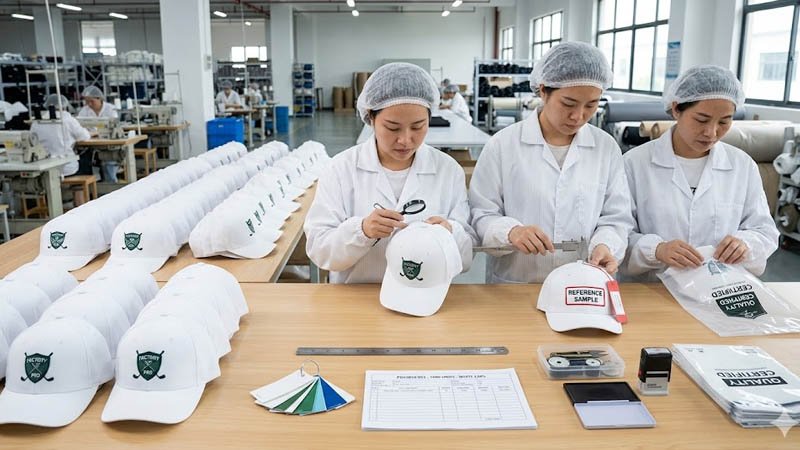
When ordering custom white golf hats in bulk, buyers should not only focus on the hat design. Production details, logo accuracy, packaging, and quality control are also important.
Confirm the Final Use
Before production, decide how the hats will be used. Are they for a golf tournament, club uniform, corporate gift, retail collection, or promotional giveaway?
The final use will affect the material, logo method, packaging, and budget.
Prepare Clear Logo Artwork
Vector logo files are recommended for custom production. Clear artwork helps improve embroidery, patch, and printing quality.
If the logo has small text or complex details, the supplier may suggest adjusting the logo size or choosing a better logo method.
Choose the Right Logo Position
The front center is the most common logo position. Other options include side embroidery, back embroidery, woven labels, or custom inner labels.
For sponsored golf events, multiple logo placements may be needed, such as event logo on the front and sponsor logo on the side.
Check the Sample Before Mass Production
A pre-production sample is very important for custom orders. Buyers should check the hat shape, material, logo color, embroidery quality, stitching, closure, and overall fit before approving bulk production.
Consider Packaging Requirements
Packaging can affect both presentation and shipping safety. Common packaging options include individual polybags, hangtags, barcode labels, branded stickers, custom boxes, and export cartons.
For structured hats, proper carton packing is important to protect the crown and brim during shipping.
Common Problems in White Hat Orders and How to Avoid Them
White hats look clean and premium, but they also require careful production and handling.
Problem 1: The Hat Gets Dirty Easily
White fabric can show dust and stains more clearly than darker colors. To reduce this issue, buyers can choose easy-care fabrics and request clean packing during production.
For retail or event distribution, individual polybag packing is recommended.
Problem 2: Logo Contrast Is Not Strong Enough
Light-colored logos may not stand out clearly on white hats. To improve visibility, choose stronger colors such as navy, black, dark green, red, or deep gray.
For a premium look, metallic embroidery colors such as gold or silver can also be considered.
Problem 3: Small Logo Details Are Not Clear
If a logo includes very small letters or fine lines, embroidery may not show every detail perfectly. In this case, a woven patch or heat transfer logo may be a better solution.
Problem 4: Hats Lose Shape During Shipping
Structured hats should be packed carefully to avoid crown deformation or brim damage. Proper stacking, inner support, and strong export cartons can help protect the shape.
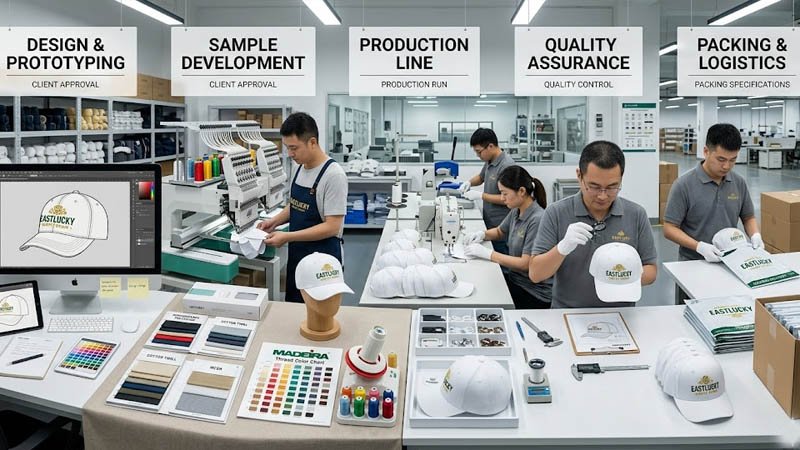
For custom white golf hats, production experience matters. A reliable manufacturer can help buyers choose the right fabric, logo method, structure, size, and packaging solution.
As a high-end custom hat and OEM/ODM manufacturer based in Guangzhou, China, GUANGZHOU EASTLUCKY Hat & Garment Co., Ltd. has 15 years of experience in professional R&D, production, and distribution of various hats and embroidered accessories. Guided by the philosophy “Quality as Root, Innovation as Soul,” EASTLUCKY provides global clients with one-stop solutions from design sampling to mass production, helping brands build efficient and high-quality supply chain services.
Proper care can help white golf hats stay clean and keep their shape.
Cleaning
Hand washing is recommended for most golf hats. Use mild detergent and lukewarm water. Avoid strong bleach or harsh chemicals, especially for embroidered logos or special patches.
Drying
Air dry the hat naturally. Avoid high heat because it may affect the brim shape, crown structure, or logo material.
Storage
Store hats in a clean, dry place. Avoid crushing the brim or stacking heavy products on top of structured hats.
For bulk stock, keep hats in proper cartons and protect them from moisture, dust, and pressure.
Are white golf hats good for outdoor events?
Yes. White golf hats are suitable for outdoor events because they look clean, reflect sunlight, and provide practical sun protection.
Can white golf hats be customized with company logos?
Yes. White golf hats can be customized with embroidery, woven patches, rubber patches, heat transfer printing, side logos, inner labels, and custom packaging.
What is the best logo method for white golf hats?
Embroidery is a classic and premium option. Woven patches are better for detailed logos. Rubber patches create a sporty look, while heat transfer is suitable for colorful graphics.
Are white golf hats suitable for golf tournaments?
Yes. They are widely used for golf tournaments, charity events, sponsor gifts, team uniforms, and participant giveaways.
What material is best for custom golf hats?
Cotton is suitable for a classic and soft feel. Polyester and performance fabrics are better for active outdoor use. Mesh designs are good for hot weather and better ventilation.
Can I order custom white golf hats in bulk?
Yes. Custom white golf hats are commonly ordered in bulk for golf clubs, brands, corporate events, promotional companies, and sports teams.
Conclusion
Custom white golf hats are a smart choice for golf events, clubs, and brands. They combine classic style, practical sun protection, comfortable wear, and strong logo visibility. Whether used as tournament gifts, club uniforms, corporate event merchandise, or retail products, white golf hats can deliver both function and brand value.
For bulk buyers, the key is to choose the right material, hat structure, logo method, and packaging. With clear artwork, proper sampling, and reliable production, custom white golf hats can become a professional and effective branding product for many golf-related projects.
How to Wear and Customize Bucket Hats for Fashion, Events and Brand Promotion
Bucket hats have become much more than a casual fashion accessory. Today, they are widely used in streetwear, outdoor activities, music festivals, corporate campaigns, school events, promotional gifts, and brand merchandise. Their soft shape, comfortable fit, and large customization area make them a practical and stylish choice for both everyday wear and brand promotion.
Whether you are a fashion brand developing a new collection, an event organizer looking for memorable merchandise, or a company searching for custom promotional hats, bucket hats offer a flexible solution. With the right fabric, color, brim style, and logo method, a simple bucket hat can become a powerful branded product.
In this guide, we will explain how to wear bucket hats for different occasions, how to choose the right style and material, and how to customize bucket hats for fashion, events, and brand promotion.
Why Bucket Hats Are Popular for Fashion and Brand Promotion
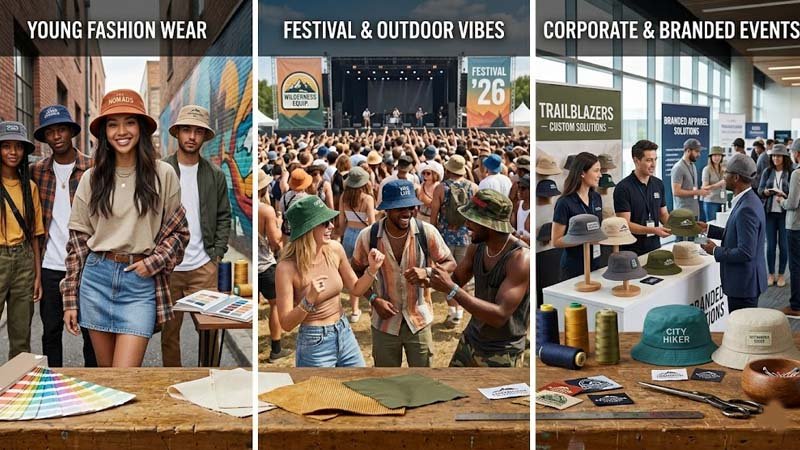
Bucket hats are popular because they combine style, comfort, and practicality. Unlike many other hat styles, bucket hats are easy to wear, suitable for different age groups, and can be matched with many types of outfits.
For fashion brands, bucket hats can be used as part of seasonal collections, streetwear lines, limited-edition drops, and lifestyle accessories. For promotional buyers, they are useful because they offer good logo visibility and practical daily use. For events, festivals, schools, and corporate campaigns, custom bucket hats can help create a strong and unified visual identity.
Another advantage is customization. Bucket hats can be made with different materials, colors, prints, embroidery, woven patches, labels, trims, and packaging. This makes them suitable for both retail and promotional markets.
A bucket hat may look simple, but small design details can change the final look completely. The crown height, brim width, structure, fabric, and logo position all affect the style.
For a casual look, soft cotton or denim bucket hats are easy to match with T-shirts, hoodies, jeans, and sneakers. For a more fashionable streetwear style, structured bucket hats with embroidery, woven patches, or bold colors can create a stronger visual effect. For outdoor and travel use, lightweight nylon or polyester bucket hats are practical because they are easy to fold, carry, and clean.
When choosing a bucket hat style, consider these questions:
What is the target market?
Will the hat be used for fashion, events, outdoor activities, or promotional gifts?
Does the design need a logo?
Should the hat look casual, premium, sporty, or trendy?
A clear product direction helps make the customization process easier and more accurate.
How to Wear a Bucket Hat for Different Face Shapes
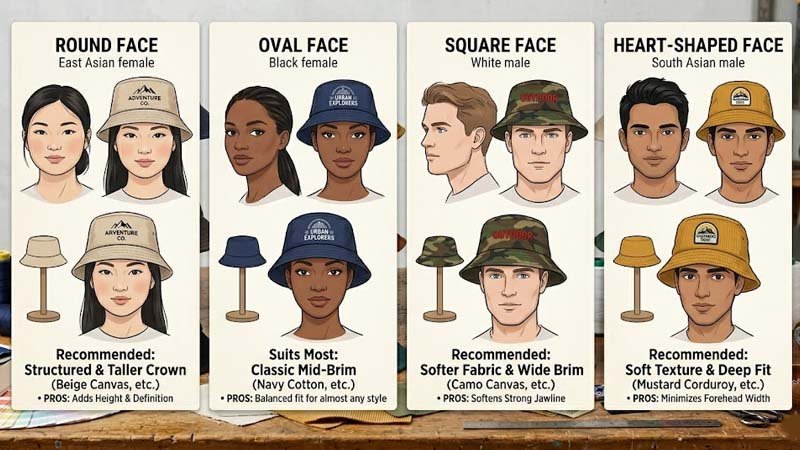
Choosing the right bucket hat shape can make the hat look more balanced and comfortable when worn.
Round Face
For a round face, a slightly taller crown or a more structured bucket hat can help add height. A medium brim is usually better than an overly wide brim because it keeps the face shape balanced.
Oval Face
Oval faces can wear most bucket hat styles easily. Short brims, wide brims, soft brims, structured designs, neutral colors, and bold patterns can all work well.
Square Face
For a square face, a softer bucket hat with a rounded brim can help soften strong facial lines. Avoid overly rigid shapes if you want a more relaxed look.
Heart-Shaped Face
For a heart-shaped face, a medium-brim bucket hat is usually a good choice. It helps balance the forehead and chin without making the upper face look too wide.
For brands, offering a comfortable standard size or adjustable design can make the product suitable for more users.
The brim is one of the most important design elements of a bucket hat. It affects both style and function.
Short Brim Bucket Hats
Short brim bucket hats are popular in streetwear and fashion collections. They look clean, modern, and easy to match with casual outfits. This style is suitable for youth brands, fashion labels, and lifestyle merchandise.
Wide Brim Bucket Hats
Wide brim bucket hats provide better sun protection and are suitable for outdoor, beach, travel, fishing, camping, and summer events. They are a good choice for outdoor brands and tourism-related promotions.
Structured Brim Bucket Hats
A structured brim gives the hat a neater and more premium look. It is suitable for fashion brands, retail products, and corporate promotional gifts that require a clean appearance.
Floppy Brim Bucket Hats
A floppy brim creates a soft, relaxed, and vacation-style look. It is suitable for beachwear, resort products, festivals, and casual lifestyle brands.
When customizing bucket hats, the brim should match the customer group and wearing occasion. For example, outdoor buyers may prefer a functional wide brim, while streetwear brands may prefer a short and structured brim.
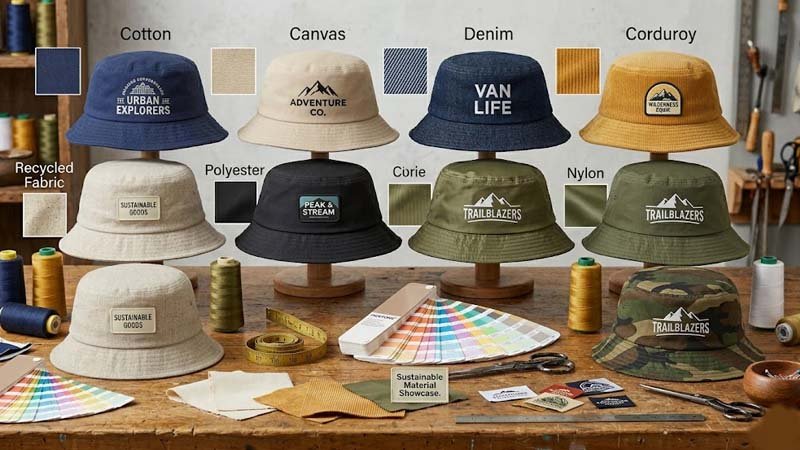
Material affects comfort, appearance, durability, cost, and seasonality. For custom bucket hats, fabric selection is one of the most important steps.
Cotton Bucket Hats
Cotton is soft, breathable, and comfortable. It is suitable for daily fashion, schools, summer events, casual brands, and promotional gifts. Cotton also works well with embroidery, woven labels, and printed logos.
Best for: casual fashion, summer promotions, schools, lifestyle brands.
Canvas Bucket Hats
Canvas is thicker and more durable than regular cotton. It gives the hat a stronger structure and a more premium feeling.
Best for: outdoor brands, workwear style, streetwear, premium promotional products.
Denim Bucket Hats
Denim bucket hats have a classic and youthful look. They are suitable for casual fashion, lifestyle brands, and retail collections.
Best for: youth fashion, streetwear, lifestyle merchandise.
Nylon Bucket Hats
Nylon is lightweight, water-resistant, and easy to fold. It is very suitable for outdoor activities and travel.
Best for: hiking, camping, fishing, travel, sports events, outdoor promotions.
Polyester Bucket Hats
Polyester is durable, cost-effective, and suitable for large-volume orders. It can also support bright colors and some printing techniques.
Best for: bulk promotional gifts, corporate events, festivals, budget-friendly campaigns.
Corduroy Bucket Hats
Corduroy has a warm, vintage, and textured look. It is suitable for autumn and winter fashion collections.
Best for: seasonal fashion, vintage brands, fall and winter collections.
Recycled Fabric Bucket Hats
Recycled polyester or eco-friendly fabric options are suitable for brands that focus on sustainability.
Best for: eco-conscious brands, sustainable campaigns, green promotional projects.
How to Choose Colors and Patterns
Color is not only a fashion choice. For custom bucket hats, it is also part of brand identity.
Neutral Colors
Black, white, beige, navy, khaki, and gray are easy to match with different outfits. These colors are suitable for corporate gifts, uniforms, schools, and retail basics.
Bright Colors
Red, yellow, orange, green, purple, and royal blue can make bucket hats more eye-catching. They are suitable for festivals, youth events, sports promotions, and brand campaigns.
Custom Patterns
Tie-dye, camouflage, floral, checkered, stripes, and all-over logo prints can make bucket hats more distinctive. Patterned bucket hats are especially suitable for fashion brands, music festivals, and limited-edition merchandise.
For brand promotion, color consistency is important. If the hat is part of a campaign or merchandise collection, the fabric color should match the brand logo, event theme, or Pantone color requirement.
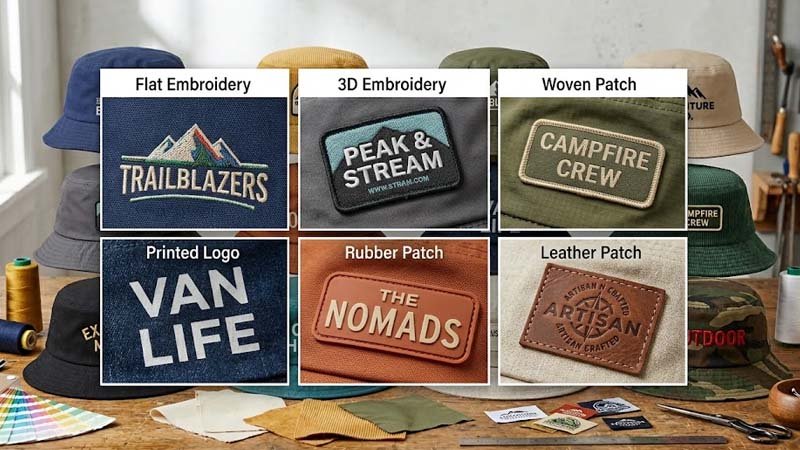
Logo customization is one of the biggest advantages of bucket hats. Different logo methods create different visual effects and price levels.
Flat Embroidery
Flat embroidery is clean, durable, and professional. It is suitable for simple logos, brand names, text, and icons.
Best for: corporate logos, fashion brands, schools, retail collections.
3D Embroidery
3D embroidery creates a raised logo effect. It looks bold and eye-catching.
Best for: streetwear brands, sports brands, bold logo designs.
Woven Patch
Woven patches are suitable for detailed logos and small text. They create a premium label-style look.
Best for: outdoor brands, fashion labels, vintage-style bucket hats.
Printed Logo
Printing is suitable for colorful artwork, gradients, large graphics, and event designs.
Best for: promotional campaigns, music festivals, colorful brand artwork.
Rubber Patch
Rubber patches create a modern, sporty, and durable look.
Best for: outdoor products, sportswear brands, travel accessories.
Leather Patch
Leather patches create a premium and natural look.
Best for: lifestyle brands, outdoor brands, premium retail products.
When choosing a logo method, buyers should consider the logo complexity, fabric type, target price, order quantity, and final product positioning.
Custom bucket hats can be developed in many ways depending on the brand’s needs.
Common customization options include:
Fabric: cotton, canvas, denim, nylon, polyester, corduroy, recycled fabric.
Color: standard colors, custom dyed colors, or Pantone color matching.
Logo: embroidery, woven patch, woven label, printing, rubber patch, leather patch.
Brim: short brim, wide brim, structured brim, soft brim, floppy brim.
Size: adult size, kids size, custom size, or adjustable design.
Details: eyelets, lining, sweatband, chin strap, inner label, care label.
Packaging: individual polybag, custom hang tag, barcode label, retail packaging.
For brand buyers, these options help create a product that matches the market, price range, and visual identity.

Bucket hats are easy to style because they can work with both casual and branded outfits.
Casual Daily Wear
For daily wear, a cotton or denim bucket hat pairs well with T-shirts, hoodies, jeans, shorts, and sneakers. Neutral colors are easy to match and suitable for everyday use.
Streetwear Fashion
For streetwear, choose a structured bucket hat with embroidery, patches, bold colors, or contrast stitching. It can be styled with oversized T-shirts, cargo pants, jackets, and sneakers.
Smart Casual Looks
A simple bucket hat in black, beige, navy, or gray can be paired with a blazer, trench coat, knitwear, or clean shirt. This creates a relaxed but stylish look.
Music Festivals
For music festivals, printed bucket hats, tie-dye colors, bright colors, and bold logos are popular. They are both stylish and practical for outdoor use.
Beach and Resort Wear
For beachwear, lightweight cotton, polyester, or nylon bucket hats work well. Wide brims, soft fabrics, and tropical patterns create a relaxed vacation feeling.
Outdoor and Travel
For hiking, camping, fishing, and travel, choose nylon or polyester bucket hats with water resistance, sun protection, and a secure fit. A chin strap or adjustable drawstring can be useful.
Corporate and Promotional Events
For corporate events, choose clean colors and simple logos. Black, navy, white, beige, and gray bucket hats with embroidery or woven patches can create a professional branded look.
Fashion brands can use bucket hats as part of seasonal collections, capsule collections, streetwear lines, or limited-edition merchandise.
For fashion use, design details are very important. Fabric texture, stitching quality, logo placement, color matching, and label design all influence the final product value. Cotton, canvas, denim, corduroy, and recycled fabrics are commonly used for fashion bucket hats.
Fashion brands can also create different versions, such as embroidered bucket hats, reversible bucket hats, printed bucket hats, or patch bucket hats, to meet different market needs.
Bucket hats are ideal for events because they are wearable, useful, and easy to customize. Compared with many small promotional items, a hat has a larger logo area and stronger visual impact.
Custom bucket hats can be used for:
Music festivals
Sports events
School activities
Outdoor campaigns
Brand launches
Trade shows
Team building events
Tourism promotions
For events, polyester or cotton bucket hats are often practical choices. They can be customized with event logos, sponsor names, slogans, dates, or colorful artwork.
Custom Bucket Hats for Brand Promotion
For brand promotion, bucket hats can help increase visibility because people can wear them repeatedly after the event. A well-designed bucket hat does not feel like a simple giveaway. It can become a practical fashion item that customers enjoy using.
Promotional bucket hats are suitable for:
Corporate gifts
Retail giveaways
Influencer campaigns
Employee uniforms
Product launch gifts
Outdoor advertising campaigns
Souvenir merchandise
To improve the promotional effect, brands should choose a design that people actually want to wear. Simple colors, comfortable materials, and a clean logo usually work better than overly complicated designs.
For brands and promotional buyers, working with an experienced manufacturer can make the custom bucket hat process more efficient and reliable.
GUANGZHOU EASTLUCKY Hat & Garment Co., Ltd. is a high-end custom hat and OEM/ODM manufacturer based in Guangzhou, China, with 15 years of expertise in professional R&D, production, and distribution of various hats and embroidered accessories. Guided by the philosophy “Quality as Root, Innovation as Soul,” we provide global clients with one-stop solutions from design sampling to mass production, enabling efficient and high-quality supply chain services for brands.
From material selection and logo development to sampling, mass production, quality control, and packaging, professional factory support helps brands achieve better product consistency and smoother project management.
Choosing the Wrong Size
A bucket hat that is too tight will feel uncomfortable, while one that is too loose may look unstable or fall off easily. For bulk orders, size confirmation is very important.
Ignoring the Target Market
A hat for a fashion brand may need better fabric and detailed logo work, while a hat for a large event may need a more cost-effective material and simple branding.
Choosing the Wrong Material
Thick fabrics may not be suitable for hot summer events, while thin fabrics may not feel premium enough for retail fashion collections.
Using an Overly Complicated Logo
Some logos are too detailed for embroidery. In this case, woven patches or printing may be better options.
Over-Designing the Hat
Too many colors, patches, labels, and accessories can make the hat look messy. A clean and wearable design often performs better.
Before placing a bulk order, buyers should confirm the key production details. This helps avoid misunderstanding and ensures the final product matches the design expectation.
Important details include:
Material and fabric weight
Hat size and brim width
Hat color and Pantone color requirement
Logo file and logo size
Logo decoration method
MOQ and unit price
Sample cost and sample lead time
Bulk production time
Packaging method
Shipping terms
Quality inspection standards
If the bucket hats are for retail, buyers may also need custom labels, hang tags, barcodes, and individual packaging.
Conclusion
Bucket hats are stylish, practical, and highly customizable. They can be worn for daily fashion, streetwear, outdoor activities, beach trips, music festivals, corporate campaigns, and brand promotions. With the right material, color, brim style, logo method, and fit, a bucket hat can become much more than an accessory — it can become a strong branded product.
For fashion brands, bucket hats can add value to a collection. For event organizers, they can create memorable merchandise. For companies and promotional buyers, they can increase brand visibility in a practical and wearable way.
When planning a custom bucket hat project, buyers should consider the target market, fabric, logo technique, color matching, size, packaging, and production requirements. A well-designed custom bucket hat can help a brand stand out and give customers a product they will continue to wear.
Are bucket hats still popular?
Yes. Bucket hats remain popular in streetwear, outdoor fashion, music festivals, travel, and promotional products. Their simple shape and flexible styling make them suitable for many markets.
How do you wear a bucket hat stylishly?
You can wear a bucket hat with casual outfits, hoodies, T-shirts, oversized shirts, denim jackets, sneakers, beachwear, or outdoor clothing. The key is to match the color, material, and brim style with the outfit.
Can bucket hats be customized with a logo?
Yes. Bucket hats can be customized with embroidery, woven patches, woven labels, printed logos, rubber patches, leather patches, and other branding methods.
What is the best material for custom bucket hats?
Cotton is good for casual and breathable designs. Canvas is durable and structured. Nylon is lightweight and water-resistant. Polyester is cost-effective for bulk promotional orders. Corduroy is suitable for vintage and winter styles.
Which logo method is best for bucket hats?
Flat embroidery is suitable for simple logos. Woven patches are better for detailed designs. Printing is suitable for colorful artwork. Rubber patches are suitable for sporty or outdoor designs.
Are bucket hats good for events?
Yes. Bucket hats are excellent for events because they are wearable, visible, practical, and easy to customize with event logos, sponsor names, slogans, or colorful artwork.
Are bucket hats suitable for brand promotion?
Yes. Custom bucket hats are suitable for brand promotion because they can be worn repeatedly, provide good logo exposure, and work well for corporate gifts, retail giveaways, festivals, and outdoor campaigns.
Can I make private label bucket hats?
Yes. Private label bucket hats can include custom woven labels, care labels, hang tags, packaging, barcode labels, and brand-specific design details.
What should I prepare before ordering custom bucket hats?
You should prepare the logo file, target quantity, preferred material, color requirements, size details, logo method, packaging needs, and expected delivery time.
What are common uses for custom bucket hats?
Custom bucket hats are commonly used for fashion collections, music festivals, outdoor events, corporate promotions, school activities, sports events, tourism souvenirs, and retail merchandise.
Best Fabric for Custom Baseball Caps: A Complete Guide for Bulk Buyers
Choosing the right fabric is one of the most important steps in custom baseball cap production. For many buyers, the first things they consider are cap style, logo design, color, and price. However, the fabric directly affects the comfort, durability, breathability, shape, logo effect, and final quality of the cap.
For bulk buyers, choosing the wrong fabric can lead to poor embroidery results, uncomfortable wear, color inconsistency, shrinkage problems, and higher after-sales risk. That is why fabric selection should be confirmed before sampling and mass production.
In this guide, we will explain the most popular fabric options for custom baseball caps, compare their pros and cons, and help brands, wholesalers, promotional companies, and OEM/ODM buyers choose the right material for different markets and applications.
Fabric is not only the outer material of a cap. It is the foundation that determines how the cap looks, feels, and performs.
A good fabric can improve:
- Wearing comfort
- Breathability
- Durability
- Cap structure
- Embroidery quality
- Printing effect
- Color consistency
- Bulk production stability
For example, cotton twill is often used for classic embroidered baseball caps because it has a stable surface and natural hand feel. Polyester is widely used for sports and promotional caps because it is durable, colorfast, and suitable for bulk production. Nylon is preferred for outdoor and travel caps because it is lightweight and quick-drying.
As a high-end custom hat and OEM/ODM manufacturer based in Guangzhou, China, GUANGZHOU EASTLUCKY Hat & Garment Co., Ltd. has 15 years of expertise in professional R&D, production, and distribution of various hats and embroidered accessories. Guided by the philosophy “Quality as Root, Innovation as Soul,” EASTLUCKY provides global clients with one-stop solutions from design sampling to mass production, helping brands build efficient and high-quality custom hat supply chains.
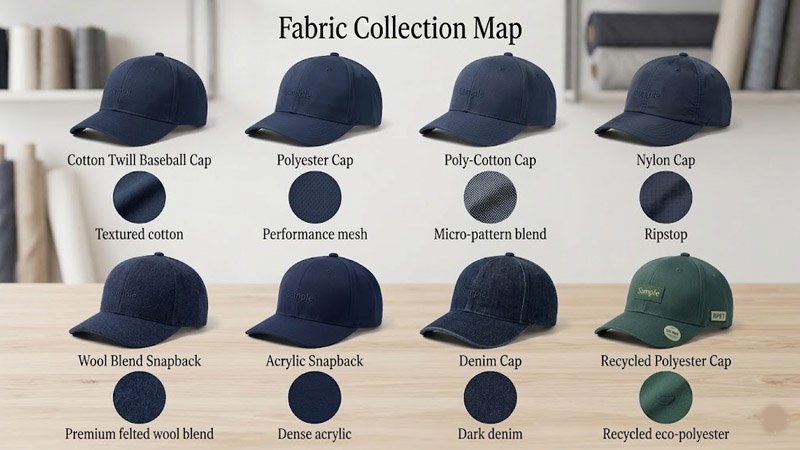
1. Cotton
Cotton is one of the most popular fabrics for custom baseball caps. It is soft, breathable, comfortable, and suitable for daily wear. Cotton caps are widely used for lifestyle brands, corporate gifts, school caps, retail merchandise, and embroidered baseball caps.
Cotton gives the cap a natural feel and classic appearance, making it a good choice for buyers who want a comfortable and premium-looking product.
Pros of Cotton Baseball Caps
Soft and Comfortable
Cotton feels natural and gentle on the skin, making it suitable for all-day wear.
Good Breathability
Cotton allows air to pass through more easily than many synthetic fabrics, which makes it a good option for warm weather and casual wear.
Suitable for Embroidery
Cotton twill provides a stable surface for flat embroidery, 3D embroidery, and embroidered patches.
Classic Appearance
Cotton caps often have a clean, casual, and timeless look, which is suitable for fashion brands and corporate branding.
Cons of Cotton Baseball Caps
May Shrink After Washing
Cotton can shrink if it is not properly treated or washed correctly.
Less Durable Than Synthetic Fabrics
Compared with polyester or nylon, cotton may not be the best option for heavy outdoor use.
Absorbs Sweat
Cotton absorbs moisture, which can make the cap feel heavier in very humid conditions.
Best For
Cotton baseball caps are best for casual wear, embroidered caps, school caps, corporate gifts, lifestyle brands, and retail collections.
Buyer Tip
For embroidered baseball caps, cotton twill is usually more stable than very thin cotton fabrics. If your logo includes small text, dense stitches, or fine details, it is better to confirm an embroidery sample before bulk production.
2. Cotton Twill
Cotton twill is one of the most commonly used fabrics for baseball caps. It has a diagonal weave that gives the fabric better strength and structure.
This fabric is especially suitable for classic baseball caps, dad hats, curved-brim caps, and custom embroidered caps.
Pros of Cotton Twill
Stable for Embroidery
The twill structure helps the embroidery stay clean and flat.
Good Shape Support
Cotton twill gives the cap a classic and slightly structured look.
Comfortable for Daily Wear
It keeps the natural softness of cotton while offering better durability.
Premium Look
Cotton twill is suitable for brand caps, retail caps, and high-quality promotional products.
Cons of Cotton Twill
Higher Cost Than Basic Polyester
Cotton twill may cost more than standard polyester fabric.
Needs Proper Washing Care
It may shrink or wrinkle if washed with high heat.
Best For
Cotton twill is best for custom embroidered baseball caps, corporate caps, brand merchandise, dad hats, and premium casual caps.
Buyer Tip
If your project focuses on embroidery quality, cotton twill is one of the safest fabric choices. It works well for both flat embroidery and 3D puff embroidery.
3. Polyester
Polyester is a synthetic fabric widely used in sports caps, promotional caps, event caps, and large-volume custom baseball caps. It is durable, colorfast, cost-effective, and easy to maintain.
For bulk buyers who need stable quality and competitive pricing, polyester is often a practical option.
Pros of Polyester Baseball Caps
Durable and Long-Lasting
Polyester has strong resistance to daily wear and is suitable for frequent use.
Good Color Retention
Polyester holds color well, making it suitable for bright brand colors and large promotional campaigns.
Cost-Effective for Bulk Orders
Polyester is usually more budget-friendly than many premium natural fabrics.
Suitable for Performance Fabrics
Moisture-wicking polyester can help keep the wearer dry during sports and outdoor activities.
Cons of Polyester Baseball Caps
Less Breathable Than Cotton
Standard polyester may feel warmer in hot weather if the cap does not have ventilation or mesh panels.
Synthetic Hand Feel
Some customers may prefer the natural feel of cotton.
Logo Method Needs Testing
For heat transfer or printing, temperature and pressure should be tested before bulk production.
Best For
Polyester caps are best for sports teams, promotional gifts, event caps, outdoor activities, company giveaways, and large-volume orders.
Buyer Tip
If your order quantity is large and your budget is limited, polyester is a good choice. For sports use, choose moisture-wicking polyester instead of standard polyester.
4. Poly-Cotton Blends
Poly-cotton blends combine the softness of cotton with the durability of polyester. This fabric is a balanced option for buyers who want comfort, durability, and reasonable cost.
It is commonly used for custom baseball caps, school caps, company uniforms, promotional caps, and daily-wear caps.
Pros of Poly-Cotton Caps
Balanced Comfort and Strength
Cotton improves softness, while polyester improves durability.
Better Shape Retention Than Pure Cotton
The polyester content helps the cap maintain its shape.
Suitable for Many Logo Methods
Poly-cotton can work well with embroidery, woven patches, and some printing methods.
Good for General Bulk Orders
It is practical for many markets and customer groups.
Cons of Poly-Cotton Caps
Not as Soft as 100% Cotton
The hand feel may be slightly less natural than pure cotton.
Not as Technical as Performance Polyester
For high-intensity sports or outdoor performance, technical polyester or nylon may be better.
Best For
Poly-cotton caps are best for corporate gifts, school caps, casual caps, event caps, and medium-to-large bulk orders.
Buyer Tip
Poly-cotton is a safe choice when you want a balance between price, comfort, and durability. It is especially suitable for promotional buyers who need reliable quality without choosing a premium material.
5. Nylon
Nylon is lightweight, strong, and quick-drying. It is commonly used for outdoor caps, running caps, hiking caps, fishing caps, travel caps, and performance headwear.
For brands that focus on outdoor activities or active lifestyles, nylon is a valuable fabric option.
Pros of Nylon Baseball Caps
Lightweight
Nylon caps are easy to wear and comfortable for sports or travel.
Quick-Drying
Nylon dries faster than cotton, making it suitable for humid environments and outdoor use.
Water-Resistant Options Available
Some nylon fabrics can be finished with water-resistant coatings.
Strong and Flexible
Nylon is durable while staying soft and packable.
Cons of Nylon Baseball Caps
Less Breathable Than Cotton
Without mesh panels or ventilation holes, nylon may feel warm.
Smooth Synthetic Feel
Some buyers may prefer the textured appearance of cotton twill or canvas.
Embroidery Requires Care
Thin nylon may need proper backing to avoid puckering during embroidery.
Best For
Nylon caps are best for outdoor brands, travel caps, fishing caps, running caps, hiking caps, and quick-dry performance caps.
Buyer Tip
For nylon caps, heat transfer logos, rubber patches, woven patches, or silicone labels are often better choices than heavy embroidery, especially when the fabric is thin.
6. Wool and Wool Blends
Wool and wool blends are often used for premium snapbacks, winter caps, structured baseball caps, and classic professional-style caps. Wool provides warmth, texture, and good shape retention.
For brands that want a high-end or traditional look, wool blend fabric is a strong choice.
Pros of Wool Baseball Caps
Premium Appearance
Wool gives the cap a refined and structured look.
Good Shape Retention
Wool blend caps can hold the crown shape well.
Warm for Cold Weather
Wool is suitable for autumn and winter collections.
Good for Embroidery and Patches
Wool blends work well with embroidered logos, woven patches, and leather patches.
Cons of Wool Baseball Caps
Higher Cost
Wool and wool blends are usually more expensive than cotton or polyester.
Requires More Care
Wool caps need careful washing and storage.
Not Suitable for Hot Weather
Wool is warmer and less breathable than cotton or nylon.
Best For
Wool caps are best for premium snapbacks, winter caps, retail collections, professional team-style caps, and high-end branded merchandise.
Buyer Tip
If your brand wants a premium snapback or structured cap, wool blend fabric can create a more upscale look. However, it may not be the best choice for summer events or low-budget promotional orders.
7. Acrylic
Acrylic is often used as a cost-effective alternative to wool. It is common in snapbacks, winter hats, and structured caps. Acrylic keeps its shape well and can be dyed in bright colors.
Pros of Acrylic Caps
Good Shape Retention
Acrylic helps structured caps maintain a firm shape.
Affordable Alternative to Wool
It gives a similar look at a lower cost.
Bright Color Options
Acrylic can be dyed in vibrant colors.
Suitable for Snapbacks
It works well for flat-brim caps and hip-hop-style hats.
Cons of Acrylic Caps
Less Breathable
Acrylic is not as breathable as cotton.
Synthetic Feel
It may not feel as natural as cotton or wool.
Not Ideal for Hot Weather
Acrylic is better for structured or cooler-weather designs.
Best For
Acrylic caps are best for snapbacks, hip-hop hats, structured caps, winter caps, and cost-conscious premium-looking designs.
Buyer Tip
Acrylic is a good option when buyers want the structure of a snapback but need better cost control than wool blend fabric.
8. Denim
Denim is a strong and stylish fabric used for fashion baseball caps, vintage caps, streetwear caps, and lifestyle collections. It gives the cap a unique texture and casual look.
Denim caps are especially suitable for brands that want a retro, youthful, or fashion-forward style.
Pros of Denim Baseball Caps
Fashionable and Unique
Denim gives the cap a strong casual and streetwear style.
Durable
Denim is strong and long-lasting.
Good for Vintage Designs
Washed denim caps are popular for retro and lifestyle brands.
Works Well with Patches
Denim pairs well with leather patches, woven patches, and embroidery.
Cons of Denim Baseball Caps
Heavier Than Other Fabrics
Denim may feel less comfortable in hot weather.
Less Breathable
It is not the best choice for sports or summer outdoor events.
Color Variation Needs Control
Washed denim may have color differences, so sample approval is important before bulk production.
Best For
Denim caps are best for fashion brands, streetwear collections, vintage-style caps, lifestyle merchandise, and retail gift products.
Buyer Tip
If you choose washed denim, confirm the washing effect and color shade before mass production. Denim color variation can be part of the style, but it should still meet brand requirements.
9. Recycled Polyester
Recycled polyester, often made from recycled plastic bottles or polyester waste, is becoming more popular among eco-conscious brands. It provides durability while supporting sustainability-focused marketing.
For brands targeting environmentally responsible products, recycled polyester is a strong option for custom caps.
Pros of Recycled Polyester Caps
Eco-Friendly Positioning
It helps brands communicate sustainability and responsible sourcing.
Durable and Practical
Recycled polyester keeps many of the same performance benefits as standard polyester.
Good for Bulk Orders
It can be used for promotional caps, event caps, and corporate gifts.
Suitable for Printing and Embroidery
It can support different logo decoration methods depending on the fabric structure.
Cons of Recycled Polyester Caps
Cost May Be Higher Than Standard Polyester
Recycled materials may have a higher price depending on availability and certification requirements.
Certification May Be Needed
Some buyers may require recycled material certification for brand compliance.
Best For
Recycled polyester caps are best for eco-friendly brands, corporate sustainability campaigns, outdoor events, schools, and promotional gifts.
Buyer Tip
If sustainability is important for your project, ask the supplier whether recycled material certification or eco-friendly packaging can be provided.
Fabric Comparison Table for Bulk Buyers
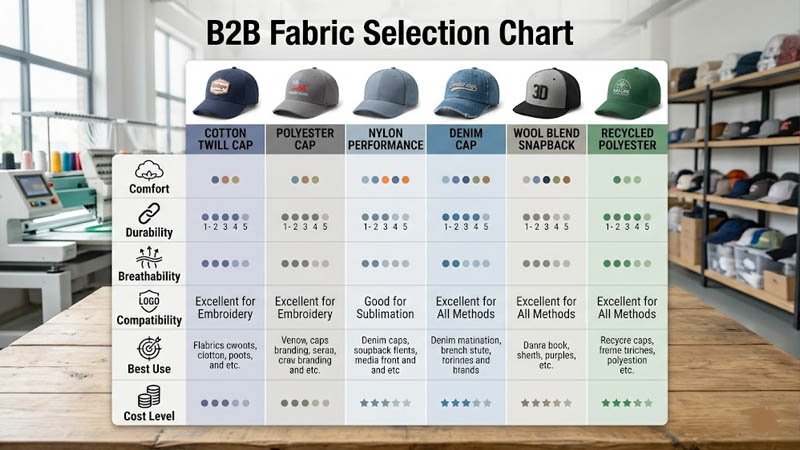
| Fabric |
Comfort |
Durability |
Breathability |
Best Logo Method |
Best Use |
| Cotton |
High |
Medium |
High |
Embroidery, woven patch |
Casual caps, brand caps |
| Cotton Twill |
High |
Medium-High |
High |
Flat embroidery, 3D embroidery |
Classic baseball caps |
| Polyester |
Medium |
High |
Medium |
Printing, heat transfer, embroidery |
Sports caps, promo caps |
| Poly-Cotton |
High |
High |
Medium |
Embroidery, patch |
Corporate caps, bulk orders |
| Nylon |
Medium |
High |
Medium |
Heat transfer, rubber patch |
Outdoor caps, travel caps |
| Wool Blend |
Medium |
High |
Low-Medium |
Embroidery, leather patch |
Premium caps, winter caps |
| Acrylic |
Medium |
Medium-High |
Low |
Embroidery, patch |
Snapbacks, structured caps |
| Denim |
Medium |
High |
Low-Medium |
Patch, embroidery |
Fashion caps, vintage caps |
| Recycled Polyester |
Medium |
High |
Medium |
Printing, embroidery |
Eco-friendly caps |
Best Fabrics for Different Logo Decoration Methods
Logo decoration is a key part of custom baseball cap production. The fabric you choose should match the logo method.
Best Fabric for Flat Embroidery
Flat embroidery works best on cotton twill, polyester twill, wool blend, and poly-cotton fabrics. These fabrics provide a stable surface, helping the embroidery stay clean and professional.
Best for:
- Corporate logos
- Brand names
- School caps
- Uniform caps
- Retail baseball caps
Best Fabric for 3D Puff Embroidery
3D puff embroidery requires a more structured fabric and cap crown. Cotton twill, acrylic, polyester twill, and wool blends are common choices.
Best for:
- Snapbacks
- Hip-hop hats
- Sports-style caps
- Streetwear brands
- Bold logo designs
Best Fabric for Woven Patches
Woven patches are suitable for logos with small details, fine lines, or multiple colors. They can be applied to cotton, polyester, denim, nylon, and wool blend caps.
Best for:
- Detailed logos
- Fashion brands
- Outdoor caps
- Premium promotional caps
Best Fabric for Heat Transfer Logos
Heat transfer works well on polyester, nylon, and performance fabrics. It is suitable for full-color logos, gradient graphics, and smooth visual effects.
Best for:
- Sports caps
- Running caps
- Event caps
- Outdoor caps
- Performance headwear
Best Fabric for Leather or Rubber Patches
Leather patches and rubber patches are suitable for cotton twill, denim, canvas, wool blend, and some polyester caps. They create a premium and textured brand effect.
Best for:
- Outdoor brands
- Workwear-style caps
- Lifestyle brands
- Premium retail collections
Best Fabric Choices by Budget Level
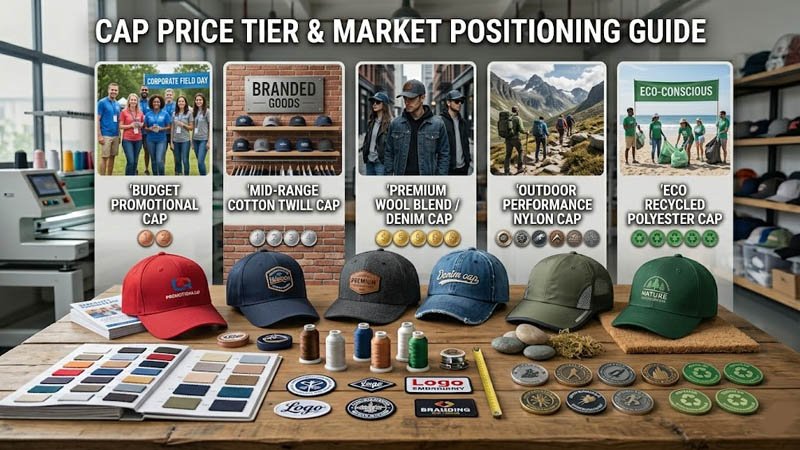
For bulk buyers, fabric selection is closely related to budget. The most suitable fabric depends on the product positioning and target market.
Budget-Friendly Promotional Caps
Recommended fabrics:
- Polyester
- Poly-cotton
- Standard cotton
These fabrics are suitable for events, giveaways, schools, corporate gifts, and promotional campaigns.
Mid-Range Brand Caps
Recommended fabrics:
- Cotton twill
- Washed cotton
- Poly-cotton
- Brushed cotton
These materials offer better comfort and appearance while keeping the cost reasonable.
Premium Retail Caps
Recommended fabrics:
- Heavy cotton twill
- Wool blend
- Denim
- Cotton canvas
These fabrics create a stronger brand image and are suitable for fashion brands, lifestyle brands, and retail collections.
Outdoor and Performance Caps
Recommended fabrics:
- Nylon
- Moisture-wicking polyester
- Lightweight polyester
- Recycled polyester
These fabrics are suitable for outdoor activities, travel, sports, fishing, hiking, and running.
Eco-Friendly Custom Caps
Recommended fabrics:
- Recycled polyester
- Organic cotton
- Recycled nylon
These are good options for brands that want to highlight sustainability and responsible production.
Best Fabrics for Different Cap Styles
Different cap styles require different fabric characteristics. Choosing the right fabric helps improve both appearance and function.
Baseball Caps
Recommended fabrics:
- Cotton twill
- Washed cotton
- Brushed cotton
- Poly-cotton
- Polyester twill
These fabrics are suitable for classic curved-brim baseball caps and embroidered brand caps.
Snapback Hats
Recommended fabrics:
- Acrylic
- Wool blend
- Polyester twill
- Cotton twill
Snapbacks usually require a stronger structure, especially for flat-brim styles and 3D embroidery.
Dad Hats
Recommended fabrics:
- Washed cotton
- Brushed cotton
- Soft cotton twill
Dad hats usually have a softer crown and relaxed shape, so soft cotton fabrics are ideal.
Trucker Caps
Recommended fabrics:
- Cotton front panel
- Polyester front panel
- Foam front panel
- Mesh back panel
Trucker caps need a front panel that supports logo decoration and a breathable mesh back.
5-Panel Caps
Recommended fabrics:
- Cotton canvas
- Nylon
- Polyester ripstop
- Washed cotton
These fabrics are suitable for outdoor, streetwear, and fashion-forward cap designs.
Performance Caps
Recommended fabrics:
- Lightweight polyester
- Nylon
- Moisture-wicking fabrics
- Stretch blends
Performance caps should be lightweight, breathable, quick-drying, and comfortable for active use.
Common Mistakes When Choosing Baseball Cap Fabrics
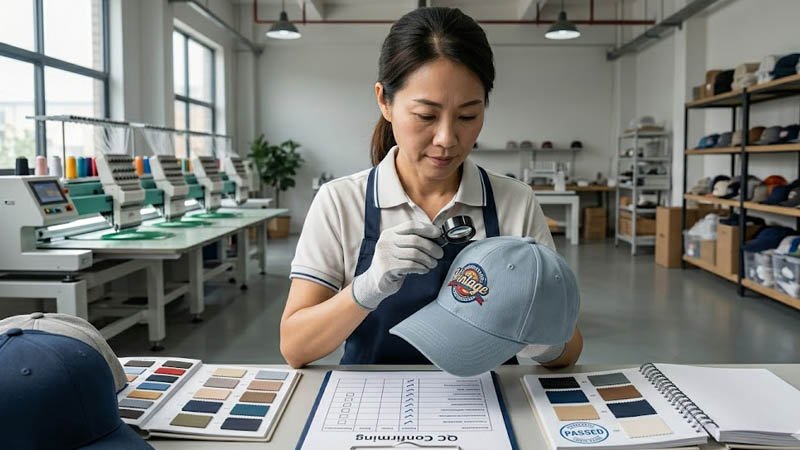
Many buyers focus only on price or appearance when choosing cap fabric. However, several common mistakes can affect the final product quality.
Mistake 1: Choosing Fabric Only by Price
The cheapest fabric may reduce product quality, comfort, and brand image. For long-term retail or brand projects, fabric quality should match the market positioning.
Mistake 2: Ignoring the Logo Decoration Method
Not every fabric works well with every logo method. For example, thin nylon may not be ideal for heavy embroidery, while polyester is often better for heat transfer logos.
Mistake 3: Using Thin Fabric for Dense Embroidery
Dense embroidery on thin fabric can cause puckering, uneven stitches, or deformation. Always test embroidery before bulk production.
Mistake 4: Not Checking Shrinkage
Cotton and some blended fabrics may shrink after washing. Shrinkage testing is important before confirming bulk production.
Mistake 5: Ignoring Color Fastness
Poor color fastness can cause fading or color bleeding. This is especially important for dark colors, outdoor caps, and washable caps.
Mistake 6: Choosing Non-Breathable Fabric for Summer Events
For hot weather or outdoor events, breathable fabrics, mesh panels, or moisture-wicking materials should be considered.
Mistake 7: Skipping Pre-Production Sample Approval
A pre-production sample helps confirm fabric, color, logo size, embroidery quality, cap shape, and packaging before mass production.
Quality Checks Before Bulk Production
Before placing a bulk order, buyers should confirm more than just the fabric name. A professional supplier should help check fabric performance and production details.
Fabric Weight
Fabric weight affects the cap’s structure and wearing feel. Heavy fabrics provide stronger shape, while lightweight fabrics are better for summer and sports caps.
Color Consistency
For bulk orders, fabric color should match the approved sample. This is especially important for brand colors and repeat orders.
Shrinkage Control
Cotton and blended fabrics should be tested for shrinkage to reduce size and shape problems after washing.
Embroidery Stability
If the logo uses embroidery, the supplier should test stitch density, backing support, and fabric stability.
Printing Compatibility
For heat transfer or printed logos, temperature, pressure, and adhesion should be tested before production.
Cap Shape and Panel Consistency
Fabric thickness and cutting accuracy affect the crown shape. Consistent panels help the cap look professional.
Packaging Confirmation
For retail or brand orders, packaging details such as labels, hangtags, barcodes, and cartons should be confirmed before shipment.
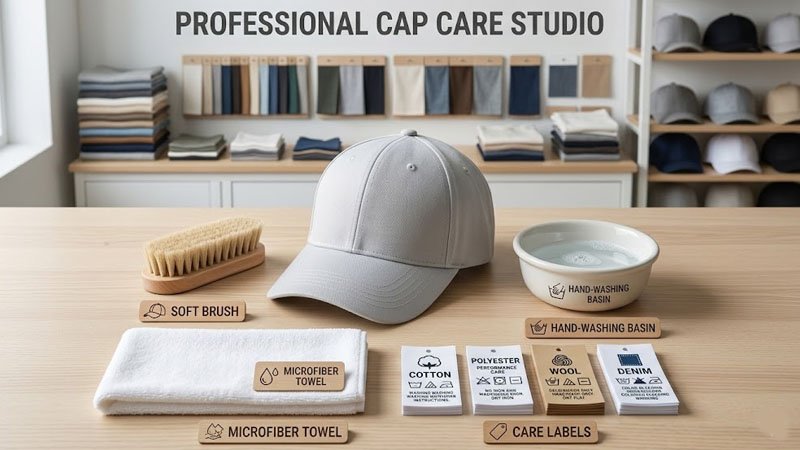
Proper care can extend the life of custom baseball caps and keep them looking good.
Cotton Caps
Wash gently with cold water and air dry. Avoid high heat to reduce shrinkage.
Polyester Caps
Polyester caps are usually easy to clean. Use a gentle cycle and avoid high heat.
Nylon Caps
Nylon dries quickly and is suitable for outdoor use. Avoid strong heat when drying.
Wool Caps
Wool caps should be hand washed or spot cleaned carefully. Do not wring or tumble dry.
Acrylic Caps
Acrylic caps can be spot cleaned or gently washed. Avoid high-temperature drying.
Denim Caps
Turn the cap inside out before washing to help protect the color and texture. Air drying is recommended.
Recycled Polyester Caps
Care instructions are usually similar to standard polyester, but always follow the supplier’s washing recommendations.
Conclusion
The best fabric for custom baseball caps depends on your target market, budget, logo method, and usage scenario.
Choose cotton twill if you want a classic embroidered baseball cap.
Choose polyester if you need durability, bright colors, and cost-effective bulk production.
Choose poly-cotton if you want a balance of comfort, strength, and price.
Choose nylon if your cap is designed for outdoor, travel, or performance use.
Choose wool blend or acrylic if you need a structured snapback or premium winter cap.
Choose denim or canvas if your brand wants a stronger fashion or vintage style.
Choose recycled polyester if sustainability is part of your brand story.
For brands and bulk buyers, fabric selection is not only a material decision. It affects the final cap quality, logo effect, customer experience, and brand value. Working with an experienced OEM/ODM hat manufacturer can help you choose the right fabric, logo method, and production solution before mass manufacturing.
FAQs
What is the best fabric for custom baseball caps?
Cotton twill is one of the best fabrics for classic custom baseball caps because it is comfortable, structured, and suitable for embroidery. For sports or outdoor use, polyester and nylon may be better options.
Is cotton or polyester better for baseball caps?
Cotton is softer and more breathable, making it suitable for casual and embroidered caps. Polyester is more durable, colorfast, and cost-effective, making it suitable for sports caps and promotional bulk orders.
What fabric is best for embroidered baseball caps?
Cotton twill, polyester twill, wool blend, and poly-cotton fabrics are good choices for embroidered baseball caps because they provide a stable surface for stitching.
What is the most durable fabric for baseball caps?
Polyester and nylon are among the most durable fabric options. They are suitable for outdoor activities, sports caps, and frequent use.
What fabric is best for summer baseball caps?
Cotton, lightweight polyester, nylon, and caps with mesh panels are good choices for summer. Breathability and moisture management are important for hot weather.
What fabric is best for snapback hats?
Acrylic, wool blend, cotton twill, and polyester twill are common choices for snapback hats because they provide good structure and shape retention.
Are nylon baseball caps good for outdoor use?
Yes. Nylon is lightweight, quick-drying, and can be water-resistant, making it suitable for outdoor, travel, hiking, fishing, and running caps.
Can baseball caps be made with recycled polyester?
Yes. Recycled polyester can be used for custom baseball caps. It is suitable for eco-friendly brands, corporate sustainability campaigns, and promotional products.
What is the best fabric for promotional baseball caps?
Polyester and poly-cotton are good options for promotional baseball caps because they are durable, cost-effective, and suitable for bulk customization.
What should buyers confirm before bulk cap production?
Buyers should confirm fabric type, fabric weight, color, logo method, embroidery or printing effect, sample quality, shrinkage control, color fastness, packaging details, and delivery time before mass production.
Do Hats Cause Hair Loss? Why Breathable Trucker Hats Are a Smart Choice
custom trucker hats
Many people wear hats every day for style, sun protection, work, outdoor activities, or brand promotion. But one common question still comes up:
Do hats cause hair loss?
The short answer is: a properly fitted hat does not directly cause hair loss. Most hair loss is related to genetics, hormones, aging, health conditions, stress, or lifestyle factors — not the simple act of wearing a hat.
However, the type of hat you choose, how tightly you wear it, and how clean you keep it can affect scalp comfort and hair condition. This is why breathable trucker hats have become a smart choice for daily wear, outdoor use, and custom brand promotions.
With a structured front panel, breathable mesh back, adjustable closure, and large logo area, trucker hats offer both comfort and strong branding value.
In this guide, we will explain the relationship between hats and hair health, why breathable trucker hats are more comfortable than many closed caps, and what brands should consider when designing custom trucker hats for bulk orders.
Do Hats Really Cause Hair Loss?
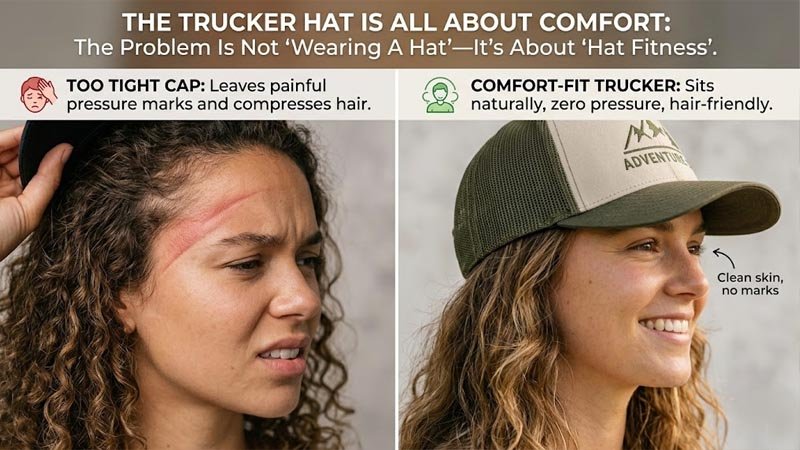
Hats are often blamed for hair thinning, but in most cases, this is a myth.
A normal, comfortable hat does not stop hair growth. Hair follicles receive oxygen and nutrients from the bloodstream, not from the air outside the head. So wearing a hat does not “suffocate” your hair.
Hair loss is usually caused by factors such as:
Genetics
Hormonal changes
Aging
Medical conditions
Stress
Nutritional issues
Harsh hair treatments
If someone notices hair inside a hat, it does not always mean the hat caused the hair to fall out. It is normal for people to shed some hair every day. A hat may simply collect loose hairs that were already shedding naturally.
So, in general:
Wearing a hat does not directly cause baldness.
The real issue is not wearing a hat itself, but wearing the wrong hat in the wrong way.
When Can a Hat Affect Hair and Scalp Comfort?
Although hats do not directly cause hair loss, some wearing habits may affect hair and scalp comfort.
The main concerns are tightness, friction, sweat buildup, and poor hygiene.
A Hat That Is Too Tight
A very tight hat can create pressure around the hairline, forehead, and temples. If the hat constantly pulls or rubs against the same area, it may contribute to hair breakage over time.
This is different from genetic hair loss. It is more about physical stress on the hair and scalp.
A good hat should feel secure but not painful or overly tight. If your hat leaves deep marks on your forehead, it may be too small or adjusted too tightly.
Constant Friction
Rough inner stitching, stiff seams, or low-quality sweatbands may rub against the scalp or hair. Over time, repeated friction can make hair feel weaker or more prone to breakage.
This is why hat construction matters. A well-made hat should have smooth inner finishing, comfortable seams, and a soft sweatband.
Sweat and Oil Buildup
Hats can collect sweat, oil, dust, sunscreen, and hair products. If a hat is not cleaned regularly, these residues may irritate the scalp.
This is especially important for hats used in summer, outdoor events, sports, workwear, or daily commuting.
A clean, breathable hat is much better for long-term comfort than a dirty or poorly ventilated one.
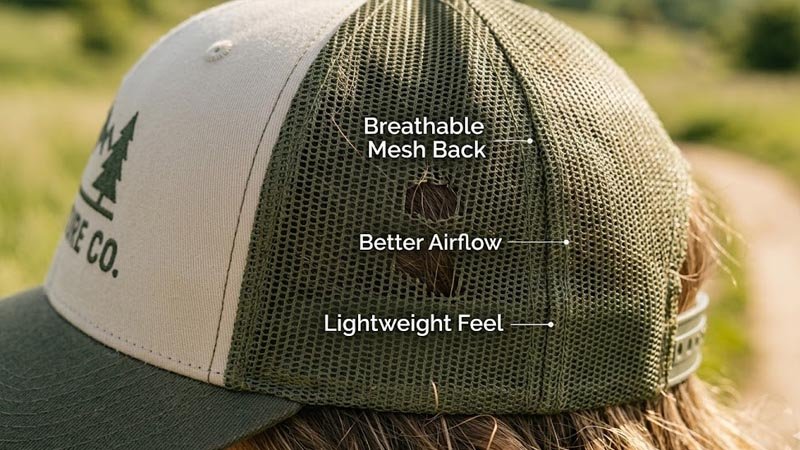
Trucker hats are different from many fully closed caps because they usually feature a mesh back panel.
This simple design detail makes a big difference in comfort.
Better Airflow
The mesh back allows air to circulate around the scalp. This helps reduce heat buildup and makes the hat more comfortable in warm weather.
For people who wear hats for long hours, airflow is important. A breathable trucker hat can feel cooler and lighter than a fully closed cap.
Less Heat and Moisture Buildup
Closed caps, beanies, and thick fabric hats can trap heat and moisture. This may make the scalp feel sweaty or uncomfortable.
A trucker hat helps release heat through the mesh back. This makes it a practical choice for:
Outdoor events
Summer promotions
Sports teams
Fishing and camping brands
Travel companies
Workwear uniforms
Corporate giveaways
For brands, this means the hat is more likely to be worn repeatedly — which increases brand exposure.
Lightweight Wearing Experience
Many trucker hats are lighter than fully structured caps. The mesh panel reduces material weight while keeping the front panel strong enough for logo decoration.
This combination makes trucker hats suitable for both casual fashion and promotional use.
Sun Protection
A trucker hat can help protect the face and scalp from direct sunlight. The brim provides shade, while the crown covers part of the head.
For outdoor workers, event staff, golfers, hikers, travelers, and people with thinning hair, this added protection can be very useful.
Different types of hats offer different levels of comfort, breathability, and hair pressure.
| Hat Type |
Breathability |
Hair Pressure |
Best Use |
| Trucker Hat |
High |
Low to Medium |
Outdoor use, summer events, brand promotions |
| Baseball Cap |
Medium |
Medium |
Daily wear, sports, casual branding |
| Beanie |
Low to Medium |
Medium |
Cold weather and winter collections |
| Tight Headband |
Low |
High |
Short-time sports use |
| Bucket Hat |
Medium |
Low |
Travel, outdoor fashion, sun protection |
From a comfort perspective, trucker hats are a strong option because they combine structure, airflow, and adjustability.
They are usually more breathable than fully closed caps and less tight than headbands. This makes them suitable for long-time wear in warm environments.
What Makes a Good Trucker Hat for Hair and Scalp Comfort?
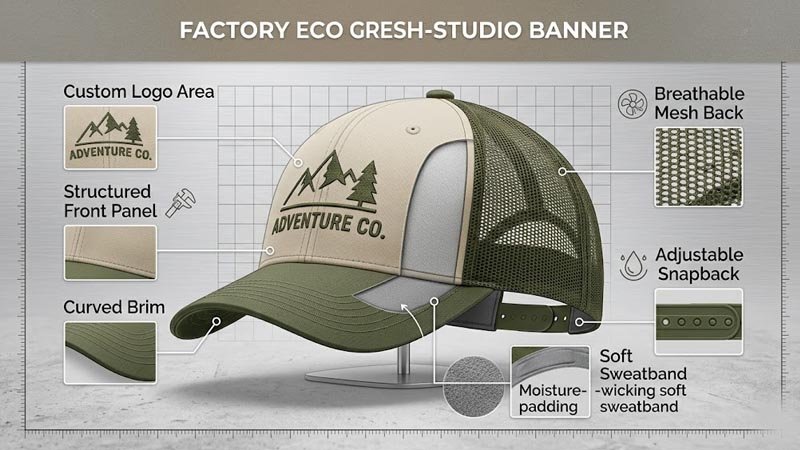
Not all trucker hats are the same. Material, structure, and production quality all affect comfort.
For brands and bulk buyers, the following details are important.
Breathable Mesh Back
The mesh back is the most important feature of a trucker hat. A good mesh should be breathable, flexible, and durable.
For summer collections, outdoor promotions, and sports events, breathable mesh helps improve the user experience.
Comfortable Sweatband
The sweatband touches the forehead directly. If it is too rough or poorly made, it may cause discomfort.
A soft, absorbent sweatband helps manage sweat and improves comfort during long-time wear.
Proper Crown Height
The crown height affects both style and fit.
A medium or high crown may reduce direct pressure on the hair, while a lower crown gives a closer fit. The best choice depends on the target market and wearing preference.
For fashion brands, crown shape also plays a big role in the overall look.
Adjustable Snapback Closure
Most trucker hats use snapback closures. This makes them easy to adjust for different head sizes.
An adjustable closure is especially useful for bulk orders because one size can fit a wider range of customers.
Smooth Inner Construction
A comfortable trucker hat should have clean inner stitching, stable panels, and smooth contact points.
Rough seams or stiff inner edges may cause friction. Good manufacturing quality helps improve both comfort and durability.
How to Wear a Hat Without Damaging Your Hair
A hat is safe for daily wear if you wear it correctly.
Here are some simple tips:
Do Not Wear It Too Tight
Adjust the hat so it feels secure but comfortable. Avoid strong pressure around the hairline or temples.
Keep Your Hat Clean
Clean your hat regularly, especially after sweating. This helps prevent odor, oil buildup, and scalp irritation.
Rotate Different Hats
If you wear hats every day, rotate between different styles or designs. This avoids constant pressure on the same area.
Let Your Scalp Breathe
After long outdoor use, remove your hat when possible and allow your scalp to cool down.
Avoid Tight Hairstyles Under the Hat
If your hair is tied too tightly under the hat, it may create extra pulling. A relaxed hairstyle is better for long-time wear.
Custom Trucker Hat Tips for Brands and Bulk Buyers
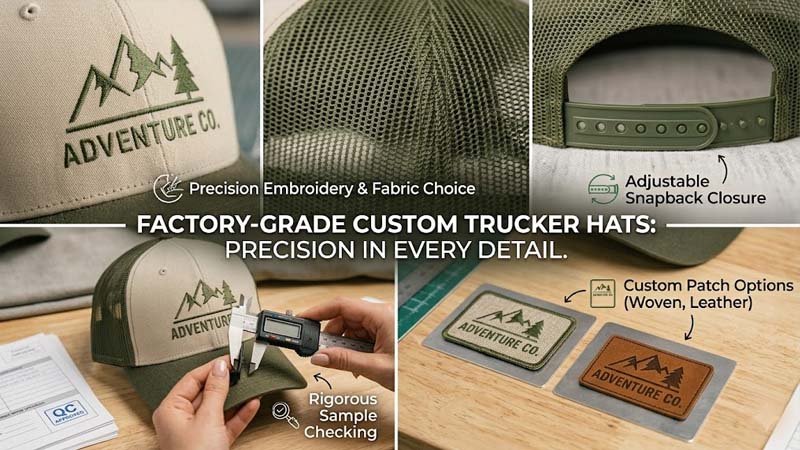
For brands, a trucker hat is not just a fashion accessory. It is also a promotional product, a uniform item, and a long-term brand exposure tool.
A comfortable custom trucker hat is more likely to be worn often. That means your logo gets more visibility.
When designing custom trucker hats, consider these points:
Choose breathable mesh for outdoor and summer markets.
Use a soft sweatband for comfort during long wear.
Select adjustable snapback closures for flexible sizing.
Choose a suitable crown shape for your target customers.
Use embroidery, woven patch, leather patch, or printed logo based on your brand style.
Check sample quality before mass production.
Pay attention to inner stitching and finishing details.
At GUANGZHOU EASTLUCKY Hat & Garment Co., Ltd., we are a high-end custom hat and OEM/ODM manufacturer based in Guangzhou, China, with 15 years of expertise in professional R&D, production, and distribution of various hats and embroidered accessories. Guided by the philosophy “Quality as Root, Innovation as Soul,” we provide global clients with one-stop solutions from design sampling to mass production, helping brands build efficient and high-quality custom headwear supply chains.
For B2B buyers, these details matter. A hat that looks good but feels uncomfortable may not be worn often. A hat that combines breathable materials, comfortable construction, and strong logo decoration creates better value for both brands and end users.
Custom trucker hats are suitable for many industries and markets.
They are especially popular with:
Outdoor brands
Fishing and camping brands
Sports teams
Streetwear labels
Corporate event organizers
Promotional product distributors
Travel and tourism companies
Construction and workwear teams
Summer campaign buyers
Retail fashion brands
Because trucker hats are lightweight, breathable, and easy to customize, they are practical for both retail and promotional use.
The large front panel also provides excellent space for logo branding, including embroidery, patches, heat transfer, and printed designs.
Common Myths About Hats and Hair Loss
Myth 1: Hats Make You Bald
False. A normal hat does not directly cause baldness. Most long-term hair loss is related to genetics, hormones, aging, or health factors.
Myth 2: Hats Suffocate Hair
False. Hair follicles receive oxygen and nutrients from the bloodstream, not from outside air. A hat does not stop hair from “breathing.”
Myth 3: Trucker Hats Cause Dandruff
Not directly. Dandruff is usually related to scalp condition, oil balance, dryness, or irritation. However, a dirty hat may make scalp discomfort worse, so regular cleaning is important.
Myth 4: Wearing Hats Every Day Is Bad for Hair
Not necessarily. Wearing hats every day is usually fine if the hat fits well, stays clean, and does not create too much friction or pressure.
FAQ
Do hats cause hair loss?
No. A properly fitted hat does not directly cause hair loss. Hair loss is usually linked to genetics, hormones, aging, or health conditions. However, a very tight or dirty hat may cause scalp discomfort or hair breakage.
Are trucker hats better for hair than baseball caps?
Trucker hats can be more breathable than fully closed baseball caps because they have mesh back panels. This helps reduce heat buildup and improves comfort in warm weather.
Can wearing a hat every day make hair flat?
Yes, wearing a hat for a long time may temporarily flatten your hair. However, this is not permanent hair damage. Choosing the right fit and crown height can help reduce this issue.
Are mesh hats good for summer?
Yes. Mesh hats are ideal for summer because they allow better airflow and help release heat from the scalp.
What is the best trucker hat for outdoor brands?
A good outdoor trucker hat should have breathable mesh, a comfortable sweatband, an adjustable snapback closure, durable stitching, and a strong logo decoration method such as embroidery or patch.
Are custom trucker hats good for brand promotion?
Yes. Custom trucker hats offer a large front logo area, strong daily wear value, and good outdoor visibility. They are a practical choice for brands, events, wholesalers, and promotional campaigns.
Conclusion
So, do hats cause hair loss?
In most cases, no. A properly fitted and clean hat does not directly cause hair loss. The real concerns are excessive tightness, repeated friction, sweat buildup, and poor hygiene.
This is why breathable trucker hats are a smart choice. Their mesh back design improves airflow, reduces heat buildup, and provides better comfort for daily and outdoor use.
For brands and bulk buyers, trucker hats offer more than style. They provide comfort, logo visibility, and practical value across many markets.
A well-designed custom trucker hat with breathable mesh, a soft sweatband, adjustable closure, and quality logo decoration can become a product people actually want to wear — and that is the key to long-term brand exposure.
Can You Dry Clean Baseball Caps? Cleaning Tips from a Custom Hat Manufacturer
Baseball caps are used everywhere—from sports teams and corporate uniforms to retail fashion, outdoor events, promotional giveaways, and everyday casual wear. Because they are worn close to the head, baseball caps can easily collect sweat, dust, oil, and stains over time.
A common question many cap owners and buyers ask is:
Can you dry clean baseball caps?
In most cases, dry cleaning is not recommended for baseball caps. While dry cleaning is useful for some delicate garments, it may damage the fabric, distort the brim, weaken the embroidery, or change the shape of the cap.
As a custom hat manufacturer, we know that the best cleaning method depends on more than just the outer fabric. The cap material, brim insert, crown structure, sweatband, and logo technique all affect how a baseball cap should be cleaned.
This guide explains why dry cleaning is not the best option for most caps, how to clean baseball caps safely, and what brands should consider when ordering custom baseball caps in bulk.
Why Dry Cleaning Is Not Recommended for Most Baseball Caps
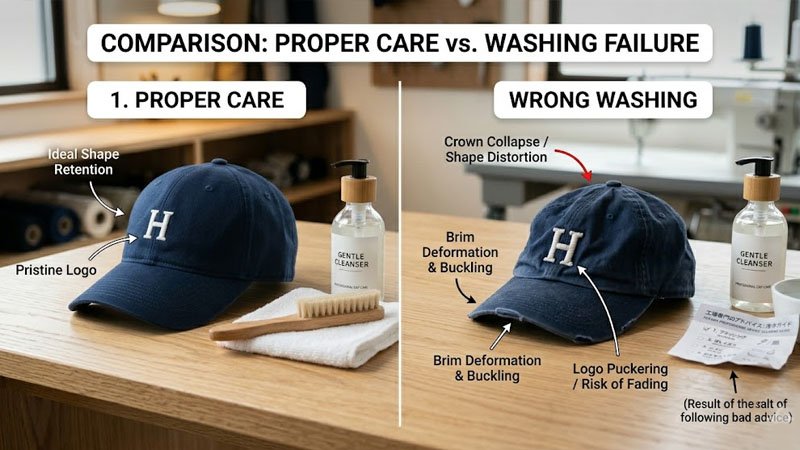
Dry cleaning does not use water. Instead, it uses chemical solvents to remove dirt and stains from fabric. Although this method works for some clothing, baseball caps are more complicated because they have a fixed shape and multiple structural parts.
A baseball cap is not just a piece of fabric. It includes a crown, brim, sweatband, stitching, logo decoration, and sometimes a structured front panel. These parts may react differently during dry cleaning.
Dry Cleaning Chemicals May Damage the Fabric
Many baseball caps are made from cotton, polyester, wool, nylon, or blended fabrics. Dry cleaning solvents can be too strong for some cap materials. They may cause color fading, surface changes, or fiber weakening.
For cotton and polyester baseball caps, dry cleaning is usually unnecessary. These materials can often be cleaned more safely with gentle hand washing or spot cleaning.
The Cap Shape May Become Distorted
Shape is one of the most important parts of a baseball cap. A curved brim, flat brim, structured crown, or six-panel shape can lose its original form if handled incorrectly.
Dry cleaning machines, chemical treatment, or pressing may flatten the crown, bend the brim, or make the cap look uneven.
Embroidery and Logos May Be Affected
Custom baseball caps often use embroidery, patches, heat transfer printing, leather labels, or PVC rubber logos. These branding details are important for the appearance of the cap.
Dry cleaning chemicals and friction may affect embroidery thread, soften adhesive layers, damage heat transfer logos, or change the surface of leather patches.
For this reason, dry cleaning is not the safest choice for most custom logo caps.
What Determines the Best Cleaning Method?
From a manufacturer’s perspective, the safest cleaning method depends on three key factors:
- Fabric material
- Brim insert material
- Logo technique
Before cleaning a baseball cap, you should not only look at the outside fabric. You should also check whether the brim is water-resistant, whether the crown is structured, and whether the logo can handle moisture or friction.
Baseball Cap Materials and Cleaning Methods
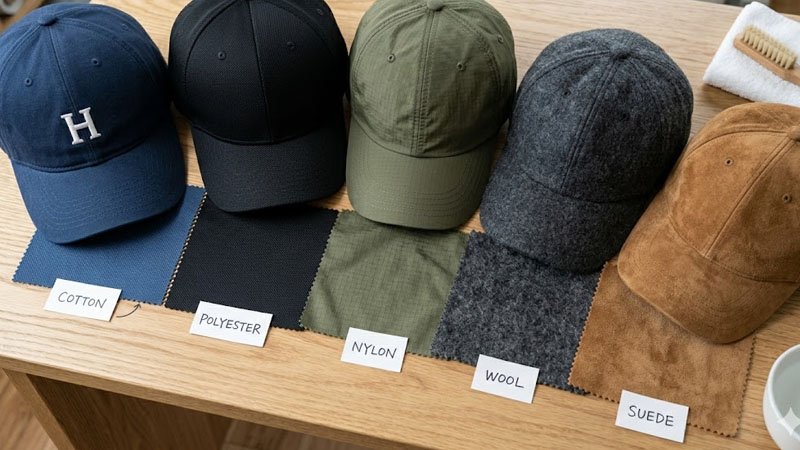
Different materials need different cleaning methods. Choosing the wrong method can cause shrinkage, fading, deformation, or surface damage.
Cotton Baseball Caps
Cotton baseball caps are soft, breathable, and comfortable. They are widely used for casual caps, promotional caps, corporate caps, and custom embroidered baseball caps.
Most cotton caps can be cleaned with gentle hand washing. Use cool or lukewarm water and mild detergent. Avoid hot water because it may shrink the fabric or affect the cap shape.
Best cleaning method: Hand washing or spot cleaning
Avoid: Hot water, bleach, strong scrubbing, tumble drying
Polyester Baseball Caps
Polyester caps are durable, lightweight, and quick-drying. They are commonly used for sports caps, outdoor caps, running caps, and promotional event caps.
Polyester is usually easier to clean than wool or felt. Some polyester caps can be machine washed with caution, but hand washing is still safer for maintaining the shape and logo quality.
Best cleaning method: Hand washing or gentle machine washing with caution
Avoid: High heat, strong detergent, fabric softener
Cotton-Polyester Blend Caps
Cotton-polyester blends are popular for custom baseball caps because they combine comfort and durability. They are suitable for daily wear, uniforms, and promotional projects.
These caps are usually easier to maintain than 100% cotton caps because polyester improves wrinkle resistance and drying performance.
Best cleaning method: Hand washing
Avoid: Dryer heat, bleach, strong rubbing on the logo
Wool Baseball Caps
Wool caps have a premium texture and are often used for fashion caps, colder-weather caps, or high-end custom designs. However, wool is more delicate and can shrink when exposed to water.
For wool caps, spot cleaning is usually safer. If the cap is expensive or heavily stained, professional cleaning may be needed.
Best cleaning method: Spot cleaning or professional care
Avoid: Soaking, machine washing, hot water
Felt Baseball Caps
Felt is delicate and can easily lose shape if washed incorrectly. It should not be soaked or machine washed.
Use a soft brush to remove dust. For stains, light spot cleaning is recommended.
Best cleaning method: Dry brushing or professional care
Avoid: Full washing, soaking, machine washing
Leather and Suede Caps
Leather and suede caps require special care. Water can stain suede and dry out leather.
For leather caps, wipe gently with a slightly damp cloth and use leather conditioner if needed. For suede caps, use a suede brush to remove dirt.
Best cleaning method: Material-specific spot cleaning
Avoid: Water soaking, dry cleaning solvents, strong heat
Why the Brim Material Matters
Many people only check the cap fabric before cleaning, but the brim structure is just as important.
The brim gives the cap its shape. If the inside material is damaged, the whole cap may look bent, soft, or uneven.
Common Brim Insert Materials
| Brim Type |
Cleaning Risk |
Recommendation |
| Paperboard brim |
High risk of deformation |
Spot clean only |
| Plastic brim |
Better water resistance |
Gentle hand washing |
| PE brim |
Lightweight and durable |
Suitable for easy-care caps |
| EVA brim |
Soft and flexible |
Suitable for sports or casual caps |
Older or low-cost caps may use paperboard inside the brim. Once wet, this type of brim can soften and lose shape. Modern baseball caps often use plastic, PE, or other water-resistant inserts, which are more suitable for gentle cleaning.
For brands ordering custom baseball caps, choosing a better brim insert can improve the cap’s durability and long-term use experience.
For custom caps, the logo is often the most important visual detail. Different logo techniques require different care methods.
Flat Embroidery
Flat embroidery is one of the most durable and widely used logo methods for custom baseball caps. It is suitable for corporate caps, promotional caps, sports caps, and retail caps.
However, even durable embroidery should be cleaned carefully. Avoid strong scrubbing directly on the thread surface.
Cleaning advice: Gentle hand washing or spot cleaning is usually safe.
3D Puff Embroidery
3D puff embroidery creates a raised logo effect. It gives the cap a bold and premium look, especially for snapback caps and streetwear caps.
Because the logo has a raised structure, too much pressure may flatten the embroidery.
Cleaning advice: Spot clean around the logo. Do not press, twist, or scrub the raised embroidery.
Heat Transfer Printing
Heat transfer printing is suitable for colorful graphics, gradients, and detailed artwork. However, it is more sensitive to heat, friction, and harsh chemicals.
Cleaning advice: Avoid dry cleaning, hot water, high heat, and strong rubbing.
Woven Patch
Woven patches are popular for outdoor caps, fashion caps, and branded merchandise. They offer clear logo details and a premium appearance.
Cleaning advice: Spot clean gently and avoid pulling or brushing the patch edges too hard.
Embroidered Patch
Embroidered patches are durable and textured. They are suitable for workwear caps, outdoor brands, and premium promotional caps.
Cleaning advice: Hand wash gently and avoid strong scrubbing around the stitched border.
Leather Patch
Leather patches give caps a high-end and natural look. However, leather does not perform well with soaking or strong chemicals.
Cleaning advice: Wipe gently with a slightly damp cloth. Do not soak the leather patch.
PVC or Rubber Patch
PVC and rubber patches are water-resistant and durable. They are often used for outdoor caps, sports caps, and modern brand designs.
Cleaning advice: Wipe clean and air dry naturally. Avoid high heat.
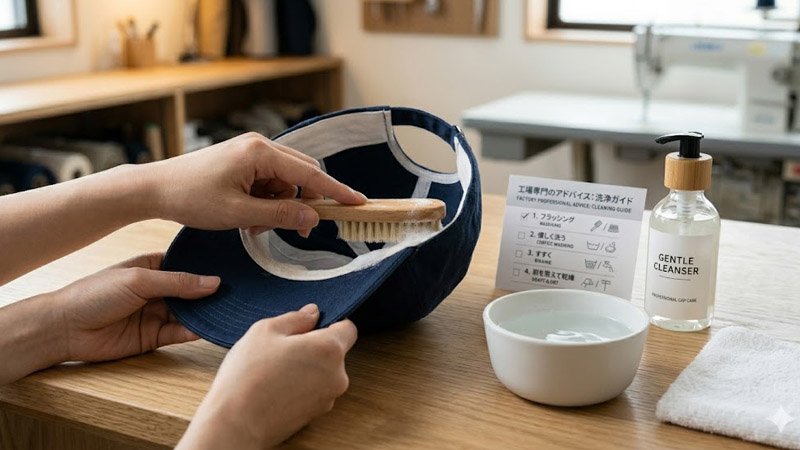
For most baseball caps, hand washing and spot cleaning are better than dry cleaning.
Method 1: Hand Washing
Hand washing is usually the safest method for cotton, polyester, and cotton-polyester baseball caps.
Steps:
- Fill a clean basin with cool or lukewarm water.
- Add a small amount of mild detergent.
- Place the cap into the water and soak it gently for a few minutes.
- Use a soft cloth, sponge, or toothbrush to clean dirty areas.
- Pay special attention to the sweatband, where sweat and oil often build up.
- Rinse gently with cool water.
- Use a towel to absorb extra water.
- Reshape the cap and let it air dry naturally.
Do not twist or squeeze the cap strongly. This may damage the crown, brim, or logo.
Method 2: Spot Cleaning
Spot cleaning is ideal for delicate caps, wool caps, felt caps, and caps with special logos.
Steps:
- Mix mild detergent with a small amount of water.
- Dip a soft cloth or toothbrush into the solution.
- Gently clean only the stained area.
- Use a clean damp cloth to remove detergent residue.
- Pat dry with a towel.
- Let the cap air dry in a ventilated place.
Spot cleaning is also suitable for caps with leather patches, heat transfer logos, 3D embroidery, or delicate trims.
Method 3: Machine Washing with Caution
Machine washing is not recommended for all baseball caps. It may work for some cotton or polyester caps, but there is always a risk of deformation.
If machine washing is necessary:
- Use a mesh laundry bag or hat washing cage.
- Choose a gentle cycle.
- Use cold water.
- Use mild detergent.
- Do not use bleach.
- Do not use fabric softener.
- Do not wash with heavy garments.
- Air dry only.
Never machine wash wool, felt, suede, leather, vintage caps, or caps with delicate logo decorations.
How to Dry a Baseball Cap Without Losing Shape
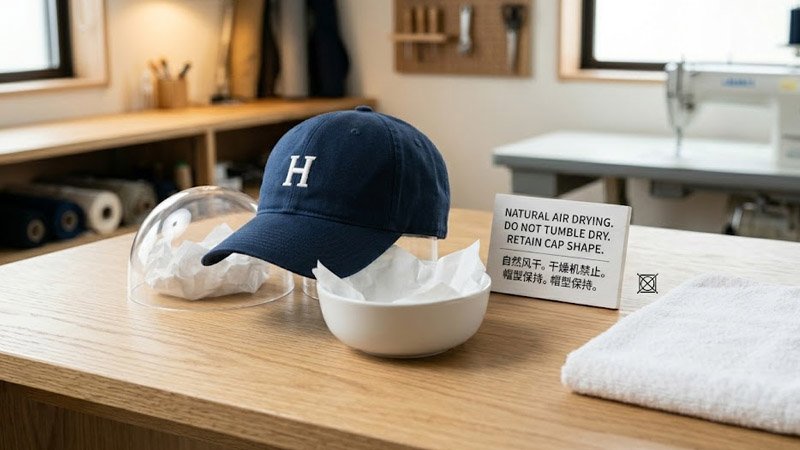
Drying is one of the most important steps in cap care. Even if the washing process is gentle, wrong drying can damage the shape.
Do Not Use a Dryer
A tumble dryer uses heat and movement, which may shrink the fabric, bend the brim, flatten the crown, or damage the logo.
Air Dry Naturally
Place the cap on a clean towel or rounded object to support its shape while drying.
You can use:
- A hat form
- A small bowl
- A clean towel
- Balled-up socks
- Soft paper stuffing
Keep the cap away from direct sunlight, radiators, and high heat. Direct sunlight may cause color fading, while heat may distort the cap structure.
How to Keep the Cap Shape After Cleaning
A good baseball cap should keep its original shape after cleaning. To protect the shape, follow these tips:
- Reshape the crown while the cap is still damp.
- Support the inside with a towel or hat form.
- Keep the brim in its natural curve or flat position.
- Do not place heavy items on top of the cap.
- Do not hang the cap while it is wet.
- Let it dry slowly at room temperature.
For structured caps, shape protection is especially important. The front panels may lose their clean appearance if the cap is dried without support.
Avoid these mistakes if you want your baseball cap to last longer.
1. Putting the Cap in the Dryer
High heat can shrink the fabric, damage the logo, and deform the brim.
2. Using Bleach
Bleach may fade the cap color and weaken the fabric.
3. Scrubbing Embroidery Too Hard
Strong brushing can damage embroidery threads and make the logo look rough.
4. Soaking Wool or Felt Caps
Wool and felt may shrink, wrinkle, or lose shape after soaking.
5. Ignoring the Brim Material
If the cap has a paperboard brim, too much water can cause permanent deformation.
6. Drying Under Direct Sunlight
Strong sunlight can cause fading, especially on dark-colored caps.
7. Using Strong Chemical Cleaners
Harsh chemicals may damage fabric, stitching, patches, and printed logos.
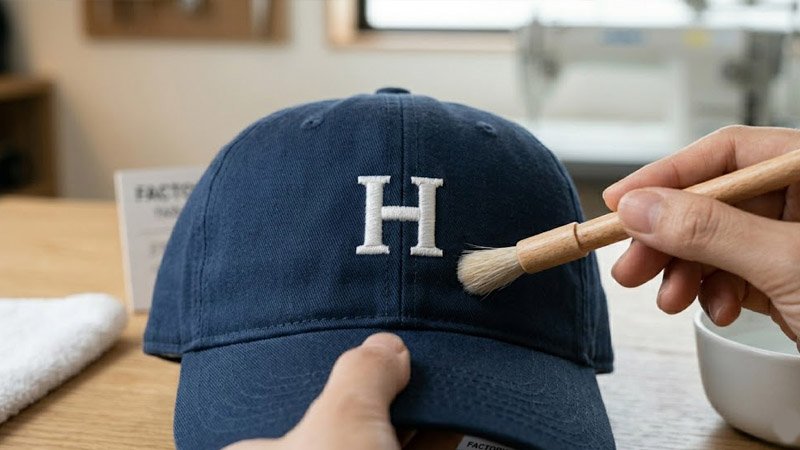
Embroidered baseball caps are popular because they look professional, durable, and premium. But embroidery still needs proper care.
To clean an embroidered baseball cap:
- Use mild detergent.
- Clean with a soft cloth or toothbrush.
- Avoid scrubbing directly over the embroidery.
- Do not press or twist the logo area.
- For 3D puff embroidery, avoid strong pressure.
- Air dry the cap naturally.
For brands ordering custom embroidered caps, embroidery thread quality and color fastness are important. High-quality embroidery can help the logo stay clear and attractive after regular use.
Best Cap Materials for Easy Cleaning
If your brand is developing custom baseball caps for uniforms, outdoor events, promotional gifts, or retail sales, choosing easy-care materials can improve user satisfaction.
Polyester
Polyester is durable, lightweight, and quick-drying. It is a good choice for sports caps, outdoor caps, and event caps.
Cotton-Polyester Blend
Cotton-polyester blends offer both comfort and durability. They are suitable for corporate uniforms, promotional caps, and daily-use caps.
Washed Cotton
Washed cotton has a soft and casual look. It is popular for fashion caps and lifestyle brands. It is best cleaned by hand or spot cleaning.
Nylon
Nylon is lightweight and often used for outdoor or performance caps. It dries quickly and is suitable for active use.
Wool Blend
Wool blend caps look premium but need more delicate care. They are better for fashion or seasonal collections rather than heavy outdoor use.
What Custom Cap Buyers Should Confirm Before Production
For brands, wholesalers, retailers, and event organizers, cleaning performance should be considered before bulk production.
A cap should not only look good in the sample stage. It should also remain comfortable, stable, and presentable after regular use.
Before placing a custom baseball cap order, buyers should confirm:
- Is the fabric easy to clean?
- Is the brim insert water-resistant?
- Is the crown structured or unstructured?
- Is the embroidery thread colorfast?
- Is the logo suitable for regular cleaning?
- Can care labels be added inside the cap?
- Is the sweatband material comfortable and durable?
- Has the sample been checked before mass production?
- Is the packaging suitable for shipping and storage?
These details help reduce quality issues and improve the final customer experience.
Cleaning Guide for Different Custom Cap Uses
Different projects require different materials and care solutions.
| Use Case |
Recommended Fabric |
Recommended Logo |
Cleaning Advice |
| Corporate uniforms |
Cotton-polyester blend |
Flat embroidery |
Hand wash |
| Outdoor events |
Polyester or nylon |
PVC patch or embroidery |
Spot clean or hand wash |
| Sports teams |
Performance polyester |
Embroidery or heat transfer |
Gentle hand wash |
| Retail fashion caps |
Cotton, washed cotton, wool blend |
Embroidery or patch |
Follow care label |
| Promotional giveaways |
Cotton or polyester |
Simple embroidery or print |
Easy-care material preferred |
| Premium brand caps |
Wool blend, suede, leather details |
Leather patch or embroidery |
Professional or spot cleaning |
This type of planning is especially useful for bulk custom cap orders. The right material and logo choice can make the product more durable and easier to maintain.
As a custom hat and OEM/ODM manufacturer in Guangzhou, China, GUANGZHOU EASTLUCKY Hat & Garment Co., Ltd. has 15 years of experience in cap development, embroidery, sampling, and bulk production. From a factory perspective, cap care starts before cleaning—it begins with the right fabric, brim structure, logo technique, and quality control during production.
When developing custom baseball caps, buyers should not only focus on price and appearance. They should also consider:
- Fabric performance
- Logo durability
- Brim quality
- Stitching strength
- Sweatband comfort
- Shape stability
- Packaging protection
- Care instructions
A high-quality cap should keep its shape, color, and branding effect after regular use. This is especially important for brands that sell caps to customers or use them as uniforms, event merchandise, or promotional products.
When Should You Use Professional Cleaning?
Most baseball caps can be cleaned at home with proper care. However, professional cleaning may be suitable for certain caps.
Consider professional care if your cap is:
- Made of wool, felt, leather, or suede
- Vintage or collectible
- Expensive or limited edition
- Heavily stained
- Designed with delicate decoration
- Difficult to reshape after cleaning
Before choosing a professional cleaner, ask whether they have experience cleaning hats. Not all dry cleaners understand baseball cap structure.
FAQ
Can you dry clean baseball caps?
Dry cleaning is not recommended for most baseball caps. The chemicals and handling process may damage the fabric, brim, crown shape, or logo. Gentle hand washing or spot cleaning is usually safer.
What is the safest way to clean a baseball cap?
The safest method is usually hand washing with cool water, mild detergent, and a soft cloth or brush. After cleaning, reshape the cap and air dry it naturally.
Can you wash an embroidered baseball cap?
Yes, many embroidered baseball caps can be hand washed gently. Avoid scrubbing directly over the embroidery, especially if the cap has 3D puff embroidery.
Can you machine wash a baseball cap?
Some cotton or polyester caps can be machine washed with caution, but hand washing is safer. Use cold water, a gentle cycle, and a hat washing cage or laundry bag. Never use a dryer.
How do you clean sweat stains from a baseball cap?
Use mild detergent and a soft toothbrush to gently clean the sweatband area. Rinse carefully and air dry the cap. Avoid bleach because it may damage the fabric color.
How do you keep a baseball cap shape after washing?
Reshape the cap while it is damp. Place it on a hat form, towel, bowl, or soft stuffing to support the crown. Let it air dry naturally at room temperature.
Can dry cleaning damage embroidered logos?
Yes. Dry cleaning chemicals and friction may affect embroidery threads, especially on detailed or raised logos. Spot cleaning or gentle hand washing is usually safer.
Can custom baseball caps be made with washable materials?
Yes. For easier care, buyers can choose polyester, cotton-polyester blends, plastic or PE brim inserts, and durable logo methods such as flat embroidery, woven patches, or PVC patches.
Is dry cleaning suitable for wool baseball caps?
Professional cleaning may be suitable for some wool caps, but it should be done by a cleaner experienced with hats. For minor stains, spot cleaning is usually safer.
Should brands add care labels to custom baseball caps?
Yes. Care labels are helpful for retail brands, uniform programs, and promotional projects. They guide users on how to clean the cap properly and reduce the risk of damage.
Conclusion
So, can you dry clean baseball caps?
For most caps, the answer is no. Dry cleaning may damage the fabric, distort the brim, affect the crown shape, or weaken the logo decoration. Instead, gentle hand washing, spot cleaning, and natural air drying are usually better choices.
For custom baseball cap buyers, cleaning performance should be considered from the beginning of product development. Fabric, brim insert, logo technique, sweatband quality, and care label instructions all affect the final user experience.
A good baseball cap should not only look clean and professional when it is new. It should also keep its shape, comfort, color, and branding effect after regular use.
If you are developing custom baseball caps for your brand, team, retail collection, uniform program, or promotional campaign, choosing the right custom hat manufacturer can help you create caps that look better, last longer, and are easier for customers to maintain.
Custom Snapback vs Trucker Hat: Fit, Logo Options and Bulk Order Guide
When ordering custom hats in bulk, choosing between a snapback hat and a trucker hat is not only about style. The right choice can affect your logo effect, wearing comfort, target audience, production cost, and final brand presentation.
Both snapback hats and trucker hats are popular choices for brands, sports teams, events, fashion labels, outdoor companies, and promotional product buyers. However, they serve different purposes.
A snapback hat is usually more structured, bold, and fashion-focused. It is a strong choice for streetwear brands, sports merchandise, retail collections, and premium embroidered logos.
A trucker hat is usually more breathable, lightweight, and practical. It is ideal for outdoor brands, summer promotions, corporate giveaways, fishing brands, camping brands, and large-volume promotional campaigns.
In this guide, we will compare custom snapback hats and trucker hats from a buyer’s perspective, including structure, fit, materials, logo decoration options, cost factors, bulk order tips, and customization process.
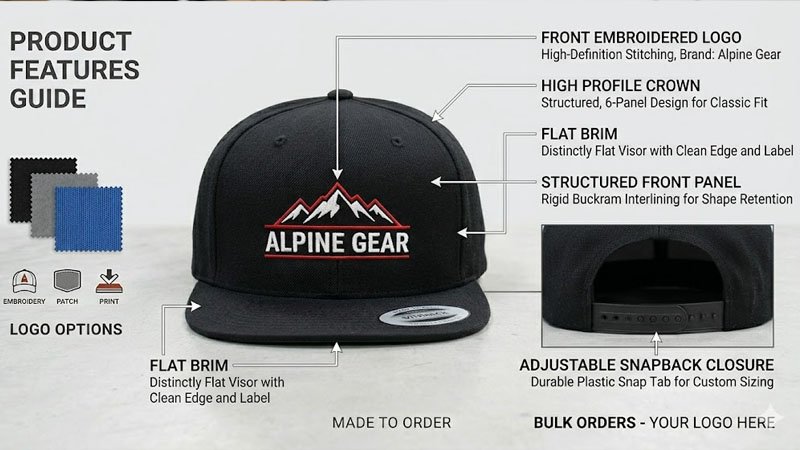
A snapback hat is a structured cap with an adjustable plastic snap closure at the back. It usually has a flat brim, a firm front panel, and a high-profile crown.
Snapback hats became popular through baseball, hip-hop culture, streetwear, and sports fashion. Today, they are widely used by fashion brands, sports clubs, music merch brands, skate brands, and companies that want a bold and modern cap style.
The most common features of a snapback hat include:
- Flat brim
- Structured front panel
- High-profile crown
- Adjustable snapback closure
- Strong shape retention
- Bold streetwear appearance
- Large front area for logo decoration
Because of its firm front panel, a snapback hat is especially suitable for embroidery and patch branding. If your brand wants a clean, structured, and premium look, a custom snapback hat is a strong option.
A trucker hat is a casual cap style that usually combines a foam or fabric front panel with breathable mesh back panels. Like snapbacks, many trucker hats also use an adjustable plastic snap closure.
Trucker hats were originally used as promotional giveaway caps for truck drivers, farmers, outdoor workers, and industrial brands. Their breathable mesh back made them practical for long hours outdoors.
Today, trucker hats are widely used by outdoor brands, fishing brands, beer and beverage companies, lifestyle brands, event organizers, corporate buyers, and promotional product distributors.
The most common features of a trucker hat include:
- Mesh back panels
- Foam, cotton, canvas, or polyester front panel
- Lightweight construction
- Better airflow
- Casual and relaxed look
- Adjustable snapback closure
- Practical design for outdoor use
If your project needs a breathable, comfortable, and cost-effective hat for outdoor use or promotional campaigns, a custom trucker hat is a smart choice.
| Feature |
Custom Snapback Hat |
Custom Trucker Hat |
| Main Style |
Streetwear, sports, fashion |
Outdoor, casual, promotional |
| Front Panel |
Structured fabric front |
Foam or fabric front |
| Back Panel |
Usually full fabric |
Breathable mesh back |
| Brim Style |
Usually flat brim |
Usually curved or slightly curved brim |
| Crown Profile |
High profile and structured |
Medium to high profile, more relaxed |
| Breathability |
Medium |
High |
| Logo Effect |
Premium embroidery and patch effect |
Strong print, patch, and label effect |
| Best Logo Methods |
Flat embroidery, 3D embroidery, appliqué, PVC patch |
Leather patch, woven patch, screen print, embroidered patch |
| Best Buyers |
Fashion brands, sports teams, retailers |
Outdoor brands, event buyers, promotional distributors |
| Best Use |
Brand merchandise, retail collections, team caps |
Giveaways, outdoor events, summer promotions |
| Cost Impression |
Medium to premium |
Cost-effective to mid-range |
| Bulk Order Suitability |
Great for premium merchandise |
Great for large promotional orders |
Key Difference 1: Structure and Fit
The biggest difference between a snapback hat and a trucker hat is the structure.
A snapback hat has a firm and structured crown. It keeps its shape well and gives the cap a clean, bold, and premium appearance. This makes snapback hats popular for fashion brands, sports merchandise, streetwear collections, and retail cap lines.
A trucker hat has a lighter and more breathable structure. The mesh back allows better airflow, making it more comfortable in hot weather or outdoor environments. This makes trucker hats suitable for summer events, outdoor promotions, fishing, camping, travel, and workwear-related projects.
Choose a snapback hat if you want:
- A strong structured shape
- A bold streetwear look
- A premium brand image
- Better front-panel embroidery effect
- A hat for fashion, sports, or merchandise collections
Choose a trucker hat if you want:
- Better breathability
- A lightweight wearing experience
- A casual promotional look
- A hat for outdoor or summer use
- A practical product for large-volume giveaways
Key Difference 2: Materials
Material choice affects the look, comfort, cost, and logo result of your custom hat.
Common Materials for Snapback Hats
Snapback hats are usually made from solid fabrics that help keep the cap shape stable.
Common material options include:
- Cotton twill
- Polyester
- Acrylic
- Wool blend
- Nylon
- Performance fabric
- Recycled polyester
Cotton twill is a popular choice for custom embroidered snapback hats because it has a smooth texture and works well with detailed embroidery. Polyester is durable and cost-effective, making it suitable for bulk custom cap orders.
Common Materials for Trucker Hats
Trucker hats usually combine a front panel with mesh back panels.
Common material options include:
- Foam front
- Cotton front
- Polyester front
- Canvas front
- Polyester mesh
- Nylon mesh
- Recycled mesh fabric
Foam-front trucker hats are often used for screen printing, heat transfer printing, or bold logo graphics. Cotton or canvas front trucker hats work well with patches, embroidery, and woven labels.
For eco-conscious brands, recycled polyester or recycled mesh can also be considered.
Key Difference 3: Brim Style
Snapback hats usually have a flat brim. This gives them a sharp, modern, and fashion-forward look. The flat brim is strongly connected with streetwear, hip-hop culture, sports teams, and youth fashion.
Trucker hats usually have a curved or slightly curved brim. This gives them a more casual, practical, and outdoor-friendly appearance. The curved brim also provides better sun protection, which is useful for outdoor activities.
From a branding perspective:
A flat brim creates a bold and premium style.
A curved brim creates a relaxed and practical style.
If your target market is fashion or streetwear, a snapback may be more suitable. If your target market is outdoor, travel, workwear, or promotional use, a trucker hat may be a better fit.
Key Difference 4: Breathability and Comfort
Breathability is one of the strongest advantages of trucker hats.
The mesh back allows air to flow through the cap, helping the wearer stay cooler in warm weather. This is why trucker hats are popular for:
- Outdoor events
- Summer promotions
- Fishing trips
- Camping brands
- Construction teams
- Farm and ranch brands
- Travel campaigns
- Sports activities
- Corporate giveaways
Snapback hats are also comfortable, but they usually use full fabric panels, which means they are less breathable than mesh-back trucker hats. However, they offer a stronger structure and a more premium appearance.
For airflow and outdoor comfort, choose a trucker hat.
For shape and brand image, choose a snapback hat.
Which Hat Is Better for Custom Logo Branding?
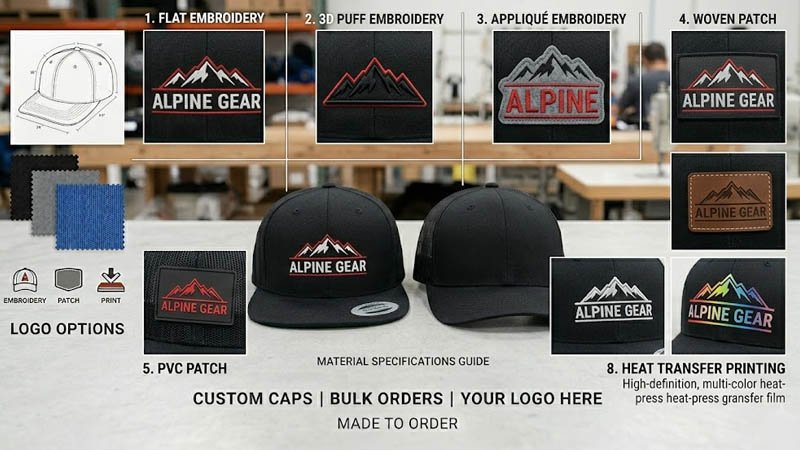
Both snapback hats and trucker hats can be customized with logos. The best choice depends on the logo design, material, front panel structure, and final brand style.
Best Logo Options for Snapback Hats
Snapback hats are excellent for logo customization because the structured front panel provides a stable surface for embroidery and patches.
Flat Embroidery
Flat embroidery is clean, professional, and suitable for most brand logos. It works well for corporate logos, sports team logos, fashion brands, school clubs, and retail merchandise.
3D Puff Embroidery
3D puff embroidery creates a raised logo effect. It is popular for streetwear brands, sports caps, hip-hop style hats, and bold logo designs.
Appliqué Embroidery
Appliqué embroidery combines fabric pieces with embroidery. It creates a layered and premium look, making it suitable for high-end custom snapback hats.
Woven Patch
A woven patch is suitable for detailed logos, small text, and clean brand labels. It is a good choice when embroidery cannot show small details clearly.
PVC Patch
PVC patches create a modern, durable, and sporty look. They are often used by outdoor brands, sports brands, and fashion labels.
Leather Patch
Leather patches give snapback hats a vintage and premium feeling. They are suitable for lifestyle brands, outdoor brands, western-style brands, and retail collections.
Trucker hats are also flexible for custom branding, especially because the front panel can be foam, cotton, polyester, canvas, or twill.
Screen Printing
Screen printing works well on foam-front trucker hats. It is suitable for bold graphics, simple logos, event slogans, and large promotional orders.
Heat Transfer Printing
Heat transfer printing is suitable for colorful logos and small-batch custom projects. It can show more color details than traditional embroidery.
Embroidered Patch
For trucker hats, an embroidered patch often gives a cleaner result than direct embroidery, especially on foam front panels. It is durable and professional.
Leather Patch
Leather patches are very popular for trucker hats. They work especially well for fishing brands, camping brands, beer brands, ranch brands, outdoor companies, and lifestyle brands.
Woven Label
Woven labels create a retro and casual look. They are suitable for simple brand logos and promotional hats.
Sublimation Printing
Sublimation printing can be used on polyester materials for colorful designs, patterns, or full-panel graphics.
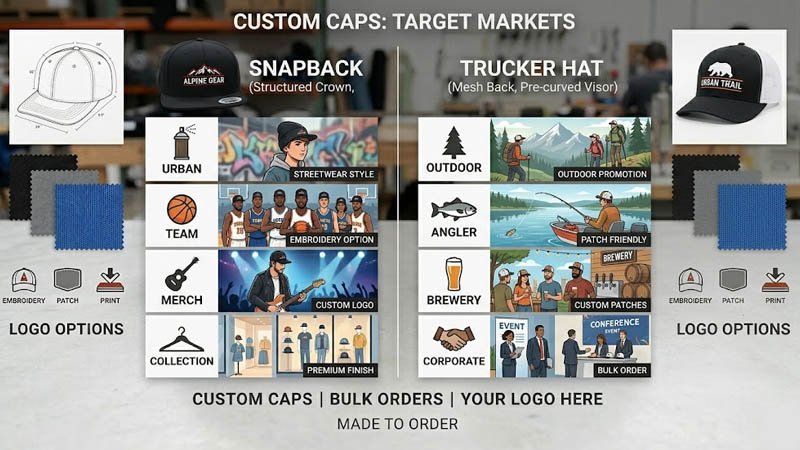
Different buyers have different goals. Choosing the right hat style depends on your market, product positioning, and end users.
Choose Snapback Hats If You Are:
- A streetwear brand
- A sports team
- A fashion retailer
- A music merch brand
- A skate brand
- A youth culture brand
- A company looking for premium embroidered caps
- A brand building a retail merchandise collection
Snapback hats are better when your project needs strong structure, bold logo visibility, and a more fashion-focused appearance.
Choose Trucker Hats If You Are:
- An outdoor brand
- A fishing or camping brand
- A beer or beverage company
- A corporate event organizer
- A promotional product distributor
- A travel company
- A construction or workwear company
- A company looking for breathable giveaway caps
Trucker hats are better when your project needs comfort, airflow, practical use, and strong promotional value.
Custom snapback hats are ideal for projects that focus on brand identity, style, and retail value.
They are commonly used for:
- Streetwear collections
- Sports team merchandise
- Music festival merchandise
- Skateboarding brands
- Hip-hop fashion brands
- Brand launch campaigns
- Retail cap collections
- Club and association merchandise
- Premium corporate gifts
A well-made snapback hat with embroidery or a high-quality patch can make a brand look more professional and valuable.
Best Use Cases for Custom Trucker Hats
Custom trucker hats are ideal for projects that need breathability, practicality, and large-volume brand exposure.
They are commonly used for:
- Outdoor events
- Summer promotions
- Fishing and camping brands
- Beer and beverage promotions
- Corporate giveaways
- Trade shows
- Travel campaigns
- Farm and ranch brands
- Construction teams
- Promotional product programs
Because trucker hats are comfortable and easy to wear outdoors, they often have a high usage rate after being given away. This makes them effective promotional products.
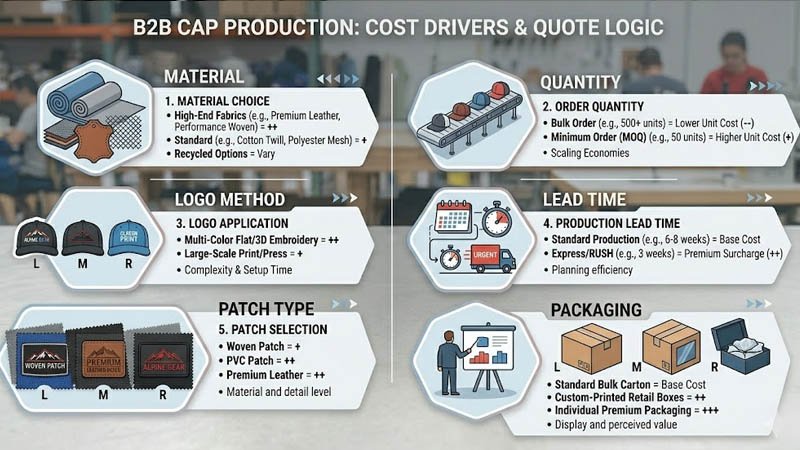
The final price of custom hats depends on several factors. Understanding these factors can help buyers make better decisions before requesting a quotation.
1. Hat Material
Cotton, polyester, nylon, canvas, foam, mesh, and recycled fabrics all have different costs. Premium fabrics usually increase the unit price.
2. Hat Structure
A structured snapback hat may cost more than a simple promotional trucker hat because it requires a firmer crown construction and more shape control.
3. Logo Method
Embroidery, 3D puff embroidery, appliqué embroidery, woven patches, PVC patches, leather patches, screen printing, and heat transfer printing all have different production costs.
4. Embroidery Size and Stitch Count
For embroidered logos, larger designs and higher stitch counts usually increase the cost.
5. Number of Logo Colors
More logo colors may increase production complexity, especially for embroidery, printing, and patch production.
6. Patch Material
Leather patches, PVC patches, embroidered patches, and woven patches have different price levels.
7. Order Quantity
Larger quantities usually reduce the unit cost. For bulk custom hat orders, quantity is one of the most important pricing factors.
8. Packaging Requirements
Custom packaging, barcode labels, hangtags, inner labels, and individual polybags may increase the total cost.
9. Sample Requirements
Custom samples are important before mass production, especially for new designs, new logo methods, or private label projects.
10. Lead Time
Urgent orders may require special production arrangements, which can affect cost and delivery planning.
In general, a snapback hat with 3D embroidery or appliqué embroidery may cost more than a simple printed trucker hat. However, a trucker hat with a premium leather patch or custom woven label can also create a high-end look.
How to Start a Custom Hat Order
A clear customization process helps reduce mistakes and improve production efficiency.
Here is a common process for custom snapback and trucker hat orders:
Step 1: Send Your Logo or Design Idea
Prepare your logo file, brand color, reference image, or design concept. Vector files such as AI, EPS, or PDF are usually preferred for production.
Step 2: Choose the Hat Style
Decide whether you want a snapback hat, trucker hat, baseball cap, 5-panel cap, dad hat, or another cap style.
Step 3: Confirm Material and Color
Choose the fabric, mesh, brim color, panel color, closure color, and stitching color based on your brand identity.
Step 4: Select the Logo Method
Choose embroidery, 3D embroidery, appliqué, woven patch, PVC patch, leather patch, screen printing, heat transfer printing, or another method.
Step 5: Confirm Logo Size and Position
Common logo positions include:
- Front panel
- Side panel
- Back panel
- Brim
- Closure area
- Inner label
The front panel is the most popular position for custom hat logos.
Step 6: Make a Pre-Production Sample
A sample helps confirm the hat shape, fabric quality, logo effect, stitching, color matching, and overall appearance.
Step 7: Confirm the Sample
After reviewing the sample, buyers can request adjustments before bulk production.
Step 8: Start Bulk Production
Once the sample is approved, mass production can begin.
Step 9: Quality Inspection and Packaging
Before shipment, the hats should be checked for logo accuracy, stitching quality, shape, color, packaging, and quantity.
Step 10: Shipping
After inspection and packing, the order can be shipped by express, air, sea, or other logistics methods based on the buyer’s timeline and budget.
Common Mistakes to Avoid When Ordering Custom Hats
Custom hats may look simple, but small details can affect the final quality. Here are some common mistakes buyers should avoid.
Mistake 1: Choosing a Hat Style Only by Appearance
A snapback may look stylish, but it may not be the best choice for hot outdoor events. A trucker hat may be breathable, but it may not create the premium streetwear look some fashion brands need.
Always choose the style based on the target user and use scenario.
Mistake 2: Using the Wrong Logo Method
Not every logo works well with every decoration method. Small text may not work well with 3D embroidery. Complex gradients may not be suitable for traditional embroidery. Detailed logos may look better as woven patches.
Mistake 3: Ignoring the Front Panel Structure
The front panel affects how the logo appears. A structured front panel is better for embroidery, while a foam front panel may be better for printing or patch application.
Mistake 4: Not Checking Color Contrast
The hat color and logo color should have enough contrast. If the colors are too close, the logo may not stand out clearly.
Mistake 5: Skipping the Sample Process
For custom hat orders, sampling is important. A sample helps confirm size, shape, fabric, logo effect, stitching quality, and overall appearance before mass production.
Mistake 6: Forgetting Packaging Details
For retail brands and distributors, packaging matters. Hangtags, labels, barcode stickers, and individual bags should be confirmed before production.
For buyers who are not sure whether a snapback or trucker hat is better for their project, working with an experienced manufacturer can reduce trial-and-error costs.
GUANGZHOU EASTLUCKY Hat & Garment Co., Ltd., based in Guangzhou, China, is a high-end custom hat and OEM/ODM manufacturer with 15 years of experience in professional R&D, production, and distribution of various hats and embroidered accessories. From design sampling and material selection to embroidery, patch development and bulk production, EASTLUCKY helps global brands build reliable custom hat solutions with consistent quality and efficient delivery.
A professional factory can help buyers choose the right cap structure, material, logo method, packaging, and production solution based on their target market and order quantity.
So, which one should you choose?
Choose a custom snapback hat if your project focuses on structure, style, premium branding, embroidery, sports merchandise, streetwear, or retail fashion.
Choose a custom trucker hat if your project focuses on breathability, outdoor comfort, summer events, promotional giveaways, practical use, or large-volume brand exposure.
In simple terms:
Snapback hats are better for structure, style, and premium logo presentation.
Trucker hats are better for breathability, comfort, and promotional use.
Both styles can be excellent custom products when the material, logo method, and design are chosen correctly.
Before placing a bulk order, consider your target customers, wearing scenario, logo design, budget, packaging needs, and expected delivery time. The right hat choice will help your brand create a product that looks good, feels comfortable, and delivers lasting promotional value.
What is the main difference between a snapback and a trucker hat?
The main difference is the structure. A snapback hat usually has a full fabric structure, flat brim, and high-profile crown. A trucker hat usually has a mesh back, foam or fabric front panel, and better breathability.
Is a snapback hat good for custom embroidery?
Yes. Snapback hats are excellent for custom embroidery because they usually have a structured front panel. Flat embroidery, 3D puff embroidery, appliqué embroidery, and embroidered patches all work well on snapback hats.
Is a trucker hat good for outdoor promotions?
Yes. Trucker hats are very suitable for outdoor promotions because they are lightweight, breathable, and comfortable in warm weather. They are popular for fishing, camping, travel, outdoor events, and summer marketing campaigns.
Which hat is better for streetwear brands?
Snapback hats are usually better for streetwear brands because they have a bold structure, flat brim, and strong fashion identity. They also work well with 3D embroidery and large front logos.
Which hat is better for corporate giveaways?
Trucker hats are often a good choice for corporate giveaways because they are practical, breathable, and suitable for large promotional orders. Snapback hats can also work well for premium corporate merchandise.
Are snapback hats more expensive than trucker hats?
Not always. The price depends on the material, logo method, structure, quantity, and packaging. A snapback with 3D embroidery may cost more than a simple printed trucker hat, but a trucker hat with a leather patch or custom woven label can also be premium.
Which hat is better for embroidered logos?
Snapback hats are often better for direct embroidery because of their structured front panel. Trucker hats can also use embroidery, but patches may create a cleaner result on foam-front styles.
Which hat is better for summer events?
Trucker hats are usually better for summer events because the mesh back improves airflow and wearing comfort.
Can I order custom snapback and trucker hats with the same logo?
Yes. Many brands use the same logo across different hat styles to create a complete merchandise collection. This is a good option for brands that want to serve different customer groups.
What is the best hat style for promotional giveaways?
Trucker hats are often popular for giveaways because they are practical, breathable, and suitable for large-volume branding. Snapbacks are better for premium brand merchandise.
What should I prepare before ordering custom hats?
You should prepare your logo file, preferred hat style, material, color, logo method, order quantity, packaging requirements, and target delivery time. If you are not sure which style to choose, a manufacturer can recommend the best option based on your project.
Call to Action
Looking for custom snapback hats or trucker hats for your brand?
Send us your logo, order quantity, preferred style, target market, and packaging requirements. Our team can help recommend the right material, logo method, and production solution for your bulk custom hat order
How to Style Custom Trucker Hats for Brands and Events
Custom trucker hats are more than casual accessories. For brands, events, sports teams, outdoor campaigns, and promotional programs, they are practical, stylish, and highly visible branding tools.
With a structured front panel, breathable mesh back, and adjustable closure, trucker hats are easy to wear and easy to customize. They work well with casual outfits, uniforms, streetwear, outdoor clothing, and event merchandise. More importantly, the front panel provides a clear space for embroidery, patches, printed logos, or branded artwork.
Whether you are planning a corporate event, launching a retail merchandise collection, preparing a trade show giveaway, or designing custom hats for your team, the right trucker hat style can help your brand look more professional and memorable.
In this guide, we will explain how to style custom trucker hats for brands and events, how to choose the right materials and colors, and what buyers should consider before placing a bulk order.
What Makes Trucker Hats Popular for Brands and Events?
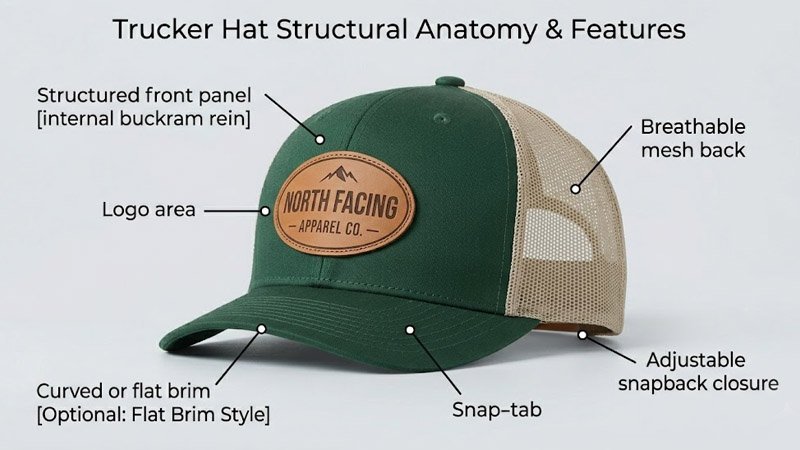
Trucker hats are popular because they combine comfort, visibility, and strong customization potential.
The classic trucker hat usually includes:
- A structured front panel
- A breathable mesh back
- An adjustable snapback closure
- A flat or curved brim
- A large front area for custom branding
For events and brand promotions, this design is very practical. The mesh back keeps the hat breathable, while the front panel gives the logo enough space to stand out.
Compared with many other promotional products, custom trucker hats are also more wearable. People can use them after the event, which means your logo continues to get exposure in daily life.
Before styling a custom trucker hat, it is important to choose the right base design. The material, brim shape, color, and logo method all affect the final look.
1. Choose the Right Front Panel
The front panel is the most important area for branding.
Common front panel options include:
- Foam front panel for a classic vintage trucker look
- Cotton front panel for a soft and natural appearance
- Polyester front panel for durability and stable colors
- Canvas front panel for a heavier outdoor or workwear style
For embroidered logos or patches, a structured front panel is usually recommended because it helps the logo stay clean and visible.
2. Choose the Right Mesh Back
The mesh back is one of the key features of a trucker hat. It provides ventilation and keeps the hat lightweight.
A breathable mesh back is especially suitable for:
- Outdoor events
- Summer campaigns
- Sports teams
- Camping brands
- Fishing brands
- Workwear teams
- Music festivals
- Promotional giveaways
For brand projects, the mesh color can match or contrast with the front panel to create a more customized look.
3. Choose a Flat Brim or Curved Brim
The brim shape affects the overall style of the hat.
A flat brim trucker hat gives a modern, bold, and streetwear-inspired look. It is suitable for fashion brands, youth brands, sports promotions, and retail merchandise.
A curved brim trucker hat gives a more classic, relaxed, and everyday look. It is suitable for corporate events, outdoor brands, team uniforms, and casual promotional use.
For most brand events, curved brim trucker hats are easier to wear for a wide audience. For streetwear or fashion-focused projects, flat brim styles may look more eye-catching.
4. Choose the Right Closure
Most trucker hats use an adjustable snapback closure. This is a practical option for bulk orders because it fits different head sizes.
Other closure options may include:
- Velcro closure
- Metal buckle closure
- Plastic snapback closure
- Elastic fit
For event giveaways and promotional campaigns, snapback closures are usually the most convenient choice.
The logo method is one of the most important decisions when designing custom trucker hats. Different logo techniques create different styles and price levels.
Flat Embroidery
Flat embroidery is clean, professional, and widely used for custom trucker hats. It works well for company logos, event names, simple icons, and short text.
Best for:
- Corporate events
- Trade shows
- Team hats
- Promotional gifts
- Uniform hats
Flat embroidery is a good choice when you want a professional and durable logo effect.
3D Puff Embroidery
3D puff embroidery creates a raised logo effect. It looks bold and premium, especially on structured front panels.
Best for:
- Streetwear brands
- Sports teams
- Fashion merchandise
- Bold letter logos
This method works best for simple logos with thick lines. Very small details may not be suitable for 3D embroidery.
Woven Patch
A woven patch is a good option for detailed logos. It can show small text, fine lines, and more complex artwork better than direct embroidery.
Best for:
- Outdoor brands
- Retail merchandise
- Lifestyle brands
- Detailed logo designs
Woven patches also give the hat a finished, retail-ready appearance.
Leather Patch
Leather patches create a vintage, premium, and outdoor-inspired look. They are often used for workwear, camping, fishing, and lifestyle brands.
Best for:
- Outdoor brands
- Workwear brands
- Premium merchandise
- Minimal logo designs
Brown, black, and tan leather patches are common choices for custom trucker hats.
Heat Transfer Printing
Heat transfer printing is suitable for colorful artwork, gradients, and full-color designs.
Best for:
- Event graphics
- Colorful brand artwork
- Promotional campaigns
- Photo-style designs
For long-term use, buyers should confirm the durability requirements before choosing heat transfer printing.
How to Style Custom Trucker Hats for Different Brand Scenarios
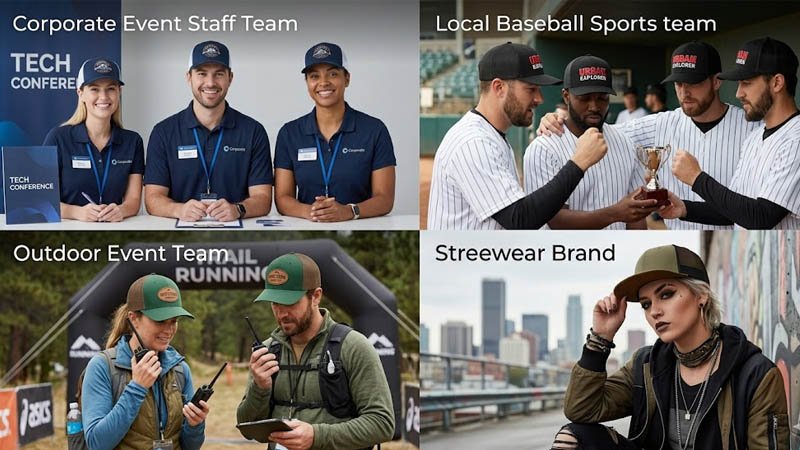
Custom trucker hats can be styled differently depending on your brand identity and event type.
Corporate Events
For corporate events, the style should be clean, simple, and professional.
Recommended design:
- Neutral colors such as black, navy, grey, or white
- Curved brim
- Flat embroidery logo
- Simple front panel design
- Adjustable snapback closure
Recommended outfit match:
- Polo shirts
- Company T-shirts
- Chinos
- Casual jackets
- Staff uniforms
A clean embroidered trucker hat can help event staff look unified while keeping the brand visible.
Trade Shows and Exhibitions
At trade shows, custom trucker hats can work as both staff uniforms and promotional giveaways.
Recommended design:
- High-contrast logo
- Lightweight mesh back
- Comfortable fit
- Clear brand name or slogan
- Simple color combination
Recommended outfit match:
- Branded T-shirts
- Lanyards
- Casual business wear
- Exhibition uniforms
For trade shows, the logo should be easy to read from a distance. Avoid overly complex designs that may lose clarity.
Outdoor Events
For outdoor events, comfort and breathability are very important.
Recommended design:
- Breathable mesh back
- Durable front panel
- Curved brim for sun protection
- Earth-tone or high-visibility colors
- Embroidery or patch logo
Recommended outfit match:
- Outdoor shirts
- Cargo pants
- Shorts
- Sunglasses
- Work jackets
This style is suitable for camping events, fishing competitions, hiking clubs, outdoor brand promotions, and summer festivals.
Sports Teams
For sports teams, trucker hats should feel energetic, comfortable, and easy to wear.
Recommended design:
- Team colors
- Embroidered team logo
- Adjustable closure
- Breathable mesh back
- Curved or flat brim depending on team style
Recommended outfit match:
- Team jerseys
- Sports T-shirts
- Joggers
- Shorts
- Sneakers
For sports teams, bold embroidery and clear color contrast can make the design more recognizable.
Streetwear Brands
For streetwear brands, trucker hats can be bold, creative, and expressive.
Recommended design:
- Flat brim
- 3D puff embroidery
- Woven patch
- Contrast mesh back
- Strong logo placement
Recommended outfit match:
- Oversized T-shirts
- Hoodies
- Denim jackets
- Cargo pants
- Sneakers
Streetwear trucker hats should feel more visual and attitude-driven. A bold front logo or raised embroidery can help create a stronger brand identity.
Music Festivals and Promotional Events
For music festivals, concerts, and promotional campaigns, trucker hats can be fun, colorful, and memorable.
Recommended design:
- Bright colors
- Printed graphics
- Event slogan
- Mesh back for comfort
- Lightweight structure
Recommended outfit match:
- Event T-shirts
- Casual shorts
- Denim
- Sneakers
- Sunglasses
For these events, the design can be more creative, but the logo should still remain clear and readable.
Color plays an important role in both styling and branding. A good color combination can make the hat easier to wear and help the logo stand out.
| Hat Color |
Best For |
Recommended Logo Style |
| Black |
Corporate events, streetwear, daily wear |
White or bright embroidery |
| Navy |
Business casual, team uniforms, events |
White, silver, or light blue embroidery |
| White |
Summer events, clean brand looks |
Dark embroidery or colorful patch |
| Grey |
Minimal branding, everyday use |
Black or navy embroidery |
| Beige / Khaki |
Outdoor brands, camping, travel |
Brown leather patch or dark embroidery |
| Olive Green |
Workwear, outdoor campaigns |
Tan patch or cream embroidery |
| Red / Bright Colors |
Sports teams, festivals, promotions |
High-contrast logo |
| Camo |
Outdoor brands, streetwear |
Leather patch or simple embroidery |
For brand projects, always check logo visibility before bulk production. A low-contrast logo may look stylish on screen but unclear on the final product.
Which Custom Trucker Hat Style Is Right for Your Brand?
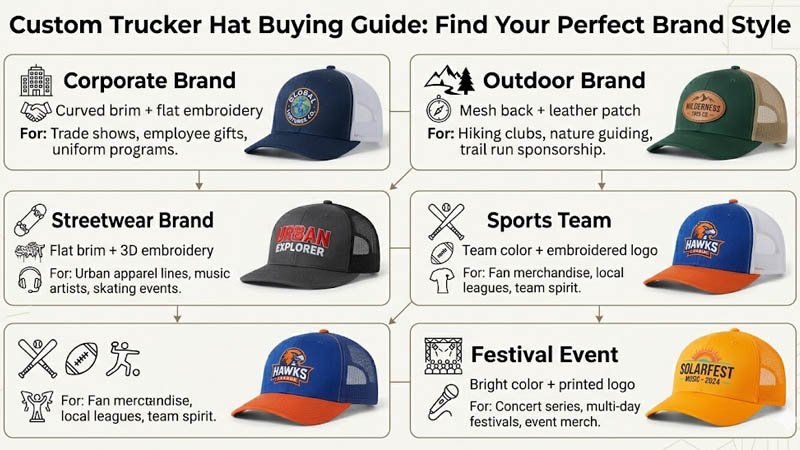
Different brands need different hat styles. The best choice depends on your market, design style, and usage scenario.
| Brand Type |
Recommended Hat Style |
Best Logo Method |
| Corporate Brand |
Curved brim trucker hat |
Flat embroidery |
| Outdoor Brand |
Mesh back trucker hat |
Leather patch or woven patch |
| Streetwear Brand |
Flat brim structured trucker hat |
3D puff embroidery or woven patch |
| Sports Team |
Breathable team trucker hat |
Embroidery or heat transfer |
| Trade Show |
Lightweight promotional trucker hat |
Flat embroidery or printed logo |
| Retail Brand |
Premium cotton trucker hat |
Woven patch or embroidery |
| Workwear Brand |
Canvas or cotton trucker hat |
Leather patch or embroidery |
| Festival Event |
Colorful trucker hat |
Heat transfer print or patch |
This type of planning helps buyers choose a hat that fits both the brand image and the actual usage environment.
Common Styling Mistakes to Avoid
Even a good trucker hat can look wrong if it is styled poorly. Here are some common mistakes to avoid.
1. Using Too Many Colors
If the hat already has a bright color or bold logo, keep the outfit simple. Too many colors can make the whole look messy.
2. Choosing the Wrong Fit
The hat should sit naturally on the head. It should not be too tight, too loose, too low, or too high.
3. Mixing the Wrong Style
A trucker hat is casual by nature. It works best with casual, sporty, outdoor, streetwear, and relaxed smart casual outfits. It is usually not suitable for formal business suits or very formal occasions.
4. Ignoring Logo Balance
For custom hats, the logo should not be too large or too small. It should fit the front panel naturally and leave enough space around the design.
5. Overloading the Front Panel
Too many words, icons, slogans, and graphics can make the hat look crowded. A clean design is often more professional and easier to remember.
Common Customization Mistakes to Avoid
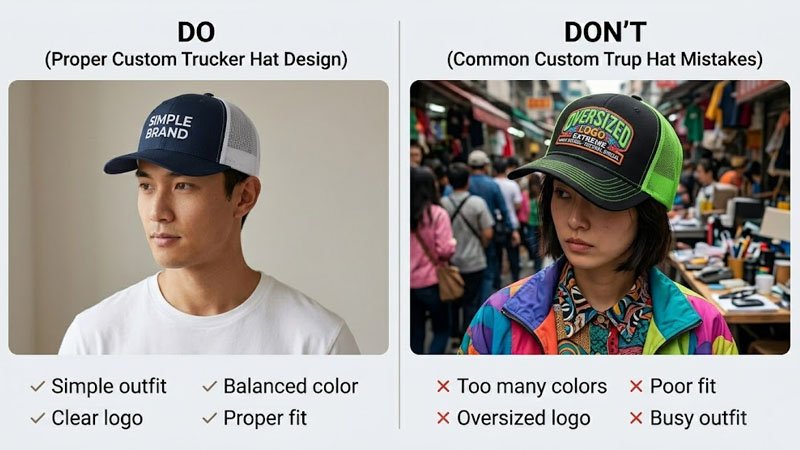
For bulk buyers, design mistakes can affect the final result and increase production risk.
1. Choosing a Logo That Is Too Detailed
Small text and fine lines may not work well with embroidery. If the logo has many details, a woven patch or printed patch may be a better choice.
2. Ignoring Material Compatibility
Different materials create different logo effects. Foam, cotton, polyester, and canvas panels may all react differently to embroidery, patches, or printing.
3. Not Checking Color Contrast
A logo needs enough contrast against the hat color. Before production, buyers should confirm whether the logo is visible and clear.
4. Skipping Sample Approval
Sampling is important for custom trucker hats. It helps confirm the logo effect, stitching quality, material, color, size, and overall shape before mass production.
5. Choosing Style Only by Price
Low-cost hats may not always deliver the best brand impression. For brand events and retail merchandise, quality, comfort, and logo clarity are very important.
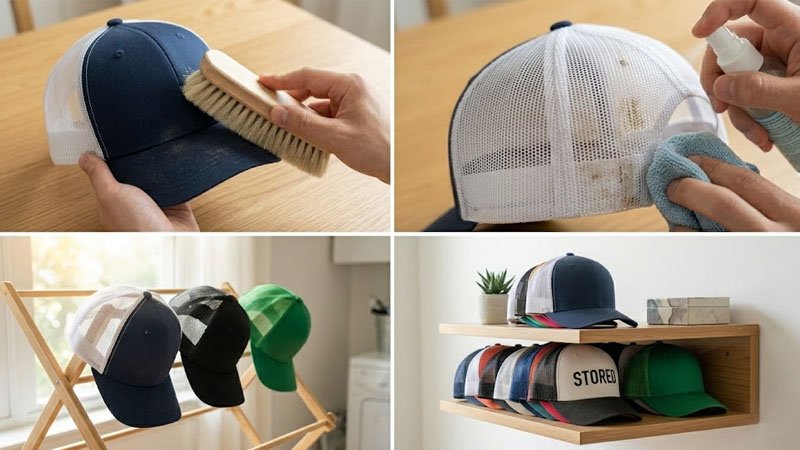
Proper care helps trucker hats keep their shape and appearance for longer.
Cleaning Tips
Spot cleaning is usually the safest method. Use a soft cloth or soft brush with mild detergent to gently clean dirt or stains.
Avoid machine washing if possible, because it may damage the structure, bend the brim, or deform the mesh back.
After cleaning, let the hat air dry naturally. Do not use high heat, as it may affect the material or logo.
Storage Tips
Store trucker hats in a cool and dry place. Avoid crushing them in bags or drawers.
For better shape protection, place the hats on a shelf, hat rack, or store them upside down. Keep the brim flat and avoid bending it too much.
For bulk orders, proper packaging is also important. Individual polybags, inner boxes, and export cartons can help protect hats during transportation.
What Buyers Should Prepare Before Ordering Custom Trucker Hats
To make the custom process smoother, buyers should prepare the following information before requesting a quote:
- Logo file
- Preferred hat style
- Quantity
- Pantone colors
- Logo size
- Logo method
- Brim style
- Material preference
- Packaging requirement
- Target delivery date
- Usage scenario
For custom buyers, working with an experienced manufacturer can help reduce sampling errors, improve logo accuracy, and ensure stable quality in bulk production.
GUANGZHOU EASTLUCKY Hat & Garment Co., Ltd. is a high-end custom hat and OEM/ODM manufacturer based in Guangzhou, China, with 15 years of expertise in professional R&D, production, and distribution of various hats and embroidered accessories. Guided by the philosophy “Quality as Root, Innovation as Soul,” the company provides global clients with one-stop solutions from design sampling to mass production, helping brands create efficient and high-quality custom hat programs.
Are trucker hats good for brand promotion?
Yes. Trucker hats are practical, wearable, and highly visible. The front panel provides a strong area for logos, while the mesh back makes the hat comfortable for daily and outdoor use.
What is the best logo method for custom trucker hats?
Flat embroidery is best for clean and professional logos. 3D embroidery is good for bold designs. Woven patches are suitable for detailed logos. Leather patches are ideal for outdoor and premium styles.
Are trucker hats suitable for outdoor events?
Yes. The breathable mesh back makes trucker hats very suitable for outdoor events, festivals, sports activities, camping, fishing, and summer promotions.
Should I choose a flat brim or curved brim?
Choose a flat brim for streetwear, fashion, and bold brand styles. Choose a curved brim for corporate events, outdoor use, sports teams, and wider audience appeal.
Can I order trucker hats with different colors?
Yes. Custom trucker hats can usually be made with different front panel colors, mesh colors, brim colors, and logo colors. Buyers can match the hat design with their brand color system.
What should I check before bulk production?
You should check the sample carefully, including material, logo position, embroidery quality, color matching, stitching, brim shape, closure, size, and packaging.
Are custom trucker hats suitable for retail merchandise?
Yes. With the right material, logo method, and packaging, custom trucker hats can be used as retail merchandise for fashion brands, outdoor brands, sports brands, and lifestyle brands.
Final Thoughts
Custom trucker hats are a smart choice for brands and events because they combine comfort, style, and strong logo visibility. They can be used for corporate events, trade shows, sports teams, outdoor campaigns, music festivals, staff uniforms, and retail merchandise.
To create a successful custom trucker hat, buyers should consider the hat structure, material, brim shape, color matching, logo method, and final usage scenario. A simple and well-balanced design often creates a stronger brand impression than an overloaded one.
Whether you need embroidered trucker hats, patch trucker hats, promotional trucker hats, or OEM custom hat solutions, the right design can turn a simple hat into a wearable part of your brand identity.
For your next custom trucker hat project, prepare your logo, quantity, preferred style, and event details. A professional manufacturer can help you choose the right material, logo technique, and production solution for your brand.
New Era 9TWENTY vs. 9FORTY: Fit, Structure, Style, and Customization Guide
When comparing the New Era 9TWENTY and 9FORTY, the biggest difference is simple: the 9TWENTY is softer and more relaxed, while the 9FORTY is more structured and sporty.
The New Era 9TWENTY is known for its unstructured crown, low-profile fit, and casual “dad hat” style. It is comfortable, easy to wear, and perfect for everyday outfits.
The New Era 9FORTY, on the other hand, has a structured crown, a pre-curved visor, and a cleaner athletic look. It holds its shape better and offers stronger front logo visibility, making it a popular choice for sports teams, events, uniforms, and promotional caps.
Both styles are adjustable, versatile, and widely loved. However, they serve different purposes. If you are choosing a cap for personal wear, brand merchandise, or a custom hat project, understanding these differences can help you make the right decision.
Quick Answer: 9TWENTY vs. 9FORTY
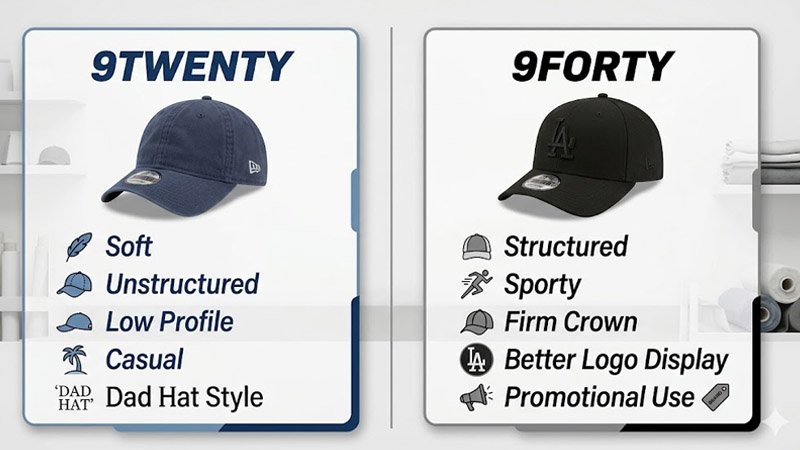
Choose the 9TWENTY if you want a soft, unstructured, low-profile cap with a relaxed vintage look.
Choose the 9FORTY if you want a structured, sporty cap with a firmer crown and better logo presentation.
In short:
9TWENTY = relaxed, soft, casual, dad-hat style
9FORTY = structured, sporty, polished, brand-ready style
9TWENTY vs. 9FORTY Comparison Table
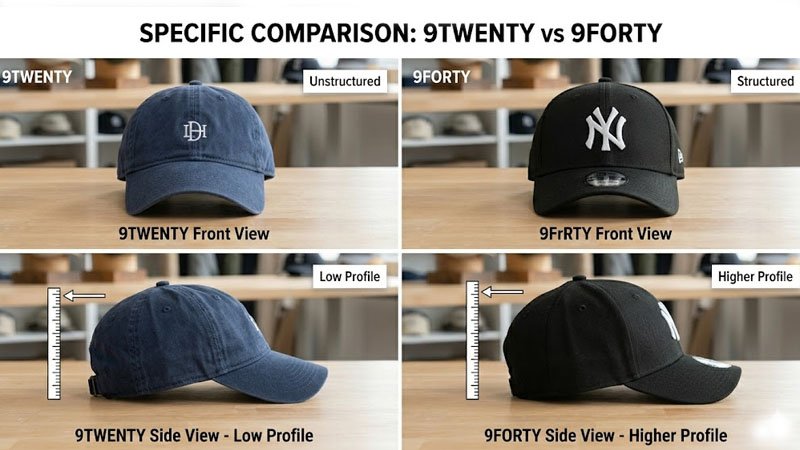
| Feature |
New Era 9TWENTY |
New Era 9FORTY |
| Crown Structure |
Unstructured |
Structured |
| Profile |
Low profile |
Mid to slightly higher profile |
| Fit Feel |
Soft and relaxed |
Firmer and more secure |
| Overall Style |
Casual, vintage, dad hat |
Sporty, clean, polished |
| Visor |
Curved visor |
Pre-curved visor |
| Logo Display |
Softer and more subtle |
More upright and visible |
| Best For |
Casual wear and lifestyle fashion |
Sports teams and brand promotion |
| Comfort |
Very soft and flexible |
Comfortable with more support |
| Custom Use |
Lifestyle caps, fashion merch, souvenirs |
Team caps, corporate caps, event caps |
| Recommended Buyer |
Brands wanting a relaxed look |
Brands needing strong logo visibility |
What Is the New Era 9TWENTY Cap?
The New Era 9TWENTY is one of the most relaxed cap styles in the New Era lineup. It is widely recognized for its soft, unstructured crown and easygoing fit.
Unlike structured caps that keep a firm front shape, the 9TWENTY has soft front panels. This allows the cap to naturally follow the shape of the wearer’s head. The result is a comfortable, slightly worn-in look that feels casual and effortless.
This is why the 9TWENTY is often associated with the popular dad hat style.
Key Features of the 9TWENTY
The 9TWENTY usually features:
- An unstructured crown
- A low-profile shape
- A curved visor
- An adjustable back closure
- A soft and flexible fit
- A relaxed vintage appearance
Because of its soft structure, the 9TWENTY does not look stiff or bulky. It is a great option for people who want a cap that feels natural, comfortable, and easy to style.
Fit and Comfort
The 9TWENTY is designed for comfort. Its soft crown and flexible material make it suitable for long-time wear.
Many 9TWENTY-style caps are made from cotton, washed cotton, or similar soft fabrics. These materials help create a breathable and lightweight feel.
The adjustable closure makes it suitable for most head sizes. However, because it has a low-profile and relaxed shape, people who prefer a stronger and more secure fit may prefer the 9FORTY.
Best Uses for the 9TWENTY
The 9TWENTY is ideal for:
- Everyday casual wear
- Lifestyle fashion brands
- Vintage-style merchandise
- Travel souvenirs
- Retail fashion collections
- Cafés, clubs, and creative brands
- Low-key logo embroidery
- Soft and relaxed promotional caps
If your brand wants a friendly, relaxed, and lifestyle-focused image, the 9TWENTY-style cap is a strong choice.
What Is the New Era 9FORTY Cap?
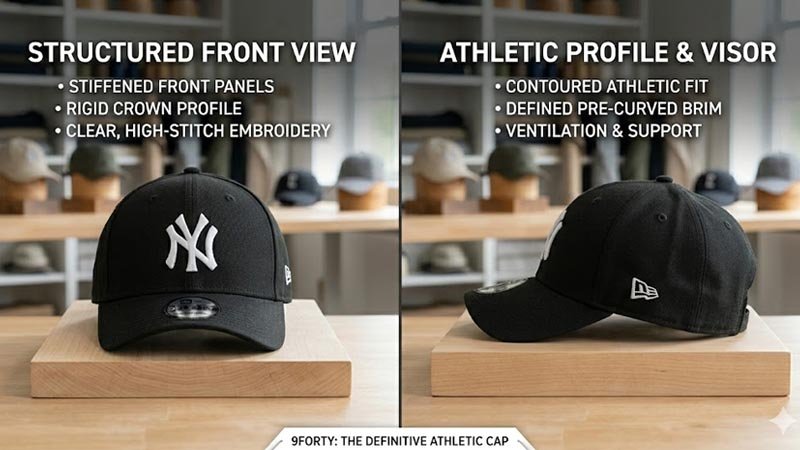
The New Era 9FORTY is an adjustable cap with a more structured and sporty design. Compared with the 9TWENTY, it has a firmer crown and a cleaner shape.
The structured front panels help the cap maintain its form. This gives the 9FORTY a sharper look and makes the front logo area more stable.
Because of this, the 9FORTY is commonly used for sports teams, corporate branding, staff uniforms, outdoor events, and promotional merchandise.
Key Features of the 9FORTY
The 9FORTY usually features:
- A structured crown
- A pre-curved visor
- A mid-profile or slightly higher-profile fit
- An adjustable back closure
- A sporty appearance
- A stronger front logo area
The structured crown makes the 9FORTY look more polished than the 9TWENTY. It is a good choice for buyers who want a cap that looks neat, stable, and brand-focused.
Fit and Comfort
The 9FORTY still offers good comfort, but it feels different from the 9TWENTY.
Instead of being soft and floppy, the 9FORTY feels more supportive. It sits more firmly on the head and holds its shape throughout the day.
For medium to larger head sizes, the 9FORTY may feel more secure. For buyers who want a professional cap shape, it is often the better option.
Best Uses for the 9FORTY
The 9FORTY is ideal for:
- Sports team caps
- Corporate event caps
- School and club caps
- Staff uniforms
- Outdoor promotional caps
- Brand merchandise
- Strong logo embroidery
- Patch designs
- Clean and professional cap collections
If your brand wants a structured, sporty, and highly visible logo presentation, the 9FORTY-style cap is usually the better choice.
Main Differences Between 9TWENTY and 9FORTY
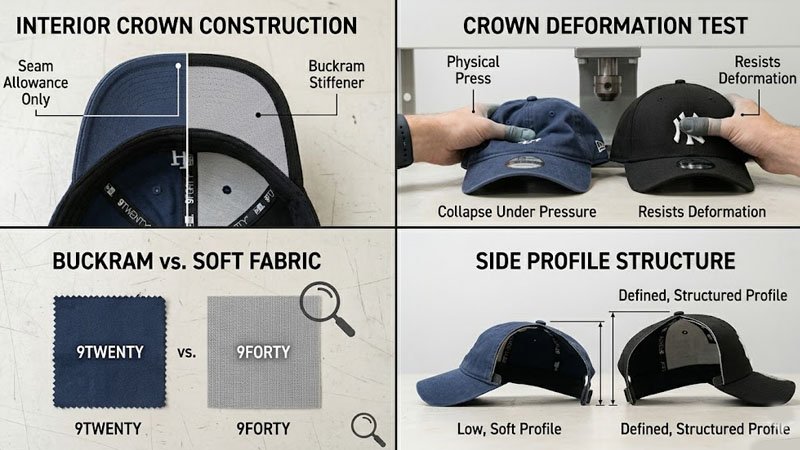
1. Crown Structure
The most important difference is the crown structure.
The 9TWENTY has an unstructured crown, which means the front panels are soft and flexible. It creates a relaxed, casual look.
The 9FORTY has a structured crown, which means the front panels are firmer and help the cap keep its shape.
If you want a soft and natural cap shape, choose the 9TWENTY.
If you want a firm and defined cap shape, choose the 9FORTY.
2. Profile and Shape
The 9TWENTY usually has a lower profile. It sits closer to the head and looks more understated.
The 9FORTY has a slightly higher and more structured profile. It creates a stronger visual shape and looks more athletic.
For a subtle daily cap, the 9TWENTY is better.
For a sharper branded cap, the 9FORTY is better.
3. Style and Appearance
The 9TWENTY is more casual and vintage. It is often worn with T-shirts, hoodies, denim, sneakers, and relaxed streetwear.
The 9FORTY is more sporty and polished. It works well with jerseys, polo shirts, uniforms, jackets, and activewear.
The difference can be summarized like this:
9TWENTY: relaxed lifestyle style
9FORTY: structured sports style
4. Logo Display
Logo display is very important for custom hat projects.
Because the 9TWENTY has a soft crown, logos appear more relaxed and subtle. It is suitable for small embroidery, minimalist branding, and lifestyle-style designs.
Because the 9FORTY has a structured front panel, logos appear more upright and visible. It is better for bold embroidery, woven patches, rubber patches, and team logos.
If you want understated branding, choose the 9TWENTY.
If you want stronger logo visibility, choose the 9FORTY.
5. Comfort and Wearing Experience
Both caps are comfortable, but they offer different wearing experiences.
The 9TWENTY feels softer, lighter, and more flexible. It is ideal for people who want a cap that feels easy and casual.
The 9FORTY feels more secure and supportive. It is ideal for people who want a cap that keeps its shape and feels more stable.
There is no single better choice. The right option depends on your style preference, head shape, and intended use.
Which Cap Should You Choose?
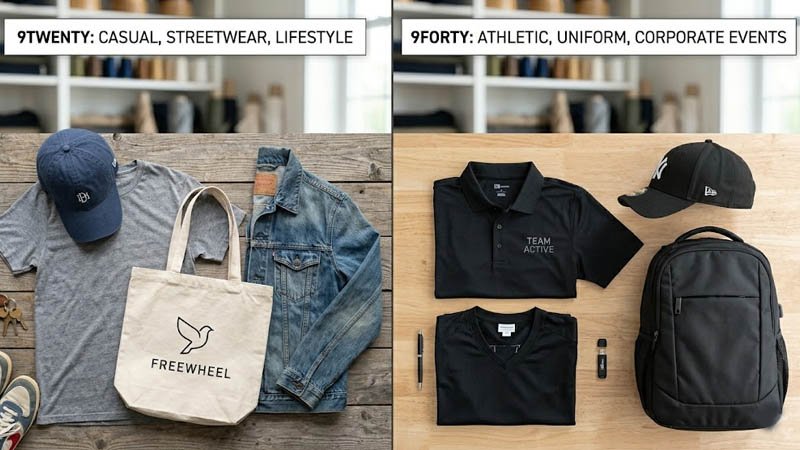
Choose the 9TWENTY If You Want:
- A soft unstructured cap
- A low-profile fit
- A relaxed dad-hat look
- A casual everyday style
- A vintage-inspired appearance
- A more subtle logo effect
- A comfortable cap for long wear
- A lifestyle-focused custom cap
The 9TWENTY is best for brands and wearers who want comfort, softness, and an easygoing fashion style.
Choose the 9FORTY If You Want:
- A structured cap
- A cleaner and sharper shape
- A sporty appearance
- A more secure fit
- Better logo visibility
- A professional branded look
- A cap for teams, events, or uniforms
- A custom cap suitable for bold decoration
The 9FORTY is best for brands and wearers who want structure, logo impact, and a more polished look.
Customization Guide: Which Style Is Better for Custom Hats?
For custom cap buyers, the choice between a 9TWENTY-style and 9FORTY-style cap is not only about fashion. It also affects production structure, logo placement, embroidery result, fabric selection, and final brand image.
A 9TWENTY-style cap is usually better for relaxed lifestyle branding. A 9FORTY-style cap is usually better for professional, sporty, or promotional branding.
Custom Hat Project Recommendations
| Custom Project Type |
Recommended Style |
Reason |
| Lifestyle fashion brand |
9TWENTY-style |
Soft, casual, and easy to style |
| Sports team caps |
9FORTY-style |
Structured crown supports bold logos |
| Corporate event caps |
9FORTY-style |
Clean and professional appearance |
| Travel souvenir caps |
9TWENTY-style |
Relaxed and approachable look |
| School or club caps |
9FORTY-style |
Durable structure and strong logo display |
| Café or creative brand merch |
9TWENTY-style |
Friendly and lifestyle-oriented |
| Promotional giveaway caps |
9FORTY-style |
Better visibility for brand logos |
| Streetwear merchandise |
Both styles |
Depends on brand image and design direction |
Manufacturing Perspective: What Should Brands Consider?
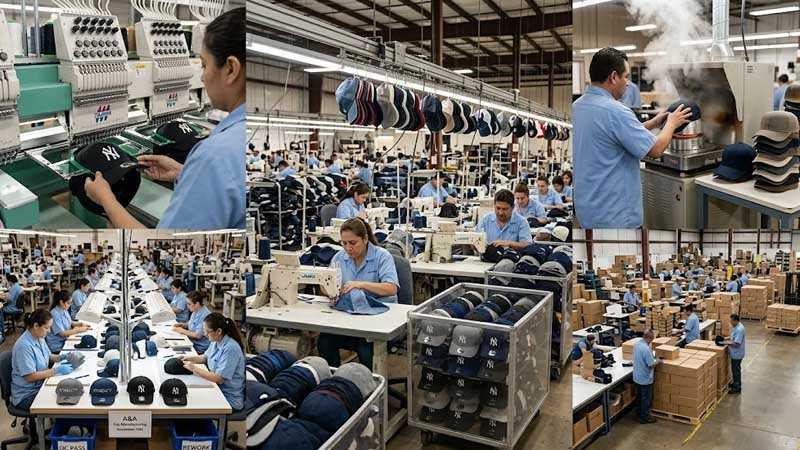
When developing custom caps inspired by 9TWENTY or 9FORTY styles, brands should consider more than just the outside appearance.
Important details include:
- Crown structure
- Front panel support
- Fabric type
- Visor shape
- Closure style
- Sweatband quality
- Embroidery method
- Patch material
- Logo size
- Color matching
- Packaging requirements
- Bulk production consistency
For example, if your logo is large, detailed, or needs strong visibility, a structured 9FORTY-style cap may provide a better decoration surface.
If your brand wants a soft, vintage, and casual feeling, an unstructured 9TWENTY-style cap may be a better match.
From a custom manufacturing perspective, choosing the right cap structure helps improve both the appearance and the final wearing experience.
GUANGZHOU EASTLUCKY Hat & Garment Co., Ltd. is a high-end custom hat and OEM/ODM manufacturer based in Guangzhou, China, with 15 years of expertise in professional R&D, production, and distribution of various hats and embroidered accessories. Guided by the philosophy “Quality as Root, Innovation as Soul,” EASTLUCKY provides global clients with one-stop solutions from design sampling to mass production, supporting efficient and high-quality supply chain services for brands worldwide.
Styling the 9TWENTY and 9FORTY
Casual Outfits
The 9TWENTY is perfect for casual daily wear. You can pair it with a T-shirt, jeans, hoodie, denim jacket, or sneakers.
Its soft crown gives the outfit a relaxed and natural feeling. It is especially suitable for people who like minimal, vintage, or lifestyle fashion.
The 9FORTY can also be styled casually, but it creates a cleaner and more structured look. It pairs well with polo shirts, bomber jackets, casual shirts, and sporty sneakers.
Sporty Looks
For sporty outfits, the 9FORTY is usually the stronger choice.
Its structured crown and pre-curved visor make it suitable for team jerseys, training wear, baseball jackets, athletic shorts, and sports-inspired streetwear.
This is also why 9FORTY-style caps are often selected for team uniforms, sports clubs, outdoor events, and athletic brand merchandise.
Streetwear Looks
Both 9TWENTY and 9FORTY caps are popular in streetwear, but they create different styles.
The 9TWENTY gives a relaxed and vintage streetwear look. It works well with oversized hoodies, loose pants, washed denim, and retro sneakers.
The 9FORTY gives a cleaner and bolder streetwear look. It works well with statement jackets, cargo pants, sports jerseys, and large logo designs.
If your brand wants a soft lifestyle identity, the 9TWENTY-style cap may be better.
If your brand wants a stronger sporty or urban identity, the 9FORTY-style cap may be better.
Final Recommendation
The New Era 9TWENTY and 9FORTY are both excellent adjustable cap styles, but they are designed for different needs.
The 9TWENTY is best for people who want a soft, unstructured, low-profile cap with a relaxed dad-hat look. It is comfortable, casual, and ideal for lifestyle fashion or subtle branding.
The 9FORTY is best for people who want a structured, sporty, and polished cap. It offers a firmer crown, stronger shape, and better logo visibility, making it ideal for sports teams, corporate events, uniforms, and promotional merchandise.
For personal wear, the best choice depends on your style preference and comfort needs.
For custom hat projects, the best choice depends on your brand image, logo design, target audience, and usage scenario.
If your brand wants a relaxed and casual product, choose a 9TWENTY-style cap.
If your brand wants a structured and professional product, choose a 9FORTY-style cap.
FAQs
What is the main difference between the New Era 9TWENTY and 9FORTY?
The main difference is the crown structure. The 9TWENTY has a soft, unstructured crown, while the 9FORTY has a structured crown that holds its shape better.
Is the 9TWENTY the same as a dad hat?
The 9TWENTY is often considered a dad-hat style because it has a low-profile, unstructured crown and a relaxed casual fit.
Is the 9FORTY structured?
Yes. The 9FORTY usually has a structured front crown, which helps the cap maintain its shape and display logos more clearly.
Which cap is more comfortable?
The 9TWENTY usually feels softer and more relaxed, while the 9FORTY feels firmer and more supportive. The more comfortable choice depends on personal preference.
Which cap is better for embroidery?
The 9FORTY is usually better for bold embroidery because its structured front panel provides a more stable surface. The 9TWENTY is better for softer, more subtle embroidery effects.
Which cap is better for small heads?
The 9TWENTY may be better for smaller heads because of its lower profile and softer fit. However, the final fit depends on the specific cap pattern and closure type.
Which cap is better for sports teams?
The 9FORTY is usually better for sports teams because it has a structured crown, sporty appearance, and stronger front logo display.
Which cap is better for lifestyle brands?
The 9TWENTY is often better for lifestyle brands because it feels casual, vintage, and easy to style.
Can both 9TWENTY and 9FORTY styles be customized?
Yes. Both styles can be customized with embroidery, woven patches, rubber patches, printed logos, different fabrics, custom closures, and branded packaging.
Which style should I choose for promotional caps?
For corporate promotions, sports events, and uniforms, the 9FORTY-style cap is usually better. For casual giveaways, lifestyle merchandise, and travel souvenirs, the 9TWENTY-style cap is a strong option.
How to Break in a New Hat Without Damaging It
A new hat can look great when you first buy it, but it does not always feel perfect right away. The crown may feel stiff, the sweatband may feel tight, or the brim may not have the shape you want. This is completely normal. Most new hats need a little time to soften, adjust, and fit more naturally.
However, breaking in a new hat should be done carefully. Using too much heat, soaking the wrong material, bending the brim too hard, or putting the hat in a dryer can cause shrinkage, fading, warping, or permanent damage.
The good news is that you can make a new hat fit better without ruining its shape. Whether you are breaking in a baseball cap, fitted cap, snapback, dad hat, trucker hat, bucket hat, wool hat, or another style, the key is to choose the right method for the material and structure.
In this guide, you will learn how to break in a new hat safely, how to soften a stiff crown, how to shape a brim, how to stretch a tight hat, and what mistakes to avoid.
Quick Answer: What Is the Safest Way to Break in a New Hat?
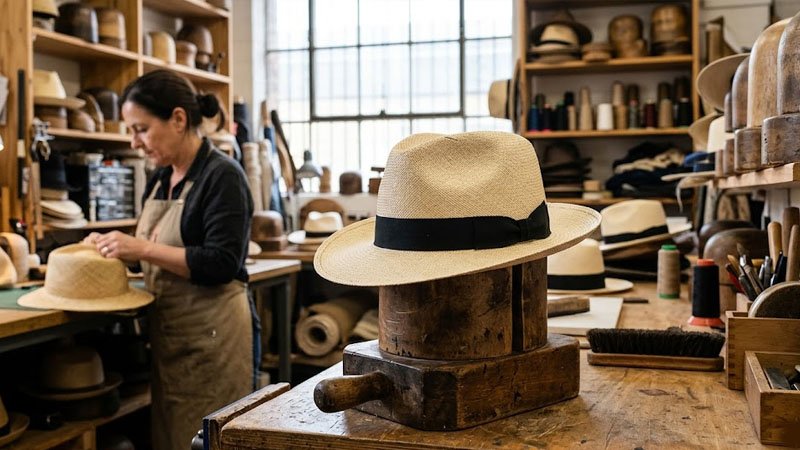
The safest way to break in a new hat is to wear it regularly. Your body heat, natural movement, and light moisture will gradually soften the sweatband, crown, and fabric, helping the hat adjust to your head shape.
If you want faster results, use gentle steam, hand shaping, or a hat stretcher. Avoid boiling water, dryers, harsh washing, aggressive bending, and soaking delicate materials such as wool, leather, straw, or structured hats.
For most hats, the best approach is simple: start gently, test slowly, and avoid high heat.
Before You Start: Check the Hat Material
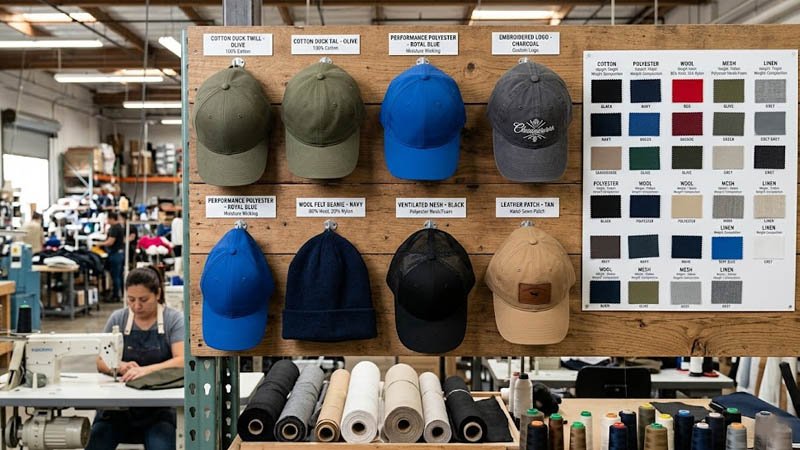
Not all hats should be broken in the same way. Before using water, steam, heat, or stretching tools, check the hat’s material and care label.
Different materials react differently to moisture and heat. A cotton cap may soften easily with regular wear or light steam, while a wool hat can shrink if soaked in hot water. A leather hat should not be washed like a fabric cap, and a straw hat can crack or lose shape if bent too aggressively.
Here is a simple guide:
| Hat Material |
Recommended Method |
Avoid |
| Cotton |
Regular wear, light steam, gentle hand shaping |
High heat, dryer |
| Wool |
Steam, slow shaping, professional care |
Hot water soaking, machine washing |
| Polyester |
Regular wear, gentle steam, careful shaping |
Excessive heat |
| Nylon |
Regular wear, hand shaping |
High heat or harsh washing |
| Leather |
Leather conditioner, professional care |
Soaking, machine washing |
| Straw |
Gentle hand shaping |
Water soaking, aggressive bending |
| Structured caps |
Steam, careful shaping, hat form drying |
Dryer, heavy washing, forceful bending |
If you are not sure what your hat is made of, choose the safest method first: wear it regularly and shape it gently by hand.
Best Methods to Break in a New Hat Safely
Different hats need different treatments. Below are the most common break-in methods, along with when to use them and what risks to watch for.
| Method |
Best For |
Time Needed |
Risk Level |
| Regular wear |
Most hats |
Several days to weeks |
Low |
| Hand shaping |
Brims and crowns |
A few minutes |
Low |
| Steam |
Stiff crowns, tight sweatbands, brim shaping |
10–20 minutes |
Low to medium |
| Warm water |
Cotton caps |
A few hours |
Medium |
| Hat stretcher |
Tight fitted hats |
Several hours to overnight |
Low to medium |
| Machine wash |
Washable cotton caps only |
One wash cycle |
Medium to high |
| Sun fading |
Vintage look |
Several days |
Medium |
The best method depends on the hat’s material, structure, and the problem you want to solve.
Wear Your Hat Regularly
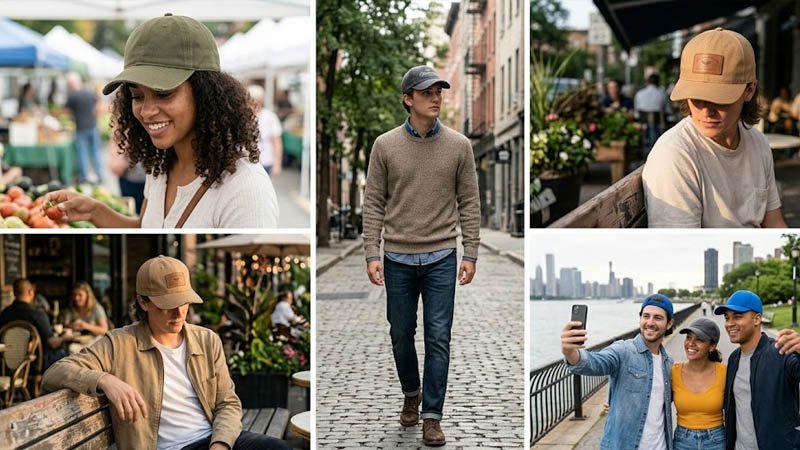
The Most Natural Break-In Method
The easiest and safest way to break in a new hat is to wear it often. Just like a new pair of shoes, a new hat may feel stiff at first, but it gradually becomes more comfortable with use.
When you wear a hat, your body heat and natural movement help soften the fabric and sweatband. Over time, the hat begins to follow the shape of your head. This creates a more personalized and comfortable fit.
This method works well for:
- Baseball caps
- Dad hats
- Trucker hats
- Snapbacks
- Cotton caps
- Casual bucket hats
- Everyday fabric hats
If your hat feels only slightly stiff or snug, regular wear may be enough.
How to Speed It Up Naturally
You can speed up the process by wearing your hat during light daily activities, such as walking, running errands, doing outdoor chores, or wearing it around the house.
A little body heat and light moisture can help relax the sweatband and fabric. However, avoid soaking the hat with heavy sweat too often, especially if it has delicate embroidery, leather patches, printed logos, or dark colors.
How Long Does This Take?
A soft cotton hat may start to feel better after a few wears. A structured cap may take one to two weeks. A fitted hat or wool hat may take longer.
This method requires patience, but it is the safest option and has the lowest chance of damaging your hat.
How to Shape a Hat Brim or Bill
The brim is one of the most visible parts of a hat. If it is too flat, too stiff, or uneven, the whole hat may look uncomfortable or unnatural.
Shaping the brim is one of the easiest ways to make a new hat look and feel better.
Shape the Brim by Hand
Start by holding the brim with both hands. Gently bend it into the curve you want. Work slowly from the sides toward the center.
Do not force the shape all at once. Light pressure is better than aggressive bending.
For a relaxed everyday look, create a soft curve. For a more traditional baseball cap style, create a deeper curve.
If the brim feels very stiff, use steam first to soften it slightly before shaping.
Use a Mug or Can for an Even Curve
For a more consistent curve, wrap the brim around a coffee mug, soda can, or another smooth round object.
Follow these steps:
- Gently curve the brim around the object.
- Hold it in place with a rubber band if needed.
- Leave it for several hours or overnight.
- Remove the hat and check the shape.
- Repeat if you want a deeper curve.
This method works best for baseball caps, dad hats, and casual caps with flexible brims.
Avoid Over-Bending the Brim
Do not fold the brim sharply in the middle. Do not twist it or bend it backward. If the brim has a stiff insert, aggressive bending can cause cracks, creases, or permanent unevenness.
A good brim shape should look natural, not forced.
How to Use Steam to Soften a New Hat
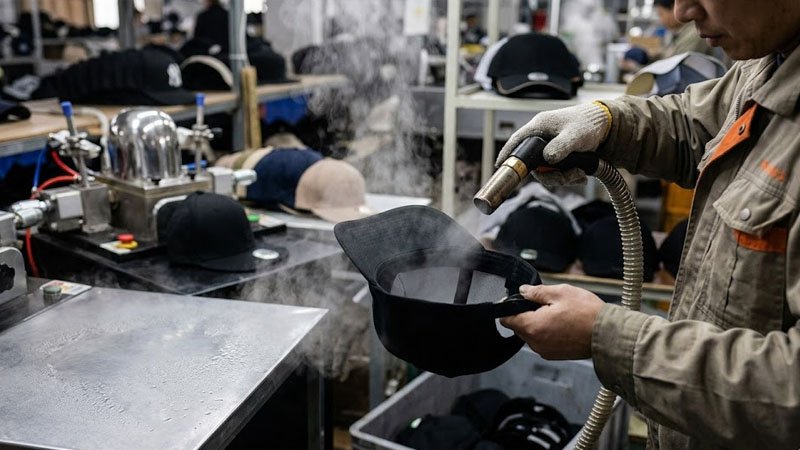
Steam is one of the most useful ways to break in a hat faster. It can soften the crown, relax the sweatband, and make the brim easier to shape.
Compared with soaking, steam gives you more control. It adds warmth and moisture without fully wetting the hat.
When to Use Steam
Steam is helpful when:
- The crown feels stiff
- The sweatband feels tight
- The brim is hard to shape
- The hat needs light reshaping
- You want faster results than regular wear
Steam works especially well for cotton caps, wool hats, and some structured hats. However, it should still be used carefully.
Step-by-Step Steam Method
- Use a garment steamer, kettle, or hot shower steam.
- Hold the hat near the steam, not directly against boiling water.
- Steam the stiff area for 20–30 seconds at a time.
- Gently shape the hat with your hands.
- Wear the hat while it cools, or place it on a hat form.
- Let it air dry naturally.
Do not over-steam the hat. Too much moisture and heat may weaken glue, affect embroidery, loosen patches, or change the structure.
Can Steam Damage a Hat?
Steam is usually safe when used lightly, but it can damage certain hats if overused. Be careful with leather hats, straw hats, glued patches, delicate trims, and highly structured crowns.
If the hat is expensive, rare, or delicate, consider professional cleaning or reshaping instead.
Can You Use Warm Water to Break in a Hat?
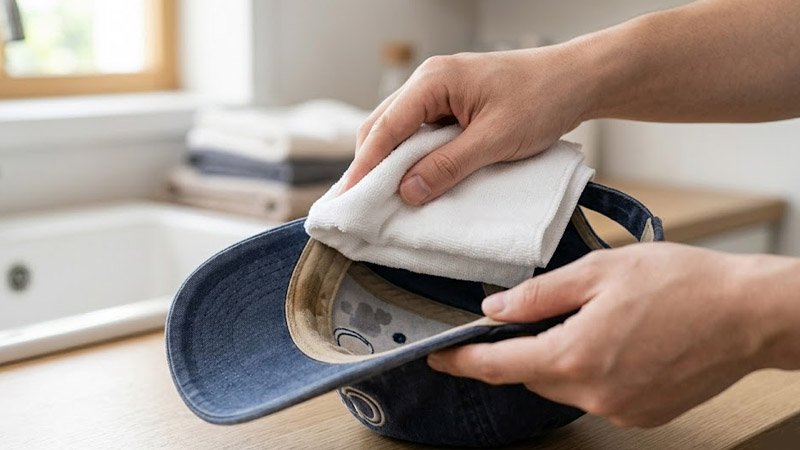
Warm water can soften some hats, especially cotton caps. However, it is riskier than regular wear or steam.
Water can cause shrinkage, fading, color bleeding, and shape loss if used incorrectly. This method should only be used for hats that can safely handle water.
Warm Water Method for Cotton Caps
If your hat is suitable for water treatment, follow these steps:
- Fill a basin with warm water. Do not use boiling water.
- Lightly soak or dampen the hat.
- Remove the hat and gently press out excess water. Do not twist it.
- Wear the hat while it is damp so it can mold to your head shape.
- Let it air dry naturally.
This can help a cotton cap become softer and more comfortable.
What to Avoid
Do not soak wool, leather, straw, or structured hats unless the care label says it is safe.
Do not use hot water on hats with dark colors, delicate embroidery, printed logos, leather patches, or cardboard-like brim inserts.
Before wetting the whole hat, test a small hidden area to see if the color runs.
The Shower Method
The shower method is a gentler version of the warm water method. Instead of soaking the hat, you expose it to steam and light moisture.
You can wear the hat during a warm shower, or place it in the bathroom while steam fills the room. Once the hat becomes slightly warm and damp, wear it until it begins to adjust to your head shape.
This method can work for casual cotton caps and some wool hats, but it is not suitable for leather, straw, or hats that should stay dry.
The shower method is useful when you want to soften the hat slowly without fully soaking it.
Should You Machine Wash a Hat to Break It In?
Machine washing can soften some hats, but it is one of the riskier methods. It should only be used when the hat’s care label allows machine washing.
Machine washing may cause shrinkage, fading, loose stitching, warped brims, or crown deformation. It is not recommended for high-end hats, wool hats, leather hats, straw hats, structured caps, or hats with cardboard brims.
How to Machine Wash a Hat Safely
If your hat is washable, follow these steps:
- Place the hat in a hat cage or delicate laundry bag.
- Use cold or lukewarm water.
- Choose a gentle cycle.
- Use mild detergent.
- Avoid bleach or harsh cleaners.
- Remove the hat immediately after washing.
- Air dry it on a towel, hat form, or rounded object.
Never put your hat in the dryer. Dryer heat can shrink the fabric, warp the brim, and damage the overall shape.
Better Alternative: Spot Cleaning
If your goal is only to clean and soften the hat slightly, spot cleaning is safer than machine washing.
Use a soft cloth, cool water, and mild soap. Gently clean dirty areas without soaking the entire hat.
How to Stretch a Tight Hat for a Better Fit
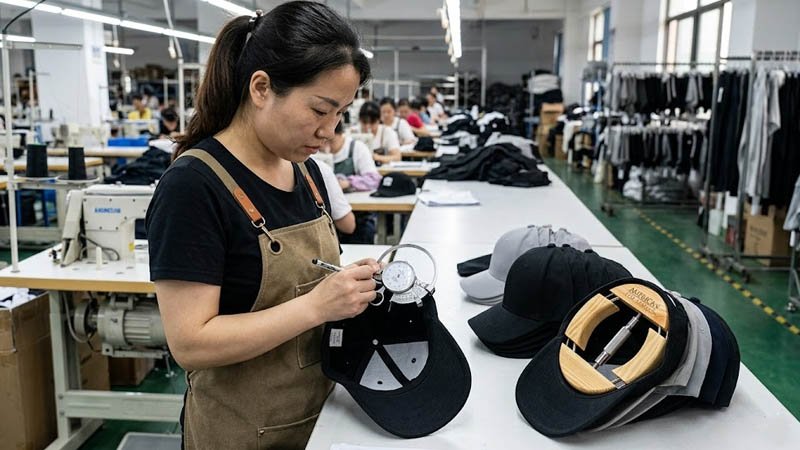
Sometimes a new hat feels too tight even after several wears. In that case, gentle stretching can help.
The key word is gentle. Stretching too quickly can damage the sweatband, seams, panels, or crown shape.
Stretch the Sweatband
If the tightness is mainly around the sweatband, lightly steam or dampen the inside band. Then gently stretch it by hand.
Wear the hat while it cools or dries. This helps the sweatband adjust to your head size.
Do not cut the sweatband unless there is no other option. Cutting can affect the hat’s structure and durability.
Use a Hat Stretcher
A hat stretcher is one of the safest tools for improving fit. It applies even pressure and helps avoid uneven stretching.
To use a hat stretcher:
- Lightly steam or dampen the sweatband.
- Insert the hat stretcher.
- Expand it slowly.
- Leave it in place for several hours or overnight.
- Try on the hat and repeat if necessary.
This method works especially well for fitted hats that are slightly too tight.
Use a Round Object
If you do not have a hat stretcher, you can place the hat over a clean round object, such as a bowl, jar, or ball.
Make sure the object is only slightly larger than the hat. If it is too large, it may overstretch the hat and distort the shape.
How to Make a New Hat Look Vintage
Some people want their new hat to feel and look worn-in. A vintage look can be created carefully, but it is easy to overdo.
Wear It Often
The most natural vintage look comes from regular wear. Over time, the fabric softens, the color becomes more relaxed, and the hat develops its own character.
This is the safest way to create an authentic worn-in appearance.
Use Sunlight Carefully
Leaving a cotton hat in the sun can create a faded look. However, strong sunlight can cause uneven fading, especially on dark colors.
If you want a subtle vintage effect, expose the hat to sunlight gradually instead of leaving it outside for too long.
Use Fine Sandpaper Lightly
Fine sandpaper can be used to gently distress the brim edge or certain fabric areas.
Use very light pressure. Avoid sanding embroidery, printed logos, patches, seams, or decorative details.
If you want a vintage look without the risk, consider choosing a pre-washed or pre-distressed hat.
What Not to Do When Breaking in a New Hat
Many hats are damaged not because people try to break them in, but because they use methods that are too harsh.
Avoid these common mistakes:
- Do not use boiling water.
- Do not put the hat in a dryer.
- Do not machine wash hats that are not washable.
- Do not soak leather, straw, or delicate wool hats.
- Do not bend the brim sharply in the middle.
- Do not twist or wring the hat when wet.
- Do not use bleach or harsh detergents.
- Do not stretch the hat too quickly.
- Do not leave dark hats in direct sunlight for too long.
- Do not ignore the care label.
When in doubt, choose the gentlest method first. A slow break-in process is better than permanent damage.
Troubleshooting Common Hat Fit Problems
The Hat Feels Too Tight
Wear it regularly for a few days first. If it still feels tight, use light steam on the sweatband and stretch it gently. A hat stretcher can help if the hat needs a little more room.
The Crown Feels Too Stiff
Use steam to soften the crown, then shape it gently with your hands. Wearing the hat often will also help the crown relax naturally.
The Brim Is Too Flat
Shape the brim by hand or wrap it around a mug or can for several hours. If the brim is stiff, use light steam before shaping.
The Hat Shrunk After Washing
Lightly steam the hat or dampen it with warm water, then stretch it carefully while it is still damp. Let it air dry on your head or on a hat form.
The Hat Lost Its Shape
Use steam to soften the fabric, then reshape it by hand. Place the hat on a rounded object, towel, or hat form while it dries.
If the hat is expensive, delicate, or badly misshapen, professional reshaping may be the safest option.
How Long Does It Take to Break in a New Hat?
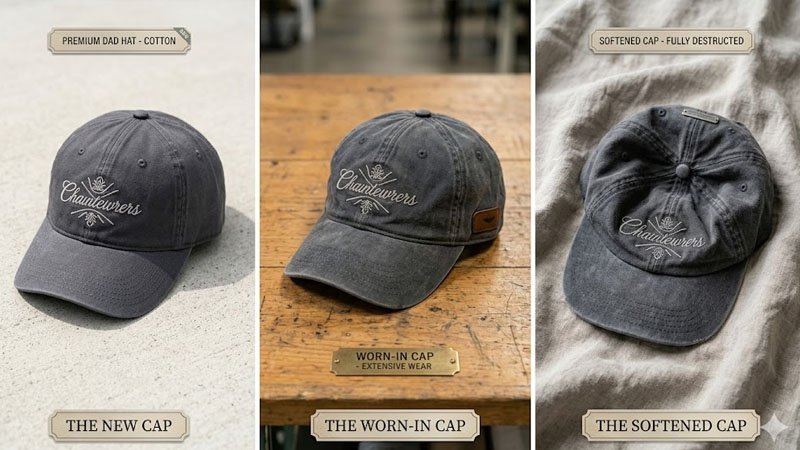
The time depends on the material, construction, and how often you wear it.
A soft cotton dad hat may feel better after a few wears.
A structured baseball cap may take one to two weeks.
A fitted cap may need several wears plus gentle stretching.
A wool hat may take longer and should be shaped carefully with steam.
A stiff or high-crown cap may take more time because the structure is designed to hold its shape.
In general, regular wear is the safest method, while steam and gentle stretching can speed up the process.
For Brands: Better Comfort Starts with Better Hat Design
For brands, retailers, and businesses ordering custom hats in bulk, the break-in experience begins long before the customer wears the hat. Fabric weight, sweatband softness, crown height, panel structure, brim flexibility, embroidery density, stitching quality, and finishing process all affect how comfortable a hat feels from the first wear.
As a Guangzhou-based high-end custom hat and OEM/ODM manufacturer with 15 years of experience, GUANGZHOU EASTLUCKY Hat & Garment Co., Ltd. understands that comfort starts at the production stage. Guided by the philosophy “Quality as Root, Innovation as Soul,” EASTLUCKY provides global clients with one-stop solutions from design sampling to mass production, helping brands build efficient and high-quality hat supply chains.
For custom hat projects, brands can improve the customer experience by choosing the right fabric, sweatband, brim insert, crown structure, and fit testing process. A well-designed hat should look good, hold its shape, and become comfortable with minimal break-in time.
Hat Care After Breaking It In
Once your hat fits well, proper care helps it stay comfortable and keep its shape longer.
Clean It Gently
Spot cleaning is usually the safest method. Use a soft cloth, mild soap, and cool water. Avoid harsh chemicals, bleach, and abrasive brushes.
If deeper cleaning is needed, always check the care label first.
Store It Properly
Do not crush your hat in a drawer or bag. Store it on a shelf, hat rack, or clean surface where the crown and brim can keep their shape.
For structured hats, use a hat form or support the crown with soft paper.
Avoid Excessive Heat and Moisture
Too much sun, rain, sweat, or heat can shorten the life of a hat. Let sweaty hats dry naturally before storing them.
If you wear hats often, rotate between different styles to reduce wear and maintain shape.
FAQs
What is the safest way to break in a new hat?
The safest way is to wear it regularly. Body heat and natural movement will gradually soften the hat and help it fit your head without much risk of damage.
How do you break in a baseball cap?
Wear it often, shape the brim gently by hand, and use light steam if the crown or brim feels stiff. Avoid dryers, boiling water, and aggressive bending.
Can you break in a fitted hat?
Yes. A fitted hat can be broken in by regular wear, light steam, and gentle stretching. If it is slightly too tight, a hat stretcher can help.
Will breaking in a hat make it bigger?
Breaking in a hat may make it feel slightly roomier because the sweatband and crown relax over time. However, it will not increase the size dramatically. If the hat is much too small, it is better to choose a larger size.
Can I use water to break in a new hat?
Warm water can be used on some cotton hats, but it should be done carefully. Avoid soaking wool, leather, straw, structured hats, or hats with delicate decorations.
Can steam damage a hat?
Light steam is usually safe for many hats, but too much steam can damage glue, patches, embroidery, or structured panels. Use short bursts of steam and shape the hat gently.
Should I put my hat in the dryer?
No. A dryer can shrink the fabric, warp the brim, and damage the hat’s shape. Always air dry your hat naturally.
How do I make a stiff hat softer?
Wear it regularly, use light steam, or gently dampen the sweatband if the material allows it. Avoid harsh washing or high heat.
How do I curve a hat brim?
Use your hands to bend the brim gently, or wrap it around a mug or can for several hours. Do not fold or crease the brim sharply.
How long does it take to break in a new hat?
It can take a few days to a few weeks, depending on the material and structure. Soft cotton hats usually break in faster, while structured or fitted hats may take longer.
Conclusion
Breaking in a new hat does not have to be difficult, but it should be done carefully. The safest method is regular wear, while steam, hand shaping, warm moisture, and gentle stretching can help speed up the process.
The most important rule is to match the method to the material. Cotton caps can usually handle more moisture, while wool, leather, straw, and structured hats need extra care. Avoid boiling water, dryers, harsh washing, and aggressive bending if you want to protect the hat’s shape, color, and durability.
With the right approach, your new hat can become softer, more comfortable, and better fitted without being damaged. A good hat should not only look great on the first day, but also become even better with time.