Custom White Golf Hats for Golf Events, Clubs and Brands
White golf hats are one of the most classic and practical accessories in the golf industry. They offer a clean appearance, comfortable wearing experience, reliable sun protection, and strong branding potential. For golf events, clubs, corporate activities, sports teams, and lifestyle brands, a custom white golf hat is more than a simple headwear item. It can become part of a uniform, a promotional gift, a retail product, or a memorable branded merchandise piece.
Because white is easy to match with different outfits and provides a clean background for logos, it has become a popular choice for golf tournaments, club uniforms, corporate golf events, and custom promotional campaigns. Whether you are planning a small club event or preparing bulk orders for a brand launch, choosing the right white golf hat can help improve both product value and brand image.

White has always been closely connected with golf fashion. It gives a fresh, clean, and professional look that fits the atmosphere of golf courses, country clubs, resorts, and outdoor sports events.
Unlike strong or seasonal colors, white is timeless. It can match almost any polo shirt, sports jacket, team uniform, or casual golf outfit. This makes white golf hats a safe and flexible choice for both individual golfers and bulk buyers.
For brands, white is also a strong background color. Logos, embroidered designs, woven patches, and printed graphics can stand out clearly on a white hat. This is especially useful when the hat is used for brand promotion, sponsorship events, or team identity.
Clean and Professional Appearance
A white golf hat gives a simple but premium impression. It looks neat, fresh, and suitable for both casual and formal golf occasions.
For golf clubs and corporate events, white hats help create a consistent and professional team image. When every player, staff member, or guest wears the same custom white hat, the event looks more organized and branded.
Easy to Match with Different Outfits
White is one of the easiest colors to coordinate. It works well with dark colors, bright colors, neutral tones, and branded uniforms.
This makes white golf hats ideal for events where participants may wear different clothing styles. Even if the apparel colors are not exactly the same, white hats can help create a unified visual effect.
Better Heat Reflection
Golf is often played under strong sunlight. Compared with darker colors, white reflects more sunlight and absorbs less heat. This can help the wearer feel cooler during long hours outdoors.
Of course, comfort also depends on the material, structure, sweatband, and ventilation design. But in warm weather, white is usually a practical color choice for outdoor sports hats.
Good Sun Protection
A golf hat helps protect the face, forehead, and eyes from direct sunlight. A suitable brim design can reduce glare and improve comfort during play.
For outdoor golf tournaments, corporate golf days, resort events, and summer promotional activities, sun protection is an important product benefit. Buyers can choose standard curved brims, wider brims, or performance golf cap designs depending on the final use.
Strong Logo Visibility
White golf hats are excellent for custom branding. A white background allows logos to look clean and easy to recognize.
Dark embroidery, colorful patches, rubber labels, and heat transfer designs can all create strong contrast on white hats. This makes custom white golf hats especially suitable for brand promotion, sponsor exposure, and event merchandise.

Custom white golf hats are suitable for many types of buyers and business needs.
Golf Clubs
Golf clubs can use custom white hats as member gifts, staff uniforms, pro shop merchandise, or tournament accessories. A clean embroidered club logo on a white hat can create a premium and professional look.
Golf Tournament Organizers
For golf tournaments, custom hats can be used as participant gifts, volunteer uniforms, sponsor merchandise, or event souvenirs. White hats are easy to match with different event colors and sponsor logos.
Corporate Event Buyers
Many companies organize golf events for clients, employees, partners, or VIP guests. Custom white golf hats with a company logo can work as practical and memorable corporate gifts.
Sports and Lifestyle Brands
For sports brands, resort brands, outdoor brands, and lifestyle labels, white golf hats can become part of a seasonal headwear collection. With the right material, logo technique, and packaging, they can be sold as retail products.
Promotional Product Distributors
White golf hats are also suitable for distributors who supply promotional gifts, branded apparel, and event products. They are easy to customize and have wide market demand.
Choosing the right material is one of the most important steps in custom hat production. Different materials create different looks, costs, and wearing experiences.
Cotton Golf Hats
Cotton is soft, breathable, and comfortable. It gives a natural hand feel and a classic appearance. Cotton white golf hats are suitable for golf clubs, resort merchandise, casual golf wear, and lifestyle brands.
Cotton is a good choice when the buyer wants a more traditional and premium look.
Polyester Golf Hats
Polyester is lightweight, durable, and suitable for outdoor sports. It can be used for performance golf hats, tournament hats, and promotional caps.
Polyester is often chosen for active use because it can support quick-dry and moisture-wicking features depending on the fabric type.
Performance Fabric Golf Hats
Performance fabrics are designed for sports and outdoor activities. They may include moisture-wicking, quick-dry, breathable, and lightweight properties.
For professional golf events, summer activities, and sports brands, performance fabrics can improve comfort and product value.
Mesh Back Golf Hats
Mesh back designs offer better ventilation. They are suitable for hot weather, outdoor events, and casual golf styles.
A white front panel with a mesh back can also create a sporty and relaxed look, making it suitable for golf teams, resort shops, and promotional campaigns.
How to Choose the Right Hat Style
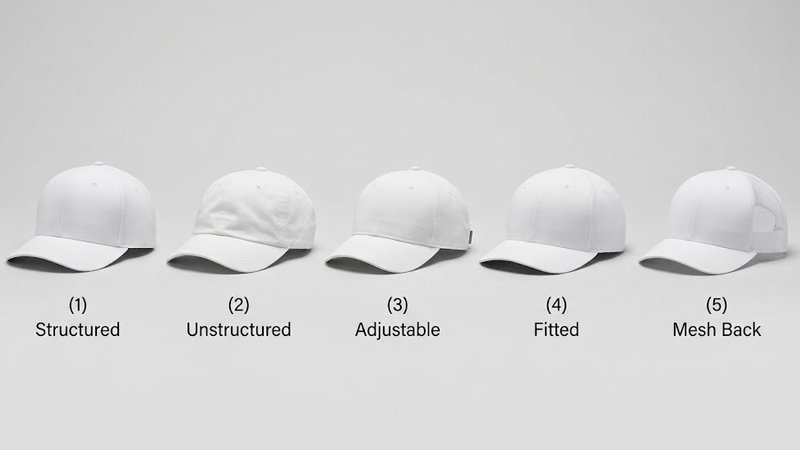
The style of the hat affects both appearance and wearing experience. Buyers should choose the right style based on the target customer, event type, and brand image.
Structured Golf Hats
Structured hats have a firmer front panel and keep their shape well. They look more professional and are suitable for corporate events, golf clubs, team uniforms, and branded merchandise.
Unstructured Golf Hats
Unstructured hats are softer and more relaxed. They are suitable for casual golf, lifestyle brands, resort products, and comfortable everyday wear.
Adjustable Golf Hats
Adjustable hats are very popular for events and bulk orders because they can fit different head sizes. Common closures include metal buckle, Velcro, plastic snapback, and fabric strap.
For golf events and promotional orders, adjustable hats are usually the most practical choice.
Fitted Golf Hats
Fitted hats provide a clean and secure fit, but they require more accurate size planning. They are suitable for premium retail collections, teams, and brand-specific projects.
Logo Customization Options for White Golf Hats
Logo customization is one of the biggest advantages of white golf hats. Since white provides a clean and neutral background, many logo methods can create a strong visual effect.
Embroidery
Embroidery is one of the most popular logo methods for golf hats. It gives the logo a textured, durable, and premium appearance.
Flat embroidery is suitable for most brand logos, text, and club names. 3D embroidery can create a raised effect and make the main logo more eye-catching.
For golf clubs, corporate events, and sports teams, embroidered white golf hats are a classic and professional choice.
Woven Patch
Woven patches are suitable for logos with small details, fine lines, or multiple colors. They create a clean and refined look.
This option is ideal for retail brands, private label collections, and logos that need better detail than standard embroidery can provide.
Rubber Patch
Rubber patches create a modern and sporty appearance. They are suitable for outdoor brands, sportswear brands, youth-focused designs, and performance-style hats.
On white golf hats, rubber patches can create strong contrast and a bold branding effect.
Heat Transfer Printing
Heat transfer printing is suitable for colorful logos, gradients, and complex graphics. It can show detailed artwork clearly and is often used for promotional or event hats.
For brands that want a lightweight logo effect without stitching, heat transfer can be a flexible option.
Inner Labels and Packaging Branding
Besides the front logo, buyers can also customize inner labels, woven labels, hangtags, stickers, polybags, and retail packaging. These details help improve the final presentation, especially for brand collections and retail products.
Bulk Order Tips for Golf Events, Clubs and Brands
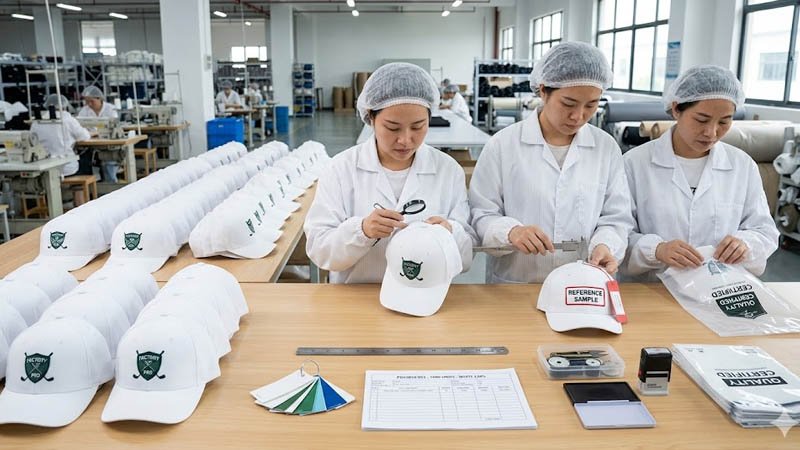
When ordering custom white golf hats in bulk, buyers should not only focus on the hat design. Production details, logo accuracy, packaging, and quality control are also important.
Confirm the Final Use
Before production, decide how the hats will be used. Are they for a golf tournament, club uniform, corporate gift, retail collection, or promotional giveaway?
The final use will affect the material, logo method, packaging, and budget.
Prepare Clear Logo Artwork
Vector logo files are recommended for custom production. Clear artwork helps improve embroidery, patch, and printing quality.
If the logo has small text or complex details, the supplier may suggest adjusting the logo size or choosing a better logo method.
Choose the Right Logo Position
The front center is the most common logo position. Other options include side embroidery, back embroidery, woven labels, or custom inner labels.
For sponsored golf events, multiple logo placements may be needed, such as event logo on the front and sponsor logo on the side.
Check the Sample Before Mass Production
A pre-production sample is very important for custom orders. Buyers should check the hat shape, material, logo color, embroidery quality, stitching, closure, and overall fit before approving bulk production.
Consider Packaging Requirements
Packaging can affect both presentation and shipping safety. Common packaging options include individual polybags, hangtags, barcode labels, branded stickers, custom boxes, and export cartons.
For structured hats, proper carton packing is important to protect the crown and brim during shipping.
Common Problems in White Hat Orders and How to Avoid Them
White hats look clean and premium, but they also require careful production and handling.
Problem 1: The Hat Gets Dirty Easily
White fabric can show dust and stains more clearly than darker colors. To reduce this issue, buyers can choose easy-care fabrics and request clean packing during production.
For retail or event distribution, individual polybag packing is recommended.
Problem 2: Logo Contrast Is Not Strong Enough
Light-colored logos may not stand out clearly on white hats. To improve visibility, choose stronger colors such as navy, black, dark green, red, or deep gray.
For a premium look, metallic embroidery colors such as gold or silver can also be considered.
Problem 3: Small Logo Details Are Not Clear
If a logo includes very small letters or fine lines, embroidery may not show every detail perfectly. In this case, a woven patch or heat transfer logo may be a better solution.
Problem 4: Hats Lose Shape During Shipping
Structured hats should be packed carefully to avoid crown deformation or brim damage. Proper stacking, inner support, and strong export cartons can help protect the shape.
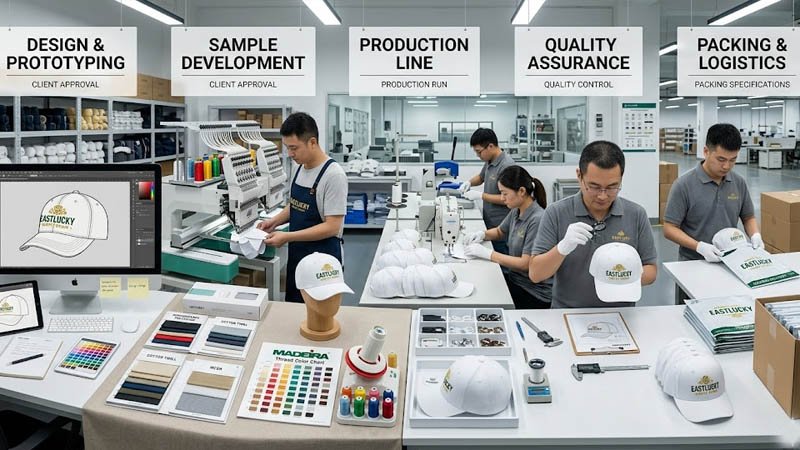
For custom white golf hats, production experience matters. A reliable manufacturer can help buyers choose the right fabric, logo method, structure, size, and packaging solution.
As a high-end custom hat and OEM/ODM manufacturer based in Guangzhou, China, GUANGZHOU EASTLUCKY Hat & Garment Co., Ltd. has 15 years of experience in professional R&D, production, and distribution of various hats and embroidered accessories. Guided by the philosophy “Quality as Root, Innovation as Soul,” EASTLUCKY provides global clients with one-stop solutions from design sampling to mass production, helping brands build efficient and high-quality supply chain services.
Proper care can help white golf hats stay clean and keep their shape.
Cleaning
Hand washing is recommended for most golf hats. Use mild detergent and lukewarm water. Avoid strong bleach or harsh chemicals, especially for embroidered logos or special patches.
Drying
Air dry the hat naturally. Avoid high heat because it may affect the brim shape, crown structure, or logo material.
Storage
Store hats in a clean, dry place. Avoid crushing the brim or stacking heavy products on top of structured hats.
For bulk stock, keep hats in proper cartons and protect them from moisture, dust, and pressure.
Are white golf hats good for outdoor events?
Yes. White golf hats are suitable for outdoor events because they look clean, reflect sunlight, and provide practical sun protection.
Can white golf hats be customized with company logos?
Yes. White golf hats can be customized with embroidery, woven patches, rubber patches, heat transfer printing, side logos, inner labels, and custom packaging.
What is the best logo method for white golf hats?
Embroidery is a classic and premium option. Woven patches are better for detailed logos. Rubber patches create a sporty look, while heat transfer is suitable for colorful graphics.
Are white golf hats suitable for golf tournaments?
Yes. They are widely used for golf tournaments, charity events, sponsor gifts, team uniforms, and participant giveaways.
What material is best for custom golf hats?
Cotton is suitable for a classic and soft feel. Polyester and performance fabrics are better for active outdoor use. Mesh designs are good for hot weather and better ventilation.
Can I order custom white golf hats in bulk?
Yes. Custom white golf hats are commonly ordered in bulk for golf clubs, brands, corporate events, promotional companies, and sports teams.
Conclusion
Custom white golf hats are a smart choice for golf events, clubs, and brands. They combine classic style, practical sun protection, comfortable wear, and strong logo visibility. Whether used as tournament gifts, club uniforms, corporate event merchandise, or retail products, white golf hats can deliver both function and brand value.
For bulk buyers, the key is to choose the right material, hat structure, logo method, and packaging. With clear artwork, proper sampling, and reliable production, custom white golf hats can become a professional and effective branding product for many golf-related projects.
How to Choose Custom Performance Hats for Outdoor and Sports Brands
Performance hats have become an essential product for outdoor brands, sportswear companies, running clubs, fishing brands, golf events, and promotional merchandise buyers. Unlike regular caps, performance hats are designed for active use. They combine breathable fabrics, moisture control, sun protection, lightweight comfort, and brand customization in one practical product.
For outdoor and sports brands, choosing the right performance hat is not only about appearance. The fabric, structure, logo method, sweatband, closure, ventilation, and packaging can all affect the final product quality and user experience.
This guide will help brand owners, wholesalers, event organizers, and OEM buyers understand how to choose custom performance hats for different outdoor and sports applications.
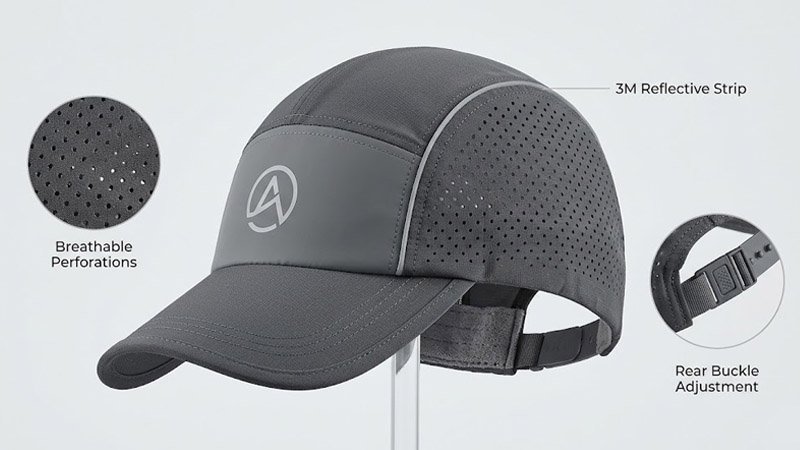
A performance hat is a functional cap designed for sports, outdoor activities, and active daily wear. It is usually made with lightweight, breathable, quick-dry, or moisture-wicking materials.
Compared with a regular cotton cap, a performance hat focuses more on comfort, function, and durability. It helps the wearer stay cooler, drier, and more protected during outdoor use.
Common features of performance hats include:
Moisture-wicking fabric
Quick-dry material
Breathable mesh or perforated panels
UV protection
Lightweight construction
Water-resistant finish
Comfortable sweatband
Adjustable closure
Reflective logo or trim options
For brands, a performance hat is also a strong promotional product because it offers both practical value and long-term logo exposure.
Before choosing a custom performance hat, it is important to understand how it differs from a regular cap.
| Feature |
Regular Cap |
Performance Hat |
| Main Use |
Casual wear, fashion, daily style |
Sports, outdoor activities, active use |
| Fabric |
Cotton, basic polyester |
Polyester, nylon, spandex, mesh, recycled polyester |
| Breathability |
Basic |
High breathability with mesh or perforation |
| Sweat Control |
Limited |
Moisture-wicking and quick-dry |
| Sun Protection |
Basic shade |
UV-protective fabric options |
| Water Resistance |
Usually limited |
Water-resistant or quick-dry options |
| Best For |
Lifestyle and casual branding |
Running, hiking, fishing, golf, cycling, outdoor events |
A regular cap can work well for fashion and casual use, but a performance hat is better when comfort, sweat control, breathability, and outdoor durability are required.
Step 1: Choose the Right Fabric
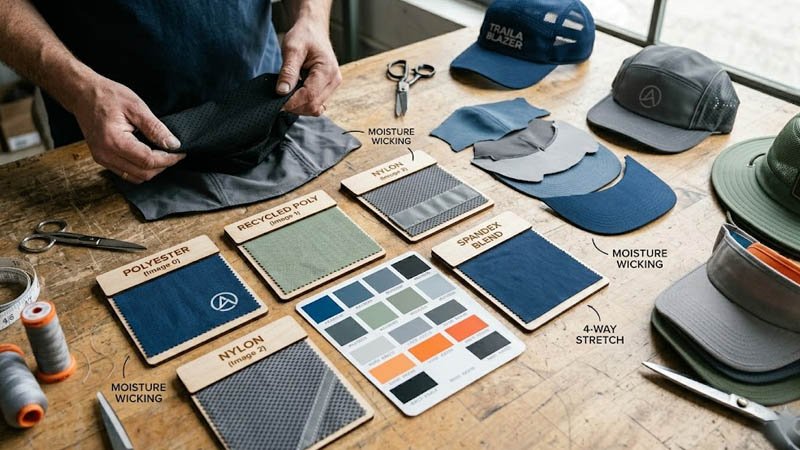
Fabric is one of the most important factors when developing custom performance hats. Different fabrics create different levels of comfort, durability, breathability, and visual style.
Polyester
Polyester is one of the most popular materials for performance hats. It is lightweight, durable, quick-drying, and suitable for many logo decoration methods.
Best for:
Running hats
Sports event caps
Promotional performance hats
Quick-dry outdoor caps
Corporate outdoor activities
Polyester is a good choice when buyers need a cost-effective and versatile material for bulk orders.
Nylon
Nylon has a smooth surface, strong durability, and better water resistance than many basic fabrics. It is often used for outdoor, fishing, hiking, and travel hats.
Best for:
Fishing hats
Hiking hats
Camping hats
Outdoor brand caps
Water-resistant performance hats
For brands that focus on outdoor adventure, nylon can give the hat a more technical and premium feel.
Polyester-Spandex Blend
A polyester-spandex blend adds stretch and flexibility. This makes the hat more comfortable and better fitting for active users.
Best for:
Fitness hats
Golf caps
Training hats
Stretch-fit sports caps
Premium sportswear collections
This fabric is suitable when comfort and fit are important selling points.
Mesh Fabric
Mesh fabric improves airflow and reduces heat buildup. It can be used on back panels, side panels, inner layers, or ventilation areas.
Best for:
Summer caps
Running hats
Outdoor event hats
Trucker-style performance hats
High-breathability sports caps
For hot-weather activities, mesh or perforated fabric is a very practical choice.
Recycled Polyester
Recycled polyester is suitable for brands that focus on sustainability. It supports eco-friendly branding while still offering lightweight and quick-dry performance.
Best for:
Eco-friendly outdoor brands
Sustainable sportswear collections
Corporate ESG gifts
Promotional performance hats
Private label headwear
For brands with environmental positioning, recycled materials can add extra value to the product story.
Step 2: Match the Hat Design to the Activity
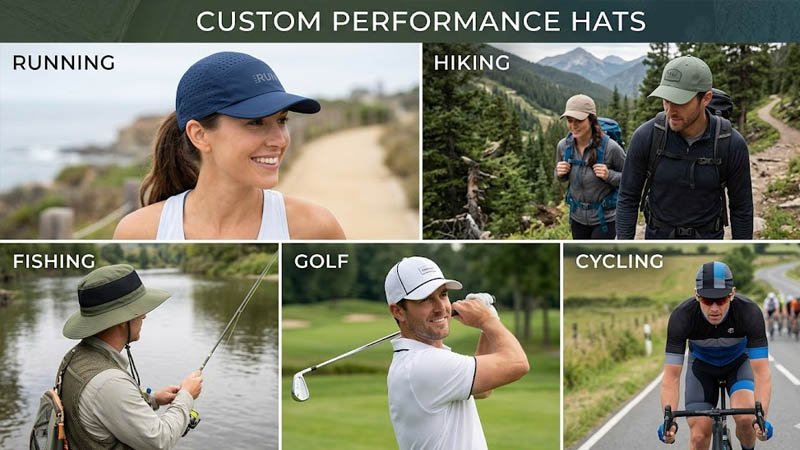
Different outdoor and sports activities require different hat features. A good custom performance hat should be designed according to the real use scenario.
Running Hats
Running hats should be lightweight, breathable, and quick-drying. The structure should not feel heavy during movement. Reflective details can also improve visibility during early morning or evening runs.
Recommended features:
Lightweight polyester fabric
Moisture-wicking sweatband
Laser-cut ventilation
Low-profile structure
Reflective logo or trim
Adjustable back strap
For running brands and marathon events, comfort and breathability should be the top priorities.
Hiking Hats
Hiking hats need durability, sun protection, and comfort for long outdoor use. A secure fit is also important because hikers may face wind, sweat, and changing weather.
Recommended features:
Nylon or durable polyester
UV-protective fabric
Breathable side panels
Water-resistant finish
Secure adjustable closure
Comfortable sweatband
For hiking and camping brands, the hat should feel reliable and practical in different environments.
Fishing Hats
Fishing hats require strong sun protection and better resistance to water, humidity, and outdoor exposure. Some designs may use a wider brim or darker underbrim to reduce glare.
Recommended features:
Water-resistant nylon
UV protection
Quick-dry fabric
Wide brim option
Dark underbrim
Adjustable chin cord option
For fishing brands, sun protection and water resistance are key selling points.
Golf Hats
Golf hats should look clean, comfortable, and premium. They need good shape retention and a professional logo presentation.
Recommended features:
Structured front panel
Lightweight polyester-spandex blend
Moisture-wicking sweatband
Curved brim
Embroidery or silicone patch
Metal buckle or clean strap closure
For golf brands and tournaments, appearance and comfort are equally important.
Cycling and Training Hats
Cycling and training hats should be lightweight, compact, and breathable. They should not feel bulky or restrict movement.
Recommended features:
Thin quick-dry fabric
Low-profile design
Stretch fit
Reflective elements
Fast-drying sweatband
Breathable panels
For cycling or training products, the design should focus on movement and ventilation.
Corporate Outdoor Events
For corporate events, team building, school activities, and promotional campaigns, buyers usually need a balance between price, comfort, and logo visibility.
Recommended features:
Polyester fabric
Custom logo printing or embroidery
Brand color matching
Adjustable closure
Bulk packaging
Cost-effective production
For event buyers, the hat should be comfortable, easy to wear, and suitable for large quantity orders.
Step 3: Choose the Best Logo Method
Logo customization is one of the most important parts of custom performance hat production. The right logo method depends on the fabric, design, usage, and brand positioning.
Embroidery
Embroidery gives a premium, durable, and classic look. It works well on structured front panels and thicker fabrics.
Best for:
Golf hats
Corporate caps
Premium outdoor caps
Sports team hats
Retail brand merchandise
Factory tip: Embroidery may not be the best choice for very thin, highly stretchable, or ultra-lightweight fabrics because it can add weight or affect the fabric surface.
Heat Transfer Logo
Heat transfer is smooth, lightweight, and suitable for detailed or full-color logos. It works well on quick-dry polyester and sports fabrics.
Best for:
Running hats
Fitness caps
Lightweight performance hats
Full-color logos
Modern sportswear designs
Factory tip: Heat transfer is a good option when the buyer wants a lightweight logo that does not affect the flexibility of the hat.
Silicone Patch
A silicone patch gives the hat a modern, waterproof, and three-dimensional look. It is popular for outdoor and sports brands.
Best for:
Fishing hats
Outdoor caps
Adventure brand hats
Water-resistant performance hats
Premium private label caps
Factory tip: Silicone patches work well when the brand wants a strong and durable visual identity.
Woven Label
A woven label is clean, lightweight, and cost-effective. It is suitable for simple branding and lifestyle outdoor designs.
Best for:
Camping hats
Casual outdoor caps
Eco-friendly collections
Promotional performance hats
Retail headwear
Factory tip: Woven labels are a good choice for brands that want a subtle and clean logo effect.
Reflective Print
Reflective printing improves visibility in low-light conditions. It is both decorative and functional.
Best for:
Running hats
Cycling hats
Night event caps
Safety-focused sports hats
Outdoor training caps
Factory tip: Reflective details are especially suitable for brands targeting running, cycling, or safety-related outdoor activities.
Step 4: Select the Right Hat Structure
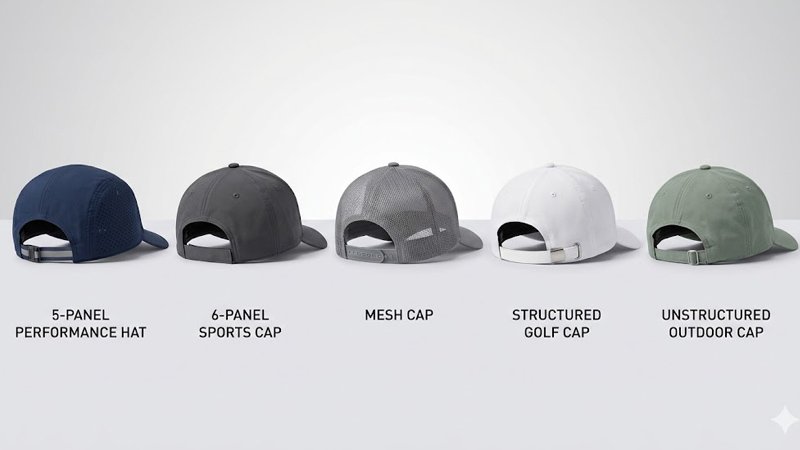
The structure of the hat affects appearance, comfort, and fit. For custom performance hats, buyers should consider panel construction, brim style, crown height, and overall shape.
Panel Construction
Common options include:
5-panel performance hat
6-panel sports cap
Trucker-style mesh cap
Unstructured outdoor cap
Structured golf cap
A 5-panel hat often gives a modern outdoor look. A 6-panel cap is more classic and suitable for sports and promotional use. A structured cap is better for premium branding and embroidery.
Brim Style
Common brim options include:
Curved brim
Flat brim
Soft brim
Wide brim
Dark underbrim
A curved brim is common for running, golf, and outdoor use. A wide brim is better for fishing and sun protection. A dark underbrim can help reduce glare.
Closure Type
Common closure options include:
Velcro closure
Plastic snapback
Metal buckle
Elastic strap
Nylon webbing strap
Stretch-fit design
For running hats, lightweight Velcro or webbing straps are practical. For golf and lifestyle hats, metal buckles or clean strap closures may look more premium.
Step 5: Consider Comfort Details
Small details can strongly affect the user experience. For outdoor and sports brands, comfort should always be considered during product development.
Important comfort details include:
Sweatband material
Hat weight
Inner seam finishing
Ventilation holes
Stretch level
Crown depth
Brim flexibility
Back closure comfort
A high-quality sweatband can improve the wearing experience during sports. Breathable construction helps reduce heat. A good closure ensures the hat stays secure without feeling too tight.
Step 6: Confirm Custom Options for Bulk Orders
For OEM and ODM buyers, performance hats can be customized in many ways. Before production, it is useful to confirm all design and order details clearly.
Common custom options include:
Fabric type
Hat style
Panel structure
Brim shape
Crown height
Logo method
Logo size and position
Color matching
Sweatband material
Closure type
Inner label
Hangtag
Barcode label
Individual packaging
Carton packing
Clear confirmation before sampling helps avoid mistakes during mass production.
GUANGZHOU EASTLUCKY Hat & Garment Co., Ltd. is a high-end custom hat and OEM/ODM manufacturer based in Guangzhou, China, with 15 years of expertise in professional R&D, production, and distribution of various hats and embroidered accessories. Guided by the philosophy “Quality as Root, Innovation as Soul,” the company provides global clients with one-stop solutions from design sampling to mass production, helping brands build efficient and high-quality custom headwear supply chains.
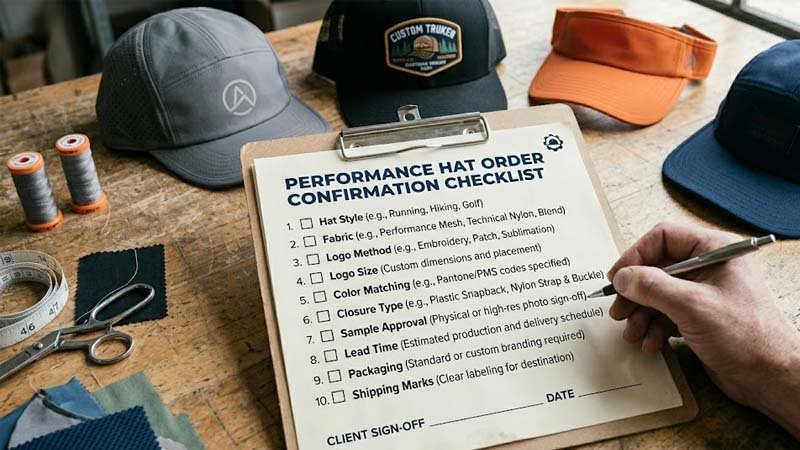
Before placing a bulk order, buyers should confirm the following details:
Hat style and panel structure
Fabric type and fabric color
Logo method and logo size
Logo position and color matching
Brim shape and crown height
Sweatband material
Closure type
Size requirements
Sample approval process
Bulk production lead time
Packaging method
Shipping marks and carton details
This checklist helps make the custom process smoother and reduces the risk of misunderstanding during production.
Step 7: Check Factory Quality Control
Quality control is very important for custom performance hats, especially for outdoor and sports brands. Buyers should work with a factory that can control both product appearance and functional details.
Fabric Inspection
The factory should check fabric color, texture, thickness, stretch, and surface quality before production. For performance hats, breathability, quick-dry function, and water resistance may also need to be confirmed.
Sample Approval
A sample helps confirm the final hat shape, fabric feel, logo effect, color matching, closure type, and overall design. For bulk orders, pre-production sample approval is an important step.
Logo Accuracy
Logo size, position, color, and finishing should be checked carefully. Whether the logo is embroidered, printed, patched, or transferred, consistency is important for brand image.
Stitching Quality
Clean stitching affects both appearance and durability. The factory should check stitching density, thread trimming, seam position, and panel connection.
Shape Control
The front panel, crown, brim, and overall cap shape should remain consistent. Shape control is especially important for structured caps, golf hats, and retail-quality headwear.
Final Inspection
Before shipment, the factory should check:
Hat shape
Logo quality
Color consistency
Stitching details
Sweatband quality
Closure function
Packaging accuracy
Carton labels
Good quality control helps ensure that the final products meet brand expectations and reduce after-sales issues.

Custom performance hats are popular because they are practical, wearable, and highly visible. Unlike many promotional products that are used only once, a good hat can be worn repeatedly in daily life and outdoor activities.
Strong Brand Exposure
A hat is worn on the head, which gives the logo high visibility. Whether used in sports events, outdoor campaigns, retail collections, or corporate gifts, custom performance hats can help brands stay visible.
Practical for Many Markets
Custom performance hats are suitable for:
Outdoor brands
Sportswear brands
Running clubs
Fishing brands
Golf tournaments
Cycling events
Corporate teams
School activities
Promotional campaigns
Retail merchandise
Suitable for Bulk Customization
Performance hats are flexible for OEM and ODM production. Buyers can customize fabric, color, logo, shape, closure, packaging, and other details according to their brand positioning.
Better User Experience
Because performance hats are designed for comfort and function, users are more likely to keep and wear them. This increases the long-term value of the product and strengthens brand recognition.
FAQ About Custom Performance Hats
What is a performance hat?
A performance hat is a functional cap designed for sports, outdoor activities, and active use. It usually features lightweight fabric, moisture-wicking performance, breathability, quick-dry comfort, and sun protection.
What is the best fabric for performance hats?
Polyester, nylon, spandex blends, mesh fabric, and recycled polyester are common choices. Polyester is lightweight and quick-drying, while nylon is strong and suitable for outdoor and water-resistant hats.
Can performance hats be customized with a logo?
Yes. Performance hats can be customized with embroidery, heat transfer printing, silicone patches, woven labels, reflective printing, and other logo methods.
Are performance hats suitable for outdoor brands?
Yes. Performance hats are very suitable for outdoor brands because they offer sun protection, breathability, sweat control, and long-term logo exposure.
What logo method is best for running hats?
Heat transfer logos and reflective printing are often good choices for running hats because they are lightweight and functional. Embroidery can also be used if the fabric and structure are suitable.
What logo method is best for golf hats?
Embroidery and silicone patches are popular for golf hats because they create a premium and professional look.
Can recycled materials be used for performance hats?
Yes. Recycled polyester can be used for eco-friendly performance hats, especially for sustainable outdoor brands and corporate ESG promotional products.
What should buyers confirm before placing a bulk order?
Buyers should confirm the fabric, hat style, logo method, logo size, color, closure type, packaging, sample details, production lead time, and shipping requirements.
Conclusion
Choosing custom performance hats for outdoor and sports brands requires more than selecting a good-looking cap. Buyers need to consider fabric, breathability, sweat control, UV protection, hat structure, logo method, comfort details, and factory quality control.
For running hats, lightweight and quick-dry fabric is important. For fishing and hiking hats, water resistance and sun protection matter more. For golf hats, shape, comfort, and premium logo decoration are key. For corporate outdoor events, cost-effective customization and clear logo visibility are usually the main priorities.
A well-designed performance hat can help brands provide practical value to users while increasing long-term logo exposure. By working with an experienced custom hat manufacturer, outdoor and sports brands can develop performance hats that are comfortable, functional, durable, and ready for bulk production.
How to Style Custom Trucker Hats for Brands and Events
Custom trucker hats are more than casual accessories. For brands, events, sports teams, outdoor campaigns, and promotional programs, they are practical, stylish, and highly visible branding tools.
With a structured front panel, breathable mesh back, and adjustable closure, trucker hats are easy to wear and easy to customize. They work well with casual outfits, uniforms, streetwear, outdoor clothing, and event merchandise. More importantly, the front panel provides a clear space for embroidery, patches, printed logos, or branded artwork.
Whether you are planning a corporate event, launching a retail merchandise collection, preparing a trade show giveaway, or designing custom hats for your team, the right trucker hat style can help your brand look more professional and memorable.
In this guide, we will explain how to style custom trucker hats for brands and events, how to choose the right materials and colors, and what buyers should consider before placing a bulk order.
What Makes Trucker Hats Popular for Brands and Events?
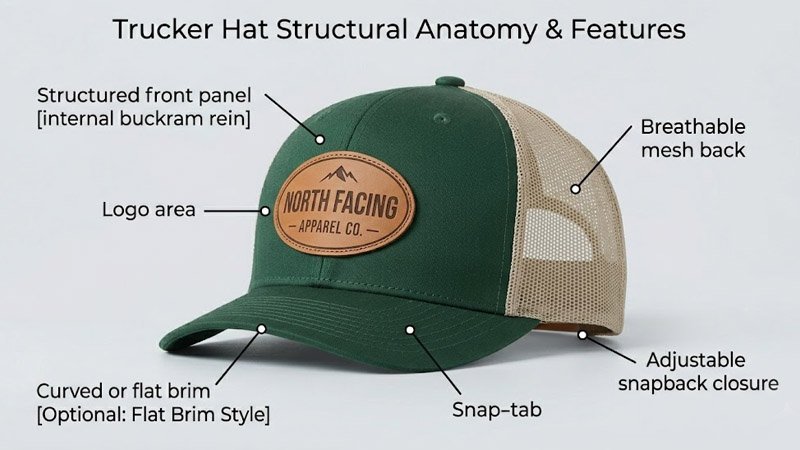
Trucker hats are popular because they combine comfort, visibility, and strong customization potential.
The classic trucker hat usually includes:
- A structured front panel
- A breathable mesh back
- An adjustable snapback closure
- A flat or curved brim
- A large front area for custom branding
For events and brand promotions, this design is very practical. The mesh back keeps the hat breathable, while the front panel gives the logo enough space to stand out.
Compared with many other promotional products, custom trucker hats are also more wearable. People can use them after the event, which means your logo continues to get exposure in daily life.
Before styling a custom trucker hat, it is important to choose the right base design. The material, brim shape, color, and logo method all affect the final look.
1. Choose the Right Front Panel
The front panel is the most important area for branding.
Common front panel options include:
- Foam front panel for a classic vintage trucker look
- Cotton front panel for a soft and natural appearance
- Polyester front panel for durability and stable colors
- Canvas front panel for a heavier outdoor or workwear style
For embroidered logos or patches, a structured front panel is usually recommended because it helps the logo stay clean and visible.
2. Choose the Right Mesh Back
The mesh back is one of the key features of a trucker hat. It provides ventilation and keeps the hat lightweight.
A breathable mesh back is especially suitable for:
- Outdoor events
- Summer campaigns
- Sports teams
- Camping brands
- Fishing brands
- Workwear teams
- Music festivals
- Promotional giveaways
For brand projects, the mesh color can match or contrast with the front panel to create a more customized look.
3. Choose a Flat Brim or Curved Brim
The brim shape affects the overall style of the hat.
A flat brim trucker hat gives a modern, bold, and streetwear-inspired look. It is suitable for fashion brands, youth brands, sports promotions, and retail merchandise.
A curved brim trucker hat gives a more classic, relaxed, and everyday look. It is suitable for corporate events, outdoor brands, team uniforms, and casual promotional use.
For most brand events, curved brim trucker hats are easier to wear for a wide audience. For streetwear or fashion-focused projects, flat brim styles may look more eye-catching.
4. Choose the Right Closure
Most trucker hats use an adjustable snapback closure. This is a practical option for bulk orders because it fits different head sizes.
Other closure options may include:
- Velcro closure
- Metal buckle closure
- Plastic snapback closure
- Elastic fit
For event giveaways and promotional campaigns, snapback closures are usually the most convenient choice.
The logo method is one of the most important decisions when designing custom trucker hats. Different logo techniques create different styles and price levels.
Flat Embroidery
Flat embroidery is clean, professional, and widely used for custom trucker hats. It works well for company logos, event names, simple icons, and short text.
Best for:
- Corporate events
- Trade shows
- Team hats
- Promotional gifts
- Uniform hats
Flat embroidery is a good choice when you want a professional and durable logo effect.
3D Puff Embroidery
3D puff embroidery creates a raised logo effect. It looks bold and premium, especially on structured front panels.
Best for:
- Streetwear brands
- Sports teams
- Fashion merchandise
- Bold letter logos
This method works best for simple logos with thick lines. Very small details may not be suitable for 3D embroidery.
Woven Patch
A woven patch is a good option for detailed logos. It can show small text, fine lines, and more complex artwork better than direct embroidery.
Best for:
- Outdoor brands
- Retail merchandise
- Lifestyle brands
- Detailed logo designs
Woven patches also give the hat a finished, retail-ready appearance.
Leather Patch
Leather patches create a vintage, premium, and outdoor-inspired look. They are often used for workwear, camping, fishing, and lifestyle brands.
Best for:
- Outdoor brands
- Workwear brands
- Premium merchandise
- Minimal logo designs
Brown, black, and tan leather patches are common choices for custom trucker hats.
Heat Transfer Printing
Heat transfer printing is suitable for colorful artwork, gradients, and full-color designs.
Best for:
- Event graphics
- Colorful brand artwork
- Promotional campaigns
- Photo-style designs
For long-term use, buyers should confirm the durability requirements before choosing heat transfer printing.
How to Style Custom Trucker Hats for Different Brand Scenarios
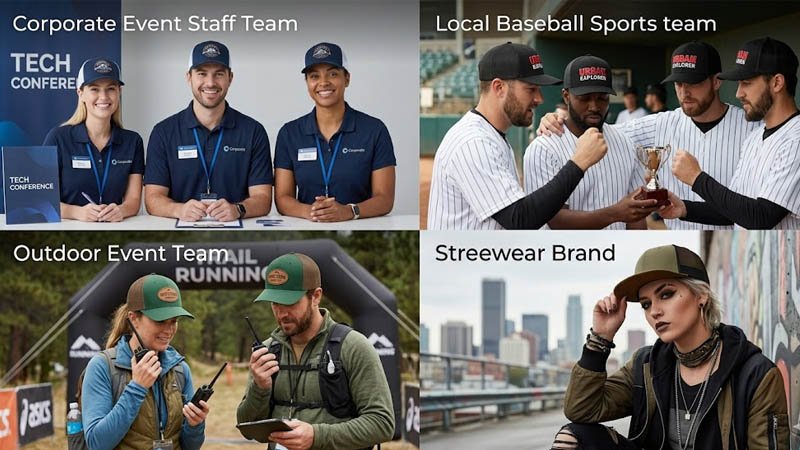
Custom trucker hats can be styled differently depending on your brand identity and event type.
Corporate Events
For corporate events, the style should be clean, simple, and professional.
Recommended design:
- Neutral colors such as black, navy, grey, or white
- Curved brim
- Flat embroidery logo
- Simple front panel design
- Adjustable snapback closure
Recommended outfit match:
- Polo shirts
- Company T-shirts
- Chinos
- Casual jackets
- Staff uniforms
A clean embroidered trucker hat can help event staff look unified while keeping the brand visible.
Trade Shows and Exhibitions
At trade shows, custom trucker hats can work as both staff uniforms and promotional giveaways.
Recommended design:
- High-contrast logo
- Lightweight mesh back
- Comfortable fit
- Clear brand name or slogan
- Simple color combination
Recommended outfit match:
- Branded T-shirts
- Lanyards
- Casual business wear
- Exhibition uniforms
For trade shows, the logo should be easy to read from a distance. Avoid overly complex designs that may lose clarity.
Outdoor Events
For outdoor events, comfort and breathability are very important.
Recommended design:
- Breathable mesh back
- Durable front panel
- Curved brim for sun protection
- Earth-tone or high-visibility colors
- Embroidery or patch logo
Recommended outfit match:
- Outdoor shirts
- Cargo pants
- Shorts
- Sunglasses
- Work jackets
This style is suitable for camping events, fishing competitions, hiking clubs, outdoor brand promotions, and summer festivals.
Sports Teams
For sports teams, trucker hats should feel energetic, comfortable, and easy to wear.
Recommended design:
- Team colors
- Embroidered team logo
- Adjustable closure
- Breathable mesh back
- Curved or flat brim depending on team style
Recommended outfit match:
- Team jerseys
- Sports T-shirts
- Joggers
- Shorts
- Sneakers
For sports teams, bold embroidery and clear color contrast can make the design more recognizable.
Streetwear Brands
For streetwear brands, trucker hats can be bold, creative, and expressive.
Recommended design:
- Flat brim
- 3D puff embroidery
- Woven patch
- Contrast mesh back
- Strong logo placement
Recommended outfit match:
- Oversized T-shirts
- Hoodies
- Denim jackets
- Cargo pants
- Sneakers
Streetwear trucker hats should feel more visual and attitude-driven. A bold front logo or raised embroidery can help create a stronger brand identity.
Music Festivals and Promotional Events
For music festivals, concerts, and promotional campaigns, trucker hats can be fun, colorful, and memorable.
Recommended design:
- Bright colors
- Printed graphics
- Event slogan
- Mesh back for comfort
- Lightweight structure
Recommended outfit match:
- Event T-shirts
- Casual shorts
- Denim
- Sneakers
- Sunglasses
For these events, the design can be more creative, but the logo should still remain clear and readable.
Color plays an important role in both styling and branding. A good color combination can make the hat easier to wear and help the logo stand out.
| Hat Color |
Best For |
Recommended Logo Style |
| Black |
Corporate events, streetwear, daily wear |
White or bright embroidery |
| Navy |
Business casual, team uniforms, events |
White, silver, or light blue embroidery |
| White |
Summer events, clean brand looks |
Dark embroidery or colorful patch |
| Grey |
Minimal branding, everyday use |
Black or navy embroidery |
| Beige / Khaki |
Outdoor brands, camping, travel |
Brown leather patch or dark embroidery |
| Olive Green |
Workwear, outdoor campaigns |
Tan patch or cream embroidery |
| Red / Bright Colors |
Sports teams, festivals, promotions |
High-contrast logo |
| Camo |
Outdoor brands, streetwear |
Leather patch or simple embroidery |
For brand projects, always check logo visibility before bulk production. A low-contrast logo may look stylish on screen but unclear on the final product.
Which Custom Trucker Hat Style Is Right for Your Brand?
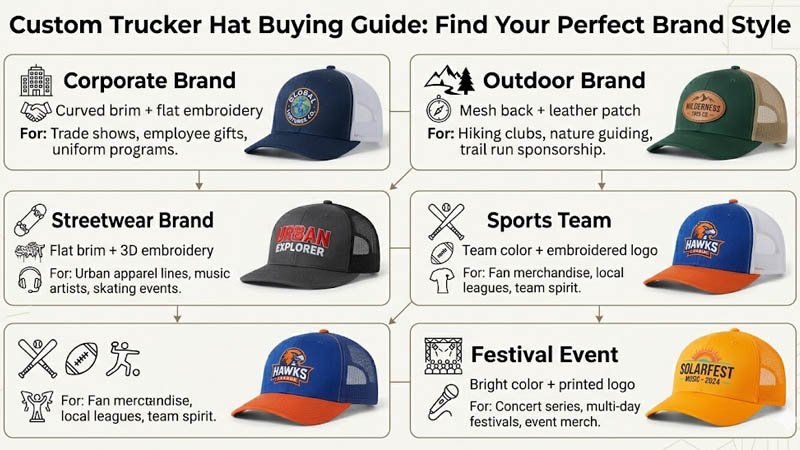
Different brands need different hat styles. The best choice depends on your market, design style, and usage scenario.
| Brand Type |
Recommended Hat Style |
Best Logo Method |
| Corporate Brand |
Curved brim trucker hat |
Flat embroidery |
| Outdoor Brand |
Mesh back trucker hat |
Leather patch or woven patch |
| Streetwear Brand |
Flat brim structured trucker hat |
3D puff embroidery or woven patch |
| Sports Team |
Breathable team trucker hat |
Embroidery or heat transfer |
| Trade Show |
Lightweight promotional trucker hat |
Flat embroidery or printed logo |
| Retail Brand |
Premium cotton trucker hat |
Woven patch or embroidery |
| Workwear Brand |
Canvas or cotton trucker hat |
Leather patch or embroidery |
| Festival Event |
Colorful trucker hat |
Heat transfer print or patch |
This type of planning helps buyers choose a hat that fits both the brand image and the actual usage environment.
Common Styling Mistakes to Avoid
Even a good trucker hat can look wrong if it is styled poorly. Here are some common mistakes to avoid.
1. Using Too Many Colors
If the hat already has a bright color or bold logo, keep the outfit simple. Too many colors can make the whole look messy.
2. Choosing the Wrong Fit
The hat should sit naturally on the head. It should not be too tight, too loose, too low, or too high.
3. Mixing the Wrong Style
A trucker hat is casual by nature. It works best with casual, sporty, outdoor, streetwear, and relaxed smart casual outfits. It is usually not suitable for formal business suits or very formal occasions.
4. Ignoring Logo Balance
For custom hats, the logo should not be too large or too small. It should fit the front panel naturally and leave enough space around the design.
5. Overloading the Front Panel
Too many words, icons, slogans, and graphics can make the hat look crowded. A clean design is often more professional and easier to remember.
Common Customization Mistakes to Avoid
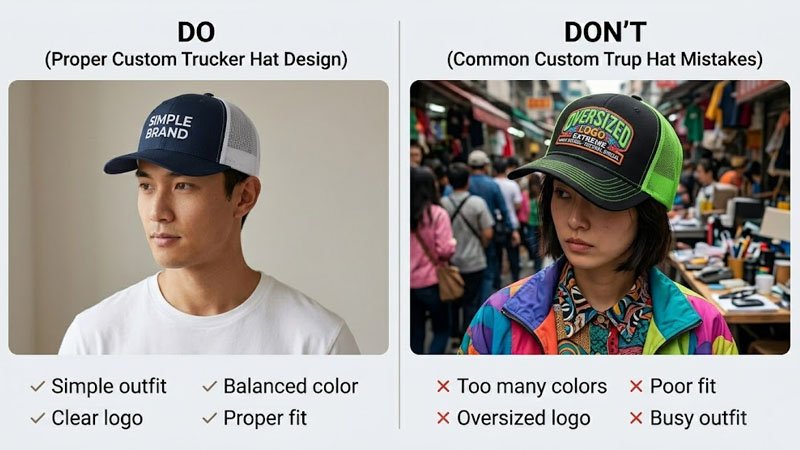
For bulk buyers, design mistakes can affect the final result and increase production risk.
1. Choosing a Logo That Is Too Detailed
Small text and fine lines may not work well with embroidery. If the logo has many details, a woven patch or printed patch may be a better choice.
2. Ignoring Material Compatibility
Different materials create different logo effects. Foam, cotton, polyester, and canvas panels may all react differently to embroidery, patches, or printing.
3. Not Checking Color Contrast
A logo needs enough contrast against the hat color. Before production, buyers should confirm whether the logo is visible and clear.
4. Skipping Sample Approval
Sampling is important for custom trucker hats. It helps confirm the logo effect, stitching quality, material, color, size, and overall shape before mass production.
5. Choosing Style Only by Price
Low-cost hats may not always deliver the best brand impression. For brand events and retail merchandise, quality, comfort, and logo clarity are very important.
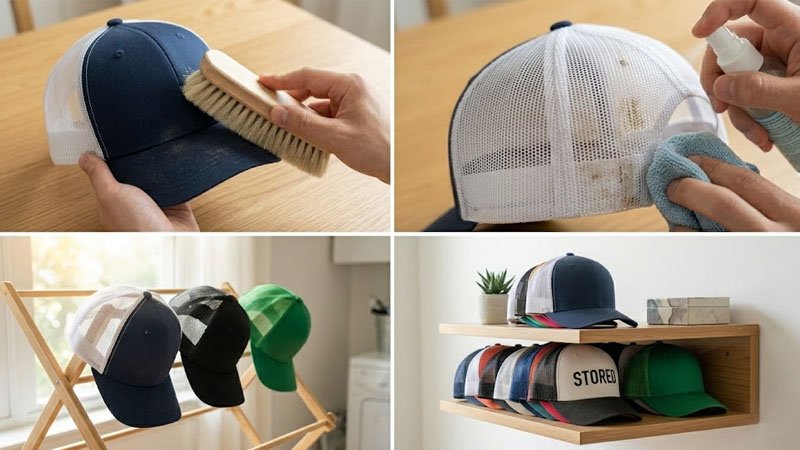
Proper care helps trucker hats keep their shape and appearance for longer.
Cleaning Tips
Spot cleaning is usually the safest method. Use a soft cloth or soft brush with mild detergent to gently clean dirt or stains.
Avoid machine washing if possible, because it may damage the structure, bend the brim, or deform the mesh back.
After cleaning, let the hat air dry naturally. Do not use high heat, as it may affect the material or logo.
Storage Tips
Store trucker hats in a cool and dry place. Avoid crushing them in bags or drawers.
For better shape protection, place the hats on a shelf, hat rack, or store them upside down. Keep the brim flat and avoid bending it too much.
For bulk orders, proper packaging is also important. Individual polybags, inner boxes, and export cartons can help protect hats during transportation.
What Buyers Should Prepare Before Ordering Custom Trucker Hats
To make the custom process smoother, buyers should prepare the following information before requesting a quote:
- Logo file
- Preferred hat style
- Quantity
- Pantone colors
- Logo size
- Logo method
- Brim style
- Material preference
- Packaging requirement
- Target delivery date
- Usage scenario
For custom buyers, working with an experienced manufacturer can help reduce sampling errors, improve logo accuracy, and ensure stable quality in bulk production.
GUANGZHOU EASTLUCKY Hat & Garment Co., Ltd. is a high-end custom hat and OEM/ODM manufacturer based in Guangzhou, China, with 15 years of expertise in professional R&D, production, and distribution of various hats and embroidered accessories. Guided by the philosophy “Quality as Root, Innovation as Soul,” the company provides global clients with one-stop solutions from design sampling to mass production, helping brands create efficient and high-quality custom hat programs.
Are trucker hats good for brand promotion?
Yes. Trucker hats are practical, wearable, and highly visible. The front panel provides a strong area for logos, while the mesh back makes the hat comfortable for daily and outdoor use.
What is the best logo method for custom trucker hats?
Flat embroidery is best for clean and professional logos. 3D embroidery is good for bold designs. Woven patches are suitable for detailed logos. Leather patches are ideal for outdoor and premium styles.
Are trucker hats suitable for outdoor events?
Yes. The breathable mesh back makes trucker hats very suitable for outdoor events, festivals, sports activities, camping, fishing, and summer promotions.
Should I choose a flat brim or curved brim?
Choose a flat brim for streetwear, fashion, and bold brand styles. Choose a curved brim for corporate events, outdoor use, sports teams, and wider audience appeal.
Can I order trucker hats with different colors?
Yes. Custom trucker hats can usually be made with different front panel colors, mesh colors, brim colors, and logo colors. Buyers can match the hat design with their brand color system.
What should I check before bulk production?
You should check the sample carefully, including material, logo position, embroidery quality, color matching, stitching, brim shape, closure, size, and packaging.
Are custom trucker hats suitable for retail merchandise?
Yes. With the right material, logo method, and packaging, custom trucker hats can be used as retail merchandise for fashion brands, outdoor brands, sports brands, and lifestyle brands.
Final Thoughts
Custom trucker hats are a smart choice for brands and events because they combine comfort, style, and strong logo visibility. They can be used for corporate events, trade shows, sports teams, outdoor campaigns, music festivals, staff uniforms, and retail merchandise.
To create a successful custom trucker hat, buyers should consider the hat structure, material, brim shape, color matching, logo method, and final usage scenario. A simple and well-balanced design often creates a stronger brand impression than an overloaded one.
Whether you need embroidered trucker hats, patch trucker hats, promotional trucker hats, or OEM custom hat solutions, the right design can turn a simple hat into a wearable part of your brand identity.
For your next custom trucker hat project, prepare your logo, quantity, preferred style, and event details. A professional manufacturer can help you choose the right material, logo technique, and production solution for your brand.
What Are the Main Parts of a Baseball Cap? A Complete Guide for Custom Hat Buyers
Choosing a baseball cap for custom production is not only about selecting a color and adding a logo. Every part of a baseball cap — from the crown and brim to the closure, sweatband, eyelets, and stitching — affects the final look, comfort, durability, and branding result.
For brands, distributors, sports teams, promotional product buyers, and OEM/ODM customers, understanding the main parts of a baseball cap can help you make better decisions before placing a bulk order. The right cap structure can improve logo presentation, wearing comfort, production stability, and overall brand value.
In this guide, we will explain the main components of a baseball cap and show how each part affects custom hat design and manufacturing.
Quick Answer: What Are the Main Parts of a Baseball Cap?
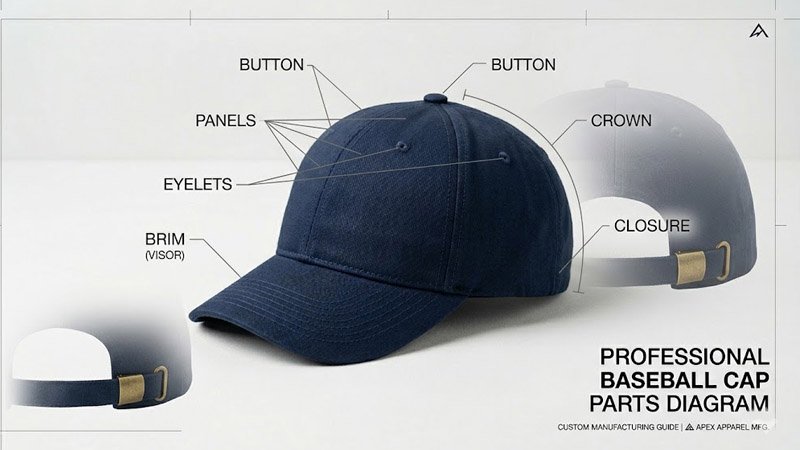
The main parts of a baseball cap include the crown, panels, brim or visor, closure, eyelets, sweatband, top button, seams, stitching, and logo decoration areas.
For custom baseball caps, these parts are not just design details. They directly affect the cap’s shape, fit, comfort, ventilation, durability, logo placement, and final production quality.
Why Baseball Cap Parts Matter for Custom Buyers
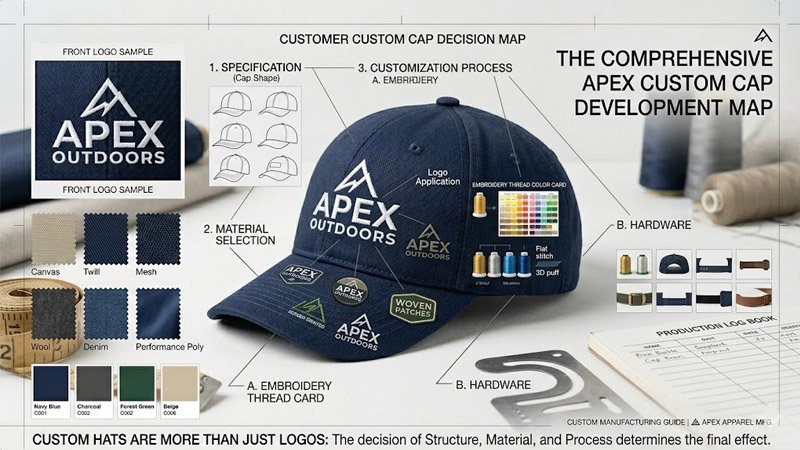
When buyers customize baseball caps, they often focus first on the logo and color. However, the structure of the cap is just as important.
A structured crown can make embroidery look cleaner. A curved brim can create a classic sports look. A snapback closure can fit more head sizes. A moisture-wicking sweatband can improve comfort for outdoor or sports use.
For bulk orders, choosing the wrong cap parts may lead to problems such as poor logo presentation, uncomfortable fit, weak structure, or a product that does not match the target market.
That is why understanding each part of a baseball cap is important before custom production begins.
1. Crown: The Main Body of the Baseball Cap
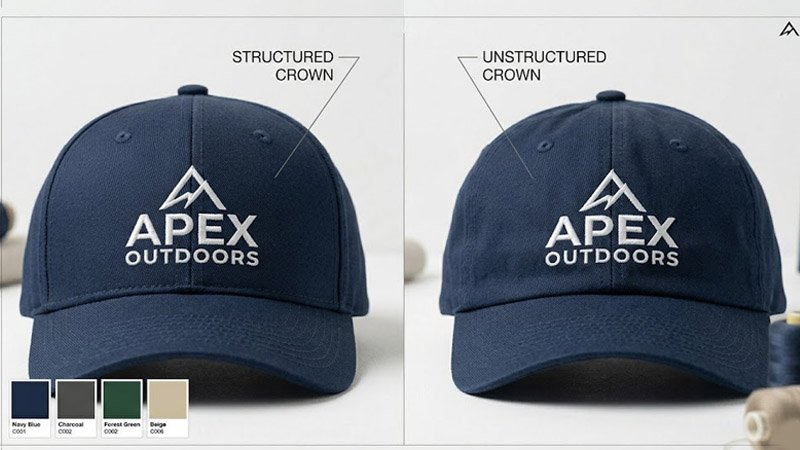
The crown is the main body of the baseball cap. It covers the top of the head and gives the cap its overall shape.
The crown affects:
- Cap structure
- Wearing comfort
- Logo placement
- Front embroidery quality
- Overall style
For custom caps, the crown is usually the most important area because it is where the main logo is placed.
A firm and well-shaped crown gives the cap a clean, professional appearance. A softer crown creates a relaxed and casual style.
2. Panels: 5-Panel and 6-Panel Construction
The crown is made from several fabric panels sewn together. Most baseball caps use either a 5-panel or 6-panel structure.
5-Panel Baseball Cap
A 5-panel cap usually has one large front panel without a center seam. This makes it suitable for large front logos, patches, and printed artwork.
A 5-panel cap is often used for:
- Camp caps
- Streetwear caps
- Outdoor caps
- Fashion headwear
- Large logo designs
Because the front panel is smooth and uninterrupted, it gives more space for clean branding.
6-Panel Baseball Cap
A 6-panel cap has six fabric sections, usually with a center seam on the front. This is the most classic baseball cap construction.
A 6-panel cap is commonly used for:
- Traditional baseball caps
- Dad hats
- Sports caps
- Corporate caps
- Uniform caps
If you want a classic baseball cap shape, a 6-panel structure is usually the safest choice.
3. Structured vs. Unstructured Crown
Another important choice is whether the cap should be structured or unstructured.
Structured Crown
A structured crown has inner support, especially in the front panels. It keeps the cap shape firm and upright.
Best for:
- Flat embroidery
- 3D embroidery
- Snapback caps
- Sports caps
- Corporate logo caps
- Premium promotional caps
Factory Tip: For large front embroidery or 3D embroidery, a structured front panel usually provides better support and helps the logo stay clean during stitching.
Unstructured Crown
An unstructured crown is softer and more relaxed. It does not have strong inner support, so it fits closer to the head.
Best for:
- Dad hats
- Casual cotton caps
- Lifestyle brands
- Small embroidered logos
- Minimalist designs
Unstructured caps are comfortable and fashionable, but they may not be the best choice for heavy or raised embroidery.
4. Crown Profile: High, Mid, and Low
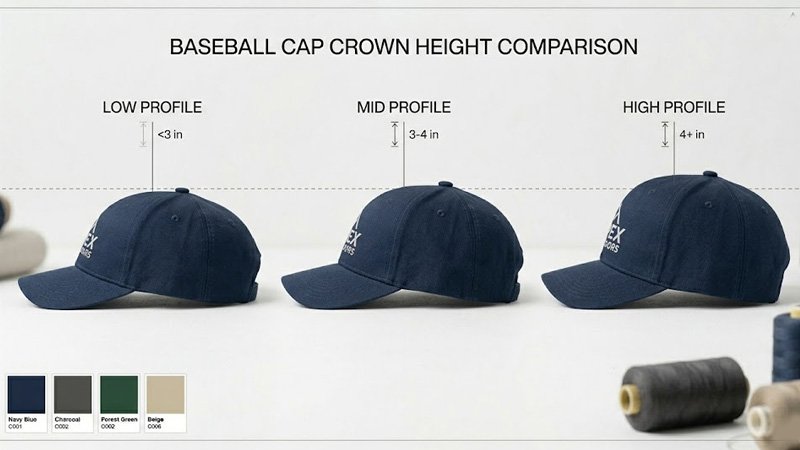
The crown profile refers to the height of the cap when worn. It affects both fit and style.
High-Profile Caps
High-profile caps have a taller crown and a bolder look.
Best for:
- Snapbacks
- Trucker caps
- 3D embroidery
- Streetwear brands
- Large front logos
Mid-Profile Caps
Mid-profile caps offer a balanced shape that suits most users.
Best for:
- Corporate caps
- Retail brands
- Sports teams
- Promotional caps
- General custom orders
Low-Profile Caps
Low-profile caps sit closer to the head and create a softer, more casual appearance.
Best for:
- Dad hats
- Casual fashion caps
- Small logo embroidery
- Lifestyle merchandise
- Minimalist brand designs
For custom buyers, the crown profile should match the target market and logo style.
5. Brim or Visor: Function and Style
The brim, also called the visor, extends from the front of the cap. It protects the face from sunlight and strongly affects the style of the cap.
The brim can be flat, curved, or pre-curved. It can also be customized with contrast colors, sandwich layers, stickers, labels, or printed designs.
6. Common Brim Types
Flat Brim
A flat brim creates a modern, bold, and streetwear-inspired look.
Best for:
- Snapbacks
- Hip-hop caps
- Fashion brands
- Sports merchandise
- 3D embroidered logos
Curved Brim
A curved brim gives a classic baseball cap appearance. It is practical, comfortable, and suitable for daily wear.
Best for:
- Sports caps
- Corporate caps
- Outdoor caps
- Promotional giveaways
- Uniform caps
Pre-Curved Brim
A pre-curved brim is already shaped during production. It gives a natural, ready-to-wear look.
Best for:
- Dad hats
- Casual caps
- Lifestyle brands
- Outdoor events
Sandwich Brim
A sandwich brim has a contrast color layer between the upper and lower brim fabrics. It is a simple way to add brand color without making the cap look too complicated.
Best for:
- Team caps
- Corporate color matching
- Promotional caps
- Brand accent designs
Factory Tip: For bulk orders, buyers should confirm the brim shape and stiffness during sampling, because different markets may prefer different brim curves.
7. Closure: The Back Adjustment System
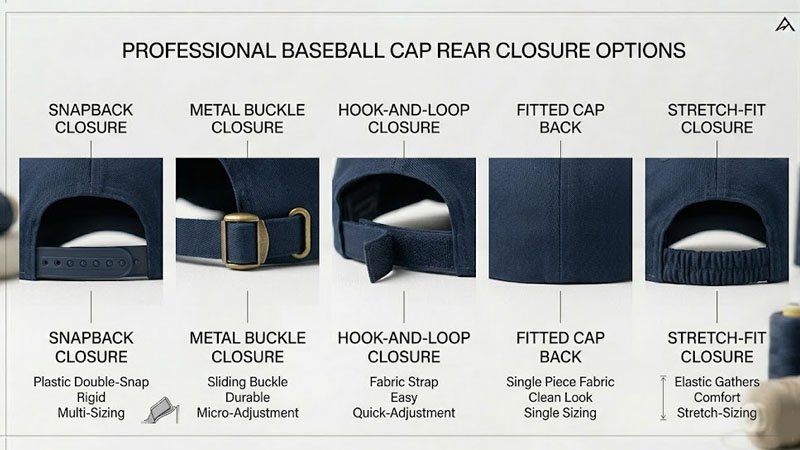
The closure is located at the back of the cap. It helps adjust the size and ensures a comfortable fit.
The closure type affects:
- Wearing comfort
- Size flexibility
- Cap style
- Target market
- Production cost
Snapback Closure
A snapback closure uses a plastic adjustable strap with holes. It is popular, durable, and easy to adjust.
Best for:
- Snapbacks
- Streetwear caps
- Sports caps
- Promotional caps
- Youth markets
Metal Buckle Closure
A metal buckle closure gives the cap a clean and premium look. It is commonly used for cotton dad hats and casual caps.
Best for:
- Dad hats
- Fashion caps
- Corporate gifts
- Premium promotional caps
Hook-and-Loop Closure
Hook-and-loop closure is easy to adjust and convenient for daily use.
Best for:
- Workwear caps
- Kids’ caps
- School caps
- Outdoor caps
- Event caps
Fitted Cap
A fitted cap has no adjustable strap. It is made according to specific head sizes.
Best for:
- Sports teams
- Retail cap collections
- Premium headwear
- Professional baseball caps
Stretch-Fit Closure
A stretch-fit cap uses elastic material to fit different head sizes comfortably.
Best for:
- Sports caps
- Performance caps
- Activewear brands
- Comfortable daily wear
Factory Tip: For promotional giveaways or event caps, adjustable closures such as snapback, hook-and-loop, or metal buckle are usually safer because they fit more head sizes.
9. Eyelets: Small Holes for Ventilation
Eyelets are the small holes on the crown of the cap. They allow air to flow through the cap and help keep the wearer cooler.
Common eyelet options include:
- Sewn eyelets
- Metal eyelets
- Matching color eyelets
- Contrast color eyelets
- Ventilation holes for performance caps
For cotton baseball caps, sewn eyelets are the most common. For outdoor caps or fashion caps, metal eyelets can add a stronger design detail.
Eyelets are especially important for summer caps, sports caps, outdoor caps, and promotional caps used in warm climates.
10. Sweatband: The Hidden Comfort Detail
The sweatband is located inside the cap, around the lower edge of the crown. It touches the forehead and helps absorb sweat.
Although it is not visible from the outside, the sweatband has a big impact on wearing comfort.
Common sweatband materials include:
- Cotton sweatband
- Polyester sweatband
- Terry cloth sweatband
- Moisture-wicking sweatband
- Elastic sweatband
For casual caps, cotton sweatbands are soft and comfortable. For sports and outdoor caps, moisture-wicking sweatbands are better because they help keep the wearer dry.
Factory Tip: Do not ignore the sweatband when developing custom caps for sports, outdoor events, or long-time wear. A poor sweatband can make the cap uncomfortable even if the outside design looks good.
11. Top Button: A Small Detail That Completes the Cap
The top button is located where the crown panels meet. It helps secure the panel structure and completes the appearance of the cap.
Common button options include:
- Matching fabric button
- Contrast color button
- Custom color button
- No-button design
A matching button gives a clean and classic look. A contrast button can add a small design highlight.
For some performance caps, a no-button design may be preferred because it feels more comfortable when worn under helmets or headgear.
12. Seams and Stitching: Details That Show Quality
Seams and stitching are important indicators of baseball cap quality. Clean stitching makes the cap look more professional and improves durability.
Custom buyers should check:
- Straight stitching
- Clean panel seams
- Even brim stitching
- Reinforced stress points
- No loose threads
- Consistent stitch density
- Neat embroidery edges
Poor stitching can make a cap look cheap, even if the fabric and logo are good. For brand buyers, these details directly affect the final product image.
13. Logo Placement Options on Baseball Caps
Logo placement is one of the most important decisions in custom baseball cap production. Different positions create different branding effects.
Front Logo
The front panel is the most common and visible logo position.
Suitable for:
- Flat embroidery
- 3D embroidery
- Woven patches
- Leather patches
- Rubber patches
- Heat transfer logos
For the best result, the logo size should match the crown height and front panel structure.
Side Logo
Side logos are usually smaller and more subtle.
Suitable for:
- Small icons
- Flag embroidery
- Event names
- Brand slogans
- Team details
Back Logo
The back area can be used for small embroidery, woven labels, or brand names near the closure.
This is a good option when the front design needs to stay simple.
Brim Logo
The brim can be customized with embroidery, stickers, labels, or under-brim printing.
This works well for streetwear caps, sports caps, and fashion headwear.
Different logo methods create different visual effects. The right method depends on the logo design, fabric, cap structure, order quantity, and target market.
Flat Embroidery
Flat embroidery is one of the most popular logo methods for baseball caps. It gives a clean, durable, and professional look.
Best for:
- Company logos
- Text logos
- Uniform caps
- Corporate caps
- Promotional caps
3D Embroidery
3D embroidery creates a raised logo effect. It gives the cap a stronger and more premium appearance.
Best for:
- Bold letters
- Sports logos
- Snapbacks
- Streetwear caps
- High-profile crowns
Appliqué Embroidery
Appliqué embroidery uses fabric pieces stitched onto the cap. It is suitable for larger designs and fashion-style branding.
Best for:
- Large logos
- Retro designs
- Streetwear caps
- Premium custom caps
Woven Patch
A woven patch is suitable for detailed logos and small text. It creates a neat and high-quality look.
Best for:
- Outdoor brands
- Fashion caps
- Retail headwear
- Detailed artwork
Leather Patch
Leather patches create a premium, outdoor, and vintage feeling.
Best for:
- Outdoor caps
- Workwear caps
- Lifestyle brands
- Premium merchandise
Heat Transfer Printing
Heat transfer printing is suitable for colorful designs, gradients, and detailed artwork.
Best for:
- Multi-color logos
- Small quantity orders
- Smooth artwork
- Fashion designs
15. Why Embroidery Is Popular for Baseball Caps
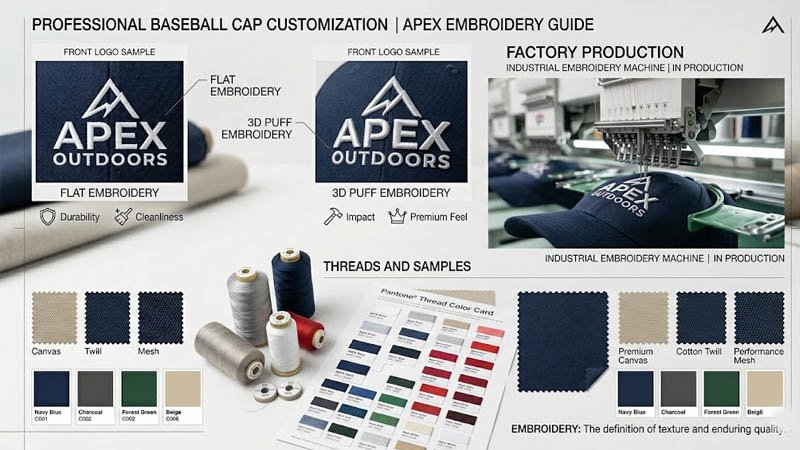
Embroidery remains one of the most popular choices for custom baseball caps because it is durable, professional, and suitable for many types of logos.
Compared with simple printing, embroidery adds texture and a more premium feeling. It is especially suitable for corporate logos, team logos, brand names, and promotional caps that need long-lasting quality.
For baseball caps, embroidery works best on stable fabric and structured front panels. If the logo has bold text or simple shapes, flat embroidery or 3D embroidery can create a strong branding effect.
For very detailed artwork, a woven patch or heat transfer logo may be more suitable than direct embroidery.
The fabric affects the cap’s texture, comfort, durability, and price. Different materials are suitable for different markets and usage scenarios.
| Material |
Best For |
Advantages |
| Cotton |
Dad hats, casual caps, corporate caps |
Soft, breathable, natural feel |
| Polyester |
Sports caps, promotional caps |
Durable, lightweight, colorfast |
| Nylon |
Outdoor caps, performance caps |
Lightweight, practical, outdoor style |
| Wool Blend |
Premium caps, winter caps |
Structured, warm, classic look |
| Mesh |
Trucker caps, summer caps |
Breathable and cost-effective |
For most custom baseball caps, cotton and polyester are the most common choices. Cotton gives a natural and comfortable feeling, while polyester offers better durability and color stability for large promotional orders.
17. Baseball Cap Parts Overview
| Cap Part |
Main Function |
Custom Options |
| Crown |
Defines cap shape and fit |
5-panel, 6-panel, structured, unstructured |
| Panels |
Build the cap structure |
Front panel, side panels, back panels |
| Brim / Visor |
Sun protection and style |
Flat, curved, pre-curved, sandwich brim |
| Closure |
Adjusts cap size |
Snapback, buckle, hook-and-loop, fitted, stretch-fit |
| Eyelets |
Improve ventilation |
Sewn eyelets, metal eyelets, contrast color |
| Sweatband |
Absorbs sweat and improves comfort |
Cotton, polyester, moisture-wicking |
| Top Button |
Secures panels and completes the look |
Matching color, contrast color, no-button |
| Stitching |
Supports durability and quality |
Brim stitching, panel stitching, reinforced seams |
| Logo Area |
Displays brand identity |
Front, side, back, brim, closure label |
18. How Different Buyers Should Choose Baseball Cap Parts
Different buyers have different needs. The right baseball cap structure should match the project purpose.
| Buyer Type |
Recommended Cap Style |
Best Logo Method |
Key Focus |
| Corporate Buyers |
Mid-profile cotton cap |
Flat embroidery |
Professional and clean |
| Sports Teams |
Structured performance cap |
3D embroidery or heat transfer |
Durable and comfortable |
| Fashion Brands |
5-panel cap or snapback |
Patch or 3D embroidery |
Strong visual identity |
| Event Companies |
Adjustable promotional cap |
Flat embroidery or printing |
Cost-effective and flexible |
| Outdoor Brands |
Trucker cap or nylon cap |
Woven patch or leather patch |
Breathability and durability |
| Retail Brands |
Premium structured cap |
Embroidery or appliqué |
Quality and brand value |
This table can help buyers choose suitable cap parts before confirming the sample.
19. Common Mistakes to Avoid in Custom Cap Production
Choosing the Wrong Crown for the Logo
A soft unstructured crown may not support heavy 3D embroidery well. If the logo is large or raised, a structured front panel is usually better.
Making the Logo Too Detailed
Small embroidery areas cannot show very fine details clearly. For detailed logos, woven patches or heat transfer printing may be better.
Ignoring the Sweatband
The sweatband affects comfort. For sports or outdoor caps, a better sweatband material can improve the wearing experience.
Choosing Fabric Only by Price
Low-cost fabric may reduce the final product quality. Buyers should consider the target market, usage, brand positioning, and budget together.
Not Confirming the Brim Shape
Different markets prefer different brim shapes. Some prefer flat brims, while others prefer curved or pre-curved brims. Always confirm the brim shape during sampling.
Skipping the Pre-Production Sample
For custom caps, a sample helps confirm the cap shape, material, color, logo size, embroidery effect, and overall quality before bulk production.
For custom baseball cap projects, a reliable manufacturer can help buyers avoid many production problems and improve final product quality.
GUANGZHOU EASTLUCKY Hat & Garment Co., Ltd. is a high-end custom hat and OEM/ODM manufacturer based in Guangzhou, China, with 15 years of expertise in professional R&D, production, and distribution of various hats and embroidered accessories. Guided by the philosophy “Quality as Root, Innovation as Soul,” we provide global clients with one-stop solutions from design sampling to mass production, enabling efficient and high-quality supply chain services for brands.
An experienced factory can support:
- Cap style recommendation
- Material selection
- Logo method suggestions
- Artwork checking
- Sample development
- Color matching
- Bulk production
- Quality inspection
- Export packaging
This is especially important for brands, distributors, event companies, sports teams, and promotional product buyers who need stable quality and reliable delivery.
Conclusion
The main parts of a baseball cap include the crown, panels, brim, closure, eyelets, sweatband, top button, seams, stitching, and logo decoration areas. Each part affects the cap’s structure, comfort, style, durability, and branding result.
For custom buyers, a baseball cap is more than a simple accessory. The right crown can improve logo embroidery. The right brim can create the correct style. The right closure can fit more users. The right sweatband can improve comfort. The right logo method can make your brand look more professional.
Before placing a bulk order, buyers should confirm the cap structure, material, crown profile, brim shape, closure type, logo method, sample quality, and packing requirements.
Whether you need embroidered baseball caps, snapbacks, dad hats, trucker caps, sports caps, or promotional caps, understanding the main parts of a baseball cap will help you create a better custom product for your brand.
FAQs
What are the main parts of a baseball cap?
The main parts of a baseball cap include the crown, panels, brim or visor, closure, eyelets, sweatband, top button, seams, stitching, and logo decoration areas.
What is the crown of a baseball cap?
The crown is the main body of the cap that covers the top of the head. It affects the cap shape, fit, structure, and front logo presentation.
What is the brim of a baseball cap?
The brim, also called the visor, extends from the front of the cap. It helps protect the face from sunlight and affects the cap’s style.
What is the best crown type for embroidery?
A structured crown is usually better for embroidery because it keeps the front panel stable and helps the logo look cleaner.
What is the difference between a 5-panel and 6-panel cap?
A 5-panel cap usually has one large front panel without a center seam, making it suitable for large logos or patches. A 6-panel cap has a classic baseball cap structure with a center seam and a traditional look.
Which closure is best for promotional baseball caps?
Adjustable closures such as snapback, hook-and-loop, or metal buckle are usually better for promotional caps because they fit more head sizes.
Is embroidery better than printing for baseball caps?
Embroidery is more durable and gives a professional textured look. Printing is better for colorful, detailed, or gradient artwork.
Can I customize both the front and side of a baseball cap?
Yes. Most custom baseball caps can support front embroidery, side logo embroidery, back logo placement, brim decoration, and custom labels.
What material is best for custom baseball caps?
Cotton is soft and breathable, making it suitable for casual caps. Polyester is durable and colorfast, making it good for sports caps and promotional caps. Mesh is often used for trucker caps and summer caps.
What should I confirm before bulk cap production?
You should confirm the cap style, material, color, crown profile, brim shape, closure type, logo size, logo method, sample quality, packing details, and delivery time.
How to Wear a Hat With Long Hair (Without Flat, Frizzy Hat Hair)
Long hair and hats can look effortlessly stylish together—but only when the pairing is done right. The most common problems are familiar: flattened roots, frizz, static, awkward ponytail placement, and hats that just don’t sit comfortably over thicker hair.
The good news? You do not need to choose between protecting your hair and looking polished. With the right combination of hat type, hairstyle, fit, and a few simple prep techniques, long hair and hats can work beautifully in every season.
In this guide, you’ll learn:
-
The best hairstyles for different hat styles
-
How to choose hats based on face shape and hair volume
-
How to prevent and fix hat hair
-
Easy hat-and-outfit combinations for different occasions
-
Common mistakes to avoid
Whether you are styling a baseball cap for everyday wear or a wide-brim hat for travel photos, this guide will help you create a look that feels comfortable, flattering, and practical.
Quick Answer: What’s the Best Way to Wear a Hat With Long Hair?
If you want a simple rule to start with, use this:
Structured hats (like baseball caps and fedoras) usually look best with low hairstyles such as a low ponytail, low bun, or braid.
Soft hats (like beanies) often look better with natural texture, loose waves, or a relaxed low bun.
To avoid hat hair:
-
Keep the hat snug, not tight
-
Add light volume at the roots before wearing the hat
-
Choose a hairstyle that doesn’t create pressure points under the crown
-
Adjust the hat position instead of pushing it down too low
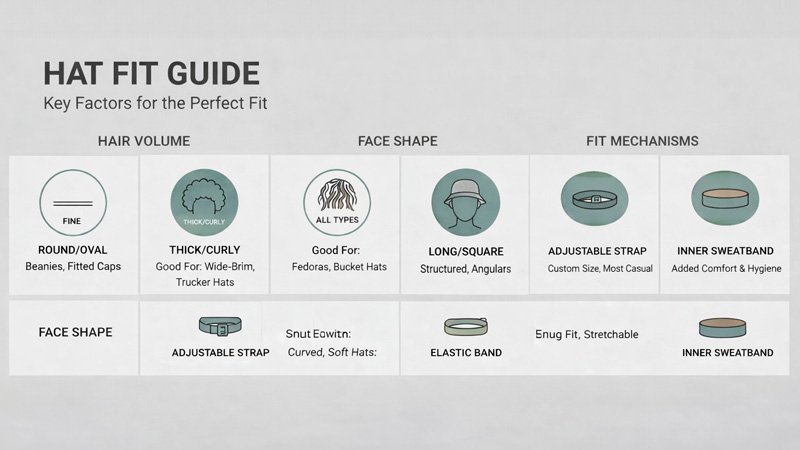
A hat that looks great on display may feel completely different when worn over long, thick, or styled hair. Before choosing a style, consider these four factors:
1) Hair Volume and Thickness
Long hair adds bulk—especially if tied up.
-
Fine or flat hair: Choose hats with a slightly structured crown to avoid a lifeless, pressed-down look.
-
Thick or heavy hair: Look for hats with enough crown depth and comfortable fit so the hat doesn’t sit too high.
-
Curly hair: Soft or adjustable hats are often easier to wear without disrupting curl shape.
2) Face Shape
Face shape affects how balanced a hat looks.
-
Round face: Medium to wide brims, angled placement, and higher crowns can help elongate the face.
-
Oval face: Most hat styles work well—great for experimentation.
-
Long face: Lower crowns and hats worn slightly higher (not pulled down too far) help balance facial length.
-
Square face: Softer lines, curved brims, and loose hair around the face can soften strong angles.
-
Heart-shaped face: Medium brims and styles with balanced crown proportions usually work well.
3) Occasion and Function
A hat for a beach trip is not the same as a hat for commuting or a winter outfit.
-
Everyday / streetwear: Baseball caps, dad caps, beanies
-
Travel / vacation: Wide-brim hats, packable sun hats
-
Smart casual / fashion styling: Fedora, beret
-
Cold weather: Knits and lined winter caps
-
Outdoor activity: Lightweight caps with breathable sweatbands
4) Fit (Most Important for Long Hair)
Fit is often the hidden reason a hat “doesn’t work.”
A hat that is too tight can cause:
A good fit should feel secure but comfortable, with no strong pressure on the crown.
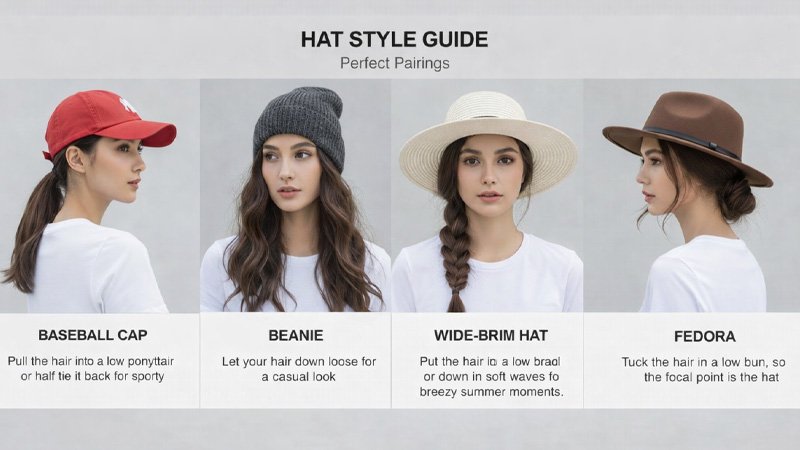
This is where most people get the best results: match the hairstyle to the hat structure.
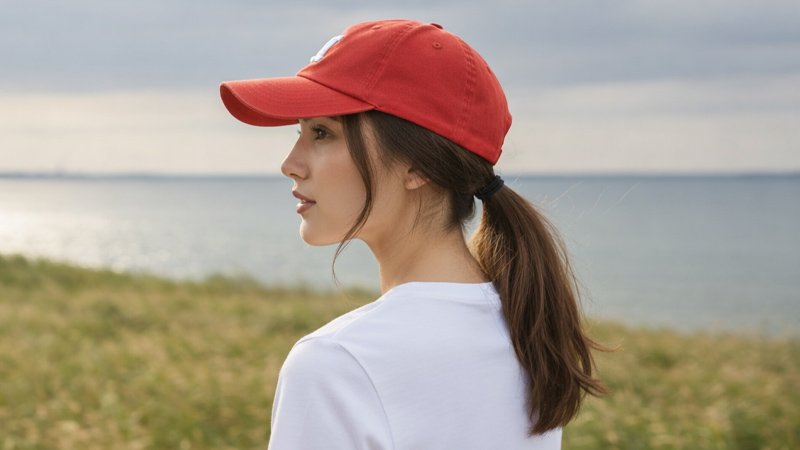
Baseball caps are one of the easiest hats to wear with long hair, but the hairstyle placement matters a lot.
Low Ponytail (Most Versatile)
A low ponytail is the easiest and most flattering choice.
Why it works:
It avoids pressure under the cap and keeps the back of the head smooth.
Best for:
Daily wear, commuting, sports casual looks
Tips:
-
Tie the ponytail below the cap opening
-
Leave a few face-framing strands for softness
-
Keep the cap slightly relaxed, not over-tightened
Low Braid
A simple braid keeps long hair neat and reduces tangling.
Why it works:
Great for windy days, active days, and travel.
Best for:
Outdoor walks, errands, casual outfits
Half-Up, Half-Down
This style works well when you want a more styled look while still wearing a cap.
Why it works:
Adds shape and volume without forcing all hair under the hat.
Best for:
Streetwear looks, social outings, casual content shoots
Avoid With Baseball Caps
-
High buns (usually too bulky under the crown)
-
High ponytails (awkward with most cap constructions unless the cap is designed with a ponytail opening)
-
Heavy root product that gets flattened quickly
2) Beanie + Long Hair
Beanies are comfortable and stylish, but they can create static, flatten the crown, and make the face look larger if styled incorrectly.
Best Hairstyles for a Beanie
Loose Hair With Soft Waves
This creates balance and keeps the look relaxed.
Why it works:
The soft volume below the hat offsets the compact shape of the beanie.
Best for:
Fall/winter outfits, cozy casual styling
Low Messy Bun
A relaxed low bun works especially well with oversized beanies.
Why it works:
It keeps hair off your neck while maintaining a soft silhouette.
Best for:
Layered winter outfits, sweaters, coats
Two Loose Braids
A playful, practical option that works in cold weather and windy conditions.
Why it works:
Helps control long hair and reduces friction tangles under scarves/coats.
Beanie Styling Tips for Long Hair
-
Don’t pull the beanie too low over the forehead if it shortens your face shape
-
Keep some hair visible around the cheeks/jawline for balance
-
Use anti-static spray or a light leave-in conditioner in dry weather
Wide-brim hats can look elegant and photogenic, but they need balanced styling so the look doesn’t feel overly heavy.
Best Hairstyles for Wide-Brim Hats
Loose Waves / Natural Hair Down
This is a classic combination.
Why it works:
The softness of the hair complements the dramatic shape of the brim.
Best for:
Travel, vacations, brunch, spring/summer styling
Side Braid
A side braid adds shape and keeps hair under control in wind.
Why it works:
Adds visual interest and works well in photos.
Best for:
Outdoor events, beach or garden settings
Low Chignon / Low Bun
This creates a refined look for dressier outfits.
Why it works:
Keeps attention on the hat shape and neckline.
Best for:
Events, weddings, smart casual looks
Wide-Brim Hat Mistakes to Avoid
-
Too much volume on top of the head (can make the hat sit awkwardly)
-
Very tight hairstyles that make the look severe
-
Ignoring wind (a loose hairstyle may look good indoors but become unmanageable outside)
4) Fedora + Long Hair
Fedoras add structure and polish, making them ideal for elevated casual outfits.
Best Hairstyles for a Fedora
Sleek Low Ponytail
A clean, minimal choice that pairs well with tailored outfits.
Straight Hair Down (Center or Side Part)
Keeps the look sophisticated and balanced.
Low Bun With Face-Framing Pieces
A great option for a polished but softer finish.
Fedora Styling Tip
Because a fedora already has strong lines, pair it with a hairstyle that is either:
This prevents the hat and hair from competing visually.
If you usually choose your hairstyle first, use this section to match the hat afterward.
1) Ponytail
Best hats: Baseball caps, sporty caps, some sun hats
Best placement: Low ponytail (most comfortable and flattering)
Avoid: High ponytail under standard caps unless the hat is made for it
2) Braids
Best hats: Beanies, baseball caps, wide-brim hats
Why braids work so well: They reduce tangling, hold shape, and look intentional
3) Buns
Best hats: Beanies, some wide-brim hats (with low bun), winter hats
Best placement: Low bun / low chignon
Avoid: High buns under structured hats
4) Hair Down
Best hats: Beanies, fedoras, wide-brim hats
Tips: Add soft texture to prevent the hair from looking too flat after removing the hat
5) Half-Up Hairstyles
Best hats: Baseball caps, casual hats, some fedoras
Why it works: Gives shape and keeps some volume without crowding the crown
How to Wear a Hat With Long Hair Based on Face Shape
Face shape matters—but hat position and hairstyle often matter just as much. If a hat “looks wrong,” try changing the angle and hair around the face before giving up on the style.
Round Face
Goal: Add length and visual balance
Try:
-
Medium or wider brims
-
Slightly higher crown styles
-
Side part or face-framing strands
-
Hair down or low ponytail with some volume
Avoid: Pulling the hat too low over the forehead
Long Face
Goal: Avoid making the face look longer
Try:
Avoid: Extra height on top (high buns + high crown hats)
Square Face
Goal: Soften angles
Try:
Heart-Shaped Face
Goal: Balance a wider forehead and narrower chin
Try:
Oval Face
Goal: Maintain balance (most styles work)
Try: Experiment with hat types, brim widths, and hairstyle placement
How to Prevent Hat Hair (Flat Roots, Frizz, and Static)
This is one of the biggest reasons people avoid hats. A few small changes can make a huge difference.
Before You Put on the Hat
1) Start With Dry Hair
Wearing a hat on damp hair often leads to flattening and shape marks.
2) Add Light Root Volume
Use a lightweight volumizing spray, dry shampoo, or a quick lift at the roots.
Tip: Avoid heavy styling creams near the crown if you plan to wear a hat.
3) Set Your Parting First
If your part changes after the hat goes on, your hair can look messy when you remove it. Set your part before wearing the hat.
4) Use a Smooth Barrier (Optional)
A silk or satin scarf/headband under certain hats can reduce friction—especially useful for curly hair or winter static.
While Wearing the Hat
1) Don’t Overtighten
A hat should feel secure, not compressive.
2) Position It Intentionally
Instead of forcing the hat low, try slightly adjusting the angle:
3) Match the Hairstyle to the Hat
Pressure points cause dents and awkward shape. Low styles usually reduce this problem.
After Taking Off the Hat (Quick Fix)
If your hair looks flat after removing the hat:
-
Flip your head slightly and shake out the roots with your fingers
-
Use dry shampoo or texturizing spray at the crown
-
Change your part temporarily for instant lift
-
Smooth flyaways with a tiny amount of serum
-
Use a quick low ponytail or braid if you’re on the go
Styling by Occasion: Hat and Outfit Combinations for Long Hair
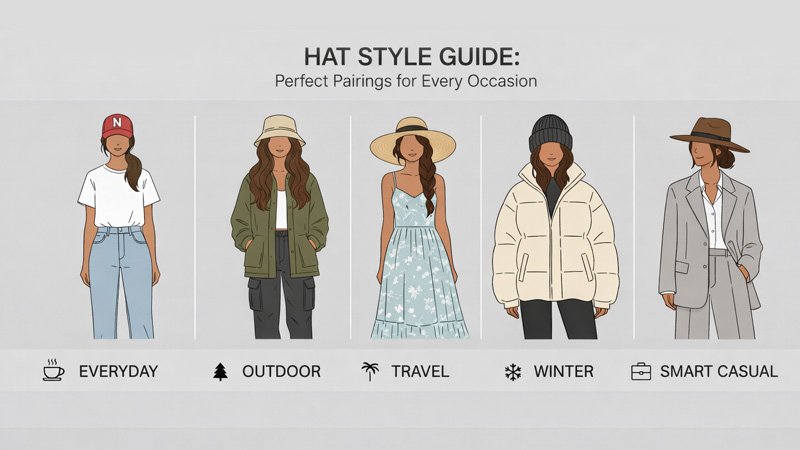
A stylish hat look is not only about the hat—it’s the full combination of hair, outfit, and occasion.
1) Everyday Casual (Easy and Fast)
Hat: Baseball cap / dad cap
Hair: Low ponytail or braid
Outfit: T-shirt, sweatshirt, jeans, sneakers
This is the easiest combination for daily wear and works well when you need a neat look with minimal effort.
2) Travel / Vacation (Comfort + Photos)
Hat: Wide-brim sun hat
Hair: Loose waves or side braid
Outfit: Flowy dress, linen set, sunglasses
Choose a hairstyle that still looks good in wind and after a few hours of wear.
3) Sporty / Outdoor Day
Hat: Breathable cap
Hair: Braids or low ponytail
Outfit: Activewear or lightweight layers
Braids are especially useful here because they stay secure and reduce tangling.
4) Fall/Winter Cozy Look
Hat: Beanie
Hair: Soft waves, low bun, or loose braid
Outfit: Knit sweater, coat, scarf
Keep some hair visible around the face to prevent the beanie from looking too heavy.
5) Smart Casual / Elevated Look
Hat: Fedora
Hair: Sleek low ponytail or low bun
Outfit: Blazer, trousers, boots, structured coat
This combination works well for polished outfits without feeling overdone.
Common Mistakes to Avoid When Wearing Hats With Long Hair
Even a good hat and hairstyle can look off if one detail is wrong. Here are the most common mistakes:
1) Pulling the Hat Too Low
This can flatten your crown, shorten your face visually, and make the entire look feel heavy.
2) Choosing the Wrong Hairstyle Height
High buns and high ponytails often fight against structured hats.
3) Ignoring Hair Texture
Fine hair, thick hair, and curly hair behave differently under hats. Style and prep accordingly.
4) Wearing an Overly Tight Hat
This causes discomfort and makes hat hair worse.
5) Forgetting the Occasion
A stylish hat is also a functional choice. Consider weather, movement, and how long you’ll wear it.
Pro Tip: Why Hat Fit and Construction Matter More Than Most People Think
Many styling problems are actually fit and construction problems, not “hair problems.”
For example:
-
A cap with insufficient crown depth may sit too high over thicker long hair
-
A rigid sweatband may create pressure lines
-
Poorly balanced crown proportions can affect how flattering the hat looks on different face shapes
This is why brands increasingly pay attention not only to style, but also to wearability, comfort, and target-user fit.
At GUANGZHOU EASTLUCKY Hat & Garment Co., Ltd., we understand that a great hat needs to do more than look good in photos. As a high-end custom hat and OEM/ODM manufacturer based in Guangzhou, China, with 15 years of expertise in professional R&D, production, and distribution of hats and embroidered accessories, we help global clients develop products that balance design, comfort, and consistent production quality. Guided by our philosophy, “Quality as Root, Innovation as Soul,” we provide one-stop solutions from sampling to mass production for efficient, high-quality supply chain support.
For brands targeting women’s casualwear, outdoor use, sports styling, or seasonal fashion, details like crown depth, sweatband comfort, fabric selection, and overall fit can directly affect the end-user experience—especially for customers with long or thick hair.
Final Thoughts
Wearing a hat with long hair is all about balance: balancing hat structure with hairstyle placement, comfort with style, and practicality with your personal look.
If you remember only three things, start here:
-
Match the hat type to the hairstyle height
-
Prioritize fit to reduce flat roots and discomfort
-
Use small prep steps to prevent hat hair and frizz
Once you get the combination right, hats become one of the easiest ways to elevate your look while staying comfortable in every season.
FAQ: How to Wear a Hat With Long Hair
How do I wear a hat without flattening my long hair?
Use a lightweight volumizing product before wearing the hat, avoid overtightening, and choose a low hairstyle like a low ponytail or braid. After removing the hat, shake the roots and use dry shampoo for quick lift.
Is it better to wear long hair up or down with a hat?
It depends on the hat type. Structured hats (like baseball caps and fedoras) usually work better with low ponytails or low buns. Soft hats (like beanies) often look great with hair down and soft texture.
What is the best hat for long thick hair?
Look for hats with enough crown depth and a comfortable fit. Adjustable caps, relaxed beanies, and well-balanced wide-brim hats are often easier to wear with thick hair than shallow, rigid styles.
Can I wear a baseball cap with a high ponytail if I have long hair?
Only if the cap is specifically designed with a ponytail opening or if the fit allows it comfortably. For standard baseball caps, a low ponytail usually looks and feels better.
How do I prevent static hair when wearing a beanie?
Use a light leave-in conditioner or anti-static spray, avoid overly dry hair, and consider a smoother inner layer (such as satin/silk) to reduce friction.
Which hairstyle is best for windy weather with a hat?
Braids (single or double) are one of the best options because they stay secure, reduce tangles, and still look intentional after hours of wear.
Need Custom Hat Solutions for Your Brand?
If you’re developing a hat collection for fashion, sports, outdoor, or promotional use, product comfort and fit are just as important as style. EASTLUCKY provides OEM/ODM support from design sampling to mass production, helping brands create hats that are both visually strong and comfortable to wear.
Contact us to discuss your next custom hat project.
Find Your Hat Size: Measure Your Head + Size Chart
Finding the right hat size is easier than most people think. You only need one accurate measurement—your head circumference—and a reliable size chart to match it.
This guide shows you:
-
exactly where to measure your head (so results don’t vary),
-
how to choose the right size for different hat styles,
-
and how to fix common fit issues like too tight or too loose.
If you’re a brand or buyer ordering in bulk, correct sizing also helps reduce sampling revisions and improves fit consistency in mass production.
Quick Answer: How to Measure Your Head (30 Seconds)
You’ll need: flexible measuring tape (or string + ruler), mirror, pen/notebook
-
Wrap the tape above your ears and across the widest part of your forehead
-
Keep the tape level all the way around your head
-
Make it snug, not tight (don’t compress skin or hair)
-
Measure 2–3 times and take the average
-
Record your result in centimeters and inches
Between two sizes? Don’t guess—use the hat-type rules in this article (they’re different for caps vs. straw hats vs. beanies).
Most Common Hat Sizes (Fast Reference)
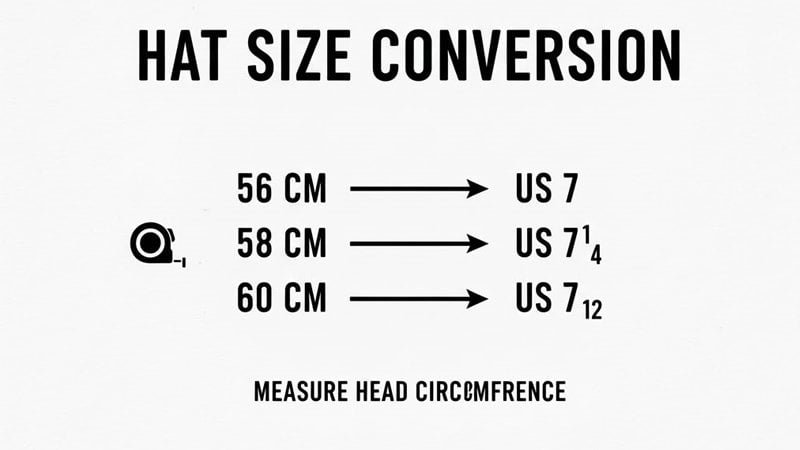
If you want a quick match before reading the full chart:
-
56 cm ≈ US 7 (S/M)
-
58 cm ≈ US 7 1/4 (M)
-
60 cm ≈ US 7 1/2 (L)
For a precise fit—especially for fitted caps—use the full chart below.
Hat Size Chart (CM to Inches + U.S. Fitted Sizes)
Match your head circumference to the closest size. If you land between two rows, choose based on the hat type section.
| Head Circumference (cm) |
Inches |
U.S. Fitted Size |
Alpha Size (S/M/L) |
| 54 |
21 1/4 |
6 3/4 |
S |
| 55 |
21 5/8 |
6 7/8 |
S |
| 56 |
22 |
7 |
S / M |
| 57 |
22 3/8 |
7 1/8 |
M |
| 58 |
22 3/4 |
7 1/4 |
M |
| 59 |
23 1/8 |
7 3/8 |
L |
| 60 |
23 1/2 |
7 1/2 |
L |
| 61 |
23 7/8 |
7 5/8 |
XL |
| 62 |
24 1/4 |
7 3/4 |
XL |
Fit tolerance tip: Measuring technique and head shape can cause small differences. For most hats, a variation of about ±0.3 cm is normal.
Choose the Right Size by Hat Type (Caps, Buckets, Straw Hats, Beanies)
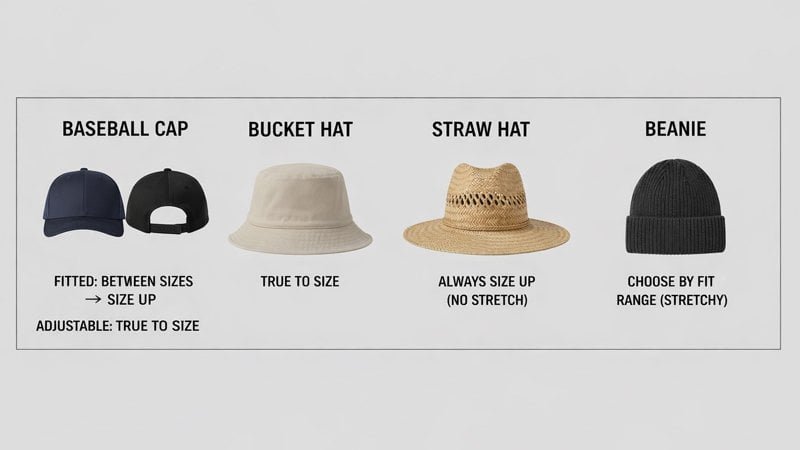
Different hat styles “feel” different even at the same circumference. Use these simple rules to choose correctly—especially if you’re between sizes.
1) Baseball Caps (Fitted / Adjustable / Flexfit)
One-sentence rule: If you’re between sizes for a fitted cap, size up.
-
Fitted caps require the most accurate sizing
-
Adjustable caps (snapback, buckle, Velcro) are more forgiving
-
Structured crowns can feel tighter than unstructured crowns
-
A thicker sweatband can reduce inner space and change the feel
Best practice: If you’re producing for retail, confirm sizing with wear testing (different head shapes can feel different even at the same circumference).
2) Bucket Hats (Fisherman Hats)
One-sentence rule: True to size for regular fit; size up for a more relaxed streetwear fit.
Bucket hats usually sit slightly looser than structured caps, but crown height and inner taping can change comfort.
If your bucket hat is intended for all-day wear, many people prefer a little extra space—especially in warm climates.
3) Straw Hats
One-sentence rule: If you’re between sizes, always size up.
Straw hats are less forgiving because the structure is rigid. A half-size too small will feel tight immediately. A slightly larger size can be fine-tuned using:
Note: Straw materials can react to humidity. Planning for a stable inner band is key for consistent fit.
4) Beanies (Cold Hats / Knit Hats)
One-sentence rule: Choose by fit range, not exact circumference.
Beanies depend on stretch and recovery. Fit changes with:
For production, beanies are usually defined by a fit range (for example, 54–58 cm or 56–60 cm), then verified through wear testing.
Common Measuring Mistakes (And How to Fix Them)
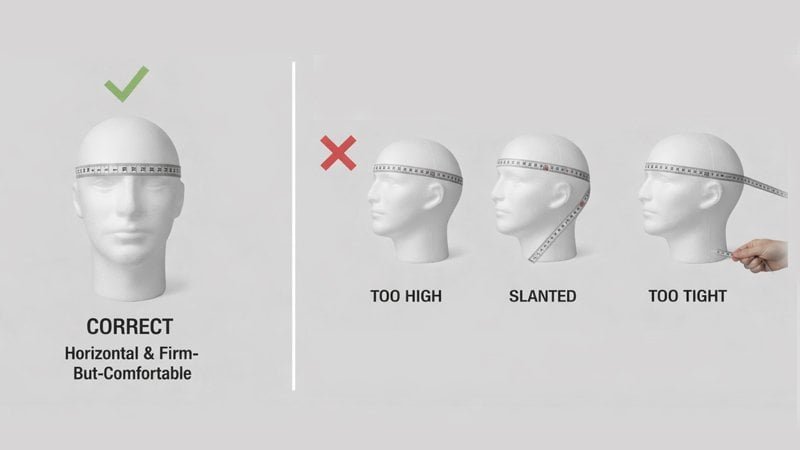
These small errors can cause big fit problems—especially for fitted caps:
-
Tape too high (above the widest forehead) → size reads smaller than reality
-
Tape slanted (not level around the head) → inconsistent results
-
Tape too tight (compressing hair/skin) → hat feels tight and uncomfortable
-
Only measured once → avoidable size mistakes
Fix: Keep the tape level, measure 2–3 times, and use the average.
Fit Troubleshooting: Too Tight vs. Too Loose
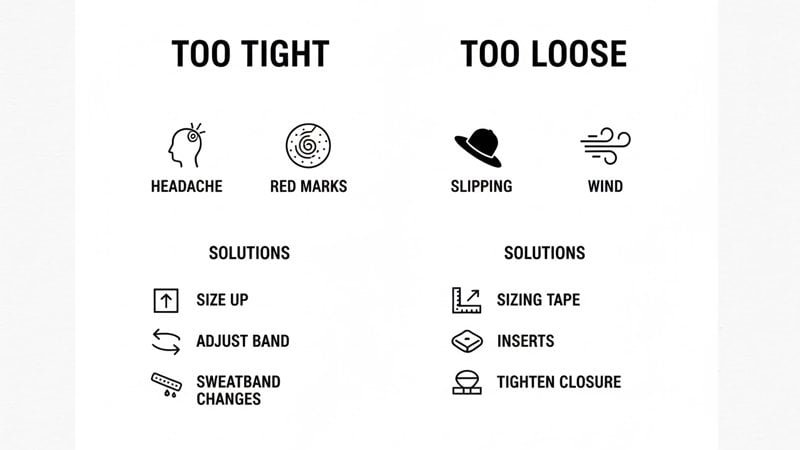
Even with correct measurement, fit issues can happen due to materials, construction, or head shape. Here’s how to diagnose and solve them.
If a Hat Feels Too Tight
Symptoms: pressure points, headaches, red marks
Common causes: size too small, thick sweatband, structured crown, shrinkage, crown depth mismatch
Solutions:
-
For fitted caps or straw hats: choose the next size up
-
For adjustable caps: loosen the closure
-
Add design adjustments: reduce sweatband thickness or modify crown depth
-
For certain materials: controlled stretching during finishing (production method dependent)
If a Hat Feels Too Loose
Symptoms: slipping, unstable in wind, constant readjustment
Common causes: size too large, stretched band, insufficient inner grip
Solutions:
-
Use hat sizing tape inside the sweatband
-
Add foam/silicone inserts for retail adjustment
-
Tighten adjustable closure range (caps)
-
Improve inner band grip design (especially useful for straw hats)
For Brands & Bulk Orders (OEM/ODM): What to Send for an Accurate Fit
If you’re developing custom headwear and want a smoother sampling process, share these details early:
-
hat type (baseball cap / bucket / straw / beanie)
-
target size range (cm) and intended fit (snug / regular / relaxed)
-
logo files (AI/PDF preferred) and branding placement
-
material and construction preferences
-
order quantity and target market (US/EU/UK)
-
reference photos or similar styles
This information helps shorten development time and reduces back-and-forth during sampling.
Need a Free Size Review for Your Custom Hats?
GUANGZHOU EASTLUCKY Hat & Garment Co., Ltd. is a high-end custom hat and OEM/ODM manufacturer in Guangzhou, China, with 15 years of expertise in R&D, production, and global distribution. Guided by “Quality as Root, Innovation as Soul,” we provide one-stop solutions from design sampling to mass production across:
-
Baseball caps (fitted, snapback, dad hats, structured/unstructured)
-
Bucket hats
-
Straw hats
-
Beanies
-
custom embroidery, patches, labels, trims, and packaging
Send us your target hat style + size range in cm, and we can help you confirm sizing direction before sampling—so your bulk production matches the fit your customers expect.
Do Trucker Hats Protect You from the Sun? A Guide to UV Protection, Hat Styles, and Smart Upgrades
Trucker hats are often a go-to choice for hot weather, offering a breathable design and a stylish look. But when it comes to sun protection, how effective are they? Do trucker hats really shield you from UV rays, or is the protection just partial? This guide answers that question and helps you choose the right hat for maximum sun safety. Whether you want to keep the classic trucker look or upgrade to a more protective style, you’ll get all the information you need.
Featured Snippet Intro:
Do trucker hats protect you from the sun? While trucker hats provide partial sun protection by shading the forehead and eyes, they leave ears, neck, and cheeks exposed. For better coverage, especially during prolonged outdoor exposure or high UV conditions, consider upgrading to a wide-brim hat or adding a neck flap. Use sunscreen and sunglasses to fill in the gaps for complete sun safety.
1) The Short Answer: What a Trucker Hat Protects
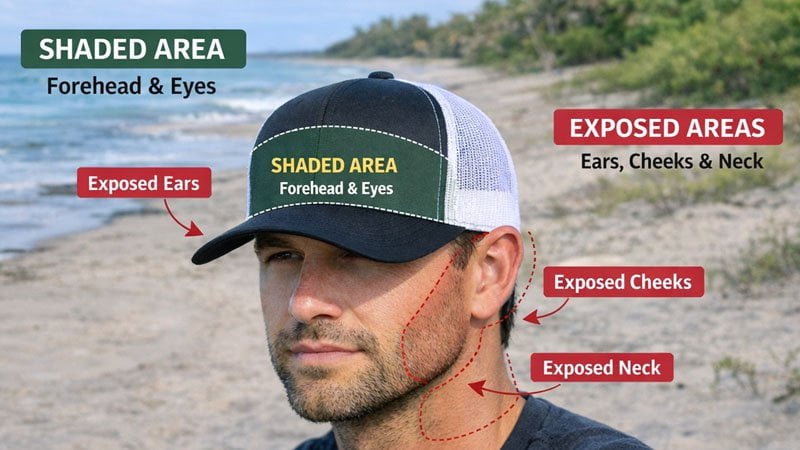
A trucker hat does provide partial sun protection, but it does not cover all of your skin. Here’s how it works:
-
Shields: The brim blocks UV rays from your forehead and eyes, reducing the intensity of direct sunlight.
-
Exposes: The ears, neck, and cheeks are often left exposed, which increases the risk of sunburn in those areas, especially with prolonged sun exposure. The mesh panels at the back also allow UV rays to pass through more easily than solid fabrics.
So while a trucker hat can be effective for short outdoor breaks, it’s not enough if you’re out in the sun for extended periods.
2) Use This 10-Second Test: When Is a Trucker Hat “Enough”?
To determine if a trucker hat offers sufficient protection, assess these three key factors:
A) UV Conditions (Intensity)
-
Low UV: Early morning, late afternoon, cloudy days, or winter sun
-
High UV: Midday, clear skies, or summer heat
B) Exposure Time
-
< 30 minutes: The brim + sunscreen is usually sufficient
-
30–120 minutes: Protection gaps start to add up, and you’ll need to cover more areas
-
2+ hours: A wider-brimmed hat or neck-flap design is recommended for full protection
C) Reflective Surfaces
When near water, sand, snow, or light-colored concrete, UV rays bounce off and hit your skin from the side or below. In these environments, a standard trucker hat alone will not be enough.
Practical Rule:
-
Short time + low UV + non-reflective setting → a trucker hat may be sufficient with sunscreen and sunglasses
-
Long exposure OR high UV OR reflective setting → opt for a wide-brim hat or neck-flap cap + sunscreen
3) Shade Isn’t Enough: Understanding UPF and Fabric Choice
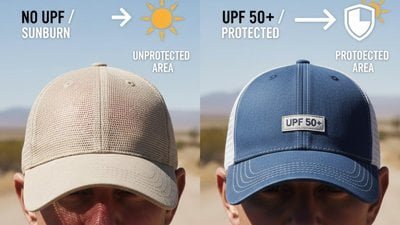
While a trucker hat may provide shade, shade alone doesn’t guarantee protection. Here’s why:
A) Shade (Brim Geometry)
The brim blocks direct UV rays from above but doesn’t shield the sides of your face or neck. Depending on the brim length and angle, a trucker hat may leave important areas exposed.
B) UPF (Ultraviolet Protection Factor)
UPF is a measure of how well a fabric blocks UV radiation.
-
UPF 50: Only 2% of UV passes through, providing excellent protection.
-
No UPF Label: Means the fabric may not block UV effectively, making it less reliable for long outdoor exposure.
Important: Even when a hat provides shade, fabrics with low UPF (like mesh) might still allow UV through, which means you’re not fully protected.
4) Where a Trucker Hat Falls Short (And How to Fix It)
Trucker hats are great for casual wear, but they’re not designed for maximum sun protection. These are the common weak points:
-
Ears: Often unprotected by the small brim
-
Neck: The back of the neck is highly exposed to UV
-
Cheeks & Sides of Face: Only the forehead is shaded, while your cheeks and jawline are left vulnerable
-
Mesh Panels: Allow UV rays to pass through, reducing the overall protection
In high UV conditions or for longer durations, these weak spots could lead to sunburn.
5) A Simple Brim Size Guide: What You Need to Know
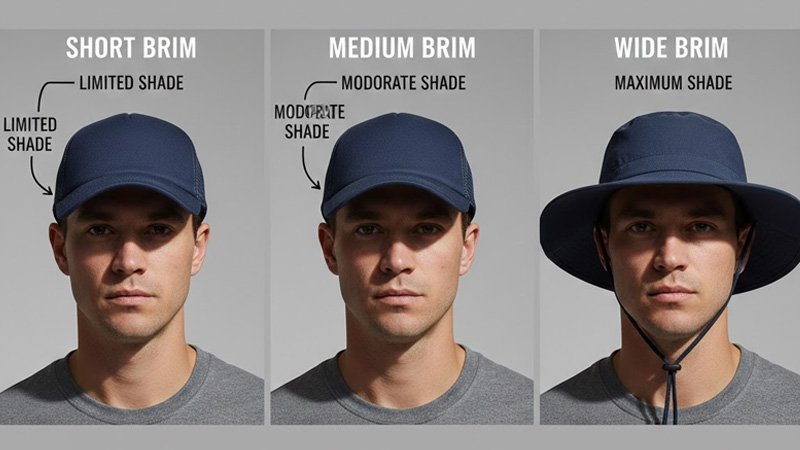
The brim of your hat plays a critical role in UV coverage. Here’s how it impacts protection:
Standard Cap Brim (Common for Trucker Hats)
-
Best for forehead and eyes
-
Limited shade for cheeks and jawline
-
No protection for ears and neck
Wide-Brim Hats
-
Offers full coverage for face, ears, and neck
-
Best for high UV exposure or longer periods outdoors
Neck-Flap (Legionnaire) Caps
-
Provides ear and neck protection while still offering cap-like comfort
-
Ideal for sports, work, or long outdoor hours
Tip: If you want better protection, brim size matters—consider switching to a wider brim for more comprehensive coverage.
6) Smart Materials and Fabric Choice: What to Look for
Not all fabrics block UV equally. Here’s a breakdown of what works:
Best Materials for UV Protection
-
Dense polyester or nylon fabrics offer the best UV blocking performance
-
Tightly woven cotton works better than loose weave fabrics
-
UPF-rated textiles guarantee a strong level of protection
What to Avoid
Color Consideration: Darker colors absorb more UV, but fabric density is the primary factor in UV protection. If comfort and glare reduction are important, choose a darker underbrim.
7) How to Upgrade a Trucker Hat for Better Sun Protection
If you love the trucker hat look but want more sun protection, consider these two upgrade paths:
Route A: Keep the Classic Look (Minimal Change)
Ideal for lifestyle brands or everyday wear.
-
Denser or UPF-rated front panel: Helps block UV where it matters most.
-
Longer brim (2.75–3 inches): Adds more shade without changing the classic style.
-
Darker underbrim: Helps reduce glare, improving eye comfort.
-
Layered habits: Sunscreen for ears, neck, and cheeks + UV-blocking sunglasses.
Route B: Maximize Sun Protection (For High UV Environments)
Ideal for outdoor workers, athletes, and long exposure.
-
Replace mesh with UV-blocking ventilation: Tightly woven micro-perforated fabrics can keep you cool while blocking more UV.
-
Add a neck flap (clip-on or integrated): Protects vulnerable areas like the ears and neck.
-
Full UPF-rated construction: Ensure all panels are designed to block UV, not just the front.
-
Sweat-wicking and cooling features: Keep you comfortable and ensure the hat stays on during long activities.
8) Trucker Hat Sun Protection Checklist
Use this checklist to evaluate your trucker hat’s effectiveness in sun protection:
| Feature |
Effect on Protection |
| Brim Length |
A longer brim (2.75–3 inches) offers better shade for the face. |
| Fabric (UPF-rated) |
Dense fabrics like polyester or nylon block more UV than thin or open-weave fabrics. |
| Mesh Panels |
Mesh allows UV rays to pass through—choose solid fabrics for better coverage. |
| Darker Underbrim |
Helps reduce glare and protects eyes from reflected UV. |
| Neck Flap (Clip-on or Integrated) |
Provides added coverage for ears and neck, which are often exposed in standard caps. |
| Sunscreen |
Apply to exposed areas (ears, neck, cheeks, etc.) for added protection. |
| Sunglasses |
Protects eyes from UV rays, especially in reflective environments. |
Tip: If you’re spending more than 30 minutes outdoors, combine your trucker hat with sunscreen and sunglasses for optimal protection.
9) FAQs
Can I make a trucker hat more protective without changing its look?
Yes. Upgrade the front panel to a denser or UPF-rated fabric, use a slightly longer brim, and add a darker underbrim. Then apply sunscreen for ears, neck, and cheeks and use sunglasses.
Are trucker hats safe for kids under strong sun?
For long sun exposure, wide-brim or neck-flap designs are safer because kids’ skin is more sensitive, especially on the ears and neck. If using a trucker hat, make sure to apply sunscreen and consider a neck flap.
Can reflective UV cause damage even if I sit in the shade?
Yes. UV can reflect off surfaces like water, sand, and snow, hitting your skin from below or from the sides. Shade blocks direct UV but doesn’t shield from reflected rays.
How often should I reapply sunscreen if I’m wearing a hat?
A hat reduces exposure to the face, but ears, neck, and other exposed areas still need sunscreen. Reapply sunscreen based on the product’s instructions and more frequently if you’re sweating or near water.
10) Create Smarter Trucker Hats with Sun Protection (OEM/ODM Support)
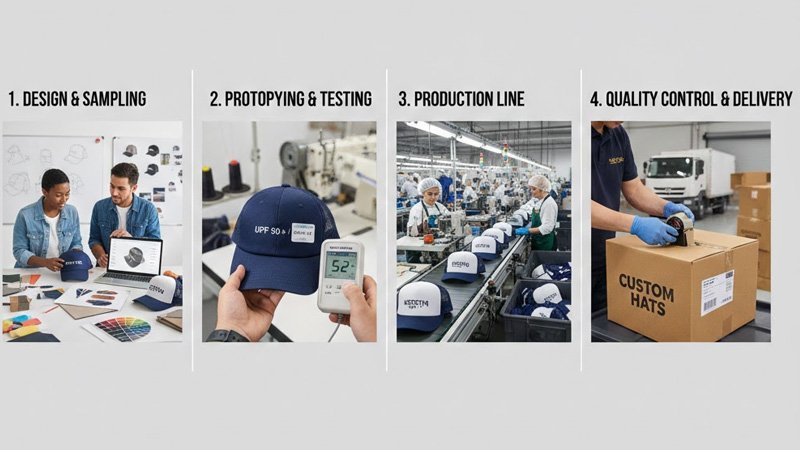
If you’re designing hats for retail or outdoor work, ensure your trucker hats combine style with sun safety. Whether it’s a custom wide-brim, neck-flap, or UPF fabric, GUANGZHOU EASTLUCKY Hat & Garment Co., Ltd. provides expert solutions for quality and performance.
With over 15 years in custom hat manufacturing and expertise in OEM/ODM services, we offer tailored designs, fast sampling, and high-quality production that meets sun protection standards. Contact us today to start creating custom trucker hats that balance breathability, comfort, and UV safety.
This version should be more optimized for Google search, easy to read, and practical for consumers seeking quick, actionable information about trucker hats and sun protection. If you need further adjustments or additional content, feel free to ask!
Why Are New Era Caps So Expensive? The Real Cost Behind 59FIFTY Pricing—and What Premium Hat Brands Can Learn
New Era caps—especially the iconic 59FIFTY fitted—often cost more than the average baseball hat. And while it’s easy to label that premium as hype, the price is usually a reflection of real inputs: official sports licensing, on-field specification discipline, premium construction, tight quality control, and scarcity-driven releases that elevate collectability.
If you’ve been asking “why are New Era caps so expensive?” this guide breaks down the true cost structure behind New Era pricing—and offers practical insights for brands who want a similar “premium” outcome through design, build, and supply chain execution.
Quick Take: Why New Era Hats Cost More
New Era hats are expensive because they stack multiple cost drivers at once:
-
Official league licensing fees (MLB/NFL/NBA royalties)
-
On-field authenticity standards (spec-driven build requirements)
-
Premium materials and structured construction (shape retention)
-
Strict quality control for consistent fit and silhouette
-
Limited drops, collaborations, and collector demand
-
Distribution and pricing discipline (fewer deep discounts)
Together, these factors position New Era as more than merchandise—it’s a certified piece of sports culture and streetwear identity.
1) Licensing & On-Field Authenticity: The Biggest Built-In Premium
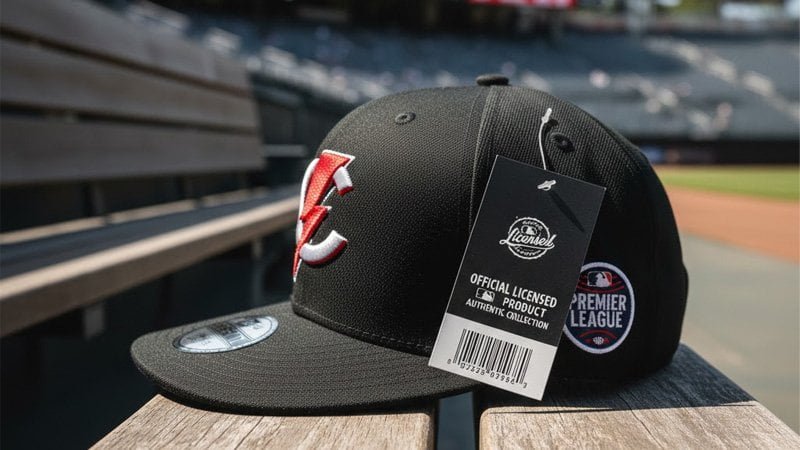
The single largest “hidden cost” behind the New Era 59FIFTY price is licensing.
When a hat includes official team branding, it carries royalty and trademark costs that are embedded into retail pricing. Licensing also comes with compliance obligations: correct logo placement, approved color standards, and brand-protected applications.
Then there’s on-field authenticity. New Era’s “Authentic On-Field” positioning implies a product built to specific standards—details that increase complexity and inspection time.
What you’re paying for:
Not just a logo, but verified legitimacy plus a spec system that protects consistency.
2) Premium Build, Materials & Structure: Shape That Lasts Costs More
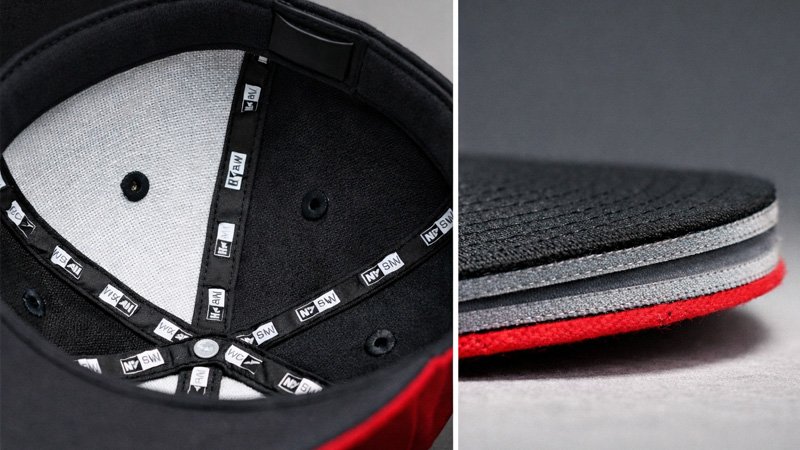
A fitted cap’s value isn’t only in how it looks—it’s in how it holds its silhouette over time.
New Era’s premium feel typically comes from:
-
Reinforced buckram for a firm crown
-
Structured six-panel construction for shape stability
-
High-density embroidery for crisp, dimensional logos
-
Interior taping and branded sweatbands for comfort and finish
-
Visor inserts designed to resist warping
Cheaper hats often lower cost through lighter structure, lower stitch density, simplified interior finishing, and broader tolerance standards. Those savings show up later as faster shape collapse, less consistent fit, or visible manufacturing variation.
Premium takeaway:
Structure is not an aesthetic choice—it’s an engineering choice.
3) Fit Consistency & Quality Control: The Quiet Differentiator
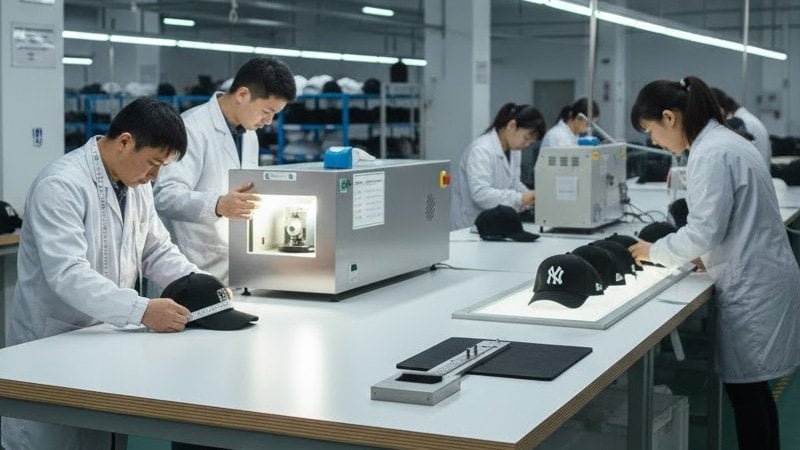
Most consumers can’t describe QC—but they can feel it.
One reason the New Era fitted cap cost stays high is that fitted caps demand repeatability across sizes and batches. Achieving consistency requires:
-
tighter measurement standards
-
process discipline in sewing/assembly
-
controlled embroidery execution
-
inspection checkpoints and defect thresholds
-
additional rework/scrap cost to protect the final experience
Collectors value that reliability. When a fitted cap’s size feels inconsistent from drop to drop, trust erodes quickly.
Premium takeaway:
Consistency is a product feature—one that costs money.
4) Scarcity, Drops & Collabs: Hype Economics That Reinforces Price
New Era pricing is also supported by “drop culture.”
Limited releases and collaborations create scarcity, and scarcity accelerates demand. When a cap is tied to an anniversary patch, special event, or exclusive colorway, it becomes a collectible.
Common premium drivers include:
-
limited production runs
-
short release windows
-
exclusive patches and embroidery packages
-
designer and streetwear collaborations
-
resale activity that signals cultural value
Premium takeaway:
Scarcity isn’t only marketing—it changes the economics of demand.
5) Distribution & Pricing Discipline: Why Discounts Are Rare
New Era also protects pricing through channel control: a tighter authorized retailer ecosystem and stronger pricing discipline reduce aggressive markdowns.
This matters because widespread discounting trains the market to wait for sales—and weakens “premium” positioning.
Pricing discipline supports:
Premium takeaway:
A premium product needs premium distribution strategy.
6) Upstream Cost Pressures: Inflation, Compliance & Smaller Runs
Beyond brand strategy, modern hat manufacturing has real cost pressure:
-
fabric and labor increases
-
more complex global logistics
-
compliance requirements (labeling, testing, restricted substances)
-
special editions with smaller runs (higher per-unit cost)
This is why two caps that look similar can differ significantly in cost once you account for total production and compliance overhead.
Premium takeaway:
The shelf price often reflects upstream reality, not just brand margin.
For many buyers, yes—because New Era delivers a unique combination of:
-
official legitimacy
-
on-field authenticity positioning
-
durable structure and consistent silhouette
-
collectable identity through drops and collaborations
For customers who only want an everyday cap, the value equation may favor premium non-licensed alternatives built with strong materials and QC—but without licensing fees.
What Premium Hat Brands Can Do Better Than “Copying” New Era
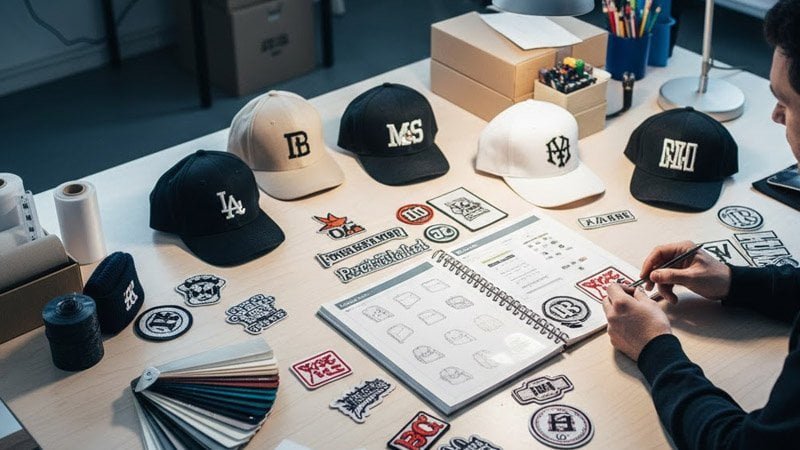
If you want to build a premium cap line—especially a structured fitted style—focus on what actually drives perceived value:
-
Silhouette engineering: crown height, panel shape, buckram selection
-
Embroidery precision: density, edge clarity, raised effects, patch quality
-
Repeatability systems: specs, tolerance control, in-line QC checkpoints
-
Intentional scarcity: capsule drops, limited colorways, event moments
-
Story that matches reality: craftsmanship and proof, not empty hype
Premium is not one feature. It’s a system.
Manufacture Premium Caps with a Brand-First Supply Chain Partner
GUANGZHOU EASTLUCKY Hat & Garment Co., Ltd. is a high-end custom hat and OEM/ODM manufacturer based in Guangzhou, China, with 15 years of expertise in professional R&D, production, and distribution of various hats and embroidered accessories.
Guided by the philosophy “Quality as Root, Innovation as Soul,” we provide global clients with a one-stop solution from design sampling to mass production, helping brands create efficient, consistent, high-quality supply chains.
If you want “New Era-level” structure and finish—without needing licensed branding—we support:
-
structured crown development and pattern refinement
-
reinforced buckram configuration and fit tuning
-
high-density embroidery and patch execution
-
fabric selection for performance and durability
-
sampling workflows for faster iteration
-
QC standards that protect silhouette consistency
FAQ (SEO-Friendly; Suitable for Schema Markup)
Why are New Era caps so expensive compared to other hats?
New Era caps cost more due to official league licensing royalties, on-field specification standards, premium structured construction, strict quality control, and scarcity-driven releases that increase demand and perceived value.
Does licensing really affect the price of a fitted cap?
Yes. Licensed hats include trademark and royalty fees and must follow approved branding and compliance rules, which increases both cost and production complexity.
Are New Era 59FIFTY caps higher quality than cheaper hats?
In many cases, yes. The 59FIFTY is known for structured construction, reinforced materials, dense embroidery, and consistent QC that helps maintain shape and fit over time.
Why do limited edition New Era caps cost more?
Limited runs increase per-unit manufacturing cost and create scarcity, which often increases demand. Special patches, embroidery packages, and exclusive colorways can also raise production costs.
Can brands make premium “New Era-style” caps without copying logos?
Yes. Brands can achieve a premium fitted look by focusing on structured crowns, reinforced buckram, high-density embroidery, consistent sizing standards, and strict QC—without licensed branding.