How to Style Custom Trucker Hats for Brands and Events
Custom trucker hats are more than casual accessories. For brands, events, sports teams, outdoor campaigns, and promotional programs, they are practical, stylish, and highly visible branding tools.
With a structured front panel, breathable mesh back, and adjustable closure, trucker hats are easy to wear and easy to customize. They work well with casual outfits, uniforms, streetwear, outdoor clothing, and event merchandise. More importantly, the front panel provides a clear space for embroidery, patches, printed logos, or branded artwork.
Whether you are planning a corporate event, launching a retail merchandise collection, preparing a trade show giveaway, or designing custom hats for your team, the right trucker hat style can help your brand look more professional and memorable.
In this guide, we will explain how to style custom trucker hats for brands and events, how to choose the right materials and colors, and what buyers should consider before placing a bulk order.
What Makes Trucker Hats Popular for Brands and Events?
Trucker hats are popular because they combine comfort, visibility, and strong customization potential.
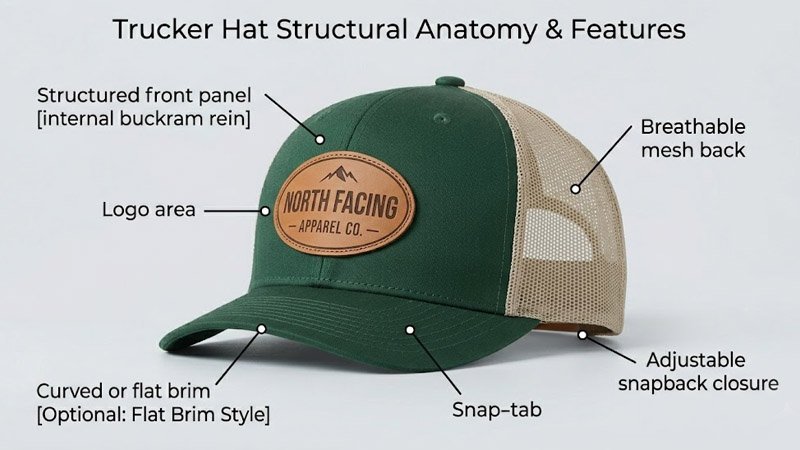
The classic trucker hat usually includes:
- A structured front panel
- A breathable mesh back
- An adjustable snapback closure
- A flat or curved brim
- A large front area for custom branding
For events and brand promotions, this design is very practical. The mesh back keeps the hat breathable, while the front panel gives the logo enough space to stand out.
Compared with many other promotional products, custom trucker hats are also more wearable. People can use them after the event, which means your logo continues to get exposure in daily life.
Before styling a custom trucker hat, it is important to choose the right base design. The material, brim shape, color, and logo method all affect the final look.
1. Choose the Right Front Panel
The front panel is the most important area for branding.
Common front panel options include:
- Foam front panel for a classic vintage trucker look
- Cotton front panel for a soft and natural appearance
- Polyester front panel for durability and stable colors
- Canvas front panel for a heavier outdoor or workwear style
For embroidered logos or patches, a structured front panel is usually recommended because it helps the logo stay clean and visible.
2. Choose the Right Mesh Back
The mesh back is one of the key features of a trucker hat. It provides ventilation and keeps the hat lightweight.
A breathable mesh back is especially suitable for:
- Outdoor events
- Summer campaigns
- Sports teams
- Camping brands
- Fishing brands
- Workwear teams
- Music festivals
- Promotional giveaways
For brand projects, the mesh color can match or contrast with the front panel to create a more customized look.
3. Choose a Flat Brim or Curved Brim
The brim shape affects the overall style of the hat.
A flat brim trucker hat gives a modern, bold, and streetwear-inspired look. It is suitable for fashion brands, youth brands, sports promotions, and retail merchandise.
A curved brim trucker hat gives a more classic, relaxed, and everyday look. It is suitable for corporate events, outdoor brands, team uniforms, and casual promotional use.
For most brand events, curved brim trucker hats are easier to wear for a wide audience. For streetwear or fashion-focused projects, flat brim styles may look more eye-catching.
4. Choose the Right Closure
Most trucker hats use an adjustable snapback closure. This is a practical option for bulk orders because it fits different head sizes.
Other closure options may include:
- Velcro closure
- Metal buckle closure
- Plastic snapback closure
- Elastic fit
For event giveaways and promotional campaigns, snapback closures are usually the most convenient choice.
The logo method is one of the most important decisions when designing custom trucker hats. Different logo techniques create different styles and price levels.
Flat Embroidery
Flat embroidery is clean, professional, and widely used for custom trucker hats. It works well for company logos, event names, simple icons, and short text.
Best for:
- Corporate events
- Trade shows
- Team hats
- Promotional gifts
- Uniform hats
Flat embroidery is a good choice when you want a professional and durable logo effect.
3D Puff Embroidery
3D puff embroidery creates a raised logo effect. It looks bold and premium, especially on structured front panels.
Best for:
- Streetwear brands
- Sports teams
- Fashion merchandise
- Bold letter logos
This method works best for simple logos with thick lines. Very small details may not be suitable for 3D embroidery.
Woven Patch
A woven patch is a good option for detailed logos. It can show small text, fine lines, and more complex artwork better than direct embroidery.
Best for:
- Outdoor brands
- Retail merchandise
- Lifestyle brands
- Detailed logo designs
Woven patches also give the hat a finished, retail-ready appearance.
Leather Patch
Leather patches create a vintage, premium, and outdoor-inspired look. They are often used for workwear, camping, fishing, and lifestyle brands.
Best for:
- Outdoor brands
- Workwear brands
- Premium merchandise
- Minimal logo designs
Brown, black, and tan leather patches are common choices for custom trucker hats.
Heat Transfer Printing
Heat transfer printing is suitable for colorful artwork, gradients, and full-color designs.
Best for:
- Event graphics
- Colorful brand artwork
- Promotional campaigns
- Photo-style designs
For long-term use, buyers should confirm the durability requirements before choosing heat transfer printing.
How to Style Custom Trucker Hats for Different Brand Scenarios
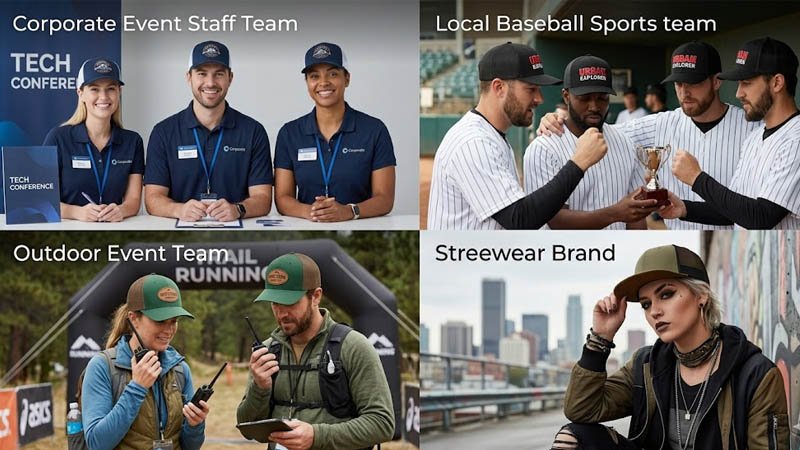
Custom trucker hats can be styled differently depending on your brand identity and event type.
Corporate Events
For corporate events, the style should be clean, simple, and professional.
Recommended design:
- Neutral colors such as black, navy, grey, or white
- Curved brim
- Flat embroidery logo
- Simple front panel design
- Adjustable snapback closure
Recommended outfit match:
- Polo shirts
- Company T-shirts
- Chinos
- Casual jackets
- Staff uniforms
A clean embroidered trucker hat can help event staff look unified while keeping the brand visible.
Trade Shows and Exhibitions
At trade shows, custom trucker hats can work as both staff uniforms and promotional giveaways.
Recommended design:
- High-contrast logo
- Lightweight mesh back
- Comfortable fit
- Clear brand name or slogan
- Simple color combination
Recommended outfit match:
- Branded T-shirts
- Lanyards
- Casual business wear
- Exhibition uniforms
For trade shows, the logo should be easy to read from a distance. Avoid overly complex designs that may lose clarity.
Outdoor Events
For outdoor events, comfort and breathability are very important.
Recommended design:
- Breathable mesh back
- Durable front panel
- Curved brim for sun protection
- Earth-tone or high-visibility colors
- Embroidery or patch logo
Recommended outfit match:
- Outdoor shirts
- Cargo pants
- Shorts
- Sunglasses
- Work jackets
This style is suitable for camping events, fishing competitions, hiking clubs, outdoor brand promotions, and summer festivals.
Sports Teams
For sports teams, trucker hats should feel energetic, comfortable, and easy to wear.
Recommended design:
- Team colors
- Embroidered team logo
- Adjustable closure
- Breathable mesh back
- Curved or flat brim depending on team style
Recommended outfit match:
- Team jerseys
- Sports T-shirts
- Joggers
- Shorts
- Sneakers
For sports teams, bold embroidery and clear color contrast can make the design more recognizable.
Streetwear Brands
For streetwear brands, trucker hats can be bold, creative, and expressive.
Recommended design:
- Flat brim
- 3D puff embroidery
- Woven patch
- Contrast mesh back
- Strong logo placement
Recommended outfit match:
- Oversized T-shirts
- Hoodies
- Denim jackets
- Cargo pants
- Sneakers
Streetwear trucker hats should feel more visual and attitude-driven. A bold front logo or raised embroidery can help create a stronger brand identity.
Music Festivals and Promotional Events
For music festivals, concerts, and promotional campaigns, trucker hats can be fun, colorful, and memorable.
Recommended design:
- Bright colors
- Printed graphics
- Event slogan
- Mesh back for comfort
- Lightweight structure
Recommended outfit match:
- Event T-shirts
- Casual shorts
- Denim
- Sneakers
- Sunglasses
For these events, the design can be more creative, but the logo should still remain clear and readable.
Color plays an important role in both styling and branding. A good color combination can make the hat easier to wear and help the logo stand out.
| Hat Color |
Best For |
Recommended Logo Style |
| Black |
Corporate events, streetwear, daily wear |
White or bright embroidery |
| Navy |
Business casual, team uniforms, events |
White, silver, or light blue embroidery |
| White |
Summer events, clean brand looks |
Dark embroidery or colorful patch |
| Grey |
Minimal branding, everyday use |
Black or navy embroidery |
| Beige / Khaki |
Outdoor brands, camping, travel |
Brown leather patch or dark embroidery |
| Olive Green |
Workwear, outdoor campaigns |
Tan patch or cream embroidery |
| Red / Bright Colors |
Sports teams, festivals, promotions |
High-contrast logo |
| Camo |
Outdoor brands, streetwear |
Leather patch or simple embroidery |
For brand projects, always check logo visibility before bulk production. A low-contrast logo may look stylish on screen but unclear on the final product.
Which Custom Trucker Hat Style Is Right for Your Brand?
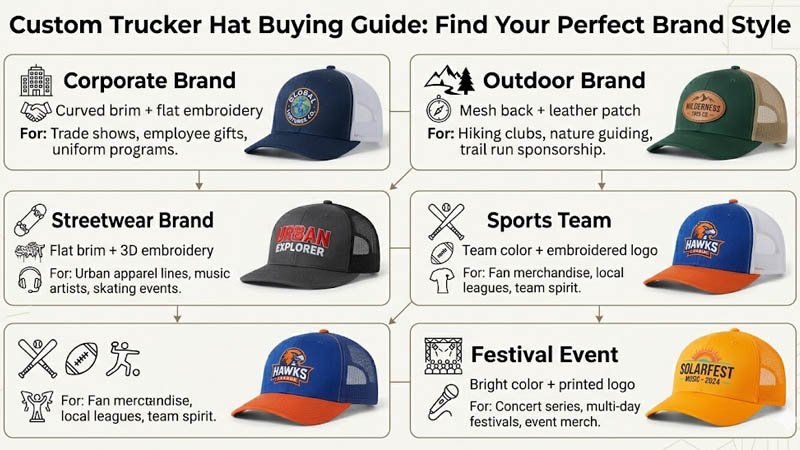
Different brands need different hat styles. The best choice depends on your market, design style, and usage scenario.
| Brand Type |
Recommended Hat Style |
Best Logo Method |
| Corporate Brand |
Curved brim trucker hat |
Flat embroidery |
| Outdoor Brand |
Mesh back trucker hat |
Leather patch or woven patch |
| Streetwear Brand |
Flat brim structured trucker hat |
3D puff embroidery or woven patch |
| Sports Team |
Breathable team trucker hat |
Embroidery or heat transfer |
| Trade Show |
Lightweight promotional trucker hat |
Flat embroidery or printed logo |
| Retail Brand |
Premium cotton trucker hat |
Woven patch or embroidery |
| Workwear Brand |
Canvas or cotton trucker hat |
Leather patch or embroidery |
| Festival Event |
Colorful trucker hat |
Heat transfer print or patch |
This type of planning helps buyers choose a hat that fits both the brand image and the actual usage environment.
Common Styling Mistakes to Avoid
Even a good trucker hat can look wrong if it is styled poorly. Here are some common mistakes to avoid.
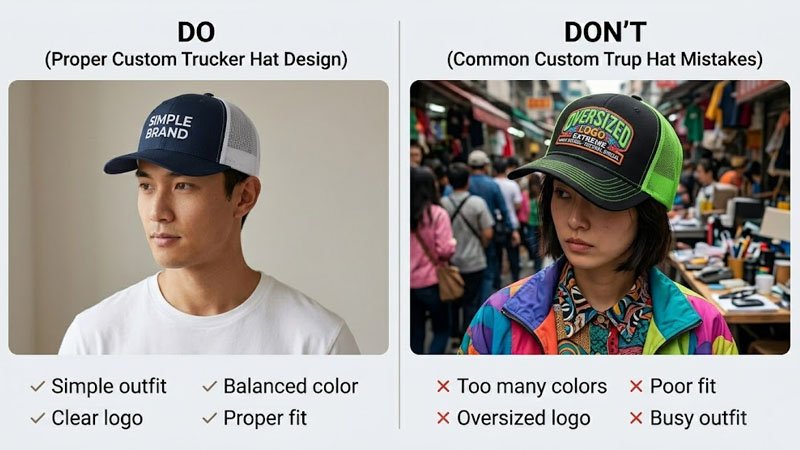
1. Using Too Many Colors
If the hat already has a bright color or bold logo, keep the outfit simple. Too many colors can make the whole look messy.
2. Choosing the Wrong Fit
The hat should sit naturally on the head. It should not be too tight, too loose, too low, or too high.
3. Mixing the Wrong Style
A trucker hat is casual by nature. It works best with casual, sporty, outdoor, streetwear, and relaxed smart casual outfits. It is usually not suitable for formal business suits or very formal occasions.
4. Ignoring Logo Balance
For custom hats, the logo should not be too large or too small. It should fit the front panel naturally and leave enough space around the design.
5. Overloading the Front Panel
Too many words, icons, slogans, and graphics can make the hat look crowded. A clean design is often more professional and easier to remember.
Common Customization Mistakes to Avoid
For bulk buyers, design mistakes can affect the final result and increase production risk.
1. Choosing a Logo That Is Too Detailed
Small text and fine lines may not work well with embroidery. If the logo has many details, a woven patch or printed patch may be a better choice.
2. Ignoring Material Compatibility
Different materials create different logo effects. Foam, cotton, polyester, and canvas panels may all react differently to embroidery, patches, or printing.
3. Not Checking Color Contrast
A logo needs enough contrast against the hat color. Before production, buyers should confirm whether the logo is visible and clear.
4. Skipping Sample Approval
Sampling is important for custom trucker hats. It helps confirm the logo effect, stitching quality, material, color, size, and overall shape before mass production.
5. Choosing Style Only by Price
Low-cost hats may not always deliver the best brand impression. For brand events and retail merchandise, quality, comfort, and logo clarity are very important.
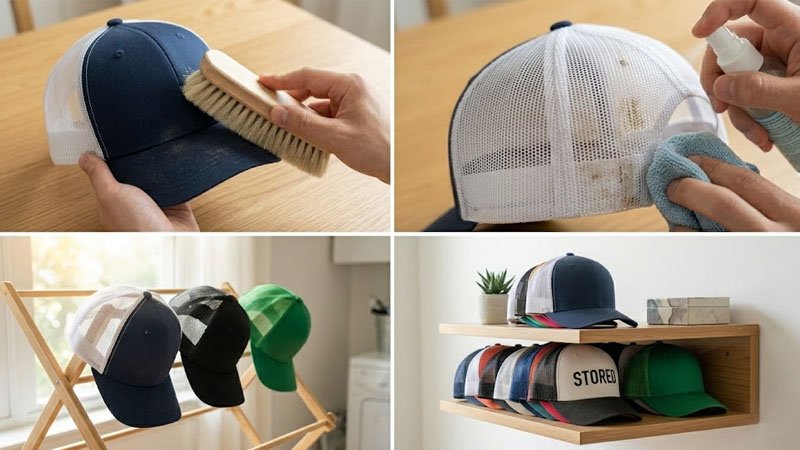
Proper care helps trucker hats keep their shape and appearance for longer.
Cleaning Tips
Spot cleaning is usually the safest method. Use a soft cloth or soft brush with mild detergent to gently clean dirt or stains.
Avoid machine washing if possible, because it may damage the structure, bend the brim, or deform the mesh back.
After cleaning, let the hat air dry naturally. Do not use high heat, as it may affect the material or logo.
Storage Tips
Store trucker hats in a cool and dry place. Avoid crushing them in bags or drawers.
For better shape protection, place the hats on a shelf, hat rack, or store them upside down. Keep the brim flat and avoid bending it too much.
For bulk orders, proper packaging is also important. Individual polybags, inner boxes, and export cartons can help protect hats during transportation.
What Buyers Should Prepare Before Ordering Custom Trucker Hats
To make the custom process smoother, buyers should prepare the following information before requesting a quote:
- Logo file
- Preferred hat style
- Quantity
- Pantone colors
- Logo size
- Logo method
- Brim style
- Material preference
- Packaging requirement
- Target delivery date
- Usage scenario
For custom buyers, working with an experienced manufacturer can help reduce sampling errors, improve logo accuracy, and ensure stable quality in bulk production.
GUANGZHOU EASTLUCKY Hat & Garment Co., Ltd. is a high-end custom hat and OEM/ODM manufacturer based in Guangzhou, China, with 15 years of expertise in professional R&D, production, and distribution of various hats and embroidered accessories. Guided by the philosophy “Quality as Root, Innovation as Soul,” the company provides global clients with one-stop solutions from design sampling to mass production, helping brands create efficient and high-quality custom hat programs.
Are trucker hats good for brand promotion?
Yes. Trucker hats are practical, wearable, and highly visible. The front panel provides a strong area for logos, while the mesh back makes the hat comfortable for daily and outdoor use.
What is the best logo method for custom trucker hats?
Flat embroidery is best for clean and professional logos. 3D embroidery is good for bold designs. Woven patches are suitable for detailed logos. Leather patches are ideal for outdoor and premium styles.
Are trucker hats suitable for outdoor events?
Yes. The breathable mesh back makes trucker hats very suitable for outdoor events, festivals, sports activities, camping, fishing, and summer promotions.
Should I choose a flat brim or curved brim?
Choose a flat brim for streetwear, fashion, and bold brand styles. Choose a curved brim for corporate events, outdoor use, sports teams, and wider audience appeal.
Can I order trucker hats with different colors?
Yes. Custom trucker hats can usually be made with different front panel colors, mesh colors, brim colors, and logo colors. Buyers can match the hat design with their brand color system.
What should I check before bulk production?
You should check the sample carefully, including material, logo position, embroidery quality, color matching, stitching, brim shape, closure, size, and packaging.
Are custom trucker hats suitable for retail merchandise?
Yes. With the right material, logo method, and packaging, custom trucker hats can be used as retail merchandise for fashion brands, outdoor brands, sports brands, and lifestyle brands.
Final Thoughts
Custom trucker hats are a smart choice for brands and events because they combine comfort, style, and strong logo visibility. They can be used for corporate events, trade shows, sports teams, outdoor campaigns, music festivals, staff uniforms, and retail merchandise.
To create a successful custom trucker hat, buyers should consider the hat structure, material, brim shape, color matching, logo method, and final usage scenario. A simple and well-balanced design often creates a stronger brand impression than an overloaded one.
Whether you need embroidered trucker hats, patch trucker hats, promotional trucker hats, or OEM custom hat solutions, the right design can turn a simple hat into a wearable part of your brand identity.
For your next custom trucker hat project, prepare your logo, quantity, preferred style, and event details. A professional manufacturer can help you choose the right material, logo technique, and production solution for your brand.
Can Men Wear Women’s Baseball Caps? Fit & Unisex Cap Guide
Fashion is becoming more flexible than ever. Today, many people choose caps, clothing, and accessories based on fit, comfort, design, and personal style rather than whether a product is labeled “men’s” or “women’s.”
So, can men wear women’s baseball caps?
The answer is yes. Men can wear women’s baseball caps if the cap fits comfortably, suits their face shape, and matches their personal style. In many cases, the difference between men’s and women’s baseball caps is smaller than people think. The most important details are head size, crown depth, brim shape, back closure, fabric, and overall design.
For brands, retailers, and promotional product buyers, this question also leads to a bigger topic: unisex baseball caps. A well-designed unisex cap can work for both men and women, making it a practical choice for fashion collections, corporate gifts, event merchandise, and custom brand orders.
Can Men Really Wear Women’s Baseball Caps?
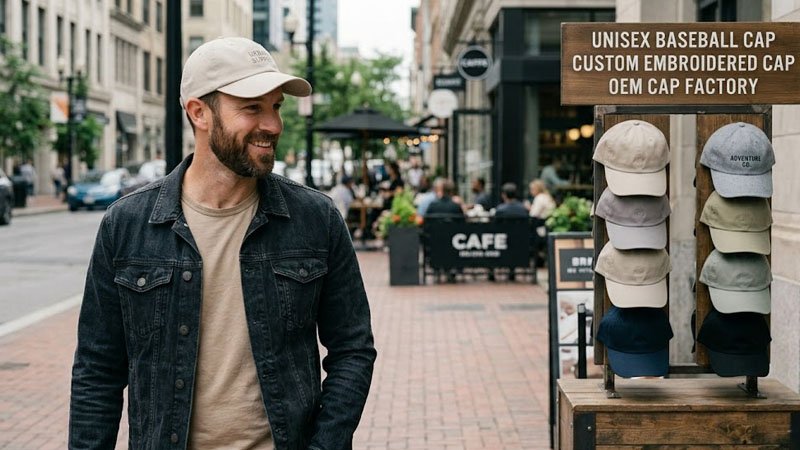
Yes, men can absolutely wear women’s baseball caps. The label on the cap is not as important as the way it fits and looks.
Many women’s baseball caps are built with the same basic structure as men’s caps. They usually include a crown, brim, sweatband, panels, eyelets, and an adjustable back closure. The difference often comes from sizing, color, decoration, and style positioning.
A women’s cap may be slightly smaller, softer, or lower in profile. A men’s cap may have a larger fit, higher crown, or more structured shape. However, many modern caps are designed with neutral colors, adjustable closures, and simple logo placement, which makes them suitable for both men and women.
If a man likes the style of a women’s baseball cap and the size is comfortable, there is no reason he cannot wear it.
Men’s vs. Women’s Baseball Caps: What Is the Difference?
Although the overall construction is similar, there are still a few differences between men’s and women’s baseball caps.
| Feature |
Women’s Baseball Cap |
Men’s Baseball Cap |
What It Means |
| Head Size |
Usually slightly smaller |
Usually slightly larger |
Men should check the size range before buying |
| Crown Height |
Often lower profile |
Usually medium or higher crown |
Crown depth affects comfort and face shape |
| Brim Shape |
May be narrower or more curved |
Usually standard or wider |
The difference is often subtle |
| Fit Type |
Commonly adjustable |
Adjustable or fitted |
Adjustable caps are easier for unisex wear |
| Design Style |
Softer colors, smaller logos, decorative details |
Neutral, sporty, bold, or structured designs |
Choose based on your style, not the gender label |
| Material |
Often soft cotton, washed fabric, or lightweight fabric |
Cotton, twill, canvas, polyester, or structured fabric |
Fabric affects comfort and shape |
In most daily situations, people will not notice whether a cap comes from the men’s or women’s section. They will notice whether it fits well, matches the outfit, and looks balanced.
How to Know If a Women’s Baseball Cap Will Fit a Man
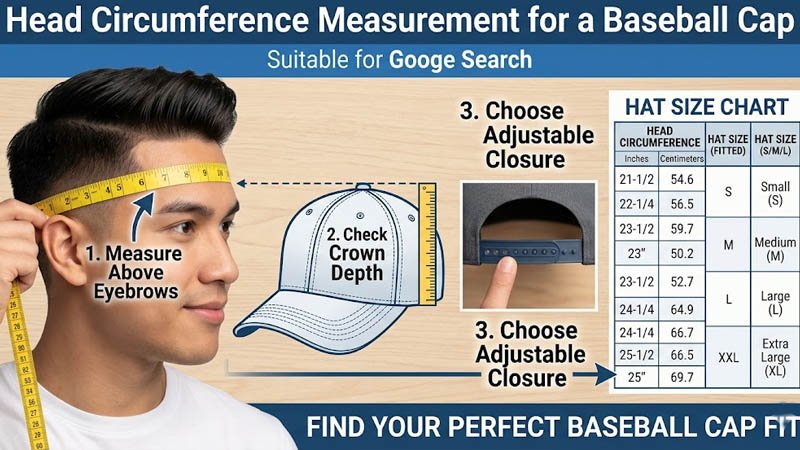
Fit is the most important factor when choosing any baseball cap. Even the best-looking cap will not work well if it feels too tight, too shallow, or uncomfortable.
1. Measure Your Head Size
Before buying a women’s baseball cap, measure your head circumference. Use a soft measuring tape and wrap it around the widest part of your head. The tape should sit above your eyebrows and around the back of your head.
Here is a simple size reference:
| Head Size |
Measurement in CM |
Measurement in Inches |
Fit Suggestion |
| Small |
54–56 cm |
21.25–22 in |
Low-profile or adjustable caps may fit well |
| Medium |
57–58 cm |
22.4–22.8 in |
Most adjustable caps should work |
| Large |
59–61 cm |
23.2–24 in |
Choose larger adjustable or structured caps |
| Extra Large |
62 cm+ |
24.4 in+ |
Avoid very shallow or small women’s caps |
If the cap is adjustable and fits within your head size range, it can be suitable for men.
2. Check the Back Closure
For men wearing women’s baseball caps, adjustable closures are usually the safest choice. They allow more flexibility and can fit a wider range of head sizes.
Common adjustable closures include:
- Metal buckle closure
- Fabric strap closure
- Snapback closure
- Velcro closure
- Plastic buckle closure
If you are buying caps for a group, event, or brand order, adjustable caps are usually better than fitted caps because they reduce sizing problems.
3. Look at the Crown Depth
The crown is the part of the cap that covers your head. Some women’s caps have a lower crown, which creates a softer and closer fit.
A low-profile cap can look stylish and casual, but it may not be suitable for men with larger heads or those who prefer a more structured shape.
A medium crown is often more versatile. It works well for both men and women and is commonly used in unisex baseball cap designs.
4. Consider the Brim Shape
Women’s caps may sometimes have a slightly narrower or more curved brim. However, in most cases, the difference is not very obvious.
A curved brim gives a classic casual look, while a flat brim creates a stronger streetwear style. If you want a more masculine or neutral look, choose a standard curved brim or a clean flat brim design.
Best Women’s Baseball Cap Styles That Men Can Wear
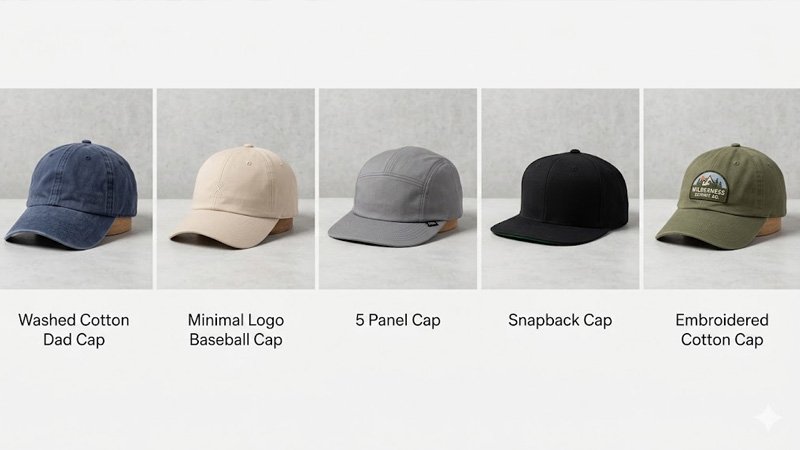
Not every women’s baseball cap will suit every man, but many styles are easy to wear. The following styles are especially suitable for men who want a comfortable, natural, or unisex look.
1. Washed Cotton Dad Cap
A washed cotton dad cap is one of the easiest styles for both men and women. It usually has a soft crown, curved brim, and adjustable back strap.
This style is casual, relaxed, and easy to match with daily outfits. It works well with T-shirts, hoodies, denim jackets, oversized shirts, joggers, and sneakers.
For brands, washed cotton dad caps are also popular for lifestyle merchandise, outdoor events, fashion collections, and promotional gifts.
2. Minimal Logo Baseball Cap
A women’s baseball cap with a small logo or simple embroidery can look clean and modern on men. Minimal designs are less gender-specific and easier to style.
Good color choices include:
- Black
- Navy
- Beige
- Grey
- Olive
- White
- Washed blue
- Khaki
Minimal logo caps are also suitable for brands that want a premium, understated look.
3. 5 Panel Cap / Camp Cap
A 5 panel cap or camp cap has a more modern and street-style appearance. Although some designs may be marketed to women, the structure itself is often unisex.
This cap style is suitable for outdoor brands, fashion labels, skate brands, music events, and lifestyle collections.
For customization, 5 panel caps work well with woven labels, small embroidery, printed logos, or rubber patches.
4. Snapback Cap
A snapback cap usually has a more structured crown and an adjustable plastic snap closure. If a women’s snapback has enough depth and size range, it can fit men very well.
Snapbacks are suitable for streetwear, sports teams, youth brands, and promotional campaigns. They are also a good choice for bold embroidery, 3D embroidery, or patch logo designs.
5. Embroidered Cotton Cap
A clean embroidered cotton cap can work for both men and women. Embroidery gives the cap a premium, durable, and professional look.
For men, simple front embroidery, side embroidery, or small back embroidery is often easier to wear than overly decorative designs. For brands, embroidered caps are a strong option because they help improve logo visibility and product value.
How Men Can Style a Women’s Baseball Cap
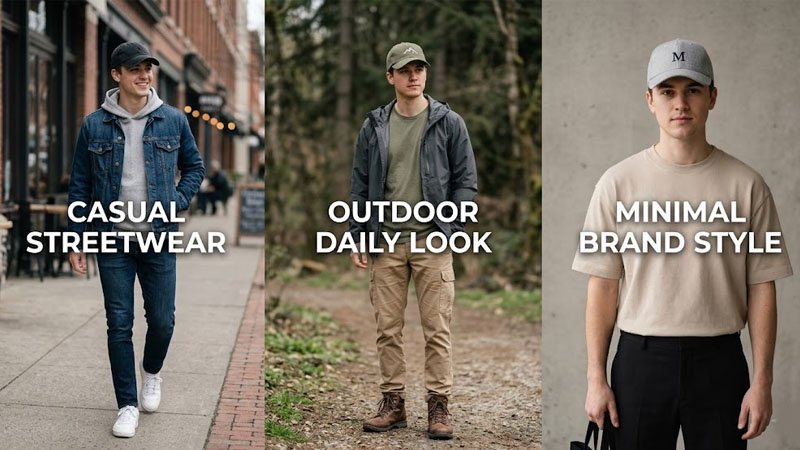
Wearing a women’s baseball cap is not difficult. The key is to choose the right color, shape, and outfit combination.
Choose Neutral or Low-Saturation Colors
If you want a natural and versatile look, start with neutral colors. Black, navy, beige, grey, olive, and khaki are easy to match and suitable for most wardrobes.
Soft colors such as cream, washed blue, or light brown can also work well if the overall design is simple.
Match It with Casual Outfits
Women’s baseball caps can look natural on men when paired with casual basics such as:
- Plain T-shirts
- Hoodies
- Denim jackets
- Bomber jackets
- Oversized shirts
- Cargo pants
- Joggers
- Sneakers
The simpler the outfit, the easier it is for the cap to blend in.
Avoid Overly Decorative Details If You Want a Neutral Look
Some women’s caps may include rhinestones, glitter, floral embroidery, bows, or very soft pastel designs. These styles can still be worn if they match your personality, but they may create a more feminine effect.
For a cleaner unisex style, choose plain fabric, simple embroidery, washed cotton, small logos, or neutral color combinations.
Choose the Right Crown for Your Face Shape
A low-profile cap can look good on smaller or longer faces. A medium crown usually works better for wider faces or larger head sizes. A structured cap creates a stronger shape, while a soft dad cap gives a relaxed and casual feeling.
The best cap should feel balanced with your face and outfit.
When a Women’s Baseball Cap May Not Be the Best Choice
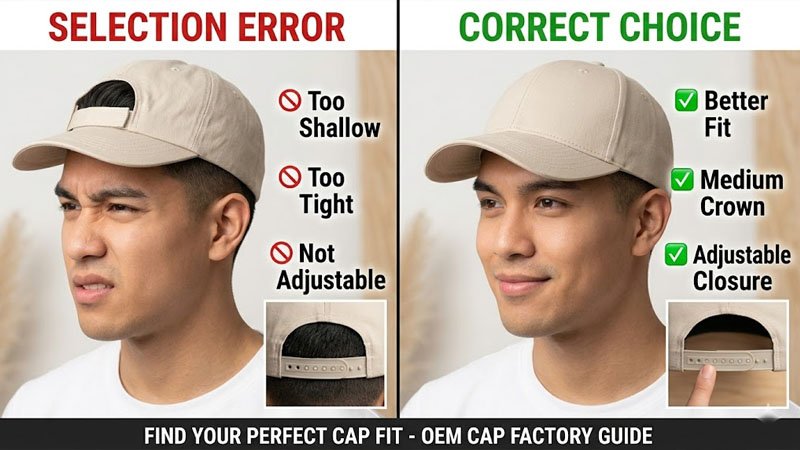
Although men can wear women’s baseball caps, not every style will be suitable. You may want to avoid a women’s cap if:
- The head circumference is too small
- The crown is too shallow
- The brim looks too narrow for your face
- The design is too decorative for your style
- The cap is not adjustable
- The fabric feels too thin or too soft
- The cap does not sit comfortably on your head
If comfort is your priority, always check the size chart, crown depth, and closure type before buying.
For Brands: Why Unisex Baseball Caps Are a Smart Choice
For brands, retailers, event organizers, and promotional product buyers, unisex baseball caps are often more practical than separating men’s and women’s styles.
A well-designed unisex cap can help brands:
- Reduce inventory pressure
- Simplify size selection
- Reach a wider audience
- Improve product flexibility
- Make bulk ordering easier
- Support both retail and promotional use
- Create a cleaner brand image
The best unisex baseball caps usually have a comfortable fit, adjustable closure, medium crown height, classic brim shape, durable stitching, and neutral color options.
GUANGZHOU EASTLUCKY Hat & Garment Co., Ltd. is a high-end custom hat and OEM/ODM manufacturer based in Guangzhou, China, with 15 years of expertise in professional R&D, production, and distribution of various hats and embroidered accessories. Guided by the philosophy “Quality as Root, Innovation as Soul,” the company provides global clients with one-stop solutions from design sampling to mass production, enabling efficient and high-quality supply chain services for brands.
For custom cap projects, details such as fabric, crown shape, brim style, embroidery size, thread color, back closure, label design, and packaging should all be confirmed before mass production.
Customization Tips for Unisex Baseball Caps
If your brand wants to develop baseball caps for both men and women, the following details are important.
1. Use an Adjustable Back Closure
An adjustable closure makes the cap suitable for more head sizes. Metal buckle, fabric strap, snapback, and Velcro closures are all common choices.
For brand merchandise or event giveaways, adjustable caps are usually better than fitted caps because they reduce the risk of size mismatch.
2. Choose a Medium Crown Height
A medium crown is usually the safest option for unisex baseball caps. It is not too shallow and not too tall, making it suitable for different head shapes.
If the cap is too shallow, it may not fit larger heads well. If it is too high, it may look too structured for customers who prefer a casual style.
3. Select Comfortable and Durable Fabric
Common fabric choices include:
- Cotton
- Cotton twill
- Washed cotton
- Polyester
- Canvas
- Blended fabric
Cotton is soft and breathable. Cotton twill gives better structure. Washed cotton creates a relaxed vintage look. Polyester is lightweight and suitable for sports or outdoor use.
The fabric should match the brand’s positioning and usage scenario.
4. Keep the Logo Clean and Clear
For unisex baseball caps, simple logo placement usually works best. Common logo options include:
- Front embroidery
- Side embroidery
- Back embroidery
- Woven patch
- Leather patch
- Rubber patch
- Printed logo
Embroidery is one of the most popular choices because it looks durable, textured, and professional. However, the logo should not be too small or too complicated, otherwise the embroidery details may not be clear.
5. Use Neutral and Market-Friendly Colors
For bulk orders, neutral colors are often safer and easier to sell. Popular choices include black, navy, white, beige, grey, olive, and khaki.
Brands can also develop seasonal colors, but the main collection should include easy-to-match colors that appeal to both men and women.
6. Confirm Samples Before Mass Production
Sample confirmation is very important for custom baseball caps. Before bulk production, brands should check:
- Cap shape
- Fabric quality
- Crown depth
- Brim curve
- Logo size
- Embroidery quality
- Thread color
- Back closure
- Label details
- Packaging method
This step helps avoid production mistakes and ensures the final caps match the brand’s expectations.
Common Mistakes When Choosing Unisex Baseball Caps
When developing or buying unisex baseball caps, some mistakes can affect comfort, appearance, and customer satisfaction.
Mistake 1: Only Choosing by Color
Color is important, but fit and structure matter more. A beautiful cap will not sell well if it feels uncomfortable.
Mistake 2: Using a Crown That Is Too Shallow
A very shallow crown may work for some women’s styles, but it may not fit many men. For unisex designs, a medium crown is usually more practical.
Mistake 3: Choosing Non-Adjustable Caps for Bulk Orders
For large orders, fitted caps can create sizing problems. Adjustable caps are more flexible and easier to distribute.
Mistake 4: Making the Logo Too Complicated
Small details may not show clearly in embroidery. A clean and simple logo usually creates a better result.
Mistake 5: Ignoring the Sample Stage
Skipping sample confirmation can lead to problems in fit, logo placement, embroidery quality, or fabric texture. A good sample helps reduce risk before mass production.
Conclusion: Fit Matters More Than Gender Labels
So, can men wear women’s baseball caps?
Yes. Men can wear women’s baseball caps as long as the cap fits well, feels comfortable, and matches their style. The label is not the most important factor. Head size, crown depth, brim shape, fabric, and back closure matter much more.
For individual wearers, the best choice is a cap that feels natural and looks balanced. For brands, unisex baseball caps are a smart option because they can serve a wider customer group and simplify bulk ordering.
In modern fashion, a good baseball cap is not defined by gender. It is defined by fit, comfort, quality, and confidence.
FAQs
Can men wear women’s baseball caps?
Yes. Men can wear women’s baseball caps if the cap fits comfortably and matches their style. Many women’s baseball caps are adjustable and can also fit men.
Are women’s baseball caps smaller than men’s?
Women’s baseball caps are often slightly smaller or lower in crown height, but this depends on the design. Adjustable caps can fit a wider range of head sizes.
What is the main difference between men’s and women’s baseball caps?
The main differences are usually head size, crown depth, color, decoration, and style positioning. The basic cap structure is often very similar.
Do women’s baseball caps look different on men?
Some may look slightly smaller or softer, especially if they have a low crown or decorative design. However, simple women’s caps with neutral colors can look very natural on men.
What type of women’s baseball cap is best for men?
Washed cotton dad caps, minimal logo caps, snapbacks, 5 panel caps, and adjustable embroidered caps are usually the easiest styles for men to wear.
Are unisex baseball caps better for brands?
Yes. Unisex baseball caps are often better for brands because they fit a wider audience, reduce inventory pressure, and make bulk orders easier.
Is embroidery suitable for unisex baseball caps?
Yes. Embroidery is a popular choice for unisex baseball caps because it looks professional, durable, and suitable for fashion, retail, and promotional use.
What should brands check before ordering custom unisex caps?
Brands should check the fabric, crown height, brim shape, logo size, embroidery quality, closure type, label details, and packaging before mass production.
Snapback vs Fitted Hats: What’s the Difference and Which Is Better?
Snapback and fitted hats are two of the most popular cap styles on the market, but many buyers still confuse the difference between them. At a glance, they may look similar. In practice, however, they differ in sizing, fit, styling, inventory management, and customization value.
The main difference is simple: snapbacks are adjustable, while fitted hats come in exact sizes with no rear adjustment. In most general-use, promotional, and custom order scenarios, snapbacks are usually the more practical choice. Fitted hats, on the other hand, are often better for exact-fit wearers, premium retail collections, and customers who prefer a cleaner, more tailored look.
Whether you are buying for personal wear, comparing cap styles for your brand, or planning a custom hat project, understanding the real differences between snapback and fitted hats will help you make a better decision.
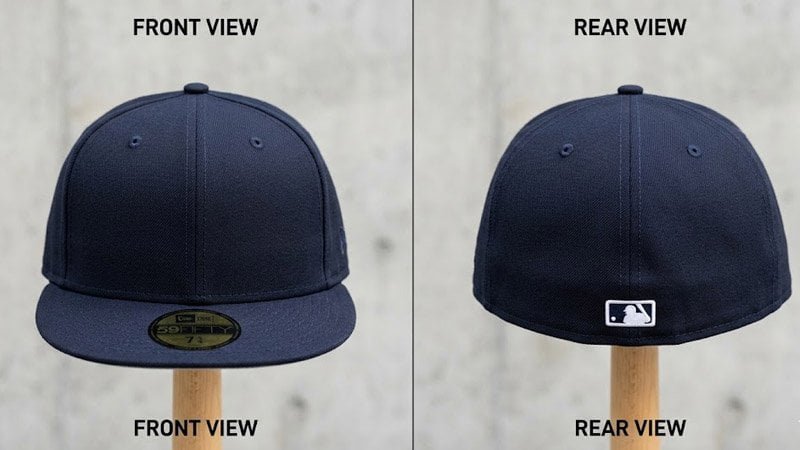
A snapback is a cap with an adjustable plastic snap closure at the back. This allows the wearer to change the fit easily, which is why snapbacks are commonly considered a one-size-fits-most option.
Snapback hats are usually known for:
-
Adjustable back closure
-
Structured crown
-
Flat brim or pre-curved brim options
-
Broad size flexibility
-
Strong use in streetwear, sports, promotions, and casual retail
Because of their adjustable design, snapbacks are easy to wear, easy to stock, and easy to distribute across mixed groups. They are especially practical for events, giveaways, team orders, and custom branding projects where size simplicity matters.
From a style perspective, snapbacks are often linked to streetwear and youth fashion. Many designs feature a structured front panel that works well for bold embroidery, patches, and logo-focused decoration.
A fitted hat is a closed-back cap made in specific head sizes. Unlike a snapback, it has no adjustable closure. Instead, the wearer chooses an exact size, such as 7, 7 1/8, 7 1/4, or similar measurements.
Fitted hats are usually known for:
Because fitted hats are made by size, they can offer a more precise and personalized fit. Many wearers prefer them for their smooth silhouette and secure feel on the head. They often look cleaner from the back because there is no visible closure.
At the same time, fitted hats are less forgiving than snapbacks. Buyers must know their correct size in advance, which makes them more specialized and slightly more complex in both retail and wholesale settings.
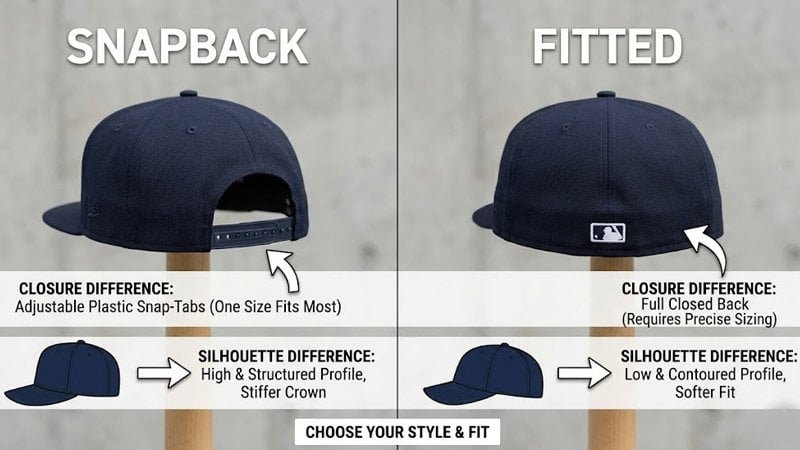
| Feature |
Snapback |
Fitted Hat |
| Back Closure |
Adjustable snap closure |
No closure, closed back |
| Sizing |
One size fits most |
Exact head size |
| Fit Flexibility |
High |
Low |
| Ease of Sharing or Gifting |
High |
Low |
| Inventory Complexity |
Simple |
More complex |
| Online Selling Risk |
Lower sizing risk |
Higher sizing risk |
| Style Positioning |
Casual, versatile, streetwear-friendly |
Cleaner, more exact-fit, more tailored |
| Best For |
Promotions, teams, casual wear, broad retail |
Premium retail, collectors, exact-fit users |
Fit and Comfort
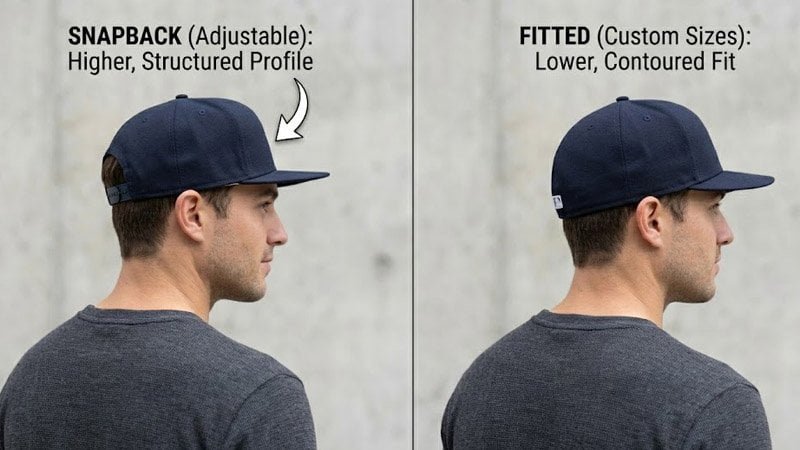
Fit is the biggest difference between snapback and fitted hats, and for many buyers, it is also the deciding factor.
Snapback Fit and Comfort
Snapbacks are more flexible because they can be adjusted. This makes them a strong choice for people who:
-
Do not know their exact head size
-
Prefer a looser or more relaxed fit
-
Change hairstyles often
-
Need hats for groups or mixed-size users
-
Want a safer option when ordering online
The adjustable closure gives the wearer more control, which is one reason snapbacks are widely used in promotional and everyday settings. For many buyers, comfort comes from convenience and flexibility, and snapbacks perform well on both.
That said, some wearers do not like the feel or look of a plastic snap closure. In more premium styling, the visible back closure may feel less clean than a fitted cap.
Fitted Hat Fit and Comfort
Fitted hats are designed for people who want an exact-size fit. When the size is correct, they often feel more secure, more balanced, and more refined on the head.
They are often preferred by people who:
-
Know their exact hat size
-
Want a cleaner back view
-
Prefer a close and stable fit
-
Care more about silhouette and exact wear experience
However, fitted hats leave very little room for sizing error. A cap that is too tight may become uncomfortable over time, while a cap that is too loose may not sit properly. Compared with snapbacks, fitted hats require more careful buying from the start.
Style and Aesthetic
Both snapbacks and fitted hats can be stylish, but they create different visual impressions.
Snapback Style
Snapbacks are usually associated with:
Many snapbacks have a higher-profile, structured front that makes embroidery stand out clearly. This is one reason they are often used for logo-heavy branding and promotional cap programs.
Their overall look is versatile and accessible. They tend to feel more relaxed and more adaptable across different users and styling preferences.
Fitted Hat Style
Fitted hats usually create a cleaner, more streamlined appearance. Since there is no rear closure, the back view looks more seamless. On the head, they often appear more tailored and more precise.
They are commonly associated with:
-
Authentic sports cap styling
-
Premium retail collections
-
Collector culture
-
Exact-fit wearers
-
Clean, silhouette-driven fashion
If your priority is a refined cap shape and a more customized wearing experience, fitted hats usually feel more elevated. If your priority is flexibility and broad styling appeal, snapbacks are often the better choice.
Durability and Longevity
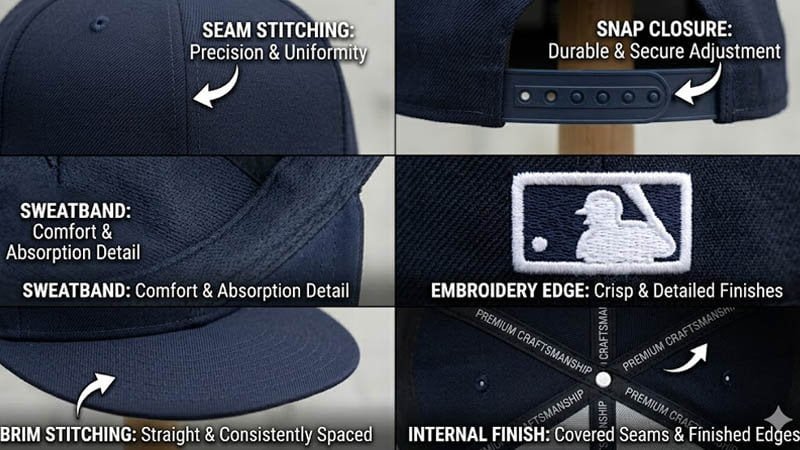
Both snapback and fitted hats can be durable if they are made with quality materials and proper construction, but the way they wear over time is slightly different.
Snapback Durability
Snapbacks are durable enough for most standard retail, event, and branding uses. The main point of wear is usually the snap closure. If the cap is adjusted very frequently or handled roughly, the plastic snap may weaken or eventually break.
Still, for most everyday and commercial use cases, snapbacks offer strong practicality and dependable wear.
Fitted Hat Durability
Fitted hats do not have adjustable hardware, which means there is one less moving part to wear out. This can help them maintain a more stable structure over time. A well-made fitted cap often keeps a clean shape when worn in the correct size.
However, because fitted hats rely on exact sizing, the wrong fit can affect how the cap sits and wears. The hat may not perform as well over time if it is regularly worn too tight or too loose.
Price and Cost Considerations
In many cases, snapbacks are more cost-efficient than fitted hats, especially for custom and bulk programs.
Why Snapbacks Are Often More Practical on Cost
Snapbacks are easier to manage because:
This makes them especially suitable for schools, events, promotions, employee wear, team programs, and general retail projects where buyers want to reduce complexity.
Why Fitted Hats Can Cost More
Fitted hats can become more expensive because:
-
Multiple size runs are needed
-
Inventory planning is more complex
-
Restocking requires better size forecasting
-
Wrong-size purchases can increase waste or returns
In fashion retail or niche collector markets, that added complexity may still be worth it. But in many commercial projects, snapbacks remain the lower-risk option.
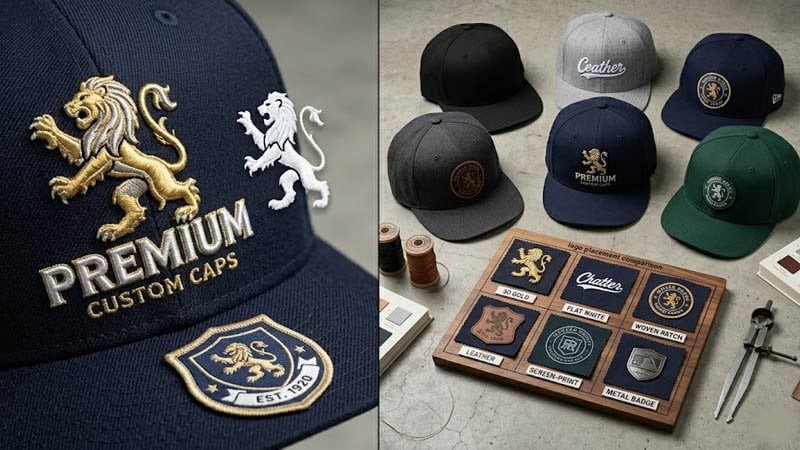
For custom hats, the choice between snapback and fitted becomes even more important.
In many branding and wholesale scenarios, snapbacks are easier to manage because they reduce size allocation problems and simplify distribution. If you are producing hats for an event, staff program, school campaign, sports promotion, or broad retail audience, snapbacks are usually the more efficient option.
Fitted hats can still be an excellent choice for premium collections or fashion-driven releases, but they require a more accurate size strategy. This makes them better suited for brands with clearer retail segmentation and customers who are willing to choose exact sizing.
For brands developing custom headwear collections, working with an experienced OEM/ODM manufacturer can make sampling, sizing decisions, decoration planning, and bulk production much more efficient. With 15 years of experience, GUANGZHOU EASTLUCKY Hat & Garment Co., Ltd. supports global clients with one-stop custom hat solutions from design development to mass production.
From a decoration point of view:
-
Snapbacks often work especially well for bold front embroidery, 3D embroidery, logo patches, and promotional branding.
-
Fitted hats can create a cleaner premium look, but they are usually better when the project has a clear size structure and stronger retail positioning.
Which One Is Better for Different Needs?
There is no single answer for everyone, because the better choice depends on the use case.
Best for Everyday Wear
For everyday convenience, snapbacks are usually better. Their adjustable fit makes them easier to wear across changing situations and more forgiving for casual use.
Best for Streetwear and Casual Fashion
Snapbacks are often more versatile for streetwear, especially when bold branding and structured front panels are part of the design concept.
Best for Premium Retail Collections
Fitted hats are often better for premium retail collections where exact fit, silhouette, and a cleaner appearance matter more than flexible sizing.
Best for Teams, Events, and Giveaways
Snapbacks are usually the better choice for group distribution. One adjustable size reduces inventory pressure and makes it easier to fit a wider range of wearers.
Best for Exact-Fit Wearers
Fitted hats are better for people who know their size and specifically want a more personalized fit.
Best for Online Sales
Snapbacks generally carry less sizing risk online. Fitted hats can still perform well, but they require a reliable size guide and more accurate customer selection.
Weather and Material Considerations
Comfort in different weather conditions depends not only on whether the hat is snapback or fitted, but also on fabric, sweatband construction, ventilation, and crown structure.
Snapbacks
Snapbacks can feel more adaptable in everyday settings, especially when made from cotton twill, polyester blends, or mesh-backed constructions. Their flexible fit can also make them easier for all-day wear.
Fitted Hats
Fitted hats may feel more enclosed because of their close fit and fixed structure. Some wearers prefer that secure feeling in cooler weather, while in hotter climates, fabric choice becomes more important.
In both styles, material matters just as much as construction. Cotton offers softness and breathability, polyester improves durability and easier care, and wool blends can create a more premium hand feel and stronger structure.
Common Mistakes Buyers Make
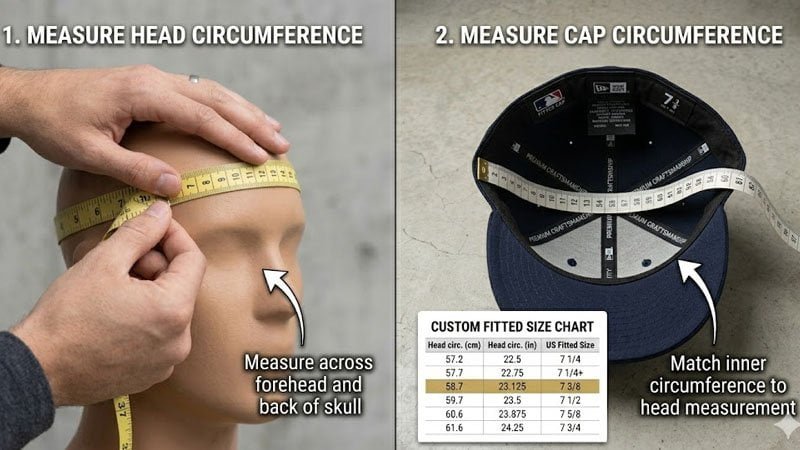
When comparing snapback and fitted hats, buyers often make a few avoidable mistakes.
Choosing Fitted Hats Without a Clear Size Plan
This is especially risky for custom or group orders. Without an accurate size breakdown, fitted hats can create stocking and distribution problems.
Using Fitted Hats for Broad Giveaway Programs
Fitted hats are less practical when the end users have mixed head sizes and no chance to pre-select sizing.
Assuming All Snapbacks Have the Same Shape
Not all snapbacks have the same crown height, brim style, or panel structure. Buyers should still compare profiles and decoration compatibility before choosing.
Ignoring Decoration Method
A cap that looks good in theory may not always work best for the chosen embroidery, patch, or print method. Hat structure should always be considered together with branding requirements.
Final Verdict: Which Is Better?
So, which is better: snapback or fitted hats?
For most general-purpose, promotional, and custom branding needs, snapbacks are usually the better choice. They are more flexible, easier to distribute, simpler to manage, and lower risk in both online sales and bulk orders.
For premium retail collections, collector-focused products, and wearers who care about exact fit, fitted hats are often better. They offer a cleaner silhouette, a more tailored wearing experience, and stronger appeal in exact-size cap markets.
In other words:
Choose a snapback if you want:
-
Adjustable fit
-
Easier sizing
-
Better flexibility for groups or gifting
-
Simpler inventory management
-
Strong performance in promotions and broad retail
Choose a fitted hat if you want:
-
Exact sizing
-
A cleaner and more tailored appearance
-
A more premium or collector-style feel
-
A more precise wearing experience
The best choice depends on your brand, your audience, and your sales or usage scenario. If you are sourcing custom hats, it is always worth comparing not only style, but also size strategy, decoration method, and production efficiency before making a final decision.
Structured vs. Unstructured Hats: What’s the Difference and Which One Should You Choose?
When shopping for a baseball cap, you’ve probably come across the terms structured and unstructured hats. But what do they actually mean—and which one is the better choice for your style, comfort, or brand?
Choosing between a structured and unstructured hat can significantly affect how it looks, feels, and complements your overall appearance. The right cap not only improves comfort but can also enhance brand visibility and personal style.
Whether you’re buying a hat for everyday wear, a sports team, or custom merchandise, understanding the difference helps you make a smarter choice.
Table of Contents
-
Definitions & Core Differences
-
Design & Fit
-
Style, Branding & Decoration
-
Comfort, Durability & Packability
-
Structured vs. Unstructured Hats Comparison
-
When to Choose Each Style
-
Conclusion
-
FAQs
Definitions & Core Differences
The main difference between structured and unstructured hats lies in the support of the front crown panels.
Structured hats feature reinforcement inside the front panels—usually made from buckram or foam. This internal support keeps the crown standing upright and helps the hat maintain a crisp, defined shape even when it’s not being worn. Because of this, structured caps often have a more athletic or professional appearance.
Unstructured hats, on the other hand, do not include this stiffening material. Without reinforcement, the crown becomes soft and collapsible. This results in a relaxed fit and the well-known “dad hat” style, which naturally molds to the shape of your head over time.
Between these two styles, you may also find semi-structured hats, which offer a lighter level of support while still maintaining some flexibility.
Quick recap:
-
Structured hats: Firm front panels, maintain shape, sportier appearance
-
Unstructured hats: Soft crown, collapsible structure, casual style
-
Semi-structured hats: Balanced feel with mild shape support
Design & Fit
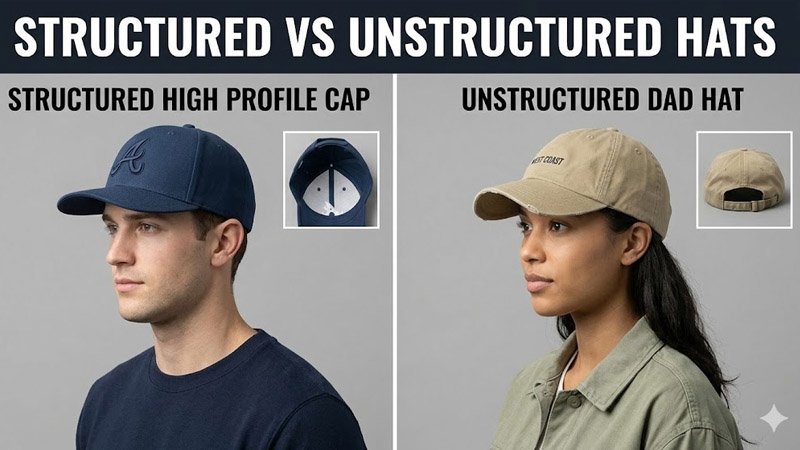
The internal structure of a hat directly affects how it fits and sits on your head.
Structured hats often create a higher profile, meaning the crown sits taller and holds a defined silhouette. This design gives the cap a more prominent look and helps logos remain visible from a distance. Because of this, structured caps are commonly used for sports teams, uniforms, and branded merchandise.
Unstructured hats generally have a lower and softer profile. Without the stiff crown, the hat follows the natural shape of your head, creating a relaxed and comfortable fit.
Typical pairings include:
-
Low-profile unstructured caps: Popular for dad hats and casual lifestyle wear
-
Mid- or high-profile structured caps: Common in sports caps, promotional hats, and uniforms
Style, Branding & Decoration
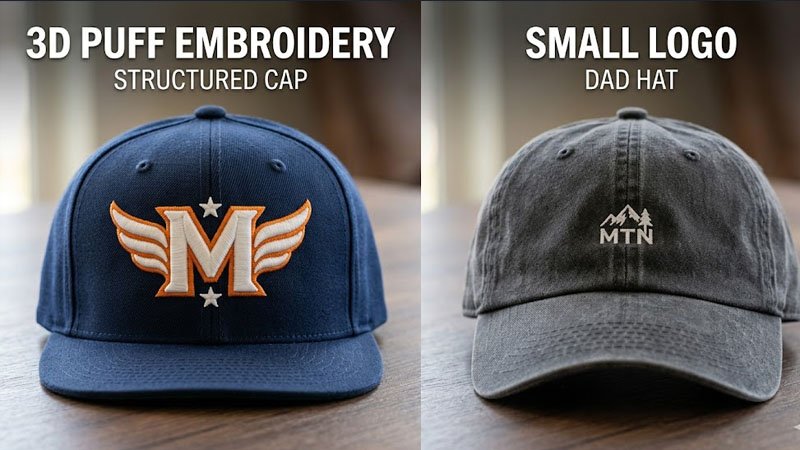
The structure of a hat also influences how well it displays branding and design elements.
Structured hats offer a flat and stable front panel, which makes them ideal for bold embroidery, 3D puff logos, large patches, or detailed branding. Because the crown maintains its shape, logos remain clean, visible, and professional-looking.
Unstructured hats, by contrast, provide a softer surface that works better for subtle or minimalist designs. Smaller logos or simple embroidery tend to complement this style, making it popular among lifestyle brands, outdoor labels, and casual fashion collections.
For businesses planning custom hats with precise logo placement and consistent quality, working with experienced manufacturers is essential. GUANGZHOU EASTLUCKY Hat & Garment Co., Ltd., based in Guangzhou, China, has over 15 years of experience in high-end custom hats and OEM/ODM manufacturing, offering complete solutions from design sampling to mass production for global brands.
Comfort, Durability & Packability
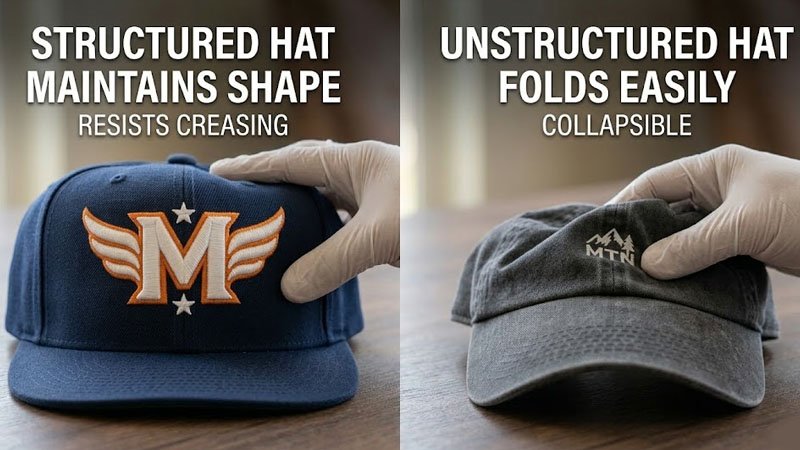
Comfort is another factor that separates structured and unstructured hats.
Unstructured hats are usually soft from the first wear, giving them a broken-in feel right away. Because they lack stiff reinforcement, they can also be folded or packed easily, making them convenient for travel or outdoor activities.
Structured hats are more rigid due to the reinforced crown. While they may feel slightly firm when new, they tend to maintain their shape longer, even after frequent use. This durability helps the hat look newer and more polished over time.
However, structured hats are less flexible when packing and should be stored carefully to preserve their shape.
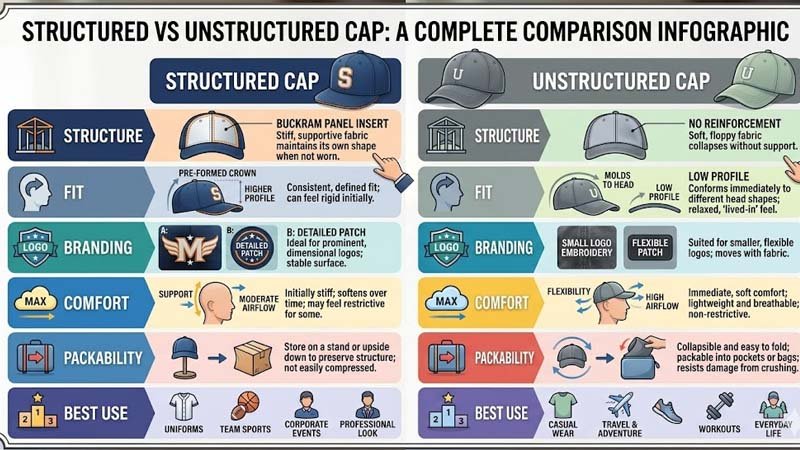
| Feature |
Structured Hats |
Unstructured Hats |
| Crown Support |
Reinforced with buckram or foam |
No stiffener; crown collapses when not worn |
| Appearance |
Crisp, firm, athletic look |
Relaxed, casual “dad hat” style |
| Profile Options |
Often mid or high profile |
Usually low profile |
| Branding Space |
Firm front ideal for bold embroidery or patches |
Softer front better for subtle logos |
| Comfort |
Slightly firm, may require break-in |
Soft and comfortable from day one |
| Shape Durability |
Maintains structure over time |
Adapts to head shape with wear |
| Packability |
Less flexible, needs careful storage |
Easy to fold or pack |
| Best Use |
Sports teams, uniforms, retail branding |
Lifestyle wear, travel, casual fashion |
When to Choose Each Style
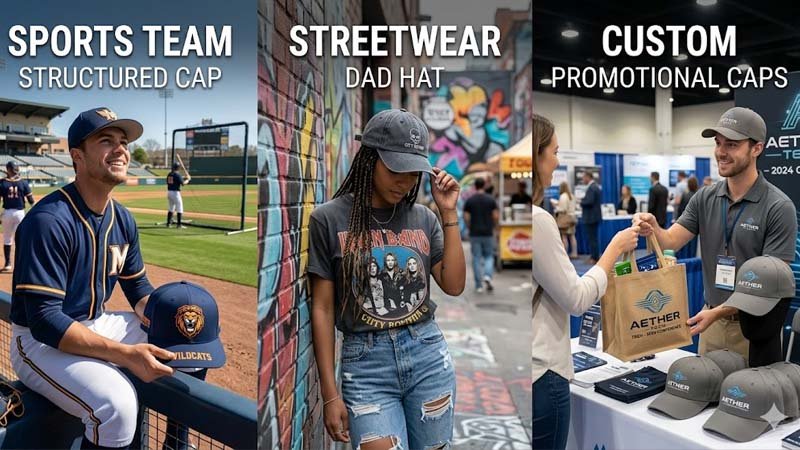
Choosing the right hat depends on your purpose and style preference.
Choose a Structured Hat If You Want:
-
A polished and professional appearance
-
Strong logo visibility for branding
-
Caps for sports teams or staff uniforms
-
Consistent shape for promotional products
Choose an Unstructured Hat If You Prefer:
Both styles have their advantages, so the best option depends on how the hat will be used.
Conclusion
Understanding the difference between structured and unstructured hats helps you choose the right cap for your needs. Structured hats provide a crisp, bold appearance that works well for branding and professional use, while unstructured hats deliver a relaxed, comfortable fit ideal for everyday wear.
Whether you’re selecting hats for personal style, retail merchandise, or corporate branding, choosing the right structure ensures the final product matches your vision.
FAQs
Can structured hats be made from the same materials as unstructured hats?
Yes. Both styles can use fabrics such as cotton twill, polyester, canvas, or blended materials. The difference lies in the internal crown support rather than the fabric itself.
Are unstructured hats better for hot weather?
Not necessarily. Breathability depends more on fabric type and ventilation features like eyelets or mesh panels rather than the hat’s structure.
Do structured hats fit larger than unstructured hats?
The fit usually depends on the hat’s profile and closure system rather than the structure. Adjustable straps, snapbacks, or fitted sizes determine how the hat fits.
Can I wash a structured hat in the washing machine?
Machine washing is generally not recommended, as it can damage the crown structure. Hand washing is usually the safest option.
Are semi-structured hats common in the market?
Yes. Semi-structured hats are widely available and provide a balance between firmness and flexibility.
Are Straw Hats Waterproof? A Buyer’s Guide
Straw hats are a strong seller for spring/summer—lightweight, breathable, and easy to style across beach, resort, and lifestyle collections. But for brands selling into humid or rainy regions (or festival and travel segments), buyers routinely ask one question:
Are straw hats waterproof?
No. Straw hats are not waterproof. A brief drizzle may be manageable, but heavy rain or prolonged dampness can warp the crown/brim, cause stains, weaken the weave, and trigger mildew.
This guide is written for brand procurement teams and wholesalers. It includes a practical material/performance comparison and a simple selection process to help you build the right assortment for your target climate and customer use.
Quick Answer: Not Waterproof (What Buyers Should Know)
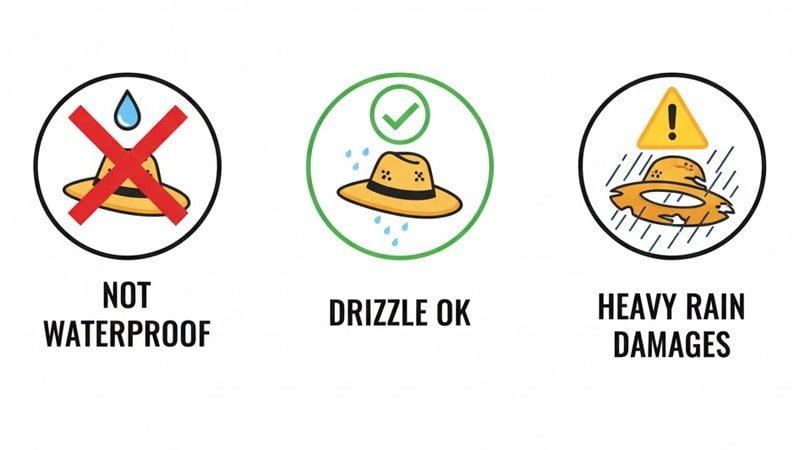
Straw is a porous structure made from natural (or paper-based) fibers. Water penetrates the weave and is absorbed by the fibers, which then swell and soften. The result is often:
-
Shape loss (warped brim, collapsed crown)
-
Staining (water rings, uneven discoloration)
-
Weakened durability (brittleness after repeated wet/dry cycles)
-
Mildew risk (odor and mold marks if stored damp)
Procurement takeaway: Treat straw hats as dry-weather products, and use clear care labeling if your customers may face unexpected rain.
What Rain Does to Straw: Common Failure Modes
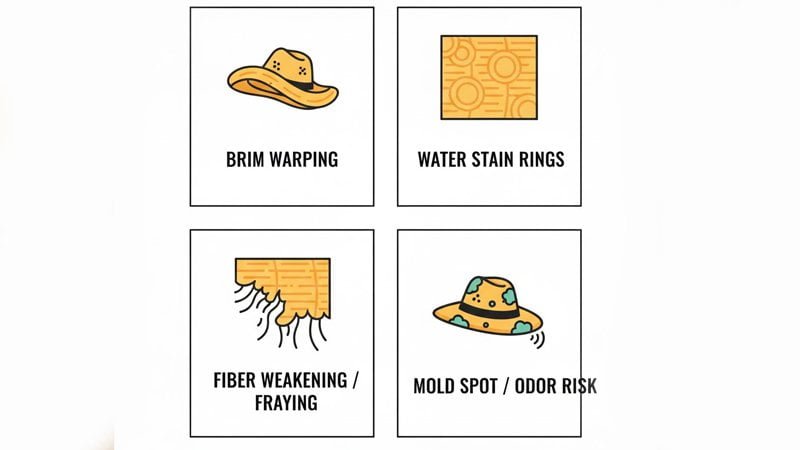
From an OEM standpoint, moisture issues usually fall into four categories:
-
Warping & Deformation
When straw absorbs moisture, structural tension changes. As it dries, the hat may “set” into a new, uneven shape—especially if heat is used.
-
Stains & Finish Spotting
Water can create rings, lift dyes, or react with coatings, glues, and trims.
-
Reduced Strength Over Time
Repeated wet/dry cycles can weaken fibers, especially at stress points such as brim edges and crown pinches.
-
Mildew & Odor
Moisture trapped in the weave (or under sweatbands and inner tapes) increases the risk of odor and mildew in storage.
Straw Types & Moisture Tolerance (Still Not Waterproof)
Different straw materials behave differently in humidity and light drizzle, but none are truly waterproof:
-
Toquilla (Panama straw): premium, breathable, but low moisture tolerance and prone to deformation when wet
-
Raffia: more flexible and slightly more forgiving, but still not rain-safe
-
Palm leaf: tougher feel and generally better tolerance to brief dampness; saturation still causes issues
-
Paper/Toyo/Shantung: performance depends on coating/finish; can resist a sprinkle but remains vulnerable in heavy rain
If your market expects mixed-weather use, straw should be positioned carefully—or complemented by alternative constructions.
“Waterproof” vs “Water-Resistant” (Labeling That Prevents Disputes)
In product terms:
Traditional straw cannot meet a strict waterproof definition due to fiber absorption and open weave gaps. “Waterproof straw” claims often refer to coatings or synthetic blends.
Best practice for brands:
-
Use “water-resistant (light drizzle)” for treated straw
-
Use “water-repellent / quick-dry” for fabric hats with finishes
-
Reserve “waterproof” for true performance constructions (validated by testing/specs)
Material & Performance Comparison Table (Buyer-Friendly)
Rating scale: ★☆☆ (low) to ★★★★☆ (high)
| Material / Construction |
Drizzle Tolerance |
Shape Retention After Wet/Dry |
Mildew Risk Control |
Stain Resistance |
Breathability |
Best Use Case |
| Toquilla (Panama straw) |
★☆☆ |
★☆☆ |
★★☆ |
★☆☆ |
★★★★☆ |
Premium resort, dry-weather |
| Raffia |
★★☆ |
★★☆ |
★★☆ |
★★☆ |
★★★☆ |
Fashion straw, light humidity |
| Palm leaf |
★★★☆ |
★★★☆ |
★★☆ |
★★☆ |
★★☆ |
Outdoor look, tougher straw feel |
| Paper/Toyo (coated) |
★★☆* |
★★☆* |
★★☆ |
★★☆* |
★★★☆ |
Value fashion straw (depends on finish) |
| Synthetic “straw-look” weave |
★★★☆ |
★★★☆ |
★★★☆ |
★★★☆ |
★★★☆ |
Straw aesthetic + mixed weather |
| Polyester/Nylon (water-repellent finish) |
★★★★☆ |
★★★★☆ |
★★★★☆ |
★★★★☆ |
★★☆–★★★☆ |
All-weather sun/travel/outdoor |
Procurement shortcut:
Can You Waterproof a Straw Hat? (Only Improve Resistance)
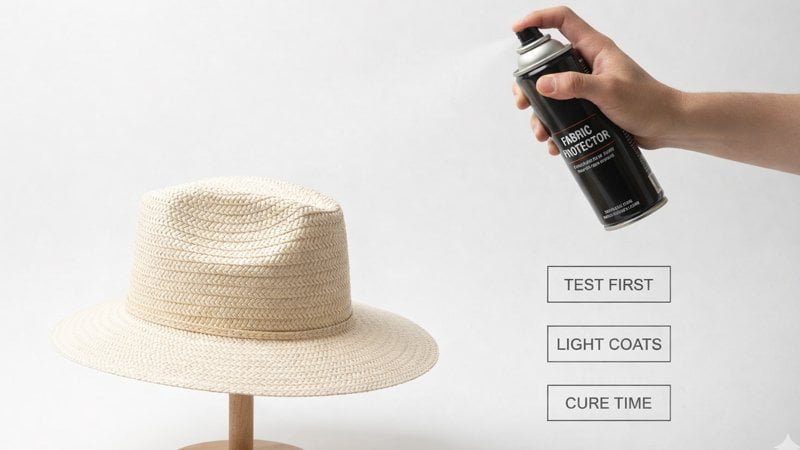
You can increase resistance to light drizzle, but you can’t make straw fully waterproof.
Common method: apply a clear, straw-safe water-repellent spray in light coats.
Treat this as maintenance, not a guarantee.
If a Straw Hat Gets Wet: Correct Care Guidance (For Inserts & Support)
Do
-
Reshape gently while the hat is still damp
-
Air-dry in a cool, ventilated area
-
Ensure the inner band dries completely before storage
Don’t
-
Don’t heat-dry (hairdryer/heater/direct sunlight) — it can lock in distortion
-
Don’t store damp hats in closed packaging — mildew risk rises sharply
-
Don’t soak to clean — it weakens fibers and stretches the weave
Buyer Selection Process: Build the Right Assortment in 6 Steps
Step 1 — Define the climate & use case
Dry resort? Festival/travel? Humid coastal? Outdoor active?
Step 2 — Decide your product promise
“Aesthetic-first straw” vs “all-weather performance”
Step 3 — Choose the best material tier
Toquilla/Raffia/Palm leaf/Paper-Toyo vs synthetic straw-look vs poly/nylon
Step 4 — Specify functional upgrades where needed
Sweat-wicking bands, breathable vents, brim reinforcement, adjustable closures, packable builds
Step 5 — Align packaging & care messaging
Reduce moisture trap risk; add care insert to prevent misuse and returns
Step 6 — Sampling & validation
Confirm wet/dry shape retention, stain risk, band drying time, and bulk consistency
Full-Category Hat Customization for Brands & Wholesalers
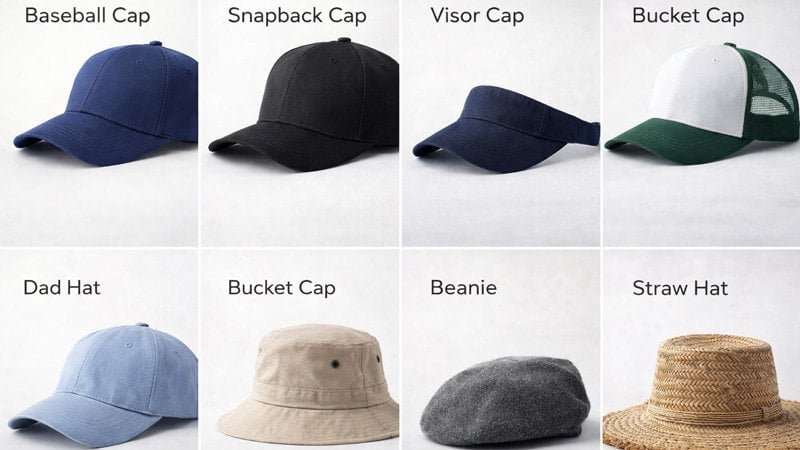
To cover both mainstream and niche demands, we support full-category development, including:
Casual Sports
Baseball Cap, Snapback Cap, Trucker Cap, Golf Cap, Visor Cap
Fashion Trendy
Bucket Hat, Dad Hat, 5 Panel Cap, Beanie, Beret Hat
Functional Protective
Bump Cap, Straw Hat, and more
We support comprehensive customization across materials, workmanship, and style architecture, from sampling to mass production.
Work With GUANGZHOU EASTLUCKY (Premium OEM/ODM)
GUANGZHOU EASTLUCKY Hat & Garment Co., Ltd. is a high-end custom hat and OEM/ODM manufacturer based in Guangzhou, China, with 15 years of expertise in professional R&D, production, and distribution of hats and embroidered accessories. Guided by “Quality as Root, Innovation as Soul,” we provide global clients with one-stop solutions—from design sampling to mass production—helping brands achieve efficient, high-quality supply chain execution.
Want a straw program plus an all-weather extension?
Share your target market climate, positioning, and target cost range. We can propose three build options (authentic straw / straw-look synthetic / water-repellent fabric) with recommended finishes and a sampling plan.
FAQs
Can straw hats handle a light drizzle?
Sometimes, but they’re still absorbent. Proper air-drying and reshaping are essential.
Are synthetic “straw” hats better for rain?
Yes—synthetic straw-look materials generally hold shape better and absorb less moisture than natural straw.
What’s the safest all-weather alternative?
Polyester/nylon hats with a water-repellent finish offer the best balance of rain tolerance, quick-dry comfort, and durability.