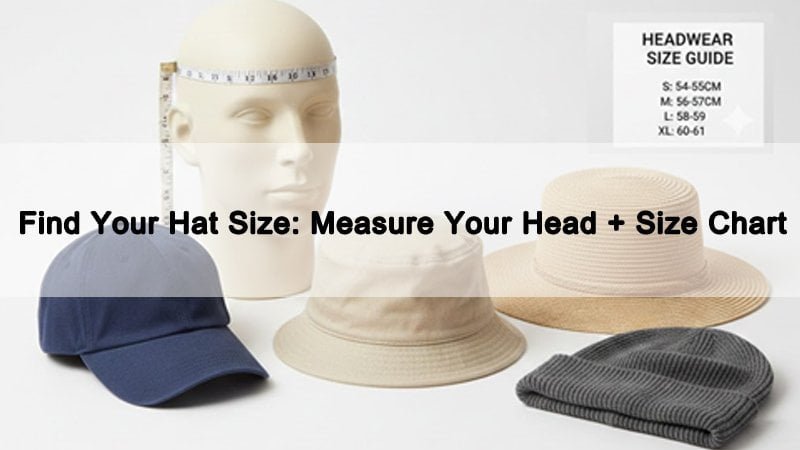
Finding the right hat size is easier than most people think. You only need one accurate measurement—your head circumference—and a reliable size chart to match it.
This guide shows you:
-
exactly where to measure your head (so results don’t vary),
-
how to choose the right size for different hat styles,
-
and how to fix common fit issues like too tight or too loose.
If you’re a brand or buyer ordering in bulk, correct sizing also helps reduce sampling revisions and improves fit consistency in mass production.
Quick Answer: How to Measure Your Head (30 Seconds)
You’ll need: flexible measuring tape (or string + ruler), mirror, pen/notebook
-
Wrap the tape above your ears and across the widest part of your forehead
-
Keep the tape level all the way around your head
-
Make it snug, not tight (don’t compress skin or hair)
-
Measure 2–3 times and take the average
-
Record your result in centimeters and inches
Between two sizes? Don’t guess—use the hat-type rules in this article (they’re different for caps vs. straw hats vs. beanies).
Most Common Hat Sizes (Fast Reference)
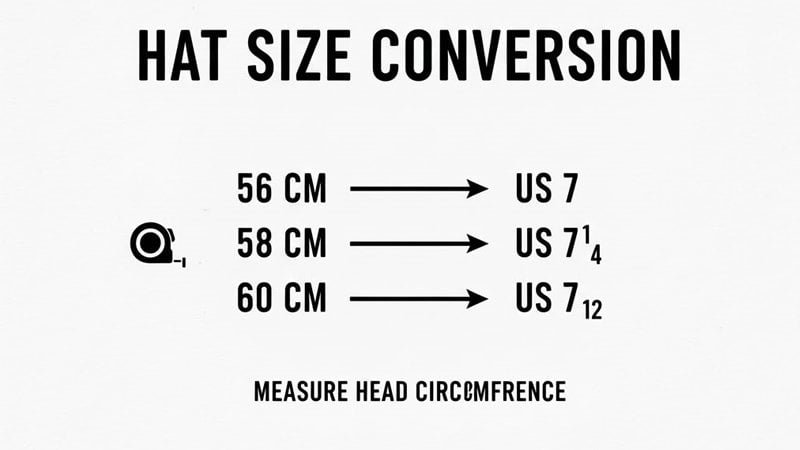
If you want a quick match before reading the full chart:
-
56 cm ≈ US 7 (S/M)
-
58 cm ≈ US 7 1/4 (M)
-
60 cm ≈ US 7 1/2 (L)
For a precise fit—especially for fitted caps—use the full chart below.
Hat Size Chart (CM to Inches + U.S. Fitted Sizes)
Match your head circumference to the closest size. If you land between two rows, choose based on the hat type section.
| Head Circumference (cm) | Inches | U.S. Fitted Size | Alpha Size (S/M/L) |
|---|---|---|---|
| 54 | 21 1/4 | 6 3/4 | S |
| 55 | 21 5/8 | 6 7/8 | S |
| 56 | 22 | 7 | S / M |
| 57 | 22 3/8 | 7 1/8 | M |
| 58 | 22 3/4 | 7 1/4 | M |
| 59 | 23 1/8 | 7 3/8 | L |
| 60 | 23 1/2 | 7 1/2 | L |
| 61 | 23 7/8 | 7 5/8 | XL |
| 62 | 24 1/4 | 7 3/4 | XL |
Fit tolerance tip: Measuring technique and head shape can cause small differences. For most hats, a variation of about ±0.3 cm is normal.
Choose the Right Size by Hat Type (Caps, Buckets, Straw Hats, Beanies)
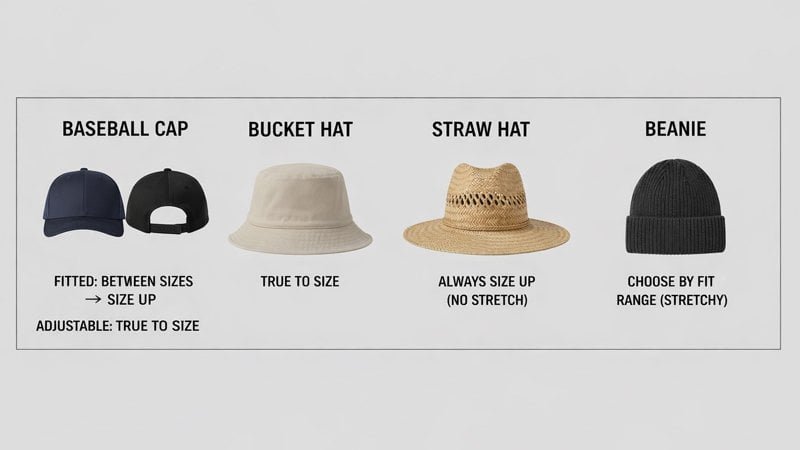
Different hat styles “feel” different even at the same circumference. Use these simple rules to choose correctly—especially if you’re between sizes.
1) Baseball Caps (Fitted / Adjustable / Flexfit)
One-sentence rule: If you’re between sizes for a fitted cap, size up.
-
Fitted caps require the most accurate sizing
-
Adjustable caps (snapback, buckle, Velcro) are more forgiving
-
Structured crowns can feel tighter than unstructured crowns
-
A thicker sweatband can reduce inner space and change the feel
Best practice: If you’re producing for retail, confirm sizing with wear testing (different head shapes can feel different even at the same circumference).
2) Bucket Hats (Fisherman Hats)
One-sentence rule: True to size for regular fit; size up for a more relaxed streetwear fit.
Bucket hats usually sit slightly looser than structured caps, but crown height and inner taping can change comfort.
If your bucket hat is intended for all-day wear, many people prefer a little extra space—especially in warm climates.
3) Straw Hats
One-sentence rule: If you’re between sizes, always size up.
Straw hats are less forgiving because the structure is rigid. A half-size too small will feel tight immediately. A slightly larger size can be fine-tuned using:
-
inner sweatband thickness
-
sizing tape
-
inner drawstring (if designed)
Note: Straw materials can react to humidity. Planning for a stable inner band is key for consistent fit.
4) Beanies (Cold Hats / Knit Hats)
One-sentence rule: Choose by fit range, not exact circumference.
Beanies depend on stretch and recovery. Fit changes with:
-
knit structure (rib vs. flat)
-
yarn composition and elasticity
-
cuff design and height
For production, beanies are usually defined by a fit range (for example, 54–58 cm or 56–60 cm), then verified through wear testing.
Common Measuring Mistakes (And How to Fix Them)
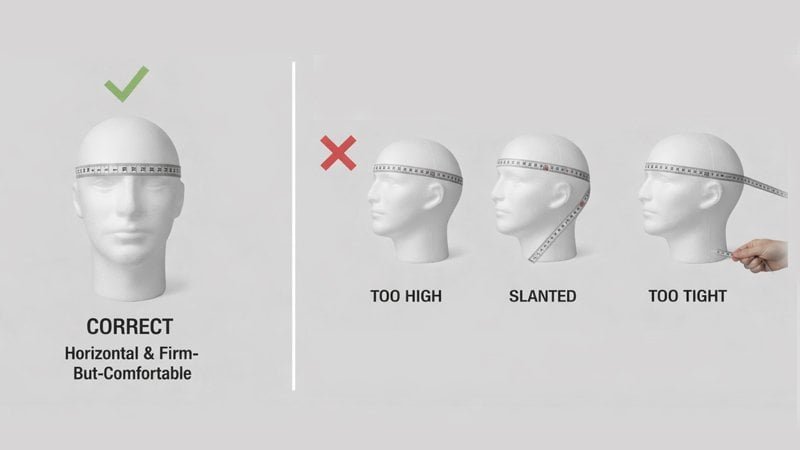
These small errors can cause big fit problems—especially for fitted caps:
-
Tape too high (above the widest forehead) → size reads smaller than reality
-
Tape slanted (not level around the head) → inconsistent results
-
Tape too tight (compressing hair/skin) → hat feels tight and uncomfortable
-
Only measured once → avoidable size mistakes
Fix: Keep the tape level, measure 2–3 times, and use the average.
Fit Troubleshooting: Too Tight vs. Too Loose
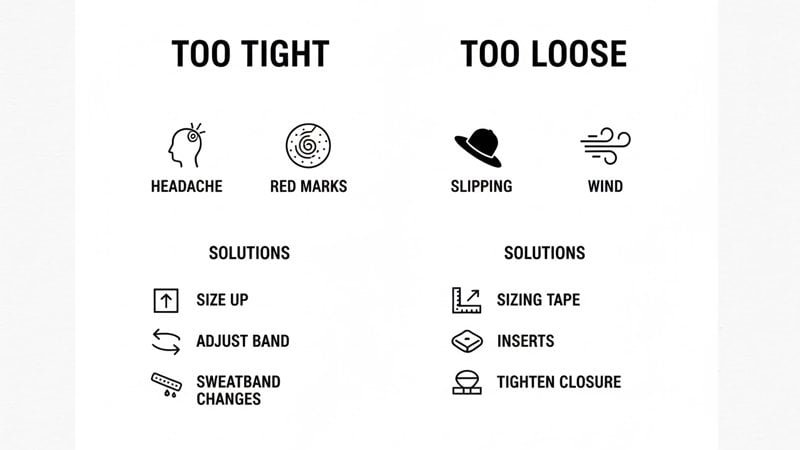
Even with correct measurement, fit issues can happen due to materials, construction, or head shape. Here’s how to diagnose and solve them.
If a Hat Feels Too Tight
Symptoms: pressure points, headaches, red marks
Common causes: size too small, thick sweatband, structured crown, shrinkage, crown depth mismatch
Solutions:
-
For fitted caps or straw hats: choose the next size up
-
For adjustable caps: loosen the closure
-
Add design adjustments: reduce sweatband thickness or modify crown depth
-
For certain materials: controlled stretching during finishing (production method dependent)
If a Hat Feels Too Loose
Symptoms: slipping, unstable in wind, constant readjustment
Common causes: size too large, stretched band, insufficient inner grip
Solutions:
-
Use hat sizing tape inside the sweatband
-
Add foam/silicone inserts for retail adjustment
-
Tighten adjustable closure range (caps)
-
Improve inner band grip design (especially useful for straw hats)
For Brands & Bulk Orders (OEM/ODM): What to Send for an Accurate Fit
If you’re developing custom headwear and want a smoother sampling process, share these details early:
-
hat type (baseball cap / bucket / straw / beanie)
-
target size range (cm) and intended fit (snug / regular / relaxed)
-
logo files (AI/PDF preferred) and branding placement
-
material and construction preferences
-
order quantity and target market (US/EU/UK)
-
reference photos or similar styles
This information helps shorten development time and reduces back-and-forth during sampling.
Need a Free Size Review for Your Custom Hats?
GUANGZHOU EASTLUCKY Hat & Garment Co., Ltd. is a high-end custom hat and OEM/ODM manufacturer in Guangzhou, China, with 15 years of expertise in R&D, production, and global distribution. Guided by “Quality as Root, Innovation as Soul,” we provide one-stop solutions from design sampling to mass production across:
-
Baseball caps (fitted, snapback, dad hats, structured/unstructured)
-
Bucket hats
-
Straw hats
-
Beanies
-
custom embroidery, patches, labels, trims, and packaging
Send us your target hat style + size range in cm, and we can help you confirm sizing direction before sampling—so your bulk production matches the fit your customers expect.