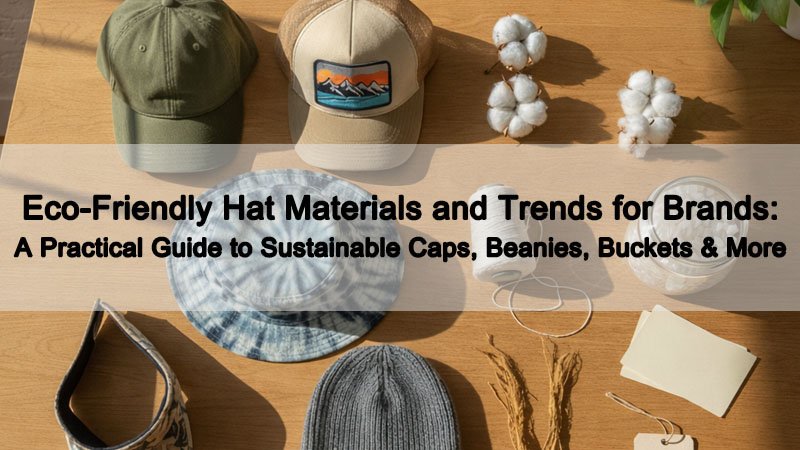
Sustainable headwear is no longer a “nice-to-have.” For brands, distributors, and promotional buyers, hats must now deliver style, comfort, durability, and credible sustainability claims—often with audit-ready documentation and clear chemical-safety expectations.
But here’s the reality: a hat isn’t truly eco-friendly just because the crown fabric is organic or recycled. Real sustainability is built across the full product system—materials, chemicals, manufacturing footprint, durability, and traceability—and it must be communicated in a way buyers can verify.
This practical guide breaks eco-friendly hat manufacturing into tools you can use immediately: material trade-offs, PFAS-free finishing options, a hat BOM (bill of materials) map, trend signals, and a buyer-ready RFQ checklist—covering mainstream and niche styles from caps to beanies, buckets, berets, visors, straw hats, and bump caps.
About the Manufacturer
GUANGZHOU EASTLUCKY Hat & Garment Co., Ltd. is a high-end custom hat and OEM/ODM manufacturer based in Guangzhou, China, with 15 years of expertise in professional R&D, production, and distribution of various hats and embroidered accessories. Guided by the philosophy “Quality as Root, Innovation as Soul,” we provide global clients with one-stop solutions from design sampling to mass production—helping brands build efficient, high-quality supply chains.
Full-category hat customization includes:
-
Casual & Sports: Baseball Cap, Snapback Cap, Trucker Cap, Golf Cap, Visor Cap
-
Fashion & Trend: Bucket Hat, Dad Hat, 5 Panel Cap, Beanie, Beret
-
Functional & Protective: Bump Cap, Straw Hat, and more
We support comprehensive customization of materials, craftsmanship, and styles.
1) What “Eco-Friendly” Means for Hats (Beyond the Fabric)
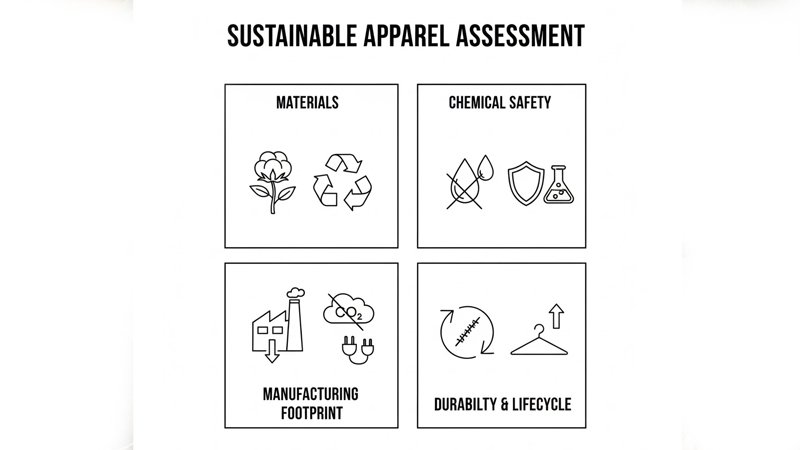
A genuinely sustainable hat should perform across four dimensions:
1) Materials (what it’s made of)
-
Organic or recycled fibres are a strong start—but claims should be by part (crown, visor, mesh, sweatband, closure, etc.)
-
Lower-impact fibres and responsible sourcing reduce upstream footprint
2) Chemical safety (skin-contact + environmental impact)
-
Performance finishes must be clearly defined
-
Increasingly, buyers request PFAS-free water repellency where DWR is needed
3) Manufacturing footprint (how it’s made)
-
Dyeing, cutting yield, waste handling, and packaging can meaningfully change impact
-
Smarter sampling reduces development waste
4) Durability + lifecycle (how long it lasts)
-
Sustainable headwear should be built to last—strong seams, stable brims, durable branding
-
Repairable components (where feasible) extend product life and reduce replacements
Buyer takeaway: Sustainability should be verifiable—with clear BOM disclosure, compliance statements, and traceability.
2) Eco-Friendly Hat Materials: Pros, Trade-Offs, Best Use
Material choice determines both performance and sustainability. Below are the most practical options used today—and when to use them.
Organic Cotton
Why brands choose it: soft hand feel, breathable, familiar to consumers, strong sustainability messaging.
Best for: Dad Hats, Baseball Caps, Bucket Hats, 5 Panel Caps, lifestyle programs, merch.
Trade-offs: can cost more; dyeing and finishing still matter—organic fibre doesn’t guarantee low-impact processing.
Recycled Polyester (rPET)
Why brands choose it: durable, quick-dry, excellent for performance, widely scalable.
Best for: Golf Caps, Visors, Performance Baseball Caps, Trucker Crown fabrics, outdoor activations.
Trade-offs: not biodegradable; hand-feel varies; when “sustainability” is a key claim, documentation and traceability matter.
Hemp Blends
Why brands choose it: naturally durable, rustic texture, outdoor/workwear aesthetics, good moisture behavior.
Best for: Bucket Hats, structured lifestyle caps, eco-heritage branding.
Trade-offs: texture isn’t always suitable for sleek fashion lines; some blends can be more challenging for consistent color matching.
Lyocell / TENCEL™ (Often Used Strategically)
Why brands choose it: smooth, breathable, premium touch.
Best for: linings, sweatbands, premium capsules, comfort-first designs.
Trade-offs: higher cost; best applied where it adds maximum perceived value (skin-contact zones).
Recycled Mesh (Trucker Hats)
Why brands choose it: reduces virgin plastic content while keeping iconic trucker structure.
Best for: Trucker Caps for promotions and summer programs.
Trade-offs: mesh stiffness and hand feel vary—approve swatches early; color matching to crown fabric requires sampling discipline.
3) The Hat Sustainability BOM Map: Where Most Sustainability Gets Won (or Lost)
Hats are multi-component products. A “green” main fabric can be undermined by hidden parts: brim inserts, buckram, sweatbands, adhesives, embroidery backing, and hardware.
Use this checklist as a BOM map when developing eco-friendly styles:
Key Parts to Specify (and Why)
-
Crown/visor fabric: defines the main sustainability story and hand feel
-
Mesh (trucker): affects comfort, structure, and color matching
-
Brim insert/stiffener: drives shape retention and performance; sustainability is often overlooked here
-
Buckram/structure: controls silhouette for structured caps (snapbacks, some 5 panels)
-
Sweatband: skin-contact comfort + potential chemical complexity if performance finishes are added
-
Thread + embroidery backing: impacts wash durability, comfort, and material mix
-
Closures/hardware: coatings and corrosion resistance can matter by market
-
Labels + packaging: visible sustainability signals (FSC cartons, reduced plastics)
Best practice: request “composition by part” (not just an overall fabric claim). This is what serious buyers and brand teams increasingly expect.
4) Eco-Friendly Finishes: Low-Impact Color and PFAS-Free Performance
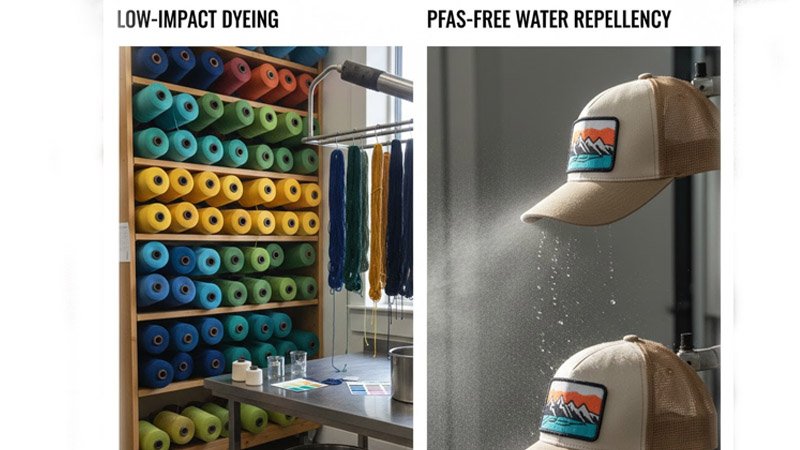
Low-Impact Color (When Programs Are Stable)
For repeat programs with stable color palettes, solution/dope dyeing can reduce resource intensity compared with conventional dyeing routes and can improve shade consistency across production lots.
Trade-offs: color flexibility can be lower; some programs require better planning (and sometimes higher MOQs).
PFAS-Free Water Repellency (When You Need DWR)
Outdoor and performance hats often request water repellency—but many buyers now specify PFAS-free DWR for environmental reasons.
PFAS-free finishing—how to make it procurement-ready
-
Specify “PFAS-free DWR” explicitly (avoid vague “eco DWR”)
-
Define performance expectations: light drizzle vs prolonged rain exposure
-
Validate via sampling and align acceptance criteria before bulk
Reality check: PFAS-free options can vary in hand feel and durability. Align priorities early—water beading vs softness vs cost—then validate with samples.
5) Trends Shaping Sustainable Headwear (What Brands Are Doing Now)
Trend 1: “BOM Transparency” Becomes Standard
More buyers want material disclosure by part, not marketing claims. Expect increasing requests for BOM-by-part composition, supplier declarations, and lot-level traceability.
Trend 2: PFAS-Free Becomes the Default Ask in Performance
Brands are raising chemical-safety expectations, especially for outdoor and sports programs. PFAS-free DWR requests are becoming more common in RFQs.
Trend 3: Comfort-First Sustainability
Consumers don’t reward sustainability if comfort is compromised. Premium feel—better sweatbands, softer hand-feel, skin-contact materials—often decides reorders.
Trend 4: Better Durability = Better Sustainability
Durability is sustainability. Strong seams, stable brims, and wash-durable branding reduce replacements and returns.
Trend 5: Packaging and Logistics Optimization
FSC cartons, reduced polybags, right-sized packaging, and consolidated shipping are becoming baseline requirements for many programs.
6) Style-by-Style Recommendations (Materials That Make Sense)
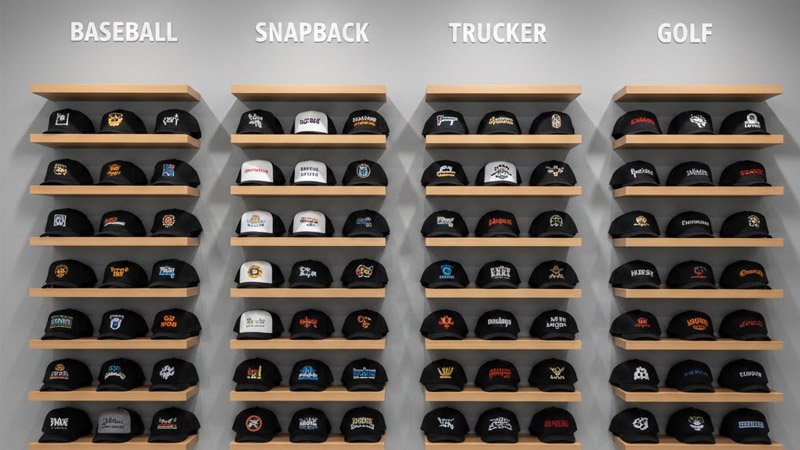
Below are practical starting points for each of your mainstream and niche hat categories.
Casual & Sports
Baseball Cap / Snapback / Golf Cap / Visor
-
Lifestyle: organic cotton + recycled thread + minimal packaging
-
Performance: rPET + breathable construction; add PFAS-free DWR only if needed
-
Visors: sweatband choice and comfort specs matter most
Trucker Cap
-
Recycled mesh + rPET or organic cotton crown
-
Approve mesh hand feel + color matching early
Fashion & Trend
Bucket Hat / Dad Hat / 5 Panel / Beanie / Beret
-
Bucket & Dad: organic cotton or hemp blends depending on target aesthetic
-
5 panel: choose stable fabrics for clean geometry and shape retention
-
Beanie: prioritize comfort + pilling control (material selection and yarn quality matter)
-
Beret: premium hand feel and structure matter—spec materials carefully for shape
Functional & Protective
Bump Cap / Straw Hat
-
Bump caps: prioritize structure, performance, and compliance first; then optimize sustainability in materials and packaging
-
Straw hats: focus on consistent craftsmanship, fibre sourcing, and protective packaging to reduce damage in transit
7) Buyer-Ready RFQ Checklist (Copy-Paste Template)
Use this RFQ structure to get accurate quotes and avoid vague “sustainable” claims.
A) Product Definition
-
Style: Baseball / Snapback / Trucker / Golf / Visor / Bucket / Dad / 5 Panel / Beanie / Beret / Bump Cap / Straw
-
End use: promo / lifestyle / performance / outdoor / protective
-
Target market(s): US/EU/UK etc.
-
Target order qty + delivery window
B) BOM by Part (Required)
For each part: material + % composition + any proof requirements
-
Crown fabric
-
Visor fabric
-
Mesh (if trucker)
-
Brim insert/stiffener
-
Buckram/structure
-
Sweatband
-
Thread/embroidery
-
Backing/films (if applicable)
-
Closure hardware
-
Labels + packaging
C) Color & Dye Route
-
Color references (Pantone or physical sample)
-
Preferred route: conventional dye / solution-dope dyed (if applicable)
-
Any durability targets (rubbing/sweat/wash) if your program requires them
D) Finishes
-
DWR required? Yes/No
-
If yes: PFAS-free DWR required
-
-
Any anti-odor/antimicrobial request? If yes, define constraints and compliance expectations
E) Packaging
-
FSC cartons required? Yes/No
-
Polybag policy (reduced/none)
-
Label/barcode requirements
8) Three Sustainable “Builds” You Can Copy
Build 1: Lifestyle Merch (Best for Dad Hat / Baseball / Bucket)
-
Organic cotton main fabric
-
Recycled embroidery thread
-
FSC packaging option
-
Best for: brand drops, events, schools, corporate merch
Build 2: Performance Active (Best for Golf Cap / Visor / Sports Caps)
-
rPET main fabric
-
Lightweight trims and breathable construction
-
PFAS-free DWR only if needed for weather exposure
-
Best for: outdoor events, sports activations, performance retail
Build 3: Trucker Program (Best for Trucker Caps)
-
Recycled mesh + rPET or organic cotton crown
-
Comfort-focused backing choice for embroidery
-
Early swatch approval to lock hand feel + color match
-
Best for: promotions, summer programs, lifestyle brands
About Us: OEM/ODM Support for Sustainable Headwear
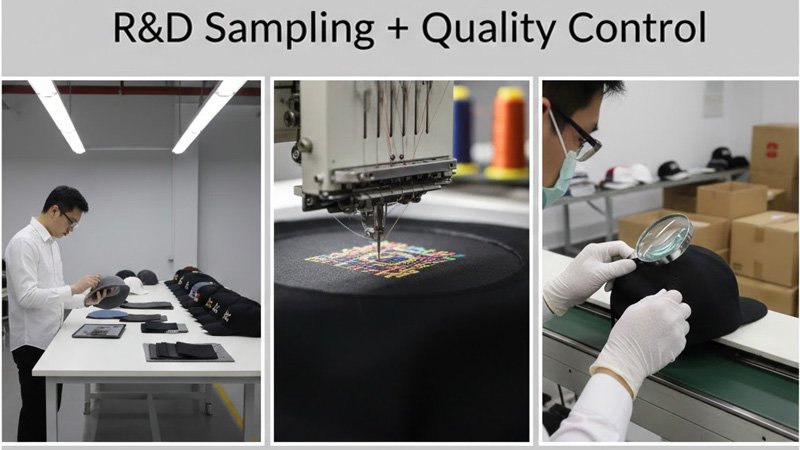
At GUANGZHOU EASTLUCKY Hat & Garment Co., Ltd., we help brands develop eco-friendly headwear that is practical to produce and credible to claim—through structured sampling, quality-first manufacturing, and clear material/finish specifications.
Next steps (choose one):
-
Request material swatches (organic cotton / rPET / hemp blends / recycled mesh)
-
Request a BOM sustainability review (send your tech pack)
-
Request a PFAS-free performance sample plan (tell us end use + target market)